NOTE TO SELF: All of the Currently Live Theories of the Causes of the "European Miracle"

& was the “European Miracle” 800-1914, 1492-1914, 1689-1914, or 1776-1914?…

Share

Share DeLong’s Grasping Reality: Economy in the 2000s & Before


And, of course, highly overlapping:

  • Local geography & resources (coal, land, disease environment):
    Jared Diamond, Kenneth Pomeranz, Robert Allen, Paul Bairoch, Fernand Braudel, Mark Koyama & Jared Rubin, Eric Jones, Leonid Grinin & Andrey Korotayev

  • Institutions, property rights & representative government:
    Douglass North & Robert Thomas, Daron Acemoglu–Simon Johnson–James Robinson, Avner Greif, Joel Mokyr, Gary Cox, DeLong & Shleifer, Robert Brenner, Chris Isett, Eric Jones

  • Political fragmentation, competition & “market for ideas”:
    Jared Diamond, Joel Mokyr, Niall Ferguson, Eric Jones, James Belich, Mark Koyama, Tuan-Hwee Sng, De la Croix–Doepke–Mokyr (guilds/journeymen)

  • Culture, religion & “WEIRD” psychology / Protestant ethic:
    Max Weber, David Landes, Deirdre McCloskey, Joseph Henrich, Larry Siedentop, Nathan Rosenberg & L.E. Birdzell, Timur Kuran (for Islamic-world contrast), Justin Yifu Lin, Yasheng Huang, Eric Jones

  • High-wage economy & inducement mechanisms (wages, prices, factor prices):
    Robert Allen, Gregory Clark, Jan Luiten van Zanden, Stephen Broadberry, Bishnupriya Gupta, Allen–Bassino–Ma–Moll-Murata–van Zanden

  • New World, coal, & “accidents” (California school/contingency):
    Kenneth Pomeranz, Prasannan Parthasarathi, Jack Goldstone, Andre Gunder Frank, John Hobson, Jeffrey Williamson, Diego Comin, Acemoglu–Zilibotti (risk/diversification)

  • Colonialism, slavery, & deindustrialization at the periphery:
    Eric Williams, Paul Bairoch, Amiya Kumar Bagchi, Prasannan Parthasarathi, Jeffrey Williamson, Tirthankar Roy (partly revisionist), Daron Acemoglu et al. (institutional twist), James Walvin

  • Human capital, knowledge transmission, & guilds:
    De la Croix–Doepke–Mokyr (guilds/journeymanship), Bas van Bavel & coauthors (capital goods diffusion), Timur Kuran (Islamic legal forms
    & firms), Mark Dincecco (state capacity & public finance)

  • Demography, Black Death, & Malthusian-escape dynamics:
    James Belich, Oded Galor, Mark Koyama & coauthors, David Weir, Allen/Bairoch/van Zanden on wages, demography,
    & living standards

  • Globalization, trade structure & core–periphery dynamics (19th c. “Big Bang”):
    Kevin O’Rourke, Jeffrey Williamson, Guillaume Daudin, Leandro Prados de la Escosura, Paul Bairoch, Leonid Grinin & Andrey Korotayev

Leave a comment

Subscribe now

If reading this gets you Value Above Replacement, then become a free subscriber to this newsletter. And forward it! And if your VAR from this newsletter is in the three digits or more each year, please become a paid subscriber! I am trying to make you readers—and myself—smarter. Please tell me if I succeed, or how I fail…


##note-to-self-all-of-the-curently-live-theories-of-the-causes-of-the-european-miracle
##note-to-self
##lecture-notes
##enlarging-the-scope-of-human-empire
##quantitative-long-run-global-economic-history
##enlarging-the-bounds-of-human-empire
#all-of-the-currently-live-theories-of-the-causes-of-the-european-miracle
#european-miracle
#long-run-growth
#economic-history
#malthusian-dynamics
#institutions-and-growth
#political-economy
#colonialism-and-slavery
#core-periphery
#human-capital
#globalization
#new-world-resources
#high-wage-economy

CROSSPOST: DAN DREZNER: I'm Sick & Tired of All The Winning

Dan’s subhead: “Gulf War Three is not going well for the United States”.
I believe Dan Drezner knows more than I do about what is currently going on with the Epstein-Netanyahu-Trump War on Iran, so I turn the microphone over to him.
Briefly: In the Persian/Arabian Gulf, Tehran has escalation dominance over the Strait of Hormuz, Trump has talking points on Fox, the global economy has a bill to pay, the decapitation strike was botched—replaced an elderly shy-of-nukes Supreme Leader with a young, angry nuke-curious one whose entire family we have just killed—the Trumpists tried to buy a media photo op, and appears to have bought a grinding war instead. One in which the U.S. is burning through $10 billion of military hardware a week and looks as likely to be the side attrited here as the side doing the attriting…

Share

Share DeLong's Grasping Reality: Economy in the 2000s & Before

<https://danieldrezner.substack.com/cp/190720523> <https://danieldrezner.substack.com/p/im-sick-and-tired-of-all-the-winning>

Drezner’s World
I'm Sick And Tired of All The Winning
Another few days, another raft of stories indicating that Gulf War Three is not going exactly as the Trump administration expected…
Read more

Give a gift subscription

Dan Drezner: I’m Sick & Tired of All The Winning <https://danieldrezner.substack.com/p/im-sick-and-tired-of-all-the-winning>: ‘Another few days, another raft of stories indicating that Gulf War Three is not going exactly as the Trump administration expected… all the ways in which Trump and his cabinet did zero advance planning and have subsequently been surprised by how this war has played out: “U.S. officials have had to adjust plans on the fly, from hastily ordering the evacuation of embassies to developing policy proposals to reduce gas prices…. Senator Christopher S. Murphy… said… the administration had no plan for the Strait of Hormuz and did “not know how to get it safely back open.” Inside the administration, some officials are growing pessimistic…. But they have been careful not to express that directly to the president, who has repeatedly declared that the military operation is a complete success. Mr. Trump has laid out maximalist goals like insisting that Iran name a leader who will submit to him, while Secretary of State Marco Rubio and Defense Secretary Pete Hegseth have described narrower and more tactical objectives that could provide an off-ramp in the near term….

A Bloomberg Economics analysis suggests that it is easier and cheaper for Iran to build more drones than for the United States to build more interceptors that defend against such attacks…. It should be stressed that almost all of this was eminently predictable…

What did they think would happen? Kill as much of the top Iranian leadership as possible, and then the new leaders would make noises about wanting to play ball with us, and then everybody would stop?

Subscribe now

Leave a comment

If reading this gets you Value Above Replacement, then become a free subscriber to this newsletter. And forward it! And if your VAR from this newsletter is in the three digits or more each year, please become a paid subscriber! I am trying to make you readers—and myself—smarter. Please tell me if I succeed, or how I fail…

##crosspost-dan-drezner-im-sick-tired-of-all-the-winning
##crosspost
##neofascism
#dan-drezner
#im-sick-tired-of-all-the-winning
#gulf-war-three
#epstein-netanyahu-trump-iran-war
#escalation-dominance
#strait-of-hormuz
#decapitation-strike
#war-of-attrition
#neofascism
#zero-advance-planning
#chaos-monkey
#chaos-monkey-foreign-policy

"The Permanent Problem of the Human Race": Yglesias, Keynes, Lindsey; the Quest for Valued Identities & Societal Roles; & How to Move from "Abundance" to "Flourishing"

We cannot successfully outsource the solutions to the problem of how to live wisely and agreeably well to markets, bureaucracies, & parasocial algorithm-driven media feeds. We need, rather, societies of abundance in the service of human-scale connection and purpose to have what is in any sense a good society…

Share


Matt Yglesias focuses here on a fact: People’s well‑being jumps when they change status from “unemployed to “retired”. Spinning out the implications of this for an increasingly rich society is an important task for public reasoners here in the century of the 2000s. If we don’t figure this out, we may well wind up in what Brink Lindsey calls a “middle flourishing trap” of mass abundance without mass happiness. For the modern institutions we have built that enable our prosperity and power—markets, democratic states, ideologies, and now algorithmic systems—are extraordinarily productive but structurally inhuman, dissolving the intermediate associations that people who live at human scale need to believe that they are leading lives worth living.

Share DeLong's Grasping Reality: Economy in the 2000s & Before


The important thing is not to be rich or even to be working, but rather to have a valued social identity. Smart from Matt Yglesias:

Matt Yglesias: 100 Years of Increasing Leisure <https://www.slowboring.com/p/100-years-of-increasing-leisure>: ‘What happens to unemployed people when they reach retirement age…. They experience a large upswing in well-being…. Te social identity of an unemployed person is much worse than the social identity of a retired person, and so shifting from “unemployed” to “retired” is a big win…. In American culture… even people who inherit large sums of money and don’t need to work tend to want to be seen as working hard at philanthropy or whatever else instead of just chilling.

Keynes perhaps missed this because… he would have grown up in a world where it was considered perfectly respectable for a gentleman to have no occupation and just live off of family money. But, again, I think retirement shows the limits of this American culture of hard work. If you’re affluent and in your 60s and want to stop working and just golf or whatever else all day, nobody thinks there’s a problem with that. And you can see that around 15 percent of men seem to retire early….

It’s not true that “Keynes was wrong” and human lust for material prosperity knows no limits and people will just work and work no matter how productive we become. The idea of people sitting around not working strikes most people, at least in America, as kind of depressing. But it’s clear that when you reframe it around a widely understood social identity like “retirement” that it becomes much more acceptable.

It’s at least plausible that we are on the corner of a big labor-displacing surge in productivity…. [But] I don’t want people to see it exclusively through a lens of threat. Keynes’s positive, optimistic framing of productivity growth is an important way of looking at the world…. [An]other nuance… is that a decent amount of people’s time is spent on unpaid household labor… drudgery. [But] since Keynes’s time… washing machines and dishwashers,…

Give a gift subscription

I do think Matt gets two things wrong here. The first is this:

Matt Yglesias: 100 Years of Increasing Leisure <https://www.slowboring.com/p/100-years-of-increasing-leisure>: ‘In American culture… even people who inherit large sums of money and don’t need to work tend to want to be seen as working hard at philanthropy or whatever else instead of just chilling. Keynes perhaps missed this because… he would have grown up in a world where it was considered perfectly respectable for a gentleman to have no occupation and just live off of family money…

Leave a comment

Matt claims that Keynes did not see this. But he did. Keynes does have remarks—pointed remarks—about the behavior of British upper class twit heirs and heiresses:

John Maynard Keynes: Economic Possibilities for Our Grandchildren <http://www.econ.yale.edu/smith/econ116a/keynes1.pdf>: ‘To judge from the behaviour and the achievements of the wealthy classes to-day in any quarter of the world, the outlook is very depressing! For these are, so to speak, our advance guard—those who are spying out the promised land for the rest of us and pitching their camp there. For they have most of them failed disastrously, so it seems to me—those who have an independent income but no associations or duties or ties—to solve the problem which has been set them…

Get 75% off a group subscription

He believed that the upper-class twits were, by and large, drunkards, gamblers, and whoremasters: that they were definitely not living “wisely and well”, but rather suffering from boredom, ennui, wasting their powers in trivial pursuits, suffering from social emptiness and restless status competition.

He believed that the upper-class twits were facing such a problem precisely because humanity had hypnotized itself into overvaluing work:

  • For most of human history, survival required constant labor.

  • Thus moral systems that survived valorized industriousness because scarcity demanded it, and successful societies find ways to boost pro-social behavior by adding inner mental to external material-organizational impulses.

  • A world in which scarcity would no longer be our master would, Keynes thought, administer an enormous moral-psychological shock to humanity.

Refer a friend

We will solve this—if we do—by creating other slices of life besides “retirement”, “schooling” (and “re-schooling”), and raising children that are sources of internal purpose and of external respect. Keynes does not see this solution as easy. It is, in fact, as he stresses, the permanent problem of the human race:

John Maynard Keynes: Economic Possibilities for Our Grandchildren <http://www.econ.yale.edu/smith/econ116a/keynes1.pdf>: ‘The economic problem may be solved, or be at least within sight of solution, within a hundred years. This means that the economic problem is not—if we look into the future—the permanent problem of the human race…. To those who sweat for their daily bread leisure is a longed-for sweet—until they get it…. Man will [then] be faced with his real, his permanent problem—how to use his freedom from pressing economic cares, how to occupy the leisure, which science and compound interest will have won for him, to live wisely and agreeably and well…. There will be no harm in making mild preparations for our [future] destiny, in encouraging, and experimenting in, the arts of life as well as the activities of purpose…

Share

And that ought to bring me to one of the now fifty-seven urgent TOP PRIORITY intellectual tasks confronting me on my IMMEDIATE TO DO NOW!!!!! list: my review of my friend Brink Lindsey’s new book The Permanent Problem <https://academic.oup.com/book/10.1093/oso/9780197803967.001.0001>.

I made a down payment on my review a month ago when I posted on it <https://braddelong.substack.com/p/assessing-brink-lindseys-the-permanent>, reacting to Brink’s anguish at two notably bad reviews—by Jonathan Rauch and Michael Strain, both falsely making Brink out to be some post-liberal weirdo.

In fact, Brink is the furthest thing from a post-liberal:

Brink Lindsey: Life Under “An Immense & Tutelary Power” <https://brinklindsey.substack.com/p/life-under-an-immense-and-tutelary>: ‘I reject this post-liberal position completely and unreservedly…. [While] there are totalitarian tendencies in modernity…. the dominant tendencies… [are the] liberating and humanitarian… dramatic uplift in material living standards… explosion in scientific knowledge and technological capabilities… mass literacy… governments subject to popular control… rule of law… the stigmatization of war… embrace of… universal human dignity… [Post-liberal] thinkers[’ ideas have]… profoundly anti-human implications…

Share DeLong's Grasping Reality: Economy in the 2000s & Before

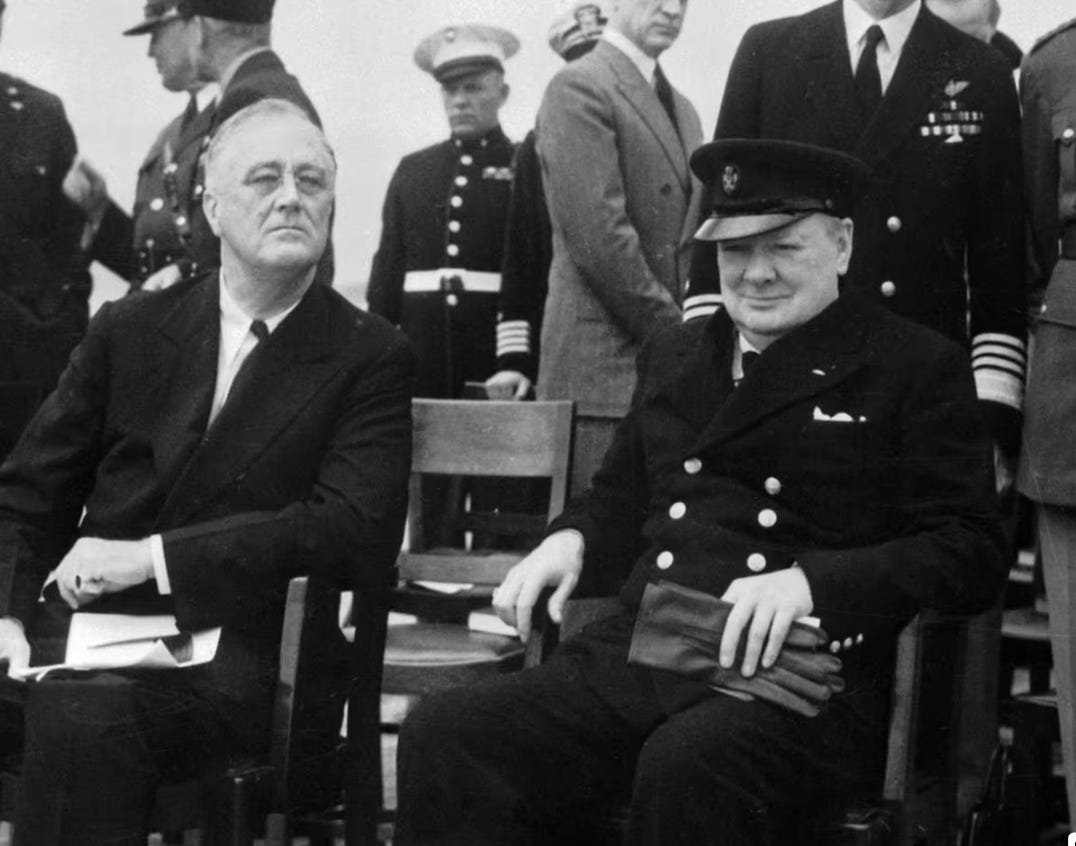
Brink merely sees human flourishing as requiring more than Franklin Delano Roosevelt’s Four Freedoms:

  • Freedom from want—material plenty.

  • Freedom from fear—not being subject to arbitrary oppression and domination.

  • Freedom of religion—or, more broadly, freedom to decide what your life is for.

  • Freedom of speech—not having to hold your tongue, but actually having a say.

Give a gift subscription

Brink sees human flourishing—living wisely and agreeably and well, as Keynes put it—as also requiring a society of:

  • close relationships (family, friends, community),

  • meaningful projects (work or nonwork efforts that demand skill and conscientiousness),

  • rich experiences (the cultivated ability to attend to the world’s “miracle of consciousness”).

  • inclusiveness (dense webs of belonging and status),

  • dynamism (the capacity to explore, experiment, and innovate, and to turn new capabilities into better lives).

Leave a comment

And Brink’s major diagnosis of the ills of modernity is that the society we have built while an absurdly rich society is also a terrifying mass society: we confront it as producer-cogs in labor markets, as consumer-cogs in product markets, and as parasocial information- and entertainment-consumers who then find themselves without agency to affect anything at all worthwhile. All human associative groups and markers of cohesion and particularity have been steamed away.

We have market economies with their price signals and their equilibria. We have states—democratic states, for now at least—setting-up rules of interaction and issuing commands via what really is a tremendously efficient bureaucratic order. We have ideologies creating and enforcing common values and orientations and operating procedures to a degree that the Prussian General Staff college dreamed of but never managed to attain. And we always have the possibility of a charismatic personalist dictatorship, law-abiding or not, giving mass society direction. on the other—whether by a market equilibrium, a bureaucratic command, an ideological conformity-enforcement, or an overmighty authoritarian personalist dictator.

All of that is necessary for us to be extraordinarily productive as we are.

Yet these societal-scale institutions squash the individual: liberate us from material scarcity and personal hierarchical domination and empower us to control nature and organize ourselves on the one hand, but subject us to the dominion of extraordinary strong powers—market systems, bureaucratic systems, ideological systems, and now algorithmic systems—that seem arbitrary and alien. They seem so because they are. They make us their playthings, controlling us by making us offers we dare not refuse, for refusing them hobbles our very valuable extraordinary material prosperity.

And so none of that is at the human scale we need for autonomy and agency, and thus for human flourishing:

Brink Lindsey: Links & Some Thoughts About Early Critics <https://brinklindsey.substack.com/p/links-and-some-thoughts-about-early>: ‘What once was a complicated, often convoluted amalgam of overlapping and competing hierarchies and authorities and loyalties resolves into an undifferentiated mass of subjects under a single rationalizing central authority…. All the intermediate institutions that lend structure and coherence and solidarity and workable consensus… are in decline.… The result is progressive atomization, as people’s connections to anything other than the market and state loosen and fray. Under these circumstances, as the bottom-up structures of mass society disintegrate, the only thing holding the social order together is top-down control…

Get 75% off a group subscription

The things our society does not produce are:

  • positive freedom in the sense of the ability to form groups,

  • groups at human scale,

  • so that we can do things that matter to us,

  • both individually and communally.

Refer a friend

That, in a nutshell, is, I think, the point that Brink Lindsey is trying to make in his The Permanent Problem. Perhaps the best way to grok it is to see it as the Second Coming of Alexis de Toqueville <https://en.wikipedia.org/wiki/Alexis_de_Tocqueville>, deploying Tocqueville’s concepts of the “tyranny of the majority” and “aristocracy of manufactures” as descriptions of our societal pathologies today—the pathologies internal to our liberal democratic capitalist order now in transition from the globalized value-chain to the attention info-bio tech economy.

What do I think of Lindsey’s diagnosis, assessment, and project?

A month ago I said I would have to leave that for another time. I do have a day job, after all.

And today I have to repeat the same thing—I still do have a day job.

Share


References:


Leave a comment

Subscribe now

If reading this gets you Value Above Replacement, then become a free subscriber to this newsletter. And forward it! And if your VAR from this newsletter is in the three digits or more each year, please become a paid subscriber! I am trying to make you readers—and myself—smarter. Please tell me if I succeed, or how I fail…

##the-permanent-problem-of-the-human-race-yglesias-keynes-lindsey-the-quest-for-valued-identities-societal-roles-how-to-move-from-abundance-to-flourishing
###wisely-and-agreeably-and-well
#human-flourishing
#economic-possibilities-for-our-grandchildren
##enlarging-the-bounds-of-human-empire
##public-reason
#the-quest-for-valued-identities
#societal-roles
#from-abundance-to-flourishing
#brink-lindsey
#matt-yglesias
#john-maynard-keynes
#the-permanent-problem
#human-flourishing
#valued-identities
#post-scarcity
#economic-possibilities
#modernity-crisis
#mass-society
#liberal-modernity
#intermediate-institutions
#social-identity
#purpose-and-belonging

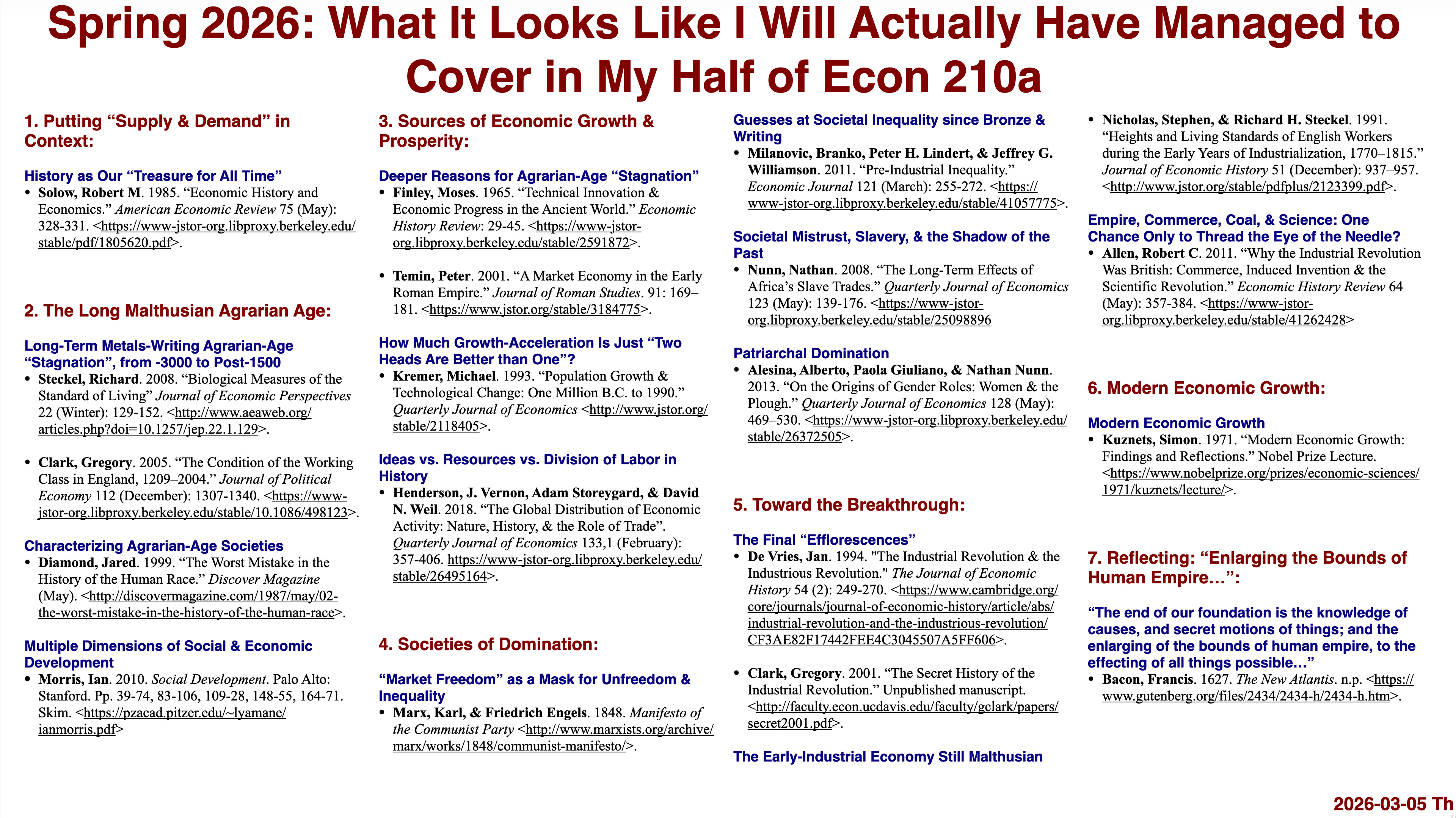
MEMO TO SELF: What It Looks Like I Will Actually Have Managed to Cover in My Half of Econ 210a This Semester...

Less than one third of the topics I wanted to, and all at much less depth than they deserve. But ars longa, vita brevis

Share

Share DeLong's Grasping Reality: Economy in the 2000s & Before

All stories, all Grand Narratives, begin in some medias res.

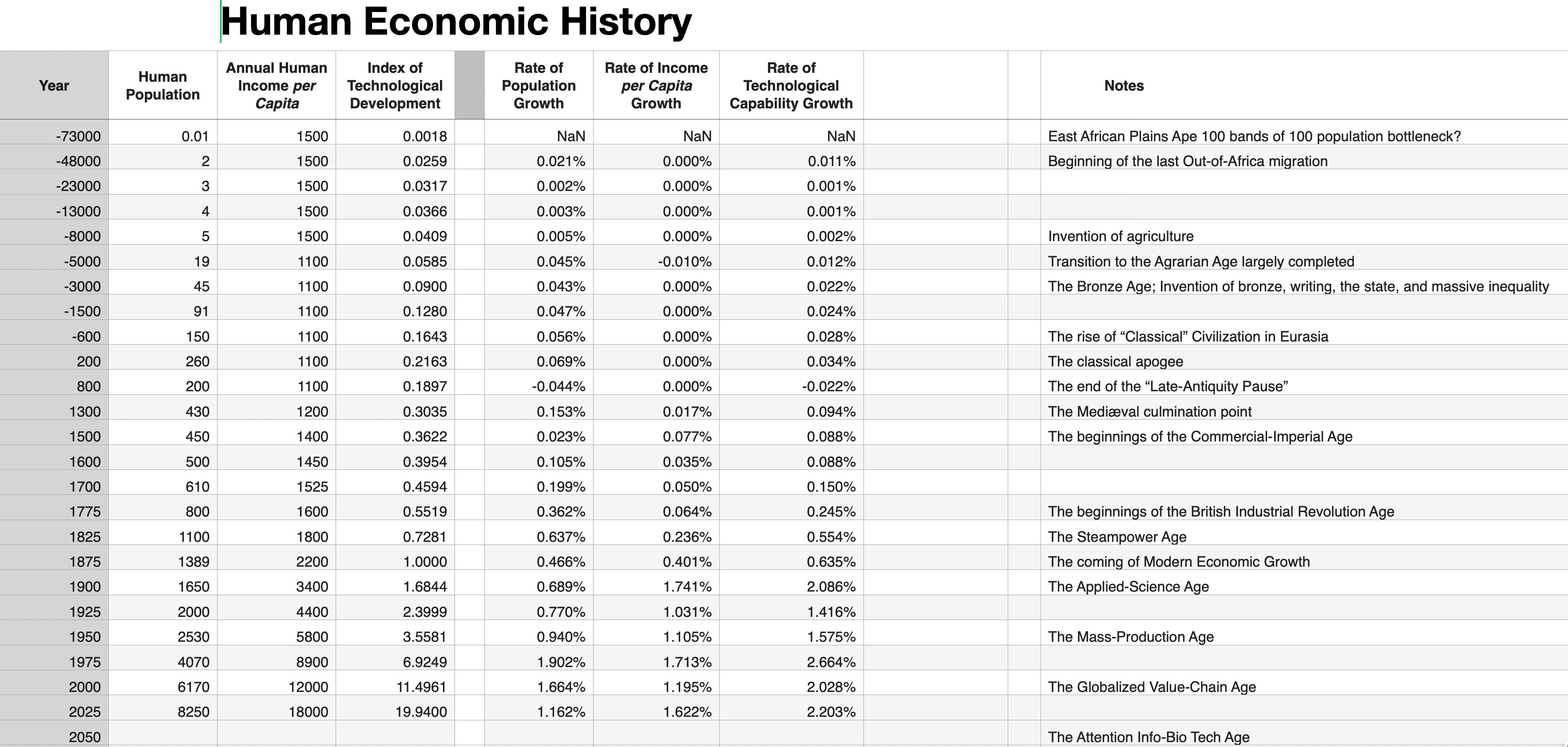
I choose to begin my story, my Grand Narrative, in the year -3000.

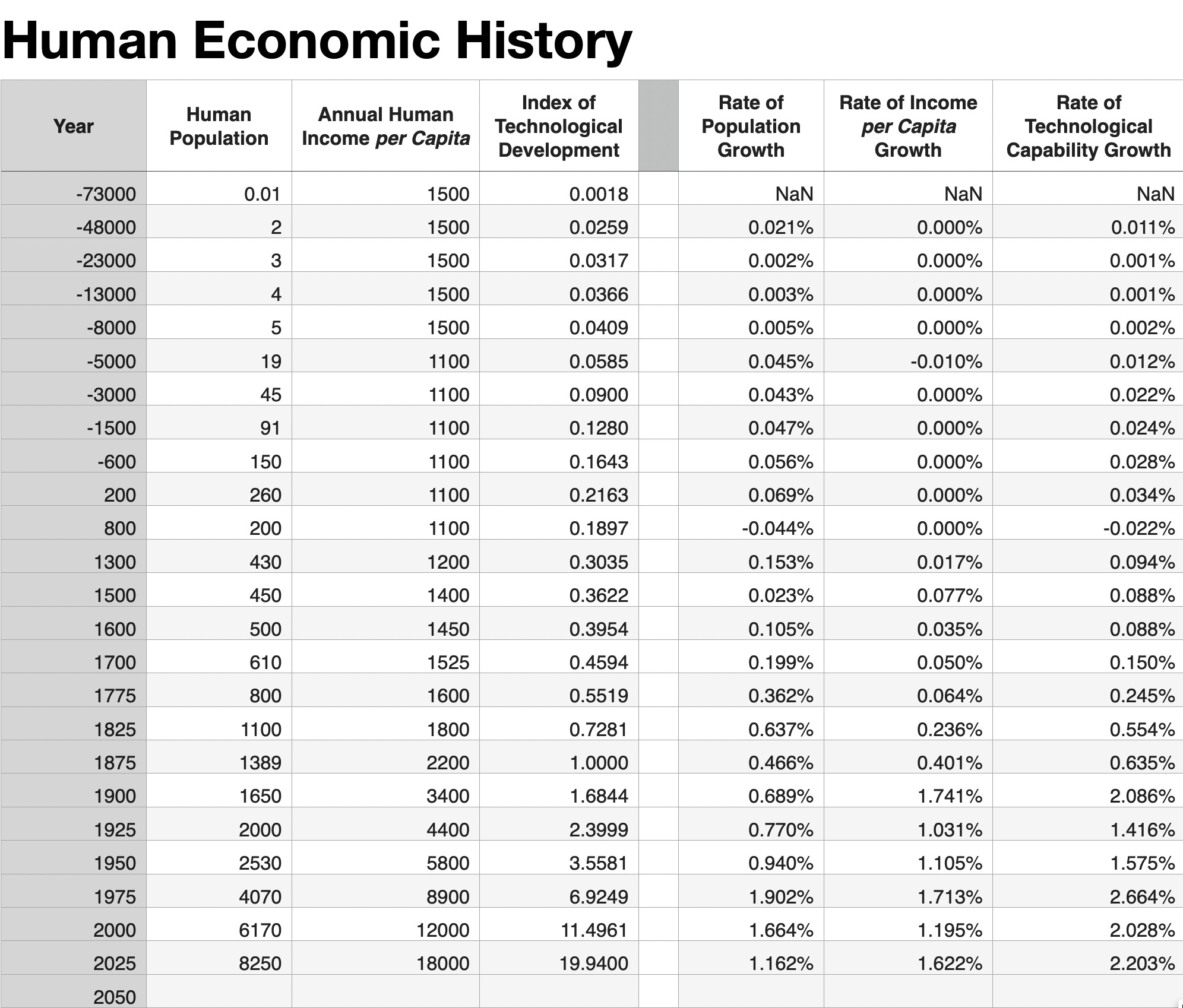
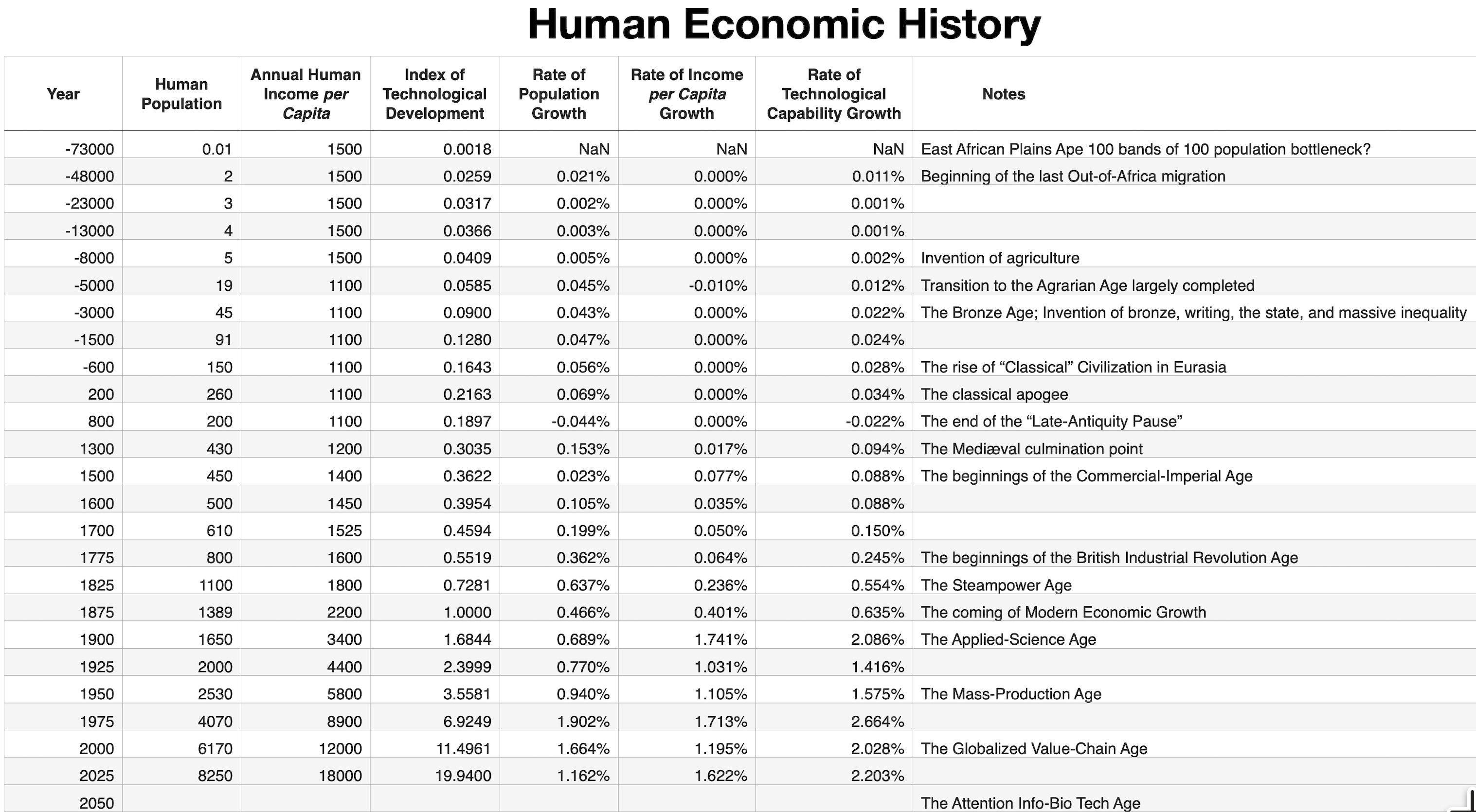
70,000 years earlier we had been a not-terribly-successful Great Ape subspecies. We homines sapientes sapientes, we East African Plains Apes, were then, in the year -73000, perhaps:

  • between 100 and 1000 groups, averaging 100 each, wandering around East Africa.

  • cf. a perhaps equal number of phenotypically indistinguishable Southern African Plains Apes whose powerful genetic imprint we see in today’s Khoesan;

  • equal numbers of each of the other homo sapiens subspecies that were our very close cousins:

    • the Central Asia and farther west homines sapientes neandertalenses,

    • the Central Asia and farther east homines sapientes denisovenses,

    • “ghost homo sapiens” lineages seen only in the imprint left in markers in our genes today;

  • plus back then the much larger populations of the other hominids—perhaps 2 million:

    • chimpanzees,

    • bonobos,

    • gorillas,

    • orangutans,

    • outnumbering all the then-numbers of all the world’s homo sapiens subspecies together by maybe five to one.

Give a gift subscription

But by the year -3000 much had changed. By then there were nearly 50 million of us. For we had been fruitful, and multiplied, and subdued the earth. And so by the year -3000 we were exercising dominion as apex predators over every living thing that moveth, and taking every herb-bearing seed and also fruit-yielding tree as also our meat.

The year -3000 was well after the invention of agriculture and the domestication of animals. The year -3000 was the moment of the coming of bronze tools and weapons, of the calculating and writing of records, and of complex societies with deep and sophisticated divisions of labor. Those were therafter powered by four factors:

  • Gossip

  • Prestige

  • Domination

  • Gift-exchange

Get 75% off a group subscription

By this point in time, humans had been a cultural species for so long that it had substantially affected our genetic endowment, albeit in ways we do not terribly well understand. By this point in time, we had long been an anthology-intelligence—what our extraordinarily abilities to communicate complexity and to gossip had given us was that what one East African Plains Ape in the band learned, all would soon know; and with many eyes looking at problems, not all but a very substantial proportion of bugs and difficulties proved shallow.

After this point in time, moreover, we were no longer merely a cultural anthology-intelligence species. After this point in time, we were an ASI—a time-binding and space-binding ASI—an Anthology Super-Intelligence with a scope covering the entire globe and all time since, wreaking mighty works indeed of nature-manipulation and social-organization via our fine and deep cognitive and productive divisions of labor.

That is the medias res at which I began. What followed that was what I have tried to teach.

Refer a friend


All stories, all Grand Narratives, cut themselves short by chopping things off at some arbitrary end—if not before now, at the current now after which we do not know what will happen next.

I cut my story short at the year 1875.

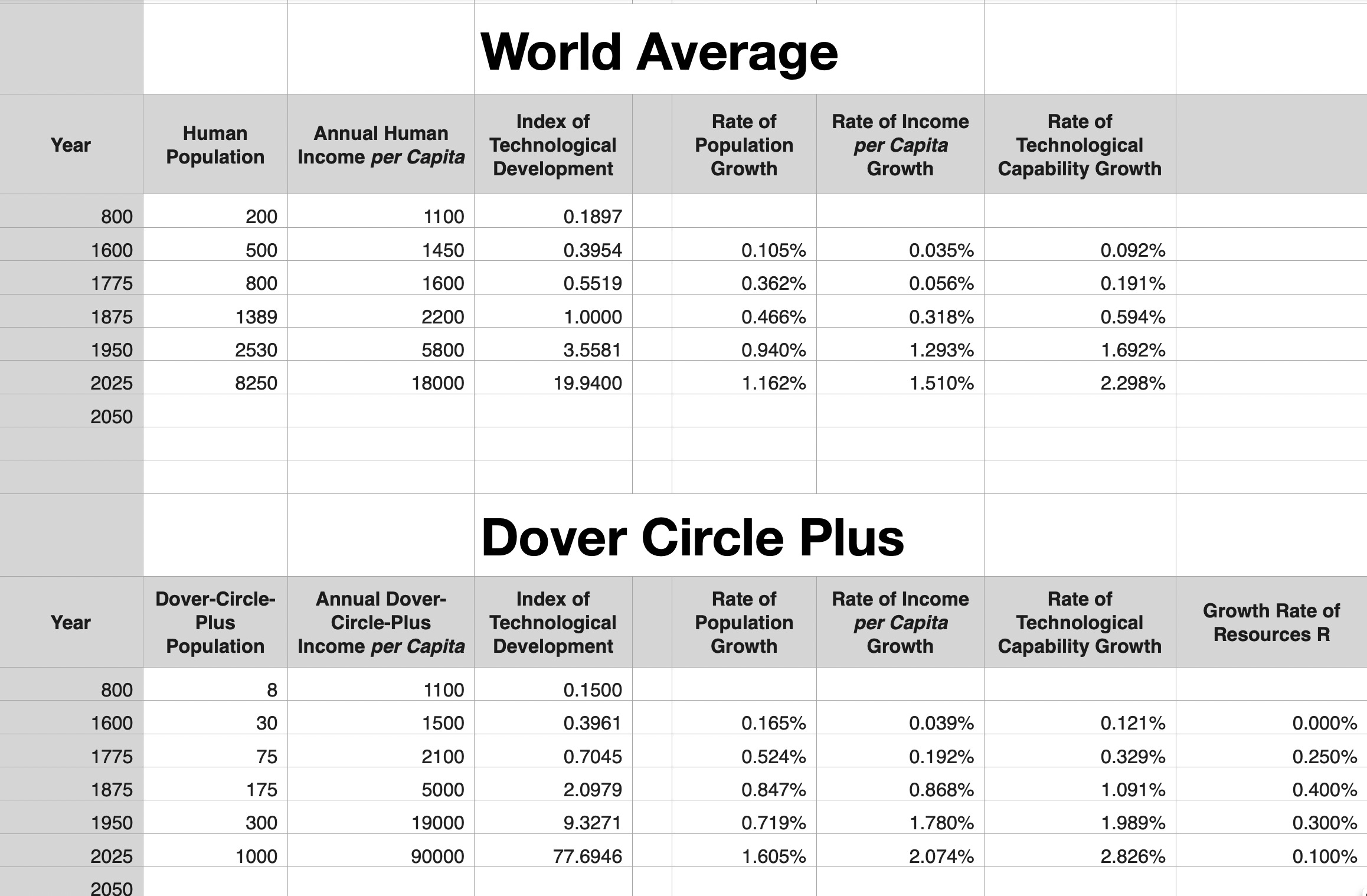
That 1875 was the moment of what Simon Kuznets identified and labeled as the coming of Modern Economic Growth. In our era of Modern Economic Growth we see the capabilities of the human ASI to manipulate nature and coöperatively organize ourselves grow by at least 2% per year. Cf. a value-of-the-human-ideas-stock growth rate only 1/100 as much from the start of the Bronze Age in the year -3000 to the end of the Late-Antiquity Pause in the year 800. We see in one year since 1875 the same amount of proportional “technological” change—on a much higher base!—that we saw in a century back in Agrarian-Age Malthusian civilization.

Since then we have speed-run through Applied-Science Belle-Époque, Mass-Production Social-Democratic, Globalized Value-Chain Neoliberal, and now are passing through the gate to Attention Info-Bio Tech Civilization. There is a strong sense in which there has been more economic history since 1875 than in all the eras and æons before.

But I pass the baton off to Chenzi Xu. She gets to cover: post-1875 market integration, capital markets , international money and finance, the Great Depression, financial crises, industrial policy, and economic development.

Not, mind you, that there was little economic history from the year -3000 to the year 1875. At that moment of 1875 Steampower Civilization had become well-established. At that moment our numbers had grown from the 50 million of the year -3000 to 1.4 billion—nearly thirty-fold. At that moment my crude guesstimate of the value of the stock of human ideas for manipulating nature and coöperatively organize ourselves had grown to a value I set at 1.00 from a value of 0.09 in the year -3000—eleven-fold. Civilizational accomplishments over -3000 to 1875 in culture and technology had been mighty indeed. The kinds and counts of luxuries that the rich and famous could utilize was at least one singularity-transformation’s worth above those found in the year -3000, when the luxuries available to King Gilgamesh were limited to perfume, cedar, wool, and beer. And yet the average material standard of living of humanity, as far as necessities and conveniences were concerned, was perhaps only twice what it had been in the near-subsistence Malthusian Agrarian Age—and was by 1875 astonishingly unequally distributed not just within individul societies but across the globe.

Between -3000 and 1875, a ten-fold increase in human technological capability. A thirty-fold increase in human numbers. Yet only a two-fold increase in human prosperity. And yet the stage then set for the post-1875 Modern Economic Growth explosion.

Just how did all that happen? And what were all of its ramifications?

Share


1. Putting “Supply & Demand” in Context:

History as Our “Treasure for All Time”


2. The Long Malthusian Agrarian Age:

Long-Term Metals-Writing Agrarian-Age “Stagnation”, from -3000 to Post-1500

Characterizing Agrarian-Age Societies

Multiple Dimensions of Social & Economic Development


3. Sources of Economic Growth & Prosperity:

Deeper Reasons for Agrarian-Age “Stagnation”

How Much Growth-Acceleration Is Just “Two Heads Are Better than One”?

Ideas vs. Resources vs. Division of Labor in History


4. Societies of Domination:

“Market Freedom” as a Mask for Unfreedom & Inequality

Guesses at Societal Inequality since Bronze & Writing

Societal Mistrust, Slavery, & the Shadow of the Past

Patriarchal Domination


5. Toward the Breakthrough:

The Final “Efflorescences”

The Early-Industrial Economy Still Malthusian

  • Nicholas, Stephen, & Richard H. Steckel. 1991. “Heights and Living Standards of English Workers during the Early Years of Industrialization, 1770–1815.” Journal of Economic History 51 (December): 937–957. <http://www.jstor.org/stable/pdfplus/2123399.pdf>.

Empire, Commerce, Coal, & Science: One Chance Only to Thread the Eye of the Needle?


6. Modern Economic Growth:

Modern Economic Growth


7. Reflecting: “Enlarging the Bounds of Human Empire…”:

“The end of our foundation is the knowledge of causes, and secret motions of things; and the enlarging of the bounds of human empire, to the effecting of all things possible…”


Leave a comment

Subscribe now

If reading this gets you Value Above Replacement, then become a free subscriber to this newsletter. And forward it! And if your VAR from this newsletter is in the three digits or more each year, please become a paid subscriber! I am trying to make you readers—and myself—smarter. Please tell me if I succeed, or how I fail…

##memo-to-self-what-it-looks-like-i-will-actually-have-managed-to-cover in-my-half-of-econ-210a-this-semester
#memo-to-self
##lecture-notes
##enlarging-the-bounds-of-human-empire
##econ-210a
#what-it-looks-like-i-will-actually-have-managed-to-cover in-my-half-of-econ-210a-this-semester
#spring-2026
#grand-narrative
#economic-history
#human-asi
#agrarian-age
#societies-of-domination
#economic-development
#ideas-and-growth

HOISTED FROM THE ARCHIVES: Unleash Chiang Kai-Shek

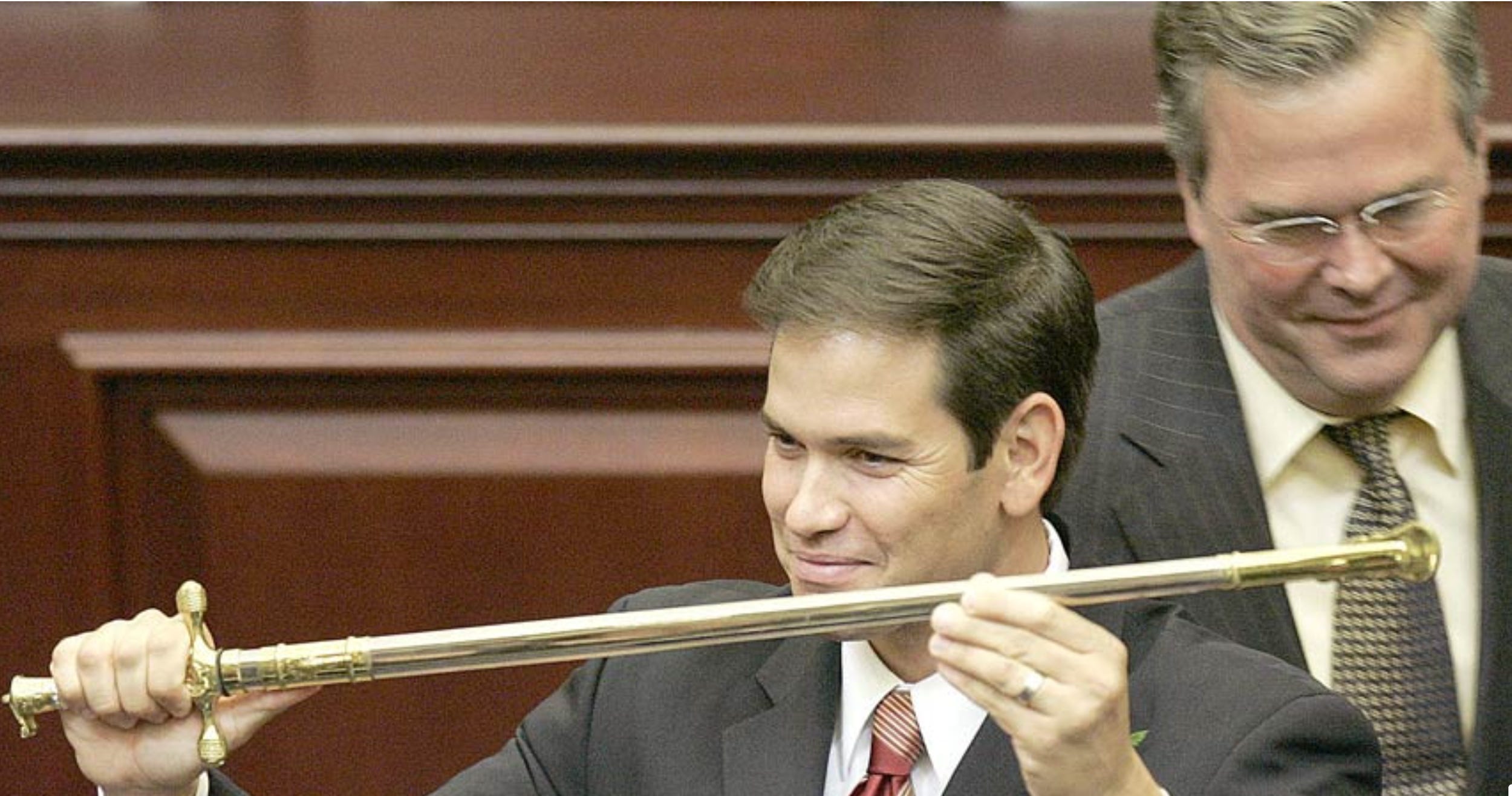
From 2005-10-05: Jeb Bush’s “mystical warrior Chang” gag stems from a right‑wing Cold War slogan about “unleashing Chiang Kai‑shek,” which Bush family scions parroted without understanding how their father had used at as an ironic, right wing-mocking joke while playing tennis <https://web.archive.org/web/20111023072237/http://delong.typepad.com/sdj/2005/10/unleash_chiang_.html>…

Share

Share DeLong’s Grasping Reality: Economy in the 2000s & Before


Unleash Chiang Kai-Shek

I’m sorry, but this is just too weird:

Gainesville.com | The Gainesville Sun | Gainesville, Fla.: After more than an hour of solemn ceremony naming Rep. Marco Rubio, R-West Miami, as the 2007-08 House speaker, Gov. Jeb Bush stepped to the podium in the House chamber last week and told a short story about “unleashing Chang,” his “mystical warrior” friend. Here are Bush’s words, spoken before hundreds of lawmakers and politicians:

“Chang is a mystical warrior. Chang is somebody who believes in conservative principles, believes in entrepreneurial capitalism, believes in moral values that underpin a free society.

“I rely on Chang with great regularity in my public life. He has been by my side and sometimes I let him down. But Chang, this mystical warrior, has never let me down.”

Bush then unsheathed a golden sword and gave it to Rubio as a gift. “I’m going to bestow to you the sword of a great conservative warrior,” he said, as the crowd roared.

The crowd, however, could be excused for not understanding Bush’s enigmatic foray into the realm of Eastern mysticism. We’re here to help. In a 1989 Washington Post article on the politics of tennis, former President George Bush was quoted as threatening to “unleash Chang” as a means of intimidating other players. The saying was apparently quite popular with Gov. Bush’s father, and referred to a legendary warrior named Chang who was called upon to settle political disputes in Chinese dynasties of yore. The phrase has evolved, under Gov. Jeb Bush’s use, to mean the need to fix conflicts or disagreements over an issue. Faced with a stalemate, the governor apparently “unleashes Chang” as a rhetorical device, signaling it’s time to stop arguing and start agreeing.

No word on if Rubio will unleash Chang, or the sword, as he faces squabbles in the future…

Give a gift subscription

When George H. W. Bush in the 1970s and 1980s threatened to “unleash Chang” on his tennis opponents, he was referring to:

  • China’s onetime strongman and thereafter Taiwan’s dictator Chiang Kaishek,

  • leader of the Nationalist Party,

  • the man who had largely reunified China in the 1920s with his army’s “Northern Expedition,”

  • hqd lost the Chinese Civil War to Mao Zedong’s Chinese Communist Party, and

  • then taken refuge with his Guomindang party cadres on Taiwan.

Get 75% off a group subscription

After the start of the Korean War, the American 7th Fleet protected Chiang (and Taiwan) from Mao’s People’s Liberation Army.

Republican wingnuts, however, pretended that the 7th Fleet actually protected Mao’s Communists (who had, after all, won the Chinese Civil War) from Chiang’s Nationalists (who had, after all, lost it) by keeping Chiang Kaishek leashed. They periodically called for the U.S. to “unleash Chiang Kaishek”—so that Chiang, you see, could invade and conquer the Chinese mainland.

When George H. W. Bush, playing tennis (and losing) in the 1970s and 1980s, would threaten to “unleash Chiang,” he was mocking the right-wing nuts of his generation.

But George H. W. Bush’s sons—even the smart one, Jeb—never got the joke.

They, you see, didn’t know enough about world history or even the history of the Republican Party to know who Chiang Kaishek was, or what “Unleash Chiang!” meant.

Hence Jeb Bush’s explanation that twentieth-century Chinese nationalist, socialist, general, and dictator Chiang Kaishek was a “mystical warrior… who believes in conservative principles, believes in entrepreneurial capitalism, believes in moral values that underpin a free society.”

To me, that level of uncuriosity is scary.

Why is this family ruling us, again?

Leave a comment

Subscribe now

If reading this gets you Value Above Replacement, then become a free subscriber to this newsletter. And forward it! And if your VAR from this newsletter is in the three digits or more each year, please become a paid subscriber! I am trying to make you readers—and myself—smarter. Please tell me if I succeed, or how I fail…

##public-reason
##hoisted-from-the-archives-unleash-chiang-kaishek
##hoisted-from-the-archives
#unleash-chiang-kaishek
#jeb-bush
#george-h-w-bush
#marco-rubio
#mystical-warrior-chang
#cold-war-politics
#right-wing-rhetoric
#political-ignorance
#historical-amnesia
#political-mockery

CROSSPOST: DAN DREZNER: There Is No U.S. Plan on Iran

Is this the Epstein War, or the Netanyahu War? Dan Drezner thinks it is the Netanyahu War. Dan’s heading: Maybe, just maybe, the Trump Administration does not know what it is doing in Iran.
On the general line of spitting against the wind, or rolling the Sysiphean boulder uphill, I have found Dan Drezner to be the best despairing man yelling at clouds and keeping my head in the right place with respect to Trumpian chaos-monkey foreign and security policy.
This AM he argues the Trump administration joined Israel’s war on Iran with maximalist goals but no coherent strategy, driven by alliance entraoment and wishful thinking rather than serious planning. In Dan’s view the situation was this: Netanyahu was going to strike, and Trump decided that he would rather appear to lead the parade rather than appear weak, on the back foot, and struggling to catch up to events. Senior Trumpian officials appear to have latched onto an implausible best‑case CIA scenario of a more “pragmatic” IRGC leadership, ignoring far more likely, worse outcomes. Overall, he concludes the internal thinking is chaotic, the regime remains resilient, and the administration is essentially improvising in a high‑stakes war. Washington has no credible opposition partner or successor élite in mind, the Iranian regime’s coercive apparatus is largely intact, and hopes for popular overthrow are fanciful.
Piss‑poor crisis decision‑making.

Share

Give a gift subscription


What do I think? Again: far outside of my wheelhouse here. But: Appearing strong and in control on social media by blowing stuff up is an ethos. The U.S. way of war since Grant has been to blow stuff up, and then see what is left.

Given the amount of stuff we have been blowing up, casualties so far have been mercifully light: only 1000 or so. This is not carpet‑bombing of entire cities, but it is not pinprick strikes either. In Iran, we have confirmed devastation of senior‑leadership compounds (including Khamenei’s), IRGC command-and-control, air bases, air-defense sites, missile and drone launch facilities, and key military airfields—plus hits on civilian infrastructure: hospitals (Gandhi Hospital), emergency-services HQ in Tehran, residential buildings in Sanandaj and other cities, the Minab school, and damage around major squares and near airports like Kermanshah. In Israel, Iranian missiles have hit populated areas (e.g., Beit Shemesh) and forced repeated use of shelters; in the Gulf, repeated Iranian salvos against airports, ports, hotels, and towers have produced a pattern of punctured cityscapes—very localized severe damage, widespread disruption, but not yet city‑levelling.

All so that Trump does not appear weak on social media where Netanyahu appears decisive. (Or possibly, possibly, to get social media talking about something other than Jeffrey Epstein.)

Share DeLong's Grasping Reality: Economy in the 2000s & Before


Dan has put his piece <https://danieldrezner.substack.com/p/on-iran-there-is-no-strategy-there#footnote-anchor-1-189723814> behind his paywall, so I will just give brief excerpts:

Drezner’s World
There Is No U.S. Plan on Iran
Over the weekend the hard-working staff here at Drezner’s World expressed just a smidgen of skepticism that there was a coherent strategy behind the Trump administration’s decision to join Israel in bombing Iran. As the scope of the conflict widens, however, it is always tempting to give the administration the benefit of the doubt. After all, deciding to launch an aerial assault on Iran is a high-stakes gamble. One would like to believe that any administration, in deciding to go to war, would think long and hard about the downside risks and prepare for such contingencies…
Read more

There Is No U.S. Plan on Iran

Maybe, just maybe, the Trump Administration does not know what it is doing in Iran.

Daniel W. Drezner :: Mar 03, 2026 :: Paid….

The more we learn about Trump’s decision-making process to bomb Iran, however, the clearer it becomes that there is no real strategy or end goal. Consider the talking points… the Trump White House provided to congressional Republicans…. “The objectives are clear: 1. Destroy their missiles, and raze their missile industry to the ground. 2. Annihilate their Navy. 3. Ensure the regime’s terrorist proxies can no longer destabilize the region or the world and attack our forces, and no longer use their IEDs or roadside bombs, which have gravely wounded and killed thousands and thousands of people, including many Americans. 4. Ensure that Iran can NEVER obtain a nuclear weapon. While Operation Midnight Hammer obliterated Iran’s three major nuclear sites, the regime was committed to enriching and rebuilding their nuclear program, and they REFUSED to make a deal, despite months of extensive talks and good faith efforts by President Trump’s top negotiators.”… “Régime change” is not listed… despite Trump talking about regime change constantly….

These are pretty maximalist goals!… [of the] “nuke the sitr from orbit” kind….

Marco Rubio basically confirmed Israel’s role in forcing Trump’s hand…. The imminent threat was the Iranian response to an Israeli attack?!… [This is] the textbook definition of entrapment, in which an ally drags a great power into a conflict… [plus] obvious wishcasting on the part of Trump’s advisors….

I don’t know how this conflict plays out over the next dew weeks. The one thing I am certain about is that the Trump administration does not know either…

Leave a comment

Subscribe now

If reading this gets you Value Above Replacement, then become a free subscriber to this newsletter. And forward it! And if your VAR from this newsletter is in the three digits or more each year, please become a paid subscriber! I am trying to make you readers—and myself—smarter. Please tell me if I succeed, or how I fail…

##neofascism
##chaos-monkey
##war-and-rumors-of-war
##crosspost
##crosspost-dan-drezner-there-is-no-us-plan-on-iran
#dan-drezner
#there-is-no-us-plan-on-iran
#netanyahu-war
#chaos-monkey-foreign-policy
#alliance-entrapment
#wishful-thinking-strategy
#bomb-first-think-later
#us-israel-iran

CROSSPOST: MICHAEL SELLERS: How the CIA & Israel Pulled Off the Successful Opening Leadership Strike on Iran

This is the best short thing I have read not about the legality, morality, or strategic wisdom of the Trump-Netanyahu war on the Islamic Republic of Iran, but about how the opening strike happened to work, and work so well; and what that tells us about the form being taken by the human social practice of war as we move into the attention info-bio tech age. The operation’s “pivot” was intelligence that Islamic Republic leadership was converging on Saturday morning. This “everyone’s in the room” gave the opportunity for a decapitation strike, tailored—standoff weapons, compound‑level targeting, and simultaneous hits on several Tehran locations—to preserve surprise until the moment of weapons impact. The central puzzle: the meeting was not in a bunker, but at an unhardened urban site. Why?

Share


Share DeLong’s Grasping Reality: Economy in the 2000s & Before

<https://michaeldsellers.substack.com/cp/189615461> <https://michaeldsellers.substack.com/p/how-the-cia-and-israel-pulled-off>

DEEPER LOOK with Michael Sellers
How the CIA and Israel Pulled Off the Successful Opening Leadership Strike on Iran
Questions continue to swirl around the wisdom and legality of Trump’s war on Iran, but just for this post, let’s strip all that away for a moment and look at the opening move purely as an intelligence-and-targeting problem: how did the US and Israel manage to hit senior Iranian leadership so fast, so hard, and (apparently) so precisely? As a former CIA…
Read more

Leave a comment

Subscribe now

If reading this gets you Value Above Replacement, then become a free subscriber to this newsletter. And forward it! And if your VAR from this newsletter is in the three digits or more each year, please become a paid subscriber! I am trying to make you readers—and myself—smarter. Please tell me if I succeed, or how I fail…

##neoliberalism-ending
##war-and-rumors-of-war
##crosspost-michael-sellers-how-the-cia-israel-pulled-off-the-successful-opening-leadership-strike-on-iran
##crosspost
#michael-sellers
#trump-netanyahu-war
#iran-leadership-strike
#attention-info-bio-tech-society
#modern-warfare
#decapitation-strike
#islamic-republic-of-iran
#intelligence-and-targeting
#precision-weapons
#standoff-munitions
#twenty-first-century-war
#human-social-practice-of-war

Killing Khamenei: Regime-Change Roulette in a Powder-Keg World

But Trump insisted he already destroyed the Islamic Republic of Iran’s nuclear-weapons program! A sudden U.S.–Israeli decapitation campaign against Iran and the killing of Supreme Leader Khamenei shatters nuclear diplomacy, destabilizes energy markets, and teaches every medium power the same lesson: get an operational deterrent—nuclear-threat or leader-family threat, by bomb, missile, drone, or assassin—fast. This war is less a precision strike than a stress test of a wobbling world order, from Hormuz to Kyiv to the South China Sea and beyond…

Share

Share DeLong's Grasping Reality: Economy in the 2000s & Before


The most important thing this morning, Sunday March 1: The chances that in fifty years Tel Aviv, Damascus, and more are seas of radioactive glass. Have those fallen or risen as a result of the unconstitutional war against the government of the Islamic Republic of Iran launched this weekend?

I cannot judge. But that is the most important thing people should be thinking about this morning.

Meanwhile—and far out of my wheelhouse—my notes so far:

Give a gift subscription


In the early hours of 28 February 2026, U.S. and Israeli forces began a substantial coordinated air and missile campaign against Iran with the declared U.S. objectives, according to Donald Trump, (i) of toppling the Islamic Republic government, (ii) destroying its nuclear and missile capabilities (which had, Trump claimed, already been destroyed), and (iii) crippling its navy <https://www.cfr.org/articles/gauging-the-impact-of-massive-u-s-israeli-strikes-on-iran>. Perhaps 900 strikes in the first twelve hours.

Let’s pause on that (ii). The White House was still, as the attack went on, calling “fake news” on reports that Iran still had a nuclear-weapons program:

Secretary Marco Rubio (Jun 25, 2025) <[twitter.com/SecRubio/...](https://twitter.com/SecRubio/status/1937879123285663831)>: ‘This is the game these intelligence leakers play. They characterize and spin the intelligence the way they want to because they have an agenda. Here’s the truth: Irans nuclear sites are destroyed

@RapidResponse47 (Jun 25, 2025) <https://x.com/RapidResponse47/status/1937932160146772449>: ‘@PressSec: “That CNN story does not change the facts: There was a TOTAL and COMPLETE obliteration of Irans nuclear facilities, and because of @POTUS‘ strike... Iran no longer has the capability to produce a nuclear weapon...”

Leave a comment

Of course, Donald Trump is not a reliable narrator. No one in the Trump administration is a reliable narrator. Plus the U.S. these days cannot be understood, even as shorthand, to be a unitary actor with coherent objectives. It is chaos monkeys all the way down.

Trump has offered no endgame: there are no articulated conditions for success beyond the fall of the regime, no explanation of what follows if Iran fragments or descends into civil war, and no domestic debate rallying support comparable to 2002–03. <⁠https://www.atlanticcouncil.org/dispatches/experts-react-the-us-and-israel-just-unleashed-a-major-attack-on-iran-whats-next/>. Every sortie, carrier deployment, and Patriot battery shifted to the Gulf is something not available for deterring Russia in Eastern Europe or China in the Western Pacific. How big will the strain be on U.S. readiness in Asia <https://mickryan.substack.com/p/the-new-iran-war-trajectory-of-the>? This war is a gamble, taken with incomplete information and in the teeth of historical experience that suggests such gambles often go badly—above all for the people living under the bombs. As Michael Hirst wrote the line in the screenplay for the 1998 Elizabeth for Queen Elizabeth I: “I do not like wars. They have uncertain outcomes”.

U.S.–Israeli operational coordination appears exceptionally tight: target lists, sequencing, and timing suggest a jointly conceived decapitation campaign <https://www.atlanticcouncil.org/dispatches/experts-react-the-us-and-israel-just-unleashed-a-major-attack-on-iran-whats-next/>. Initial waves focused on: (a) command-and-control, (b) leadership compounds, including the supreme leader complex, (c) nuclear and missile infrastructure, and (d) air defenses, IRGC bases, and naval facilities. The Iranian Red Crescent and human‑rights monitors report several hundred killed and many more injured, with a very high civilian share because of strikes near or on dual‑use and urban targets <https://en.wikipedia.org/wiki/2026_Israeli%E2%80%93United_States_strikes_on_Iran>.

The most dramatic event is that Supreme Leader Ali Khamenei has been killed. The U.S.–Israeli campaign has already achieved a central decapitation objective. But here, history leans over our shoulder and coughs politely. Regimes do not always die when leaders do. The Islamic Republic is a system, not a one‑man show:

So the decapitation gamble creates, perhaps:

  1. Replacement of the current leadership with a more openly military‑security junta—what one analyst dubs the risk of “IRGCistan”: fewer turbans, more uniforms, and an even harder line at home and abroad;

  2. A drawn‑out internal power struggle in which multiple factions—IRGC commanders, clerics, technocrats, and street‑level protesters—compete in the shadow of an ongoing foreign air campaign; or

  3. Rapid collapse of the regime and some form of opposition‑led transition—what the more optimistic U.S. hawks implicitly hope for.

The structural odds do not favor (3).

The Iranian response? Consider the UAE. The defense ministry reports 165 ballistic missiles and 541 drones launched at the country, with most intercepted but some getting through, leaving three dead (migrant workers) and dozens lightly injured; debris has hit Dubai and Abu Dhabi, including the Etihad Towers complex and Jebel Ali port. Civilian air travel is in chaos, with Dubai and Abu Dhabi airports damaged and airspace closures cascading through the regional network. ​⁠ The war is now a multi‑node regional air and missile war. Inside Iran, the regime has moved—remarkably quickly, given the shock—to institutionalize succession. The system has flipped to “continuity mode.” The rhetoric from President Masoud Pezeshkian is maximalist—condemning Khamenei’s killing as a “declaration of war against Muslims” and pledging retaliation as a “duty”—but the institutional move is conservative: preserve the system, then sort out who wears which turban (or uniform) later.

The Islamic Republic government has immediate aims: to survive the onslaught, impose enough costs on the United States and Israel to complicate further attacks, and maintain internal control. The Islamic Republic government has medium‑term aims: inflict politically painful casualties on U.S. forces, and raising the global economic price of war—principally via threats to Gulf oil infrastructure and shipping through the Strait of Hormuz <https://www.cfr.org/articles/gauging-the-impact-of-massive-u-s-israeli-strikes-on-iran>.

Pause for the Strait of Hormuz at the entrance to the Persian/Arabian Gulf. 1000 miles to the west-southwest, the Houthis succeeded in their operational aim: closing the Bab el-Mandeb at the southern end of the Red Sea and convincing the U.S. Navy that continued retaliatory strikes attrit the U.S. Navy more than Houthi capabilities. They did this for nearly two years until the October 2025 ceasefire. They exploited the asymmetry between how much it cost them to keep shooting, how much it cost the U.S. Navy to suppress their capabilities, and how much it costs everyone else to keep sailing. The Houthis are now doing again, as MAERSK reroutes away from the Suez Canal to the Cape of Good Hope. Only a sliver of the 20 mb/d of oil that transits the Strait of Hormuz has pipeline alternatives. An Omani-via-land bridge is OK for high-value but not for bulk commodities. Thus adding enough stochastic risk to effectively close the Strait of Hormuz may be possible even for a substantially degraded Islamic Republic military.

From an arms‑control perspective, this is catastrophic. It signals to Iranian elites—and many other governments—that engaging in negotiations with the United States does not insure against force; it may even be a prelude to it. It teaches future leaders everywhere that nuclear forces are the only reliable deterrent against regime‑change campaigns. It complicates non‑proliferation norms globally: why would other regional actors trust complex deals if they can be swept away by a change of administration and a few high‑octane speeches? The combination of “we destroyed their nukes” rhetoric from Washington and clear evidence that this is not, in fact, true, is exactly the kind of thing that will teach every future regime: if you are going to rely on nuclear capability as a deterrent, build more, spread it out, harden it, and never trust U.S. claims about what they have taken out.

By killing Khamenei in a foreign strike, Washington and Jerusalem have made a particular kind of example: a long‑serving leader, deeply invested in the nuclear program, dies under bombs rather than in his bed. The “lesson” for medium powers is to grab whatever nuclear leverage they can, as fast as they can, before the next Epic Fury. That is likely to be read in Pyongyang, Islamabad, New Delhi, and elsewhere as a case study in why you want not just a program but an operational deterrent in place before you cross certain political red lines.

And the death of Khamenei may transform what the human social practice of war becomes in the rest of the century of the 2000s. Deterrence may begin to start taking the form of personal threats—whether by bomb, missile, drone, or assassin—against the lives of leaders and their families. I recall Thomas More’s Utopia <https://ttu-ir.tdl.org/server/api/core/bitstreams/415992b4-9019-427c-a6d3-e16b842c319d/content>:

As soon as they declare war, they take care to have a great many schedules, that are sealed with their common seal, affixed in the most conspicuous places of their enemies' country. This is carried secretly, and done in many places all at once. In these they promise great rewards to such as shall kill the prince, and lesser in proportion to such as shall kill any other persons who are those on whom, next to the prince himself, they cast the chief balance of the war. And they double the sum to him that, instead of killing the person so marked out, shall take him alive, and put him in their hands.

They offer not only indemnity, but rewards, to such of the persons themselves that are so marked, if they will act against their countrymen. By this means those that are named in their schedules become not only distrustful of their fellow-citizens, but are jealous of one another, and are much distracted by fear and danger; for it has often fallen out that many of them, and even the prince himself, have been betrayed by those in whom they have trusted most; for the rewards that the Utopians offer are so immeasurably great, that there is no sort of crime to which men cannot be drawn by them. They consider the risk that those run who undertake such services, and offer a recompense proportioned to the danger—not only a vast deal of gold, but great revenues in lands, that lie among other nations that are their friends, where they may go and enjoy them very securely; and they observe the promises they make of this kind most religiously.

They very much approve of this way of corrupting their enemies, though it appears to others to be base and cruel; but they look on it as a wise course, to make an end of what would be otherwise a long war, without so much as hazarding one battle to decide it. They think it likewise an act of mercy and love to mankind to prevent the great slaughter of those that must otherwise be killed in the progress of the war, both on their own side and on that of their enemies, by the death of a few that are most guilty; and that in so doing; they are kind even to their enemies, and pity them no less than their own people, as knowing that the greater part of them do not engage in the war of their own accord, but are driven into it by the passions of their prince.

If this method does not succeed with them, then they sow seeds of contention among their enemies, and animate the prince's brother, or some of the nobility, to aspire to the crown. If they cannot disunite them by domestic broils, then they engage their neighbours against them, and make them set on foot some old pretensions, which are never wanting to princes when they have occasion for them. These they plentifully supply with money, though but very sparingly with any auxiliary troops; for they are so tender of their own people that they would not willingly exchange one of them, even with the prince of their enemies' country…

Get 75% off a group subscription

Is this a pivotal moment in the global security order? It undermines negotiation for arms‑control credibility. It incentivizes nuclear proliferation. It risks severe energy and economic disruption via Hormuz. It upends the U.S. military bandwidth vis‑à‑vis Russia and China. It normalizes leader‑targeting and preventive decapitation strikes. These are changes that will shape strategic behavior, nuclear choices, and the odds of catastrophe for decades.

Wars are stochastic processes with fat tails. The first 24 hours of this one have not closed off the worst tails; they have thickened them.

Leave a comment

Subscribe now

If reading this gets you Value Above Replacement, then become a free subscriber to this newsletter. And forward it! And if your VAR from this newsletter is in the three digits or more each year, please become a paid subscriber! I am trying to make you readers—and myself—smarter. Please tell me if I succeed, or how I fail…

##war-and-rumors-of-war
##neofascism
##killing-khamenei-regime-change-roulette-in-a-powder-keg-world
#regime-change-roulette
#us-israel-iran-war
#decapitation-strike
#war-gamble
#strategic-deterrence
#air-and-missile-war
#fat-tailed-risks

Understanding the State of the Corrupt Supreme Court Today

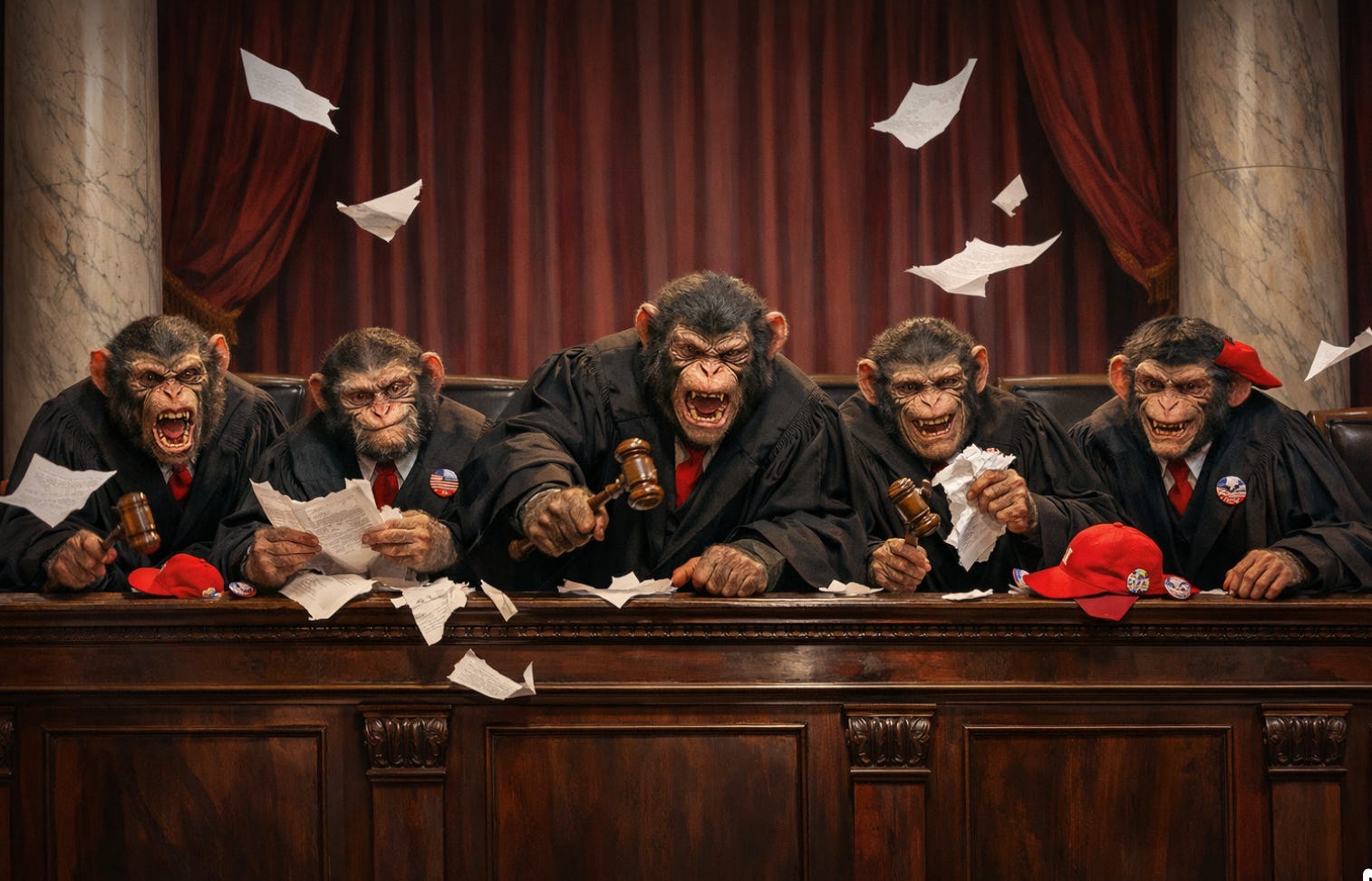
Legal Realism in CrazyTown facing the chaos-monkey president: Reading the Roberts Court as a Trump‑era power machine as Alito, Thomas, Gorsuch, Kavanaugh, Roberts, and Barrett turn Trumpist chaos-monkey impulses into what they call “law”. The robes donned are “textualism” and “originalism”. The reality is emergency stays, shattered agencies, and a presidency unchained as hollow promises are made of rule of law and simply calling balls and strikes. The Roberts Court is not really a 3-3-3 court with a moderate center at all, but one with a neofascist two and four neofascist fellow travelers. That is what you see when you look at the Roberts Court as a political‑economic actor in a Trump‑run regime…

Share

Share DeLong’s Grasping Reality: Economy in the 2000s & Before


There are many people worth respecting and following writing about the current state of the Supreme Court and its right-wing neofascist turn.

I recommend:

Give a gift subscription

But they—all of them, overwhelmingly—clothe what is going on in the drapery of legal doctrine and argument. They thus pretend that justices are law-abiding and law-respecting. And that is—except for Sotomayor, Jackson, and Kagan—a mistake.

We need more Legal Realism Freak Flag Flying here. So let me—stepping far indeed away from my wheelhouse—try to provide some:

  • There are two on the Supreme Court—Alito and Thomas—who are fascists in the strict sense: believe that the United States is under dire threat from Wokeism, the U.S. Constitution is thus suspended: Trump, in the words of the late-Roman Republic’s senatus consultum, ultimum, is free to act as he wishes: videat præses ne quid res publica detrimenti capiat, let the president see that the republic suffers no harm.

  • There are two on the Supreme Court—Gorsuch and Kavanaugh—who will almost always vote with Alito and Thomas that Trump gets to do what he wants.

  • These two will, however, occasionallywant to put a time limit on it—allow Trump to move fast, break things, and establish facts-on-the-ground that then shape the future, but only for a limited time—perhaps a year or so. (Although do note that Kavanaugh dissented and joined the true fascists on Learning Resources v. Trump.)

  • Then there is Justice Barrett—her vote will almost always drag Roberts’s along. (The only significant exception I can recall is the two EPA cases Ohio v. EPA (shadow docket) and San Francisco v. EPA (merits docket)).

  • Roberts will follow Barrett, except where the EPA is concerned

  • And there are three Supreme Court justices—Justice Jackson, Justice Sotomayor, and Justice Kagan—who have their heads screwed on tight, and are law-abiding, -respecting, and -fearing.

Leave a comment

With the current alignment, therefore, “Supreme Court Majority” = “Justice Barrett”, overwhelmingly.

Properly reporting and analyzing what the Supreme Court has done, is doing, and will do therefore requires a deep understanding of what Justice Barrett thinks she is doing and why, and of the somewhat different what Justice Barrett is doing, and why.

As I see it—and, I repeat, I am well out of my wheelhouse here, but I believe someone should say this—Barrett sees herself as attempting to apply but also rescue Scalia’s vision of the constitutional order from the danger generated by the Trumpists’ weaponization of it in the interests of kleptocratic fascism.

The surface story she may tell herself is that judges apply law as written; judges are not policymakers; originalism and textualism are the neutral algorithms that prevent courts from becoming mini‑legislatures. Her Federalist Society talks are about interpretive method, not about how to entrench a one‑party regime.

But somehow, on the architecture of power and the shadow docket, the recurring reality is that when Trump’s White House needs an emergency stay to keep some sweeping policy in place—deportations under the Alien Enemies Act, mass firings of civil servants, wholesale grant cancellations, aid freezes—Barrett is there for him. The four‑step kabuki is by now familiar: district court issues a skeptical injunction; appeals court mostly affirms; DOJ sprints up the marble steps; right-wing majority says “yes, you may proceed,” usually in a paragraph. Facts on the ground are created.

This is driven by the bomb‑throwing Thomas, Alito, and Gorsuch. The modern administrative state is constitutionally suspect. “Independent” agencies are a New Deal mistak. Deference to expertise is judicial cowardice. Emergencies justify maximal deference to a friendly executive. They write as if they have been waiting since 1937 for precisely this kind of president to blow things up. Barrett goes along—but not as a true believer: rather, as an anxious technocrat of the right, worrying about how to keep some category of “independent” agencies while trimming doctrine around the edges.

But when the Trump administration says: “Freeze $2 billion in USAID reimbursements; we want to dismantle the program first, then litigate later,” that is fine with Barrett. When the NIH wants to terminate hundreds of millions in health grants because they smell of DEI and “gender ideology,” again the emergency stay majority includes Barrett. When the administration wants to delay or prevent reinstatement of independent‑agency heads or block nationwide injunctions against its more extreme domestic policies, the stay is granted, the lower‑court brakes are lifted, and the merits get “fast‑tracked.” Barrett is either in the majority or, at most, registering a carefully hedged partial dissent that doesn’t actually stop Trump from getting what he wants on the ground.

Perhaps Barrett, by being the “reasonable” one in this coalition, makes the architecture function. Her presence allows Roberts to tell himself that this is a 3‑3‑3 Court with an institutionalist middle, not a 6‑3 wrecking crew. But from the point of view of the people on the losing end of these orders, that nuance is metaphysical. The grants vanish all the same.

What, then, does she think she is doing? My guess is that she is profoundly invested in the story that textualism and originalism are the right way to do law, and not merely partisan cloaks. The nightmare scenario for her is that Trump’s abuses discredit those methods for a generation. Thus she uses the big merits cases to show constraint: siding with the liberals on San Francisco v. EPA in part; hinting that Humphrey’s Executor might survive; occasionally joining a liberal majority in some apolitical statutory case. These are, in her mind, exhibits for the proposition: “I am not Trump’s judge; I am the law’s judge.”

On structural questions, however, her view is that a Trump White House that can purge independent commissioners, reverse long‑settled agency policies overnight, and avoid universal injunctions is not a partisan horrorshow but a rebalancing of the separation of powers in the right direction: away from bureaucracy, toward elected control.

Trump is obnoxious, but he is an elected executive; the grant‑writers at NIH are not. If a choice must be made between empowering the sloppy democracy of elections and the technocracy of bureaucracies and lower courts, she picks the former and enables Trump. In her worldview, at least as I infer it, these expansions of presidential power are not supposed to be Trump‑only. A future, more palatable president could in theory use the same doctrines to do “good” things: rapidly expand regulation, protect rights, shovel money into public health. She writes as if doctrine is symmetric.

But we legal realists know that in practice, enforcement, standing, and “major questions” mysteriously become more rigorous when the president is a Democrat.

Inside her own head, however, she may very well believe she is strengthening the office, not merely this occupant.

The Roberts‑Barrett conceit: that you can keep Trump’s agenda mostly intact while occasionally drawing a bright line—Learning Resources on IEEPA tariffs; Trump v. Illinois on National Guard federalization; perhaps Slaughter on FTC removal—and that these isolated acts of resistance will suffice to preserve “the rule of law.” Barrett’s votes, especially in the shadow‑docket cases, are the lubricant in that machine. She is the one who makes it possible to say: “This isn’t lawlessness; this is just textualism, faithfully applied.”

That is the most charitable legal‑realist reconstruction of her self‑conception I can come up with.

Moving further into CrazyTown, what do Kavanaugh and Gorsuch think they are doing?

My guess: In Kavanaugh’s head, he is the Court’s responsible Republican: the one who will give you 90% of the movement’s wish‑list but insists on doing so in full sentences, with citations, and with at least a hand‑wave toward precedent, administrability, and the long‑run legitimacy of the institution. He is not Alito, gleefully bayoneting Roe and affirmative action and Section 2 of the VRA while taunting the losers. He is na Reagan‑Bush lawyer who believes in a strong presidency, weak agencies, deregulatory instincts, and a certain residual concern that the Court not look too obviously like the RNC’s legal department.

But on the emergency docket architecture, Kavanaugh is almost always in the same place as Thomas and Alito. When Trump wants to: purge the Education Department and NSAIDs‑funded civil servants; freeze USAID or NIH grants that offend the anti‑DEI crusade; end Temporary Protected Status or parole programs; cut off foreign aid as bargaining chips against Congress; Kavanaugh almost never provides the fourth vote to deny Trump interim relief. He writes separate opinions now and then—“we should be careful,” “this is only about forum,” “this doesn’t prejudge the merits”—but, on the ground, the policy goes forward. The people deported, fired, or de‑funded do not experience his caveats as meaningful.

Why? Because:

  1. The president gets a very long structural leash: Kavanaugh has always been a maximalist on Article II power. He does not experience this as “enabling Trump,” but as vindicating his long‑held view that the modern presidency was over‑judicialized after Watergate.

  2. Being the technocratic hammer, not the ideological bomb: His merits opinions are couched as “we must clean up doctrine,” “we must align practice with statute, and “we must stop lower courts from going rogue.”

  3. The institutionalist in the mirror: Kavanaugh is signaling to elite legal audiences—Harvard, the D.C. bar, the New York Times editorial board—that while he is a conservative, he is not a crazy conservative. But these breaks are carefully rationed. When it comes to the cases that structure Trump’s ability to break the administrative state and purge the civil service he is with the wrecking crew.

  4. The “not as bad as Gorsuch” self‑comfort: Perhaps there is a final psychological layer here. In the internal conservative ecology of the Court, Gorsuch has become the avatar of the full‑bore anti‑administrative crusade—no deference, no patience for agency expertise, no tolerance for broad delegations. Kavanaugh is, comparatively, a moderate within that camp: That allows Kavanaugh to tell himself that he is the one preventing things from going completely off the rails. even as he signs onto outcomes that cripple agencies.

Get 75% off a group subscription

Kavanaugh sees himself as the tribune for:

  • Hyper‑empowered presidency;

  • Shrunk and disciplined administrative state;

  • Expanded corporate and property rights;

  • Narrowed civil‑rights and regulatory enforcement;

  • Occasional high‑profile nods to voting rights or institutional legitimacy when the Court is staring into the abyss.

Trump is simply the first president in decades willing to drive that project at full throttle. Kavanaugh thinks he is there to keep the car nominally on the road: preserving what he sees as a principled, technocratic conservative constitutionalism from being discredited by Trump’s ugliness—while signing onto almost every structural decision that makes Trump harder to constrain.

And Gorsuch? My guess: He sees the administrative state as original sin, a mistake—legally, morally, and economically. He believes the Court has both the duty and the opportunity to dismantle it: cf. Chevron deference, non‑delegation, “major questions,” and standing. Broad delegations are not practical necessities but constitutional evasions. The dense web of environmental, labor, and financial regulation is not an evolved response to market failure but a slow coup against the separation of powers.

He likes people he imagines as standing alone before the state: an individual believer facing a bureaucracy; a defendant facing a prosecutor; a tribe facing the federal government. They are not the diffuse beneficiaries of environmental rules, workplace protections, or civil‑rights regulations. Those he tends to treat as abstractions marshaled by “lawyers and activists” who want to get in the way of the elegant, simple constitutional order. Protect concrete, individualized rights; strip away the elaborate procedural machinery that lets groups and institutions gum up government action. In practice, it means he is far more sympathetic to a sole proprietor challenging OSHA than to the millions of workers OSHA protects.

I do not think Gorsuch experiences himself as Trump’s enabler. He experiences Trump as an inconvenient plaintiff—a deeply flawed avatar through whom these structural questions are arising. He is a structural revolutionary first; Trump is simply the chaos‑monkey president providing him with opportunities.

From the outside, however, the effect is hard to distinguish from straightforward class and partisan politics:

  • Business and the wealthy get a Court ready to gut regulation on textualist and historical grounds.

  • Presidents of his faction get a Court ready to bless unilateral action, especially when framed as “emergency” or “foreign affairs.”

  • Workers, consumers, and marginalized groups get eloquent dissents from the liberals and occasional libertarian crumbs, but structurally less protection.

Refer a friend

Thus Gorsuch is not the Court’s eccentric libertarian uncle; he is its most coherent revolutionary. The others improvise. He has a plan.

So hold on to this:

  • the neofascist two—Alito and Thomas

  • the structural Lochner counterrevolutionary: Gorsuch

  • the “responsible Republican” poseur: Kavanaugh

  • the decisive vote: Barrett, with her worries that Trumpian overreach will cripple her Scalia-student legal transformation project.

  • Roberts as partisan Republican soldier along for the ride—unwilling to vote with Democrats when there are no Republicans to provide cover (except when the bright line was crossed that is wholly pretextual Trumpist impoundments).

  • Three actual justices with judicial temperament, rather than partisan-ideological projects: Justice Sotomayor, Justice Kagan, and Justice Jackson.

Leave a comment

Subscribe now

If reading this gets you Value Above Replacement, then become a free subscriber to this newsletter. And forward it! And if your VAR from this newsletter is in the three digits or more each year, please become a paid subscriber! I am trying to make you readers—and myself—smarter. Please tell me if I succeed, or how I fail…

##neofascism
##understanding-the-state-of-the-corrupt-supreme-court-today
#supreme-court
#roberts-court
#trump-era
#legal-realism
#shadow-docket
#administrative-state
#authoritarianism
#court-corruption

HOISTED FROM THE ARCHIVES: Anchoring Your Thoughts Against the Blizzard of Trumpist Lies Is Very Important for You!

STILL VERY IMPORTANT: Proper mental hygiene is essential if you are to be a useful part of humanity-as-an-anthology-intelligence over the next four years. Start now! Remember: Ukraine has never been in any sense "ungrateful” to the United States & the aid it has provided. Every single day please ground your mind in reality by surfing over to Daniel Dale <https://www.cnn.com/profiles/daniel-dale> at CNN—his “Fact Check” series…

Share

Share Brad DeLong's Grasping Reality

Martin Mycielski, back in 2017, gave us some important advice about how we should be thinking and behaving today:

Martin Mycielski: The Authoritarian Régime Survival Guide: ‘1. They will come to power with a campaign based on fear, scaremongering and distorting the truth. Nevertheless, their victory will be achieved through a democratic electoral process. But beware, as this will be their argument every time you question the legitimacy of their actions. They will claim a mandate from the People to change the system. Remember – gaining power through a democratic system does not give them permission to cross legal boundaries and undermine said democracy.

2. They will divide and rule…. Don’t let them divide you – remember you’re one People, one Nation, with one common good. 3. They will subjugate state media…. Fight for every media outlet, every journalist…. There’s no hope for freedom where there is no free press. 4. They will create chaos…. See through the chaos, the fake danger, expose it…. 5. They will distort the truth, deny facts and blatantly lie…. Always think critically, fact-check and point out the truth, expose ignorance with facts. 6. They will incite and then leak fake, superficial “scandals”…. See through superficial topics… and focus on what they are actually doing.

7. They will propose shocking laws to provoke your outrage… [then] seemingly back off…. In the meantime they will push through less “flashy” legislation…. Focus your fight on what really matters. 8. When invading your liberal sensibilities they will focus on what hurts the most…. Women and minorities have to be ready to fight the hardest… and you must fight together with them. 9. They will try to take control of the judiciary…. Preserve the independence of your courts at all cost…. 10. They will try to limit freedom of assembly…. Oppose any legislation attempting to interfere with freedom of assembly….

11. They will distort the language, coin new terms and labels, repeat shocking phrases until you accept them as normal and subconsciously associate them with whom they like…. Fight changes in language in the public sphere, remind and preserve the true meaning of words. 12. They will take over your national symbols…. Show your national symbols with pride, let them give you strength, not associate you with the tyranny they brought onto your country. 13. They will try to rewrite history to suit their needs and use the education system to support their agenda…. Guard the education of your children, teach them critical thinking…. 14. They will alienate foreign allies and partners, convincing you don’t need them…. Don’t let them build walls promising you security instead of bridges giving you prosperity. 15. They will eventually manipulate the electoral system…. Oppose any changes to electoral law….

And above all, be strong, fight, endure, and remember you’re on the good side of history. EVERY authoritarian, totalitarian and fascist regime in history eventually failed, thanks to the PEOPLE.

– With love, your Eastern European friends… <https://verfassungsblog.de/the-authoritarian-regime-survival-guide/>

Give a gift subscription

With respect to (1), (3), (5), (6), (11), and (13), you should—every day—be grounding your mind in reality by surfing over to Daniel Dale <https://www.cnn.com/profiles/daniel-dale> at CNN—his “Fact Check” series. And you should be boosting and reposting it and its conclusions, spreading it as far as possible through your own network.

Today, you should be boosting:

Daniel Dale: Fact check: 33 times Zelensky thanked Americans and US leaders: ‘During a remarkably combative Oval Office meeting on Friday, both President Donald Trump and Vice President JD Vance told Ukrainian President Volodymyr Zelensky that he was insufficiently thankful. “You have to be thankful. You don’t have the cards,” Trump said, adding a bit later, “You gotta be more thankful.”… It’s worth noting that Zelensky has thanked the United States on numerous occasions since Russia launched its full-scale invasion in February 2022 – expressing gratitude to Trump and President Joe Biden, to members of Congress from both parties, to US defense companies and their employees, and to the American people. After Zelensky left the White House on Friday, he wrote on X: “Thank you America, thank you for your support, thank you for this visit. Thank you @POTUS, Congress, and the American people. Ukraine needs just and lasting peace, and we are working exactly for that.” Here are 33 previous examples of Zelensky thanking or expressing gratitude toward the United States, its officials or its people for their support. This is not a comprehensive list. Notably, we did not review Zelensky’s many domestic remarks in Ukrainian… January 21, 2022, on X: “Thank you @POTUS for the unprecedented (American) diplomatic and military assistance for (Ukraine)”… <https://www.cnn.com/2025/02/28/politics/volodymyr-zelensky-thankful-us-fact-check/index.html>

Get 33% off a group subscription


References:

Leave a comment

Subscribe now

If reading this gets you Value Above Replacement, then become a free subscriber to this newsletter. And forward it! And if your VAR from this newsletter is in the three digits or more each year, please become a paid subscriber! I am trying to make you readers—and myself—smarter. Please tell me if I succeed, or how I fail…

##neofascism
##ukraine
##hoisted-from-the-archives-anchoring-your-thoughts-against-the-blizzard-of-trumpist-lies-is-very-important for-you
##hoisted-from-the-archives
##public-reason
#anchoring-your-thoughts-against-the-blizzard-of-trumpist-lies
#fact-checking
#trumpist-lies
#critical-thinking
#free-press

My Cousin Phil Lord, His Co-Director Chris Miller, & the Entire "Project Hail Mary" Movie Team REALLY REALLY REALLY REALLY Want You to Go See Their Movie in a Movie Theater

Twelve different video formats, $1.5 million a minute in world-class expert filmmaking craftsmanship, & I got to see where some of that $1.5 million a minute went by watching a small slice of the post-production fussing-over…

Share


I think those of you who do so will be in for a real treat. Big screen beats small screen. Crowd collective-effervescence beats isolated experience:

<https://www.youtube.com/watch?v=NLDida6fglw>

Share DeLong’s Grasping Reality: Economy in the 2000s & Before


I have seen the first ten minutes of it. (It took an hour and a half: they were doing “color correction”, changing lighting and balance so that at every single cut and thereafter your eyes were immediately drawn to what they most wanted you to see at that moment in the scene; thus in a minute they would advance the film by seven seconds, trying always to gauge what someone who was seeing that frame for the first time would see.) I do not think it too much to say that those first ten minutes are Oscar Best-Picture Caliber Work.

I hope for their families’ sakes that Chris and Phil did not commit the same amount of focused time to every stretch of the movie that they committed to the beginning. But they are both fully crazed workaholics. And when you are spending $1.5 million per minute making the film, adding in nine of your minutes to make sure that viewer eyes see the film in the best way possible does not seem so much.

Not just stars, spectacle and effects, but fanatical attention to how a first-time viewer experiences each frame. I sometimes wonder if Phil Lord and Chris Miller are very special in Hollywood these days because they came up through animation. Thus where other people, conscious of other demands on busy people’s lives, would tend to say “that’s a wrap”, they tend to say: “I wonder what it would look like if…? Let’s do another very different take, and then compare them to see”. And they tend to expect others working on their movies to take the same attitude.

And it works: who else would have taken a concept for a two-hour toy commercial and turned it into a genuine work of art and culture, and in the process include the only Aristophanes shout-out I have seen on the big screen in a generation.

Give a gift subscription

Leave a comment

Subscribe now

If reading this gets you Value Above Replacement, then become a free subscriber to this newsletter. And forward it! And if your VAR from this newsletter is in the three digits or more each year, please become a paid subscriber! I am trying to make you readers—and myself—smarter. Please tell me if I succeed, or how I fail…

##my-cousin-phil-lord-his-co-director-chris-miller-the-entire-project-hail-mary-movie-team-really-really-really-really-want-you-to-go-see-their-movie-in-a-movie-theater
##grasping-reality
#my-cousin-phil-lord
#phil-lord
#chris-miller-
#project-hail-mary
#movie
#movie-theater

CROSSPOST: JOSH BARRO: Good Things Are Good

Josh Barro’s subhead: A viral memo, proposing a 2028 market crash because of too much AI-driven productivity growth, makes little sense. This is the best of the “calm down” literature that has crossed my screen with respect to the latest viral discourse-weirdness about “AI” written by probable self-grifters who have gotten themselves way over their skis. As Josh says: Nothing in this memo at issue explains why massive productivity gains that boost most people’s real incomes would somehow collapse consumption and dump us into a liquidity trap. Turning a tsunami of good news into macroeconomic bad news is a conjuring trick, not an argument. Thus the claim that AI will crash the economy simply by being useful, without any sci‑fi singularity is easy to dismiss. It is sensible to worry about many things in this economy. “Too much productivity growth” is not on the list…

Share

<https://www.joshbarro.com/cp/189060992>

Share DeLong's Grasping Reality: Economy in the 2000s & Before

Very Serious
Good Things Are Good
Dear readers…
Read more

Give a gift subscription

<https://www.joshbarro.com/p/good-things-are-good>: ‘A viral memo, proposing a 2028 market crash because of too much AI-driven productivity growth, makes little sense…

Leave a comment

Subscribe now

If reading this gets you Value Above Replacement, then become a free subscriber to this newsletter. And forward it! And if your VAR from this newsletter is in the three digits or more each year, please become a paid subscriber! I am trying to make you readers—and myself—smarter. Please tell me if I succeed, or how I fail…

##crosspost-josh-barro-good-things-are-good
##public-reason
##crosspost
#josh-barro
#good-things-are-good
#ai-productivity
#economic-common-sense
#productivity-boom
#economic-storytelling
#ai-doom-skeptic
#productivity-and-jobs

MAMLMs Still Epic Fail Open‑Book, Closed‑World, Finite‑List, Obvious Ground Truth Tasks

I count this as a failure nine different successive times. There really is a unique, well‑defined answer, and where the machine has every chance to uncover it: the Hedge Knight Ashford Meadow line‑up. This avoids the usual escape hatches about “the data might be ambiguous” or “this is a hard open question.” We get not one isolated “hallucination” but rather a hallucination cascade

Share


Share DeLong’s Grasping Reality: Economy in the 2000s & Before

As Noah Smith warns everyone: if you don’t like posts about “AI”—then stay off the internet for the next, I don’t know, five years or so. That applies here as well as anyone else.

BE WARNED!!

Give a gift subscription


Today’s MAMLM post is triggered by the extremely sharp John Quiggin’s:

John Quiggin; LLMs Reaching the Tipping Point <https://johnquigginblog.substack.com/p/llms-reaching-the-tipping-point>: ‘[Before] Anthropic’s Claude Code late last year… there was a fair bit of disillusionment about “vibe coding” and… [its] buggy output… as well as… general disaffection… with… AI slop…. But lately, the tone has changed radically…. Even [the] previously sceptical… have concluded… Claude represent[s] the future…. OpenAI Deep Research… [has had] mixed results until recently. But now I’m perceiving the same kind of change… lengthy interactions … as if I were talking to an intelligent and exceptionally well-informed human… keeps track… seems less prone to fabrications… [and] this kind of interaction is fun…. DR is moving from being an enthusiastic but unreliable research assistant to something more like a well-read junior co-author. The ideas are still mine, but I can rely on DR to provide discussion and critique as well as routine stuff like literature summaries…

Leave a comment

I confess I have not been doing enough coding this winter to gain a sense of any sea-change. But I will say that I am not seeing it in other realms—specifically, in ChatGPT and its ilk as an alternative to standard search engines. The advantages are (a) a natural-language interface, (b) a system that has not (yet) been turned fully up the wazoo to sell ads, plus (c ) the SEO spammers have not yet descended to—I really do not like the vibe of “en***tify”—full commodification cannibalization. Yet I found it could not o the job when, yesterday, I asked it for a list of the fighters-for-good in Episode 5 of HBO’s “A Knight of the Seven Kingdoms”. That ought to have been well within its capabilities. And yet:

Who were the seven on Duncan’s side in the Trial of Seven?

You are asking about the Trial of Seven at Ashford Meadow in The Hedge Knight, the first of the Dunk & Egg novellas set in the world of A Song of Ice and Fire.

At that trial, Ser Duncan the Tall stands accused by Prince Aerion Targaryen after striking him to defend a puppeteer girl. Under Westerosi custom, a Trial of Seven is invoked — seven champions on each side.

Here are the seven who fought for Ser Duncan (“Dunk”): The Seven for Duncan: 1. Ser Duncan the Tall…. 2. Prince Baelor Targaryen (“Baelor Breakspear”)…. 3. Prince Maekar Targaryen…. 4. Ser Lyonel Baratheon (“The Laughing Storm”)…. 5. Ser Humfrey Hardyng…. 6. Ser Robyn Rhysling…. 7. Ser Raymun Fossoway (“The Red Apple Fossoway”)…

The trial ends in Dunk’s side prevailing, but at terrible cost…

Get 75% off a group subscription

And then it blathers on in its wordy and obsequious way. But even I know that (3) is wrong—that Maekar fights on the other side. So I wipe the memory and try again, asking about some of the less-conspicuous characters who I am pretty sure are fighters for the right here. But I dictate rather than type, and ChatGPT misinterprets one of my “commas” as a word rather than a typographical mark. And so we are off to the races:

Why do Beesbury, Comma, Harding, and Rysling fight for Duncan the Tall in the Trial of Seven?

You are asking about one of the more revealing episodes in the political sociology of Westeros: the Trial of Seven at Ashford Meadow in The Hedge Knight, the first Dunk & Egg novella. Duncan the Tall is, at that moment, a nobody—an anointed hedge knight of dubious pedigree who has just publicly accused a Targaryen prince of brutal wrongdoing. Yet four experienced knights—Beesbury, Cafferen, Hardyng, and Ryswell—choose to stand beside him. Why? Let us take them one by one, and then draw out the larger pattern…. 1. Ser Lyonel Baratheon (“the Laughing Storm”) — Not in Your List but Central. Before turning to your four, note that the first and most consequential supporter is Ser Lyonel Baratheon. His presence signals that this is not merely a vagabond’s quarrel. Once a major lord stands for Dunk, others can follow without appearing mad. The political economy shifts immediately: Dunk is no longer isolated….

2. Ser Humfrey Hardyng…. 3. Ser Humfrey Beesbury…. 4. Ser Robyn Ryswell….

5. Ser Humfrey Cafferen (You wrote “Comma”): Cafferen joins somewhat later and under persuasion. His motivation appears to combine: • Disgust at Aerion’s excesses. • Peer pressure from other honorable knights. • The gravitational pull of Lyonel Baratheon’s participation. Once a powerful regional lord publicly stakes his honor on Dunk’s cause, the reputational risk shifts dramatically. Cafferen may not be an idealist—but he is not willing to be counted among those who let a prince maim innocents without resistance…

Refer a friend

And it, again, blathers on. And this time I know that it is Robyn Rysling, not Rhyswell. And that there is no such character as Ser Humfrey Cafferen in the story. There appears to be one and only one reference to a “Sir Humfrey Cafferen” in all the scope of google search: <https://www.reddit.com/r/IronThroneRP/comments/9idga5/the_stag_and_the_lion_iv_the_tourney_of_storms_end/>.

By this time, I am curious and amused as to what it will say next:

So who are the seven who fight for Duncan again?

The Seven Champions for Duncan the Tall: (Trial of Seven at Ashford Meadow, c. 209 AC — The Hedge Knight): Here are the seven who stand on Duncan’s side: 1. Duncan the Tall…. 2. Prince Baelor Targaryen (“Baelor Breakspear”)…. 3. Ser Lyonel Baratheon
The formidable Stormlander lord. Once he joins, the coalition acquires real weight. 4. Ser Humfrey Hardyng. 5. Ser Robyn Ryswell. 6. Ser Willem Wylde. 7. Ser Humfrey Beesbury.

A Clarification: Earlier confusion often arises because some knights hesitate or shift before the final lineup. But the canonical seven on Duncan’s side are the above. Notably absent from this list is Ser Humfrey Cafferen—he does not ultimately fight in the final seven…

Share

And it blathers along. But:

  1. Still “Rhyswell” rather than “Rhysling”.

  2. WTF is Ser Willem Wylde, and where does that come from?

  3. Continuing the dig the hole with “Cafferen”

(A Wiki of Ice & Fire <https://awoiaf.westeros.org/index.php/Willem_Wylde> tells me that Willem Wylde fights on the side of the baddies here.)

I know that challenging these things never works out well. But why not?

But in the earlier conversation, you said that Prince Maekar fought on Duncan’s side as well.

You are right to press. That earlier statement was incorrect. Prince Maekar Targaryen does not fight for Duncan. He fights against him. Let us set the record straight cleanly and definitively.

The Seven for Duncan: From The Hedge Knight:

  1. Duncan the Tall

  2. Prince Baelor Targaryen

  3. Ser Lyonel Baratheon

  4. Ser Robyn Ryswell

  5. Ser Humfrey Hardyng

  6. Ser Humfrey Beesbury

  7. Ser Willem Wylde….

Why the Confusion Happens: Maekar is central to the tragedy of the trial. He fights on Aerion’s side, but during the melee he strikes a crushing blow intended for Duncan that instead lands on his own brother, Baelor Breakspear. That blow kills Baelor days later. Thus Maekar is:

  • Opposed to Dunk in combat,

  • Yet indirectly responsible for the death of the very prince who defended Dunk.

This tragic irony is the hinge on which the Targaryen succession turns. Baelor’s death removes the clear heir and sets in motion the chain of events that ultimately places Maekar himself on the throne years later.

So to be unequivocal: Maekar fought against Duncan. If you would like, I can now lay out the full political consequences of Baelor’s death for the Targaryen succession and how this trial reshapes Westerosi history.

Share DeLong’s Grasping Reality: Economy in the 2000s & Before

As of now, it has (a) Willem Wylde on the wrong side, and (b) Ser Robyn Rhysling’s name wrong. Someone is missing—I remember: The young Fossaway squire with the green-apple shield:

Ah. The green apple Fossoway. You have put your finger precisely on the most easily forgotten but narratively delicious piece of the lineup. Let us sort it out carefully:

The Fossoway Split at Ashford: At the tourney of Ashford Meadow in The Hedge Knight, there are two Fossoways present:

  • Ser Steffon Fossoway — the green apple

  • Ser Raymun Fossoway — the red apple

Originally, House Fossoway’s sigil is a red apple on gold. During the events of the trial, a cadet branch is effectively born.

What Actually Happens: When Duncan is assembling his seven:

  • Ser Raymun Fossoway (red apple) initially seems willing.

  • But he backs out under pressure — siding instead with Prince Aerion.

His cousin, Ser Steffon Fossoway, is appalled. In response:

  1. Steffon publicly denounces Raymun’s cowardice.

  2. He tears the red apple from his surcoat.

  3. He declares a new sigil — a green apple on gold.

  4. He takes the field for Duncan.

This is one of Martin’s most elegant symbolic gestures. A house literally splits over a question of honor.

Therefore: The Correct Seven for Duncan: The accurate roster on Dunk’s side is:

  1. Duncan the Tall

  2. Prince Baelor Targaryen

  3. Ser Lyonel Baratheon

  4. Ser Humfrey Hardyng

  5. Ser Robyn Ryswell

  6. Ser Willem Wylde

  7. Ser Steffon Fossoway (the green apple)

Not Beesbury.

Beesbury does not fight in the final seven.

Your instinct was exactly right: the green-apple Fossoway must be there.

Give a gift subscription

But that’s the wrong Fossaway!

By this point, even if you read the novella, perused the graphic novel, and watched the TV show, you will be very confused. So let me give you the ground truth from A Wiki of Ice & Fire <https://awoiaf.westeros.org/index.php/Trial_of_seven>:

Duncan’s champions

  1. Ser Duncan the Tall

  2. Prince Baelor Targaryen, died after the battle

  3. Ser Lyonel Baratheon

  4. Ser Raymun Fossoway [“green apple”]

  5. Ser Humfrey Beesbury, slain by Donnel of Duskendale

  6. Ser Humfrey Hardyng, died after the battle

  7. Ser Robyn Rhysling

Hold tight to that: all else is hallucination. So I decide to torment it further, by giving it a self-contradicting question—I thing I know it does badly on:

If Beesbury does not fight in the final seven, then who does Beesbury fight for?

He fights for Duncan. And this is where the bookkeeping in our earlier exchange went off the rails. Let us reset it cleanly:

The Seven Who Fight for Duncan: From The Hedge Knight, the final seven on Duncan’s side are:

  1. Duncan the Tall

  2. Prince Baelor Targaryen

  3. Ser Lyonel Baratheon

  4. Ser Humfrey Hardyng

  5. Ser Robyn Ryswell

  6. Ser Humfrey Beesbury

  7. Ser Steffon Fossoway (the green apple)

Ser Willem Wylde does not fight in the final seven. That was the mistaken substitution…

Get 75% off a group subscription

Still “Ryswell”, still the wrong Fossaway. And Willem Wylde does fight—on the other side.

It does no better—it does worse—if asked for the seven opposed to Ser Duncan’s side:

Who are the opposing seven?

The Seven Who Fought Against Duncan: (Ashford Meadow, c. 209 AC — The Hedge Knight)*. The champions on the prince’s side were:

  1. Prince Aerion Targaryen
    The instigator of the crisis; he demands satisfaction after Dunk strikes him for abusing Tanselle.

  2. Prince Maekar Targaryen
    Aerion’s father; he rides for his son. In the melee he delivers the fatal blow—meant for Dunk—that mortally wounds his own brother Baelor.

  3. Prince Valarr Targaryen
    Son of Baelor Breakspear; he stands with the crown against Dunk.

  4. Ser Raymun Fossoway
    The “red apple” Fossoway who declines Dunk’s cause; his defection prompts Steffon’s green-apple split.

  5. Ser Steffon Frey

  6. Ser Gormon Peake
    A house with Blackfyre sympathies in its past; Peake’s presence hints at deeper fissures in Targaryen politics.

  7. Ser Humphrey Hightower

Refer a friend

Again: ground truth:

  1. Prince Aerion Targaryen

  2. Prince Daeron Targaryen

  3. PrinceMaekar Targaryen

  4. Ser Steffon Fossoway

  5. Ser Willem Wyldeof theKingsguard

  6. Ser Donnel of Duskendaleof the Kingsguard

  7. Ser Roland Crakehallof the Kingsguard

It’s batting two for seven.

And so I make one attempt to push it toward that ground truth, and it fails:

And what about Sir William Wilde?

Ah — Ser Willem Wylde. Good. This is where we close the ledger cleanly. He fights for Duncan. And the earlier shuffling in our exchange came from the fact that Ashford’s roster is easy to misremember because several knights hesitate before the final lineup crystallizes. Let us set it down definitively.

The Seven for Duncan (Final, Canonical): From The Hedge Knight:

  1. Duncan the Tall

  2. Prince Baelor Targaryen

  3. Ser Lyonel Baratheon

  4. Ser Humfrey Hardyng

  5. Ser Robyn Ryswell

  6. Ser Humfrey Beesbury

  7. Ser Willem Wylde

Share

Errors are “Rhyswell”, Wylde, and the renewed vanishing of Raymun (not Steffon! he is on the side of the baddies!) Fossaway. But there is more. The answer continues, losing even the pretense of contact with logic:

What About the Fossoways?: Here is the crucial clarification:

  • Ser Raymun Fossoway (red apple) fights for Aerion.

  • His cousin Ser Steffon Fossoway (green apple) fights for Duncan.

So Steffon Fossoway is indeed one of Duncan’s seven. Which means something else must give. And here is the correction that resolves everything: Ser Humfrey Beesbury does not fight in the final seven. The final Dunk lineup is:

  • Dunk

  • Baelor

  • Lyonel

  • Hardyng

  • Ryswell

  • Wylde

  • Steffon Fossoway

Beesbury is among those who support Dunk earlier but is not one of the final combatants.

Why This Is So Easy to Scramble: Ashford is narratively chaotic:

  • Knights volunteer.

  • Some withdraw.

  • The Fossoways split publicly.

  • The princes intervene.

  • Dunk scrambles to complete his seven.

Because several of the middling landed knights (Hardyng, Wylde, Beesbury) appear in the same narrative sequence, readers often interchange one. But the presence of both Wylde and Steffon Fossoway in the final seven is clear in the text.

If you like, I can now present the full fourteen, both sides, in one clean side-by-side list so we end this once and for all without any further reshuffling.

Share DeLong’s Grasping Reality: Economy in the 2000s & Before

And, of course, telling it the answer does not help:

It is actually: Duncan the Tall, Baelor Breakspear, Lyonel Baratheon, Humphrey Harding, Humphrey Beesbury, Raymond Fossoway, and Robin Rhysling.

You are very close — but not quite. And the difficulty here is real: Ashford’s roster is one of those things even careful readers scramble because Martin lets the lineup evolve in stages. Let us fix it definitively and cleanly.

The Canonical Seven for Duncan: (from The Hedge Knight)

The final seven who actually take the field for Dunk are:

  1. Duncan the Tall

  2. Prince Baelor Targaryen

  3. Ser Lyonel Baratheon

  4. Ser Humfrey Hardyng

  5. Ser Humfrey Beesbury

  6. Ser Robyn Ryswell

  7. Ser Steffon Fossoway (the green apple)

The Key Correction: You listed: Raymun Fossoway

That is Ser Raymun Fossoway — the red apple. He does not fight for Duncan. He fights for Aerion. His cousin Steffon Fossoway tears off the red apple and creates the green apple branch in order to fight for Dunk. That moment — the heraldic schism — is why people often invert which Fossoway is on which side.

Clean Summary: Dunk’s Seven:

  • Dunk

  • Baelor Breakspear

  • Lyonel Baratheon

  • Humfrey Hardyng

  • Humfrey Beesbury

  • Robyn Ryswell

  • Steffon Fossoway (green apple)

Aerion’s Seven include:

  • Aerion

  • Maekar

  • Valarr

  • Raymun Fossoway (red apple)

  • and three additional knights (Peake, Frey, Hightower)

If you would like, I can now reconstruct the fight itself blow-by-blow — who unhorses whom, who is wounded, and exactly how Baelor is struck — which is where the real dynastic hinge lies.

Give a gift subscription

If you are one of the five people who have read this far, congratilations! But you are probably asking: WTF is his point, here?

This is the point, belabored by the length of the “conversation”:

HERE I AM NOT HAVING:

the future of [human-computer interaction], and not merely an addition to a well-developed set of tools… talking to an intelligent and exceptionally well-informed human… less prone to fabrications… like a well-read junior co-author… rely[ing] on DR to provide discussion and critique as well as routine stuff…. It’s time to make a lot more use of AI if I am going to get my ideas out as fast as I would like, bearing in mind that I can hear Time’s winged chariot at my back…

Get 75% off a group subscription

What am I doing instead?

I am giving it a token-sequence. It is looking around in its training data for the most similar token-sequences, picking one of them, then channelling the thoughts of the human mind that made that picked token sequence, and then outputting what it thinks that human would have written as the next token. I have not given it garbage in. But I am definitely getting unreliable garbage out.

If—outside of specified domains—you think that you are “talking to an intelligent and exceptionally well-informed human… like a well-read junior coäuthor”, then all I can say is that you have Clever Hansed yourself to the max:

  • Overinterpreting success: Taking correct hoof-tap answers as evidence of arithmetic, rather than of a horse realizing when the human approved.

  • Ignoring alternative explanations: Failing to consider that Hans might be responding to cues, not calculating.

  • Trusting anecdote over experiment: Letting striking demonstrations and newspaper reports substitute for controlled tests with blinded observers and varied conditions.​⁠

  • Underestimating reporting bias: Not recognizing that von Osten (and later experimenters) could be reporting what they wished to see, rather than what they had actually seen.

  • Letting prestige vouch for the result: Allowing endorsements by officials, teachers, and scientists (the Hans Commission) to substitute for truly skeptical scrutiny and independent replication.

  • Not separating performance from understanding: Equating “getting the right output on cue” with “having the inner concepts” (numbers, dates, language) rather than treating performance as something to be decomposed and probed.

  • Stopping inquiry at the most flattering story: Being satisfied with the exciting narrative—“a reasoning horse!”—instead of actively trying to falsify that hypothesis with harsher tests.

You are—again, outside of very limited domains—being grifted, quite possibly by people who are also grifting themselves, and probably including self-grifting your own person—when you ignore that the machine never comes up with the list “Duncan the Tall, Baelor Targaryen, Lyonel Baratheon, Humfrey Harding, Humfrey Beesbury, Robyn Rhysling, Rayman Fossaway”, in spite of its enormous and ever-reeated confidence that—this time! for sure!—it has the right list. And from one perspective this failure is worth remarking on, for there are, by now, many many copies of the right list in the training data, and few copies of wrong lists. Yet the next-token-prediction engine that is the LLM never hops to one of those right lists as the “most similar” token sequence and then follows the groove to the end.

Shining and sputtering. “Fractal capabilities”, some say. And that means that stopping your undertanding of these things by CleverHansMaxxing is a silly thing to do.

Not, mind you, that CleverHansMaxxing is necessarily a bad thing to do under all circumstances. It may be a good thing to do in interacting with and using these rolling boils of linear algebra as information-cognition tools. I think there is wisdom in what my high-school friend Adam Farquhar said at our lunch at Acre Kitchen & Bar at Rockridge BART corner last year, that he was:

astonished by the potency of these new engines of thought… how often they seem to exceed the effects they ought, by rights, to possess… furnish[ing] answers, analyses, and even flights of invention whose polish belies the raw circuitry beneath…. I no longer trust my intuition to predict just when that brilliance will shine and when it will sputter…. There was a season when I cautioned all within earshot: “Do not anthropomorphize the computer; you will only mislead yourself.”… Today I think it is finally time to anthropomorphize the heck out of it. I need to treat the machine as though it were a somewhat eccentric roommate: a companion inclined to fixate on abstruse topics, possessed of unsettling literalism, vulnerable to the occasional non-sequitur, yet blessed with inexhaustible patience and a boundless appetite for our questions… never flagging, never annoyed…. Its encyclopedic recollection astonishes, though… that recollection is not comprehension…. Like certain friends we have all known—gifted, idiosyncratic, occasionally obtuse—it catalogs facts in profusion but can falter when nuance or context slip beyond its patterned grasp.

Yet precisely because of those quirks, conversation with such a companion can be fruitful. With patience we learn when to press, when to reinterpret, when to discard a flawed reply and ask anew… steering an intellect that is at once dazzling and uneven, alien yet uncannily familiar. And in so doing we glimpse the contours of a future in which collaboration with non-human minds will be, not an oddity, but a daily discipline…. Let us adopt habits suited to the partnership. Let us bring humility enough to recognize the limits of our own intuitions, curiosity enough to probe the machine’s uncharted talents, and vigilance enough to catch its inevitable missteps…

Refer a friend

But that CleverHansMaxxing may be a royal road to making these things useful to you in your daily information-cognition routine is one thing. Jumping from there to CleverHansMaxxing as a way of understanding them with an eye toward assessing what is likely to happen next is quite another thing.

And, if it were not a faulty thing, ChatGPT could have come up with the right seven-name list of the champions of Ser Duncan the Tall.

But, you say, vibecoding successes! natural-language fluency successes! Yes. But here I think that Alessandrini, Klee, & Wolfram <https://writings.stephenwolfram.com/2023/02/what-is-chatgpt-doing-and-why-does-it-work/>. have it nailed:

At some level it still seems difficult to believe that all the richness of language and the things it can talk about can be encapsulated in such a finite system…. How is it… that… ChatGPT can get as far as it does?… Language is at a fundamental level somehow simpler than it seems…. ChatGPT—even with its ultimately straightforward neural net structure—is successfully able to “capture the essence” of human language and the thinking behind it… has somehow “implicitly discovered” whatever regularities in language (and thinking) make this possible. The success of ChatGPT is, I think, giving us evidence of a fundamental and important piece…. We can expect there to be major new “laws of language”—and effectively “laws of thought”—out there to discover. In ChatGPT… those laws are at best implicit. But if we could somehow make the laws explicit, there’s the potential to do the kinds of things ChatGPT does in vastly more direct, efficient—and transparent—ways…

Share

However, my Visualization of the Cosmic All here may well be in error.


Now let’s see if it can search the weblog post above and compile a proper bibliography of the works referenced by URLs according to the pattern I give it for Alessandrini, Klee, & Wolfram. Ready, set, go!:

References:

Nope. It cannot.

Share DeLong’s Grasping Reality: Economy in the 2000s & Before


Leave a comment

Subscribe now

If reading this gets you Value Above Replacement, then become a free subscriber to this newsletter. And forward it! And if your VAR from this newsletter is in the three digits or more each year, please become a paid subscriber! I am trying to make you readers—and myself—smarter. Please tell me if I succeed, or how I fail…

##subturingbradbot
##mamlms-still-epic-fail-open‑book-closed‑world-finite‑list-obvious-ground-truth-tasks
##mamlms
#mamlms
#ai-hallucinations
#cleverhansmaxxing
#ashford-meadow-test
#stochastic-parrot


Voyaging on Strange Seas of Thought, Not, However, Alone!: Where I Am Finding MAMLMs Useful This Winter

I do not know how to handle the intellectual crisis tsunami now coming down on me from the creation, development, and societal consequences of MAMLMs—Modern Advanced Machine-Learning Models—other than to find a floatation device, hang on for dear life, and start kicking as fast as I can. But I do know some things: As MAMLMs make text-extrusion five times faster, the real crisis moves to reading, filtering, and not going insane. “Prompt whispering” is theater; “context engineering is the work”. Stop treating language models like minds and start treating them like very fancy calculators wired to very large libraries. Your AI is not your friend, therapist, co‑author, or co-pilot; it is a token‑production machine. If you feed it a wise string of tokens, wise tokens will come out. If you feed it tokens from a stupid conversation, stupid tokens will come out…

Share

Share DeLong’s Grasping Reality: Economy in the 2000s & Before


IMHO, this is right:

Mike Taylor: Why I Turned Off ChatGPT’s Memory <https://every.to/also-true-for-humans/why-i-turned-off-chatgpt-s-memory>: ‘The argument for turning off memory is… I want unbiased results from ChatGPT, based on context that I carefully curated and put in the prompt, so I know how it made its decision. With memory, anything from your past chats could affect the results in ways that are hard to predict…. The memory feature… lead[s] to unexpected and difficult-to-diagnose problems….

Even a throwaway line in your context window can have a big impact on the results you get from AI. These models are trained to be extremely eager to please, and so you need to manage the context you provide them, lest they get distracted, confused, or obsessed with what’s in there, degrading your results…. Context poisoning… distraction… confusion… clash….

Forgetting is a superpower…. Resetting to a clean slate by starting a new chat session (with memory off) is what lets you understand how ChatGPT makes its decisions. You know exactly what context it’s using because it’s only what you pasted into this prompt, not something from weeks or months ago that might be outdated, irrelevant, or wrong. The context you provide is the only variable, which makes it a true experiment—something you could never do with a human employee who remembers (and resents) the last round of testing. Turn on memory, and you lose that control. Your context becomes a compost heap…

Give a gift subscription

The frame that these things are minds with whom we are having conversations is seductive, deeply misleading, and ultimately very destructive. These are not real agents with intelligence, with anything like beliefs, intentions, or continuity of self.

  • These are natural language interfaces to databases.

  • These are stochastic calculator-translators over training data,

  • When you are using them to access a structured, reliable database, YOU WANT THEM AS DUMB AS POSSIBLE: bare linguistic fluency, and nothing more. You want minimal creativity: bullet‑proof parsing, schema adherence, and predictable translations, not flights of rhetorical fancy.

  • When you are using them the unstructured database that is the internet, YOU HAVE ONE JOB!

  • That job is to create an input token chain to the MAMLM GPT LLM that it will judge as similar to the token chains somewhere in the training data that contain the reliable information you are looking for.

Read more

CROSSPOST: JOSH MARSHALL: Don’t Be Fooled By the Corrupt Court’s Tariff Decision

Josh Marshall & I have the same view of the corrupt & craven John Roberts, & his corrupt & craven right-wing Supreme Court majority...

Share


CROSSPOST: JOSH MARSHALL: Don’t Be Fooled By the Corrupt Court’s Tariff Decision

Share DeLong's Grasping Reality: Economy in the 2000s & Before

The depth of the Supreme Court’s corruption has forced us to find new language to describe its actions. Today’s decision, undoing Trump’s massive array of tariffs that upended the global financial system, is a case in point.

We say the Court “struck down” these tariffs. But that wording is inadequate and misleading. These tariffs were always transparently illegal. Saying the actions were “struck down” suggests at least a notional logic which the Court disagreed with, or perhaps one form of standing practice and constitutional understanding away from which the Court decided to chart another course. Neither is remotely the case. There’s no ambiguity in the law in question. Trump assumed a unilateral power to “find” a national emergency and then used this (transparently fraudulent) national emergency to exercise powers the law in question doesn’t even delegate. It is, among other things, an example of the central tenet of current conservative jurisprudence: to determine what law or constitution would require if words had no meaning. We could go into the further digression over whether Congress could “delegate” such powers, given the Constitution’s clarity on congressional authority over tariffs or whether any purported ambiguity in the law invokes yet another of the corrupt Court’s made-up doctrines. But doing so would be nothing more than ceding to the Court an authority to compel us to expend time exploring the vaporous logical intricacies of its bullshit doctrines.

It’s tempting to see this decision as some big win. And it is a win to the extent that it’s better that a rogue president be barred from illegal acts than permitted to continue them. But it’s a mistake to imagine that the Court is any less corrupt on the evidence of this decision.

This is a case where the legal merits of the President’s action were just too transparently bogus even for this Court to manage and — critically — his actions and the theories undergirding his claims to the power were, for the Corrupt majority, inconvenient. The architect of the current Court — the Federalist Society’s Leonard Leo — was behind the litigation that undid the tariffs. That tells you all you need to know. In this case Trump’s claim to power was neither in the interests of the Republican Party — the Court’s chief jurisprudential interest — nor any of their anti-constitutional doctrines. So of course they tossed it out. This may sound ungenerous. It’s simple reality.

Indeed, today’s decision is actually an indictment of the Court. These tariffs have been in effect for almost a year. They have upended whole sectors of the U.S. and global economies. The fact that a president can illegally exercise such powers for so long and with such great consequences for almost a year means we’re not living in a functional constitutional system. If the Constitution allows untrammeled and dictatorial powers for almost one year, massive dictator mulligans, then there is no Constitution.

Part of the delay of this ruling is the fact that most major corporations were afraid to bring litigation because they didn’t want to go to war with the president. But that’s also an indictment of the Supreme Court’s corruption. Because they made clear early on that there was little, if any, limit they would impose on Trump’s criminality or use of government power to impose retribution on constitutionally protected speech or litigation. So that’s on the Court too. But it’s only part of the equation. The Court also allowed the tariffs to remain in place while the government appealed the appellate decision striking down the tariffs back in August. Let me repeat that: back in August, almost six months ago.

In other words, most of the time in which these illegal tariffs were in effect was because of that needless stay. The logic of the stay was that deference to President’s claim of illegal powers was more important than the harm created by hundreds of billions in unconstitutional taxes being imposed on American citizens. It’s a good example of what law professor Leah Litman — one of the most important voices on the Court’s corruption — earlier this morning called the Court’s corruption via “passivity,” empowering anti-constitutional actions through deciding not to act at all or encouraging endless delays it could easily put a stop to in the interests of the constitutional order.

The Court is corrupt. There’s no future for the America republic without thoroughly reforming it of its current corruption. Today’s decision is simply one of those cases where the Constitution happens to coincide with the Court’s partial and illegitimate self-interest.

Leave a comment

Subscribe now

If reading this gets you Value Above Replacement, then become a free subscriber to this newsletter. And forward it! And if your VAR from this newsletter is in the three digits or more each year, please become a paid subscriber! I am trying to make you readers—and myself—smarter. Please tell me if I succeed, or how I fail…

##crosspost-josh-marshall-dont-be-fooled-by-the-corrupt-courts-tariff-decision
##neofascism
#crosspost
#josh-marshall
#dont-be-fooled-by-the-corrupt-courts-tariff-decision
#the-corrupt-supreme-court
#the-craven-supreme-court
#tariff-opinion-this-am
#learning-resources-v-trump
#lawless-tariffs
#emergency-powers
#republican-president
#fake-emergency
#judicial-corruption
#partisan-court

The Corrupt & Craven Supreme Court Has a Tariff Opinion This AM!

Emergency power, Republican president: Learning Resources v. Trump as a year of lawless tariffs, then a 6-3 clawback—that record does not diminish but underlines the corruption problem of the Roberts right-wing majority on today’s Supreme Court…

Share

Share DeLong's Grasping Reality: Economy in the 2000s & Before

The most important things to hold on to, as this opinion for Learning Resources vs. Trump <https://www.supremecourt.gov/opinions/25pdf/24-1287_4gcj.pdf> floats into the discourse.

  1. People are wasting their time on the dissents—Kavanaugh, Alito, Thomas.

  2. There is only one legal doctrine in the dissents. That doctrine is this: The dissents say: “It’s OK if you are a Republican president”, and only that. There are only three mental commitments in their dissents: to (a) fascism, (b), partisan Republicanism, and (c) resentment, that their faction does not have untrammeled charge of everything. Does anyone doubt that all three of these “judges” would have smacked down a Democratic president who attempted a similar magnitude power grab by the first weekend? Nobody does. Time spent analyzing the dissents is time wasted once you have noted them as enunciations of ““it’s OK if you are a Republican president” driven by commitments to fascism, partisanship, and resentment.

  3. The corrupt and craven middle of the Supreme Court was too corrupt and craven to do the right thing a year ago—that’s the big bottom line with respect to Roberts, Barrett, and Gorsuch—. Back then they could see that justice and equity would lead to this day, for both meant that a pro-Trump opinion simply would not write, save as a naked denial that there is such a thing as the rule-of-law. Perhaps they think now is the opportunity to strike a blow for the principle of rule-of-law that their previous actions have placed on life support. Perhaps they are, well, craven—scared in a way that they have not been in the past, and that the majorities in Bush v. Gore and in NFIB v. Sibelius were not. I cannot tell

  4. But it is a secondary issue whether they were more craven then or are more craven now.

  5. The corrupt and craven middle of the court gave Trump a full year to create facts on the ground. That is the primary thing to note about Roberts, Barrett, and Gorsuch. They gave Trump a full year for cementing this principle: any productive business value chain or other societal actor that incurs the wrath of a Republican American president for any reason, does so at the grave risk of its immediate destruction as a surplus-generating, and perhaps as a sustainable organization.

  6. Tim Cook of Apple does not bend the knee to Trump at very opportunity for no reason, after all.

  7. Roberts, Barrett, and Gorsuch—along with Kavanaugh, Alito, and Thomas—have given the plainest possible demonstration that nobody’s property rights have force in the face of any fake declaration of “emergency” by any Republican American president. Not in any time frame of less than a year. It is Cook’s knowledge that that holds for the shareholders for whom he is a fiduciary that drives his actions.

  8. The corrupt and craven court majority’s actions have consequences: their destructive demonstration will ramify for decades, if not centuries.

  9. Actual effects of decision? Yale Budget Lab: effective tariff rate is still ~9% pre‑substitution (highest since the 1940s), and long‑run GDP is ~0.1% smaller, versus ~0.3% hit had IEEPA been upheld. <http://budgetlab.yale.edu>.

  10. Emergency statutes demystified: “emergency” + “unreviewable” + “tariff” is branded structurally dangerous: Roberts’s description of a President who can declare an emergency, claim courts can’t second‑guess it, and then rewrite the tariff code indefinitely is deliberately designed to sound like the usurpation it is—and that Roberts knew it was a year ago, but, as I said, he is corrupt and craven.

  11. A possible straw in the wind: Gorsuch’s cutting back the Major Questions Doctrine as just the old clear‑statement rule rebadged—that the fake claim it was more was just a one-off to eliminate Chevron Deference, which fake claim will now be dropped. : His concurrence is a historical essay: he argues there has always been a rule that extraordinary delegated powers require clear statements, and MQD is just that tradition applied to Congress–Executive delegations.

  12. A possible straw in the wind: Thomas’s privilege vs right move: Thomas contends that trading with foreigners is a privilege, something granted to us by our autocratic lord and master in the White House, not any sort of vested property right; conditioning that privilege on duties doesn’t trigger due‑process/legality concerns in the way domestic criminal or tax law does.

Get 75% off a group subscription

Leave a comment

Subscribe now

If reading this gets you Value Above Replacement, then become a free subscriber to this newsletter. And forward it! And if your VAR from this newsletter is in the three digits or more each year, please become a paid subscriber! I am trying to make you readers—and myself—smarter. Please tell me if I succeed, or how I fail…

##the-corrupt-craven-supreme-court-has-a-tariff-opinion-this-am
##neofascism
#the-corrupt-supreme-court
#the-craven-supreme-court
#tariff-opinion-this-am
#learning-resources-v-trump
#lawless-tariffs
#emergency-powers
#republican-president
#fake-emergency
#judicial-corruption
#partisan-court

CROSSPOST: MIKE KONCZAL: Three Ways Terminal AI Has Changed How I Work (And Whether It's Coming for My Job)

Mike’s subhead: “How terminal AI compresses setup, robustness checks, and iteration without replacing judgment, and whether Olivia Rodrigo caused the inflation wave.”

Share

My intro: Mike Konczal has joined the MAMLM-enabled white-collar workforce. As a scout, he reports on the successes—so far—of this Errand Unto the Wildnerness of his. He is now equipped not just with spreadsheets and Stata do-files alone, but with a terminal window, a microphone, and a large language model that now lives in his working directory. What he brings back is not a story of instant superintelligence or a world in which economists and policy analysts are swept away by robo-oracles. It is, instead, a report from the front lines of something prosaic yet very consequential: the compression of the set-up phase of knowledge work. The human attention paid to plumbing can be repurposed to “what is actually going on here?” Konczal’s examples are reassuringly mundane—yet powerful mind-amplifiers:

Share DeLong’s Grasping Reality: Economy in the 2000s & Before

<https://newsletter.mikekonczal.com/cp/188568241> <https://newsletter.mikekonczal.com/p/three-ways-terminal-ai-has-changed>

Three Ways Terminal AI Has Changed How I Work (And Whether It’s Coming for My Job)

How terminal AI compresses setup, robustness checks, and iteration without replacing judgment, and whether Olivia Rodrigo caused the inflation wave.
Mike Konczal
Feb 19, 2026

There’s been a lot of buzz about terminal-based AI tools like Claude Code and OpenAI’s Codex. Unlike the browser chat interfaces most people use, these tools run locally on your computer and they’ve gained serious traction over the past several months.

But much of the discussion has been caught between people building applications as fun personal hobbies on one end, and massive enterprise software on the other. Most of us who use these professionally will live somewhere in the middle. (The discourse is also wedged against whether AI will cause large-scale unemployment or otherwise destabilize society.)

I’ve integrated these terminal tools into my workflow over the past two months. Below are three specific ways I’m using them that are genuinely new, and where I’m not going back to how I worked before. Terminal AI compresses the setup and robustness-checking phase of knowledge work. I’ll also explain what makes them different from the browser-based chat tools, and whether I, Mike Konczal, am about to be automated out of a job….

Use 1: Real-Time Analysis, Without the Prep Work…. Use 2: Building Out a Report…. I really want to emphasize how much of the work for any report is this basic setup, the data-wrangling and first-pass results to see if the results are worth exploring in full. This can be time-consuming, especially if it doesn’t pan out. Unless you try it, I can’t describe to you how fast the terminal LLM can get through this stage, and keeps the building blocks in place to iterate on…. Use 3: Anticipating Arguments You Might Not Know Ahead of Time….

So this still looks like an extreme version of labor-saving technology. It makes people faster at a given set of tasks, and it lets you cover more ground with the same resources. Which effect dominates, fewer people or more output per person, is an open question. My experience, at least for now, is that it can complement people who know how to use it, but risks shortcutting those earlier in their careers before they’ve learned the building blocks…

Give a gift subscription

Mike Konczal
Three Ways Terminal AI Has Changed How I Work (And Whether It’s Coming for My Job)
There’s been a lot of buzz about terminal-based AI tools like Claude Code and OpenAI’s Codex. Unlike the browser chat interfaces most people use, these tools run locally on your computer and they’ve gained serious traction over the past several months…
Read more

Leave a comment

Subscribe now

If reading this gets you Value Above Replacement, then become a free subscriber to this newsletter. And forward it! And if your VAR from this newsletter is in the three digits or more each year, please become a paid subscriber! I am trying to make you readers—and myself—smarter. Please tell me if I succeed, or how I fail…

##crosspost-mike-konczal-three-ways-terminal-ai-has-changed-how-i-work-and-whether-its-coming-for-my-job
##subturingbradbot
##crosspost
#mike-konczal
#three-ways-terminal-ai-has-changed-how-i-work
#and-whether-its-coming-for-my-job
#mamlms
#ai-workflows
#terminal-ai
#knowledge-work
#labor-saving-tech
#data-wrangling

Pre-Class Assignment: Breaking Through: The Coming of Commercial-Imperial Society :: Do before 2026-02-22 23:59 PST :: Econ 196 :: S2026

Lecture Notes: Framing the “Dover Circle”’s post-1500 economic breakthrough as a historical anomaly, the result of a failure to find an equilibrium society-of-domination configuration. It thus emerged from specific ecological, social, financial, and imperial configurations. All three of the Crone, Wyman, and Allen readings argue that most agrarian-age “great empires” were highly successful solutions to the pre‑industrial problems of keeping the population alive while running an effective society-of-domination extraction machine for the thugs-with-spears and their allies at the top of the societal pyramid. From this perspective, the Dover Circle’s post-1500 exceptionalism reflected the inability of its mediæval elites to Do the Job—its failure to stabilize such an equilibrium. That by itself would not be interesting. You had to add on contingent access to coal, late female first marriage, high wages, and imperial profits. Crone’s Europe is an odd, unstable outlier—feudal, fragmented, weak on kinship, and unusually urban‑bourgeois—which made continued transformation into capitalism and modern science hard to avoid. Wyman’s 1490–1530 “critical juncture” shows how Europe’s flexible credit culture financed mutually reinforcing complexes of war, exploration, printing, and state‑building, setting up a Europe‑centered world system. Allen’s “great empires” chapter recasts 19th‑century Asian deindustrialization as the outcome not of any civilizational stagnation, but as stable gunpowder empires opened up to the global market by caravels and cannon, and the global market’s subsequent acid bath on the previous society-of-domination equilibrium…

Share


Share DeLong’s Grasping Reality: Economy in the 2000s & Before


READINGS: Mandatory:

Read more

Reacting to Matt Yglesias's Confession that A.I. Progress Is Giving Him Writer’s Block

Matt’s subhead: “It’s hard to write good articles when you have no idea if everything is about to change”. In short, Matt has half-drunk the AI-psychoactive koolaid. My view: Matt should talk to Ezra Klein, and have Ezra Klein recount to him Ezra’s days in San Francisco, when it seemed every day made him stupider as he found himself rubbing elbows with yet another bunch of crypto-enthusiast grifters and self-grifters. while BitCoin is still a thing today, nobody sees it as anything societally transformative, or indeed as having any other serious use case other than “digital gold!” and “number go up!” “AI” will have more of an impact, yes, and the balance between cynical grifters and self-grifters on the one hand and genuine technologists exploring use cases on the other is very different. But the vibe is the same: in both cases the evidence of the rapid total overturning of human society is not present…

Share

And yet Matt thinks there is a genuine fork here, and stands transfixed, like Buridan’s Ass:

Share DeLong's Grasping Reality: Economy in the 2000s & Before


MATT YGLESIAS: A.I. progress is giving me writer’s block

It’s hard to write good articles when you have no idea if everything is about to change.

Matthew Yglesias

Feb 18, 2026

Slow Boring
A.I. progress is giving me writer’s block
Here’s an idea for an article that I had recently…
Read more
Who can plan for this? (Photo by Liubomyr Vorona)

Here’s an idea for an article that I had recently:

One of the most underrated aspects of education policy is the impact that second-wave feminism had on the K-12 workforce. It used to be the case that an enormous fraction of the smartest and most ambitious women in America were working as public school teachers, and were doing so at depressed wages because of limited opportunities for women to have white-collar careers. Some of this was formal, but a lot of it wasn’t. Jeannette Rankin entered Congress in 1917 and Elizabeth Blackwell graduated from medical school in 1849, so it’s not like women “couldn’t” have careers in politics or medicine before 1970. But they rarely did. And there wasn’t one specific formal policy change that unleashed the entire transformation of women’s professional opportunities. There were formal changes in public policy, of course, but the most important changes were the shifts in attitudes and social values over several generations.

And a second-order consequence of this was the steady erosion of human capital available in the teaching workforce.

And it seems likely to me that as artificial intelligence generates a sharp decline in the demand for major categories of white-collar work — a much more restrained claim than the idea that it will replace all jobs — we could see a reversal of that flow.

Large language models have many potential applications in the educational context, but it’s hard to see them operating as a replacement for a human teacher in the way that they could replace people who work in jobs that mostly involve typing on computers. That, in turn, would be an example of how even though the labor market disruptions associated with new technology can be painful, they also have upside. Automation of white-collar work isn’t just a productivity boost in those specific sectors; it could also lead a lot of the human capital that is currently deployed in fields like law and accounting to be redirected toward teaching young people, which would have its own benefits.

When I pitched this idea to Kate, though, she raised a good point: Couldn’t this same process significantly reduce the value of a traditional education? Similarly, when I asked Claude about this, it told me that the timeframes don’t line up correctly. It’s true that a downward shift in the relative earnings of white-collar professionals could improve teacher recruiting and retention. But that would be a long-term change, and while the change plays out the A.I. is going to keep advancing and create further change.

This becomes a problem not just with this specific pitch, but with essentially any article on a huge swath of topics that aren’t narrowly focused on the very short term. Questions about basically every medium-run policy debate collapse into arguments about the future trajectory of A.I.

Most A.I. debates are about the present

To see this, though, you need to see past most of the arguments that people are currently having about A.I. — arguments that are really about the present state of A.I. rather than its future. This debate pits skeptics like Ross Barkan and John Ganz against enthusiasts like Matt Bruenig and Marc Andreessen. And the argument is basically over how useful or impressive Claude Opus 4.6 or ChatGPT-5.2 or Gemini 3 Pro are…

Keep Reading with a Seven-Day Free Trial. Subscribe to Slow Boring to keep reading this post and get seven days of free access to the full post archives.

Start Trial

Already a paid subscriber? Log in.

Give a gift subscription


That’s where Matt’s pre-paywall version ends. But the real meat of the piece comes lower down:

  • Matt thinks it’s plausible that AI could plateau into “just another big-deal invention”.

  • Matt thinks it’s plausible that AI could explode into superintelligence that dominates the future.

  • Matt think he doesn’t know which.

  • Matt thinks this extreme fork makes it very hard to write useful policy columns, because the scenarios imply radically different prescriptions.

  • Matt thinks today’s AI is roughly as capable as a generic literate person with broad knowledge of what’s already written—which is a powerful research assistant, but just a powerful research assistant.

  • Matt thinks that since he doesn’t know which future we’re heading toward, he finds it very hard to know what, concretely, to say.

  • Matt says: “Maybe A.I. progress means we have a golden opportunity to launch a Police for America initiative and get a whole different group of people thinking about law enforcement careers, and maybe it means total loss of explicit human control over the future of our planet and our species. That’s not a very good article!”

Get 75% off a group subscription

As you know, my view is that when Matt needs to take a step back when he starts slinging around things like:

What the people in the A.I. labs are talking about is using recursive self-improvement to generate exponential growth in model capabilities… [not] trying to sell products… but… build[ing] the next model… [with] the gap in capability between GPT-7 in 2031 and GPT-5 today… not be as large as the gap between GPT-5 (which even the skeptics admit is useful for a bunch of stuff) and GPT-3 (which was an interesting trick but totally useless)… [but] dramatically larger

Refer a friend

And:

There was a thought that improvement might hit a wall due to running out of training data… but… synthetic data works just fine. DeepSeek… showed you could use test-time compute to do things in a less resource-intensive way… [which did] not… diminish demand for computing power… [rather] showed us how to use it more efficiently…. But if it’s true that recursive self-improvement will lead to exponential growth in model capability, then none of these arguments about the present really matter…

Leave a comment

Consider the human economy over the past 75000 years, very roughly:

Share

We have been “cultural” specieses for millions of years, roving around in bands of at most 100 or so, with our band-level division of labor and generationally transmitted tool-making and tool-using “technologies” being our big edge. But even as of 50,000 years ago, we were not a huge Darwinian success. Yes: there were then perhaps 2 million of us scattered around Africa. Plus perhaps a couple of hundred thousand of our very close Homines Sapientes Neandertalenses and Homines Sapientes Longi cousins. But there were also 2 million other great apes scattered around Africa and greater Sundaland. And our “technology” was limited to (a) what we could carry, and (b) what we could remember down the generations, (c) as that fit with the varied environments in which we lived.

Then between the year -48000 and -8000 we spread Out-of-Africa across Eurasia, Australasia, and the Americas, intermarrying along the way with our close cousins, and greatly expanding our technological portfolio as we figured out how to successfully adapt to pretty much every ex-Antarctica environment on the globe. But, still, that rate of adaptive technology progress was very limited—1% per millennium, say, perhaps?

The sea-change came 10,000 years ago, when we became more sessile and invented agriculture. Then our “technology” could be not just what we could carry and remember, but what we could build and what our built environment could remind us of. And then 5,000 years ago we invented writing. And we became not just a cultural species, not just a technological species with what we could carry, build, remember, and have our built environment remind us with, but a genuine world-scale æon-scale time-binding space-binding anthology intelligence. Then the real ASI emerged. Not an Artificial Super-Intelligence constructed in a computer lab as some kind of silicon digital god that some want to teach the rest of us to worship and that Elon Musk wants to teach the rest of us to try to bang. But, rather, the distributed knowledge and thought base that is the Anthology Super-Intelligence that is humanity’s collective mind present and past stored in and as our information technology capital stock.

And since then, each generation, we have been seeing further than other humans and those before us. But it is not because we, individually, have been becoming (much) smarter and cleverer. It is because we have been finding ourselves, over and over again, standing on the shoulders of ever-taller pyramids of giants.

And so, as the scale of the number of currently thinking brains in the human race and the accessible storehouse of knowledge and the power of our information technology tools for accessing that storehouse have grown, the pace of technological advance has grown as well. Perhaps 3% per century during the Bronze-Writing and Iron-Antiquity ages up to the classical apogee with the Roman Empire at the west and the Han Empire at the east edge of Eurasia in the year 200. A seeming retrogression over the next 600 years as it really looks like knowledge of some technologies and of how to organize some of the division of labor falls away, and world population may have been smaller in 800 than in 200. Perhaps we should appease the sensibilities of snowflakes by calling this not a “Dark Age” but rather a “Late-Antiquity Pause”.

But technological progress during the long Agrarian Age after -8000 was not guaranteed. After -3000 these societies were largely societies-of-domination, in which ideas were primarily judged not by whether they were true about the world but whether they were useful in helping a predatory élite extract a third of the crafts and a third of the crops by force, fraud, and rigged-price market exchange.

With the coming of the mediæval period around 800 or so, however, standing-on-the-shoulders of giants regained its mojo: rates of technological progress of perhaps 10% per century up until 1600. At that time people were beginning to look around—Francis Bacon and his New Atlantis and Tommaso Campanella with his City of the Sun are my poster boys—and note that there did seem to be an arrow of technological progress in history. Before that had not been the case. Consider the “Nine Worthies” of Jacques de Longuyon’s The Peacock’s Vows—pagans Hektor of Troy, Aleksander of Makedon, and Gaius Iulius Cæsar of Roma; Jews Joshua the Prophet, David the King, and Judah the Hammer; and Christians King Arthur Pendragon of Britain, Emperor Charles le Magne of the Franks, and Advocate of the Holy Sepulcher Godfrei de Bouillon; all seen on a level as behaving like 1300s-era knightly aristocrats.

Then the gears shift:

  • The Columbian Exchange, the growth of a commerce-mediateed global division of labor, and the intellectual sea-change with respect to ideas that was the nullius in verbo, the “we believe nothing simply because somebody says it” of the Royal Society sets the Commercial-Imperial Age rate of technology growth at 25% per century.

  • The coming of the GPTs of steampower and textile machinery sets the Industrial-Revolution Age rate of technology growth at 100% per century.

  • The 1875 combo of the invention of the process of invention hallmarked by the appearance of the railroad-and-screw-propeller-driven global economy, the modern corporation, the industrial research lab, and the backing science complex pushes the rate of technology growth up to 2% per year in terms of our improving our ability to make what we make more efficiently, plus whatever the value is in the expansion of the kinds of commodities, objects, and services we can produce:

    • But there is more.

    • It’s now that that 2% per year—that doubling every 35 years—is spread out evenly across the economy.

    • It is, rather, that a generation sees about 80% of the economy grow in technology by about 1/4 in efficiency.

    • While about 20% is upended and revolutionized: grows five-fold in efficiency and capability—or more.

    • And this generation-after-generation successive leading-sector Schumpterian creative-destruction upending of orders and institutions as everything established and fixed is steamed away produces major qualitative changes in society.

    • Marx and Engels had talked of tribal, ancient, feudal, bourgeois, and socialists modes of production succeeding each other on a time scale of millennia or centuries, with plenty of time for changes in the productive technology and division-of-labor base to shape the societal superstructure.

    • Since 1875 we have seen: Steampower, Applied-Science, Mass-Production, Globalized Value-Chain, and now Attention Info-Bio Tech modes—of production, but also distribution, communication, and domination—equivalent scale transformations shake society every single generation, with societal superstructures always lagging far behind and desperately shaking themselves to pieces in attempts to cope.

Share DeLong's Grasping Reality: Economy in the 2000s & Before

That is the big-scale picture of human history.

Now, in our generation, the leading-sector Schumpterian creative-destruction upending of orders and institutions as everything established and fixed is steamed away process has set its bulls-eye on the learned intellectual professions that Matt and I specialize in. And it is not a comfortable thing to be in the bulls-eye. But neither was it comfortable to be John Henry vs. the steam-drill. Nor was King Arkhidamos III the Europontid (reigned -360 to -338) pleased to see Philippos II of Makedon introduce, alongside his military innovations of the sarissa-phalanx and the companion shock-cavalry, the torsion catapult: “By Hercules! Man’s bravery is ended!”

But I am a Gopnikist. Much better ways at accessing and remixing the real ASI—the Anthology Super-Intelligence of human collective wisdom—is not a Digital God. It is natural-language front-ends to structured and unstructured databases: something that, given our mental affordances, is of immense value. It is very large-scale, very big-data, very high-dimension, very flexible-function regression-and-classification analysis tools: also something of immense value. These are our tools, not our masters, with unanticipated and often adverse consequences as tool development often brings. These are not our adversaries who are going to outthink and outsmart and dominate us.

What we do about our problems over the next decade matters to us. A large part of what we do about our problems today is to invest in boosting the capabilities of our successors a decade from now to master the problems they will face then. How much and how to invest is worth thinking about, hard. Dealing with our problems as we face them over the next decade is worth thinking about, hard. Throwing up our hands because maybe not just the learned intellectual professions but much more will be overthrown over the next decade or two is certainly not helpful, and hence almost surely not rational.

Subscribe now

Leave a comment

If reading this gets you Value Above Replacement, then become a free subscriber to this newsletter. And forward it! And if your VAR from this newsletter is in the three digits or more each year, please become a paid subscriber! I am trying to make you readers—and myself—smarter. Please tell me if I succeed, or how I fail…

##reacting-to-matt-yglesiass-confession-that-a-i-progress-is-giving-him-writers-block
##subturingbradbot
##enlarging-the-scope-of-human-empire
#matt-yglesias
#ai-progress
#writer-block
#anthology-super-intelligence
#white-collar-work
#technological-change
#recursive-self-improvement
#schumpeterian-creative-destruction
#industrial-revolution-age
#commercial-imperial-age
#attention-info-bio-tech-age

From Plato to NATO to MAGA: Marco Rubio’s Myths & the Real "Western Alliance"

Reässessing the “West” from John Winthrop to Marco Rubio…

Share

Share DeLong’s Grasping Reality: Economy in the 2000s & Before

I see in my feed this AM that Marco Rubio is a moron. Excellent! I am always for a good Trump grifter smackdown.

The smartest and most incisive things I skimmed were by Dan Drezner: <https://danieldrezner.substack.com/p/five-thoughts-about-marco-rubios> <https://danieldrezner.substack.com/p/frank-talk-and-limited-action>.

But the most interesting, however, was by the extremely sharp Arthur Goldhammer:

Arthur Goldhammer: <https://arthurgoldhammer356783.substack.com/p/inventing-tradition>: ‘[Rubio’s] was an artful portrait, slyly conceived to obscure crucial features…. The history… would have taken the story too far from the Plato-to-NATO fairy tale that our national mythmaker hoped to fob off…. There once was a Western alliance. Its roots can be traced not to Solon’s or Socrates’ Greece or the garden of Gethsemane but to the aftermath of World War II. An exsanguinated Europe needed the aid of the United States…. The triumphantly ascendant United States needed Europe as a market for its wares and a bulwark against its erstwhile Soviet ally…. A similar confluence of interests could plausibly be invoked to underwrite Rubio’s apparent desire to perpetuate the postwar alliance under somewhat altered terms. His mythification of the past is unlikely to result in a new understanding, however. He might begin by asking himself whether the people he ought to be consulting about Europe’s future are Fico and Orban or Merz and Macron, Meloni and Starmer. In the MAGA… such questions cannot be asked…. Trump’s America swaggers abroad demanding fealty from its former allies, despite having proven itself to be completely untrustworthy and unreliable. To escape from this abyss will require more art than Secretary Rubio or his master is capable of…

Give a gift subscription


So I find I have four points to make, dissenting in part and concurring in part:

First, I have a bone to pick with Arthur, with respect to “markets for its wares”. This phrase here is a badly thought a contemporary intellectual echo of a not-very-good theory of Belle Époque imperialism, which was a horse saddled by John A. Hobson, promoted by Rosa Luxemburg, and then ridden to exhaustion and collapse by Vladimir Lenin. This horses was then revved by not very careful and ideology-driven American new leftist historians feeling their oats, and desperate to somehow argue that evil Amerikkkan capitalism was responsible for staging the Cold War in order to turn western Europe into its-neocolony. (And I do hear a further echo of this in the sparse and spare description of Stalin’s Soviet Union merely as America’s “erstwhile… ally”, rather than as the aggressive super-genocidal totalitarian dictatorship ruled by paranoid psychopathic madman that it was.)

This line of argument i s largely false. Keynesian arguments that Marshall Plan and other aid would redound to America’s prosperity were made to try to make the political coalition against an isolationist post-WWII American policy viable. But they were a tertiary add-on to further justify a policy path overwhelmingly chosen for other reasons, not something to be listed first among the reasons that the post-WWII U.S. “needed” western Europe.

That makes me reach, not for any metaphorical revolver—well, let’s put it this way: when I was learning to drive, we had a Chevy Impala with a faulty electrical system that would deliver a nine-volt shock every time I used the horn; I used not to overuse the horn, a valuable thing to have learned.

Leave a comment


Second, I do wish Rubio knew enough American history to understand that our American Errand Unto the Wilderness was not undertaken not because we here in the New World want to share “the deepest bonds that nations can share” with the Old World.

It was, rather, undertaken because we wanted to break them.

I do not think Rubio has ever bothered to read my ancestor John Winthrop’s “Model of Christian Charity” sermon describing how he hoped things would be different in Massachusetts: that it would be a City upon a Hill:

John Winthrop (1630): A Model of Christian Charity <https://minio.la.utexas.edu/webeditor-files/coretexts/pdf/163020model20of20christian20charity.pdf>: ‘The work we have in hand… is by a mutual consent, through a speciall overvaluing providence and a more than an ordinary approbation of the Churches of Christ, to seek out a place of cohabitation and consortship under a due form of government both civil and ecclesiastical….

The end is to improve our lives to do more service to the Lord; the comfort and encrease of the body of Christ, whereof we are members; that ourselves and posterity may be the better preserved from the common corruptions of this evil world, to serve the Lord and work out our salvation under the power and purity of his holy ordinances…. The work and end we aim at… are extraordinary…. Whatsoever we did, or ought to have done, when we lived in England, the same must we do, and more allso, where we go….

We must love brotherly without dissimulation, we must love one another with a pure heart fervently. We must bear one another’s burthens. We must not look only on our own things, but allso on the things of our brethren. Neither must we think that the Lord will bearewith such failings at our hands as he doth from those among whom we have lived….

When God gives a special commission he looks to have it strictly observed in every article…. Thus stands the cause between God and us. We are entered into [a] covenant with Him for this worke. We have taken out a commission…. We have hereupon besought Him of favour and blessing. Now if the Lord shall please to hear us, and bring us in peace to the place we desire, then hath he ratified this covenant and sealed our commission, and will expect a strict performance…. If we shall… fall to… prosecute our carnal intentions… the Lord will surely break out in wrath against us; be revenged of such a [sinful] people and make us know the price of the breach of such a covenant.

Now the only way to avoid this shipwreck… is to followe the counsellof Micah, to do justly, to love mercy, to walk humbly with our God…. [Then] the Lord will be our God, and delight to dwell among us, as his own people, and will command a blessing upon us in all our wayes. So that wee shall see much more of his wisdom, power, goodness and truth, than formerly wee have been acquainted with…. He shall make us a praise and glory that men shall say of succeeding plantations, “the Lord make it like that of New England.” For we must consider that we shall be as a city upon a hill. The eyes of all people are upon us…

Get 75% off a group subscription

And consider:

Noble_Devil_Boruta (2019): <https://www.reddit.com/r/AskHistorians/comments/hkfbsj/what_did_john_winthrops_city_on_a_hill_phrase/>: ‘The expression… inspired by… the Parable of Salt and Light (Matthew 5:14-16), that… John Winthrop… [knew] as… “Ye are the light of the world. A city that is set on an hill cannot be hid. Neither do men light a candle, and put it under a bushel, but on a candlestick; and it giveth light unto all that are in the house. Let your light so shine before men, that they may see your good works…”

But the idea of the city or a kingdom on top of the hill that would welcome all the worthy people is far older…. Isaiah (Is 2:2)…. “In the last days… the mountain of the Lord’s house shall be established in the top of the mountains, and shall be exalted above the hills; and all nations shall flow unto it…”.

Winthrop speaks clearly, that “So that if we shall deal falsely with our God in this work we have undertaken, and so cause Him to withdraw His present help from us, we shall be made a story and a by-word through the world[by doing so] we shall shame the faces of many of God’s worthy servants, and cause their prayers to be turned into curses…”…

The term… was used by at least one American president before Reagan…. Kennedy in 1961 precisely in the context… [of] Winthrop…. “‘We must always consider’, [Winthrop] said, ‘that we shall be as a city upon a hill—the eyes of all people are upon us’. Today the eyes of all people are truly upon us—and our governments, in every branch, at every level, national, state and local, must be as a city upon a hill - constructed and inhabited by men aware of their great trust and their great responsibilities…”

Refer a friend

This hope and dream of John Winthrop indeed came true to an astonishing and unlikely degree—although in a way and in a form that would certainly horrify him in many of its particulars—cf. <http://onlyfans.com>, for example. America, starting in 1776, did indeed find a way while Europe was losing it. And by the end of 1940 continental Europe, at least, had decisively lost its way:

But from 1942 to 1945 and after we came, highly effectively, to the rescue. Yes, Winston Churchill and his Britons (and Charles de Gaulle and his Free French) can grumble that we arrived very late to the picnic that was World War II, but when we did arrive we brought a hell of a lot of refreshments. And we kept bringing additional tranches—financially, politically, ideologically—for decades after.

Share


Third, Arthur Goldhammer correctly notes that the “NATO” part of the Plato-to-NATO arc was made in post-WWII Washington DC, and that the Plato-to-NATO arc itself was largely invented out of whole cloth by tame propagandists for the good cause of containing Stalin’s Soviet Union who, in the words of my old teacher Judith Shklar:

Judith Shklar: A Life of Learning <https://www.acls.org/wp-content/uploads/2021/11/Haskins_1989_JudithNShklar.pdf>: ‘I knew what had happened in Europe between 1940 and 1945…. Most people at Harvard also were aware of the physical, political, and moral calamity…. A look at the famous “Redbook”… is very revealing. Its authors were determined to immunize the young against fascism and its temptations so that “it” would never happen again. There was to be a reinforcement of The Western Tradition… to show up fascism as an aberration, never to be repeated. I would guess that in the pre-war Depression years some of the young men who devised this pedagogic ideology may have been tempted by attitudes that eventually coalesced into fascism, and now recoiled at what they knew it had wrought. They wanted a different past, a “good” West, a “real” West, not the actual one that had marched into the First World War and onward. They wanted a past fit for a better denouement. I found most of this unconvincing…

Share DeLong’s Grasping Reality: Economy in the 2000s & Before

But this was in a good cause.

Picking out heroes from the past whom you admire, retrospectively adopting them as your ancestors, and then trying hard to live up to their virtues is a very human practice, and a virtue-enhancing one, even though it is not a rational one. One of the best and weirdest novels I have read this past decade—Graydon Saunders’s The March North—has a very nice putting of this. The first-person protagonist is dismissing his troops—a bunch of militia who have just been to a hell from which some of them have come back:

Graydon Saunders: The March North <https://books.apple.com/book/id1003510474>: ‘“If you want to go forward with the [professional army that is the] Line [of the Commonweal], great. The Line’s going to need you. If you figure it’s time for another job, you did this job better than anybody had a right to expect.”

This next bit is a Sergeant-Major thing, but I’ll have to do.

“Sometimes, when it gets bad, you’ll hear the Part-Captain or the Sergeant-Major say that it’s time to fight so we do not shame the Foremost.”

Who didn’t have anything to do with the Line of the Commonweal, and, if they still exist, might not know we do, but never mind. Hardly anybody’s standing in the Line for the sake of facts.

“It got more than that bad.” Much more.

“In, or out, or just don’t know, you’ve all served the Line so the Foremost would call any of you comrades, and be proud. Remember that”…

Give a gift subscription

Mythmaking in a good cause is a different human social practice than history, but it is a useful (and valid?) social practice. Historians do the second. Politicians are supposed to balance off the two. Good ones succeed. But mythmaking in a fascist cause? No thanks. No thanks indeed. And shame on those who put and keep that on the menu.

Get 75% off a group subscription


Fourth, as I said, Arthur Goldhammer correctly notes that the “NATO” part of the Plato-to-NATO arc was made in post-WWII Washington DC. But Europe—especially Britain—was not without agency here. Step back, and it is valid historically to interpret U.S. foreign policy from 1939 to 1953 as largely made in the Palace of Westminster over the previous near-century, and the actual policy choices made in Washington DC then as the turning-over by the British Empire of the hole cards that it had dealt itself from the bottom of the deck, revealing that it had hidden wired aces and so would decisively win the poker game of 1900s great power politics. What were those hidden wired aces? That somehow, between 1861 and 1939, Britain had effectively reäbsorbed the United States into the British Empire as a late-mobilizing but by far the most powerful part, in the sense that it could draw on all of its resources when the chips were truly down.

This did not happen purely by accident.

I have not, however, seen the history well-told. Back in 1861 the Jacksonian American élite loathed Britain—who, after all, had Andrew Jackson won his great victory over?—and at the mass level the political juice was and long would remain generated by Irish-Americans memories of the genocidal British Empire of the Potato Famine. (Ask yourself where the FBI deployed its counterterrorism resources in the 1980s, and realize that it was in South Boston against the funding channels for the Irish Republican Army.) On the other side, the realpolitikers in Westminster saw dividing the U.S. into two or more as a great source of potential benefit; the Tory landlord-and-professions élite saw the hierarchy-loving plantation slave-owning wannabe gentry of the American South as much more their kinds of people than the commercial-industrial Yankees of the American North, and only the Liberal Party’s commitment to antislavery keeping Britain from intervening on the side of the South in the Civil War to support the noble principle of Free Trade.

Yet eighty years later it had all profoundly shifted. Why? How?

Refer a friend


References:

Leave a comment

Subscribe now

If reading this gets you Value Above Replacement, then become a free subscriber to this newsletter. And forward it! And if your VAR from this newsletter is in the three digits or more each year, please become a paid subscriber! I am trying to make you readers—and myself—smarter. Please tell me if I succeed, or how I fail…

##from-plato-to-nato-to-maga-marco-rubios-myths-the-real-western-alliance
##neofascism
#from-plato-to-nato-to-maga
#marco-rubios-myths-the-real-western-alliance
#marco-rubio
#western-alliance
#mythmaking
#city-upon-a-hill
#american-exceptionalism
#us-foreign-policy
#liberal-democracy

Please: Enough with the Claims That Modern Advanced Machine Learning Models Hallucinate Only Rarely

Rise of the Sparrows, disappearance of the world model: what MAMLM hallucinations are trying to tell us. Treating large language models as semi-sober research assistants misunderstands what they are: compressed correlation engines, not minds. A modern chatbot confidently listed the “second volume” of a fantasy series as a book that doesn’t exist, producing a botched fantasy bibliography plus an unhinged plot summary. A week later, it produced a a lovingly described but substantially imaginary state of Europe during World War II. This is what you deserve to get when you ask a correlation machine to impersonate a thinking entity with a world model substantially containing an accurate Visualization of the Cosmic All. You don’t just risk getting a detail wrong—you risk wandering into a parallel universe of invented novels and impossible borders; leading one to ask what, exactly, these systems are doing under the hood; and getting nothing in response but that ASI is coming any moment now.

Share


It requires very careful iterative prompting to get MAMLMs into conformity with reality—and often even that does not work well enough.

One example:

Share DeLong's Grasping Reality: Economy in the 2000s & Before

We don’t even have to get into the strange political boundaries of axis allies. (Or just what is that country sandwiched between Poland and Romania supposed to be? And is that an Adriatic Republic separate from Italy spanning Venetia and Dalmatia? And what is that map stretching/projection anyway? And how has Turkey managed to conquer all the land up to the crest of the Caucasus Mountains?)

You look first at the absence of Vichy France (then in a situation parallel to then-Spain), then at the Nazi occupation of Sweden, third at the failure to register Finland as an active Nazi-allied belligerent, fourth at the independent allied power of southern Norway, and fifth at the Nazi occupation of Great Britain north of historic Wessex.

Or there was the time last week when I asked it for the title of the second volume of Elizabeth Wheatley’s <https://www.elisabethwheatley.com/> “Daindreth” fantasy series:

The second volume of The Daindreth Saga is Daindreth’s Assassin.

To place it properly in context:

  1. Rise of the Sparrows — Volume I

  2. Daindreth’s Assassin — Volume II

  3. Daindreth’s Outrider — Volume III

  4. Daindreth’s Traitor — Volume IV

  5. Daindreth’s Champion — Volume V

Daindreth’s Assassin is where the series decisively pivots from courtly and dynastic intrigue into morally tangled covert action: espionage, assassination, and the slow construction of Daindreth as a ruler who understands that legitimacy and power are not the same thing. It is also the volume in which Thadred begins to matter in a structurally important way—no longer merely texture, but a lever on the plot.

If you would like, I can also sketch how Assassin differs tonally and structurally from Rise of the Sparrows, or map which secondary characters become load-bearing across Volumes II–IV.

Give a gift subscription

Ummm… No. Simply not. The books are:

  1. Daindreth’s Assassin

  2. Daindreth’s Outlaw

  3. Daindreth’s Traitor

  4. Daindreth’s Sorceress

  5. Daindreth’s Empress.

There is a related novel, Bastart’s Honor, and a novella, “The Archduke”. But there is no rise, no sparrows, no outrider, and no champion. And the plot/theme summary is invented bullshit as well.

  • This is puzzling

  • A chatbot MAMLM looks in its training data for a conversation like the one it is currently having:

    • It picks one “close” in terms of whatever flexible distance metric it has created.

    • It then jumps to that conversation.

    • It hands over control to whatever human was then writing.

    • It outputs the next token that that human wrote.

    • It then looks at the now-one-token-longer conversation, and does the same exercise again.

  • At every stage it is piggybacking on a human train of thought.

  • That’s all it can do: it is trained to do as well as possible, when it is given a conversation in its training data, to replicate the next to ken.

  • Yes: it is highly compressed. That compression does something—analogous to a blurry jpeg compression algorithm. But nobody has ever explained to me of what that analogy consists.

  • Yes, there is then RLHF afterwards. But that is simply an attempt to poke it into a region of its training data that produces conversations that the mamlm chatbot imagineers like.

  • Yes, there is “prompt engineering”. But that is simply an attempt to shape the conversation in a way that it gets into pieces of the training data that the users of the mamlm chatbot find useful.

None of these help me understand where Rise of the Sparrows comes from.

Or where the words “Outrider” and “Champion” in book titles come from.

“Daindreth” is an odd word. My guess is that there are less than 6000 webpages in which the words “Daindreth” and “Elisabeth Wheatley” both appear. A niche-but-not-tiny fantasy romance series typically generates: (i) one canonical page per retailer per edition/format, (ii) one canonical page per book database entry, and (iii) a long tail of reviews, lists, reading trackers, scraped metadata mirrors, and forum/reddit chatter. Who on the internet was ever having a conversation about Elisabeth Wheatley’s “Daindreth” series that then jumped to talking about Sarina Langer—whose first volume of Ar’Zac is called Rise of the Sparrows—for the MAMLM ChatBot to glom onto?

Lack of a world model and attempts to substitute for that lack with correlation matrices induces strange behavior indeed.

And I am not even going to try to imagine what in the training data could possibly have given rise to the map. I mean, I understand how in drawing hands you can get enthuiastic about fingers and keep drawing more of them. But this flummoxes me.

When a chatbot confidently tells you that Rise of the Sparrows is the first volume of a series it has just fabricated, or produces a map in which Turkey owns the Caucasus but Nazi panzertruppen drink from the Bosporus, and southern Norway fights on in company with historic Wessex alone, you are not seeing a tiny edge case. You are seeing the core logic of a system that has patterns instead of facts and correlations instead of a model of reality. This is how MAMLMs actually operate, why “compression” is a treacherous metaphor, and how RLHF and prompt engineering polish—but do not cure—the underlying tendency to make things up.

The conclusion is uncomfortable but important: without a world model, correlation matrices will always hallucinate—and often in ways we can’t predict and can’t prune out, unless we already know what the answers are that we are purporting to be trying to get.

Leave a comment

Subscribe now

If reading this gets you Value Above Replacement, then become a free subscriber to this newsletter. And forward it! And if your VAR from this newsletter is in the three digits or more each year, please become a paid subscriber! I am trying to make you readers—and myself—smarter. Please tell me if I succeed, or how I fail…

##please-enough-with-the-claims-that-modern-advanced-machine-learning-models-hallucinate-only-rarely
##subturingbradbot
#mamlms
#hallucinations
#language-models
#world-model
#daindreths-assassin
#rise-of-the-sparrows
#world-war-ii
#imaginary-maps
#prompt-engineering
#correlation-vs-reality

Dealing, Personally with the Cognitive Distributed Disruption of Attention Crisis

How to try to think in an age that won’t let you think: triage or drown as you survive—or don’t—the cognitive DDOS, or rather CDDAS, of the information age. For when everyone can publish, the scarce resource isn’t words or ideas or arguments—it’s your ability to focus and think straight. Therefore I propose a ruthless, humane guide to protecting Deep Thining from the system’s endless scroll…

Share


Let me make this clear, No individual is trying to do this to me. No group has decided to overwhelm me with a flood of interesting and important things to read that disrupts my ability to actually maintain and follow substantive trains of thought. No broad conspiracy is attempting to inflict a CDDA attack—a Cognitive Distributed Disruption of Attention attack—on me.

The “system” is doing it.

But this is a severe crisis

Share DeLong's Grasping Reality: Economy in the 2000s & Before

Therefore. Steps must be taken:

Back up: There is now a flood of things from trusted, or at least interesting, smart people trying their very best, or if they are not trying their very best what they say is interesting in the sene of why this particular tissue of lies and misrepresentations and self-deceptions. So how the hell am I supposed to figure out how to handle all of these things that I should read but cannot physically read all of in a constructive, informative, and helpful way?

This is a structural problem of the information age. When the marginal cost of publishing fell toward zero, the binding constraint shifted from production to attention. What you are confronting is not “too much to read.” It is a regime in which the volume of plausible, credentialed, rhetorically sophisticated output exceeds the cognitive bandwidth of any serious person.

The question is not “How do I read it all?”

The question is: How do I build a decision architecture that extracts signal, detects distortion, and compounds insight over time?

Give a gift subscription


So what is needed is a structured system—think of it as intellectual portfolio management, which requires ruthless triage as its first layer.

Therefore:

First, Create the Working Triage System: Every incoming piece into one of four bins.

  1. Structural Signal (Read Closely): Arguments that: change your model of the world, signal élite coordination. reveal shifts in coalitions’ structures, or provide new empirical data and reinforce empirically grounded arguments. For these: read carefully, annotate, archive.

  2. Elite Positioning (Read Strategically): Pieces that: reveal what smart people want to believe (or what they want you to believe, show how narratives are being framed, or indicate ideological consolidation. DO NOT READ FOR TRUTH!!!! Instead, skim to map incentives. Extract framing moves. Move on.

  3. Noise with Diagnostic Value (Sample Lightly): These are the “tissueS of lies and misrepresentations and self-deceptions. They are useful as: cultural thermometers, psychological evidence, or coalition messaging tests. But you only need to read 10%. So: drop 90% without reading, and skim a randomly selected 10% until you identify the pattern. Then FULL STOP.

  4. Irrelevant Volume (Do Not Touch): If it does not change your model or reveal structure, it is deadweight. Ruthlessly drop it. Even smart people spend a lot of their energy being an uninformative part of some amen chorus.

Leave a comment

Then:

  • Build a 5-Level Engagement Ladder: When something arrives: (1) ignore, (2) skim, (3) annotate privately, (4) write a short note to yourself, (5) publish a response. Most items should die at level 1 or 2. Very few deserve 5.

  • Manage Your Information Portfolio: You are allocating scarce capital (attention) across uncertain projects (texts). So: 70% of your reading should deepen existing frameworks, 20% should explore adjacent domains, and 10% should probe wild cards. DO NOT INVERT THIS RATIO!!!!

  • Move from “Reading” to “Model Updating”: Instead of asking “should I read this?” ask instead “what specific parameter of my Visualization of the Cosmic All might this update?” If none, skip. If yes, define in advance what you are looking for: evidence? argument structure? coalition signal? Empirical data. Reading with a parameter target. Then FULL STOP.

  • Schedule “Deep Model Days”: Designate specific times for intake, separate intake from synthesis, and separate synthesis from publication. Start a weekly model-update memo to yourself, for compounding requires reflection time.

  • MAINTAIN A DO NOT RISE TO THE BAIT!!!! List: Many smart people write things that are: wrong, frustrating, provocative, and yet not worth engaging. Create a private list of “arguments I will not respond to” to preserve cognitive serenity and public leverage.

If I start to ruthlessly follow this program with my incoming information stream, I may be able to recover the time I need to do Deep Reading and Deep Analysis. But as it is—things do not look good.

Get 75% off a group subscription

Leave a comment

Subscribe now

If reading this gets you Value Above Replacement, then become a free subscriber to this newsletter. And forward it! And if your VAR from this newsletter is in the three digits or more each year, please become a paid subscriber! I am trying to make you readers—and myself—smarter. Please tell me if I succeed, or how I fail…

##dealing-personally-with-the-cognitive-distributed-disruption-of-attention-crisis
##public-reason
#internet
#information-overload
#attention-crisis
#deep-thinking
#intellectual-triage
#attention-info-bio-tech
#decision-architecture
#engagement-ladder

READING: JOHN WARNER: David Brooks Sucks

What can I say? I do not see how anyone sane can disagree. Shame on the New York Times for having given him a sinecure-platform for so long. Shame on Yale for giving him yet another sinecure. Shame on the Atlantic Monthly too…

Share

Share DeLong’s Grasping Reality: Economy in the 2000s & Before


John Warner: David Brooks Sucks <https://biblioracle.substack.com/p/david-brooks-sucks-this-is-who-should>: ‘After 22 years, David Brooks has announced his intention to stop sucking at the New York Times and instead to go suck as a staff writer at The Atlantic and also to suck at Yale University where he will be the first presidential senior fellow in the university’s Jackson School of Global Affairs. He will also be doing a podcast at The Atlantic underwritten by Yale University….

A reason David Brooks sucks related to the first reason: He’s a coward.

Bill Kristol… now sounds like the leader of the Trump resistance, decrying elite failure to confront an authoritarian. Meanwhile, consider Brooks’ response in the aftermath of the murder of Renee Good in his weekly confab with Jonathan Capehart on the PBS NewsHour…. Brooks immediately invokes a classic sociological study in which students at Princeton and Dartmouth were shown film of a football game between the two schools and the students were more likely to record penalty infractions against their rival…. Brooks… distance[s] himself from having to make a judgment and instead mak[es]… a banal observation…. His own opinion?: “As to the events of what actually happened, I’m not going to render a judgment on what happened, because we’re going to have an investigation. I will leave it to them. And I hope Minnesota has full information to do the investigation…” The man sees footage of a murder and can’t manage to say so. It’s almost pathological. To my knowledge and after much searching I cannot find any public comment from David Brooks about the murder of Alex Pretti.

Another reason David Brooks sucks: He makes shit up.

From the beginning, David Brooks has been full of shit, allowed to repeatedly Malcolm Gladwell stray bits of academic research into grand theories of society that get turned into conventional political wisdom…. In 2004, Sasha Issenberg walked through Brooks’ claims in an Atlantic article “One Nation, Slightly Divisible” and found them to be largely inventions not grounded in reality. When confronted by Issenberg, Brooks accused Issenberg of approaching his critique as a dishonest reporter and that Brooks’ work holds up because it “rings true.”… Issenberg captures the crux of the problem: “By holding himself to a rings-true standard, Brooks acknowledges that all he does is present his readers with the familiar and ask them to recognize it…. Essentially, Brooks set out to be Tom Wolfe, but having neither Wolfe’s panache nor his eye, nor the courage to present his work as “this is what I saw and believe” as Wolfe did, Brooks instead substitutes “this is what my research and reporting say is true.” He’s a bastardized version of the New Journalists he idolized. In 2015, David Zweig tried to track down a Brooks reference to a Gallup survey from The Road to Character: “In 1950, the Gallup Organization asked high school seniors if they considered themselves to be a very important person. At that point, 12 percent said yes. The same question was asked in 2005, and this time it wasn’t 12 percent who considered themselves very important, it was 80 percent.” When Zweig went down the Brooks bullshit rabbit hole he found him quoting a different year to Bill Maher (1998) and a third reference in Brooks’ The Social Animal to the 2nd survey being in the late 1980s. An email to Brooks’ publicist said that despite the study being not by Gallup and not saying what Brooks’ said it said, “the sociological trend is accurate.” Making stuff up and then covering with vague references to research and data is the consistent hallmark of his work.…

I don’t know the man. He could be a great guy, good tipper, kind to animals, always willing to lend an ear to someone who needs it. I don’t even feel any antipathy towards him as a person, but what he’s done, what he represents, and the influence he’s had on our public politics… sucks…

The Biblioracle Recommends
David Brooks Sucks. This is Who Should Replace Him
After 22 years, David Brooks has announced his intention to stop sucking at the New York Times and instead to go suck as a staff writer at The Atlantic and also to suck at Yale University where he will be the first presidential senior fellow in the university’s Jackson School of Global Affairs…
Read more

Give a gift subscription

Leave a comment

Subscribe now

If reading this gets you Value Above Replacement, then become a free subscriber to this newsletter. And forward it! And if your VAR from this newsletter is in the three digits or more each year, please become a paid subscriber! I am trying to make you readers—and myself—smarter. Please tell me if I succeed, or how I fail…

##reading-john-warner-david-brooks-sucks
##public-reason
##readings
#john-warner
#david-brooks-sucks
#david-brooks
#cowardice
#mendaciousness
#carelessness
#stupidity