
Reacting to Matt Yglesias's Confession that A.I. Progress Is Giving Him Writer’s Block
Matt’s subhead: “It’s hard to write good articles when you have no idea if everything is about to change”. In short, Matt has half-drunk the AI-psychoactive koolaid. My view: Matt should talk to Ezra Klein, and have Ezra Klein recount to him Ezra’s days in San Francisco, when it seemed every day made him stupider as he found himself rubbing elbows with yet another bunch of crypto-enthusiast grifters and self-grifters. while BitCoin is still a thing today, nobody sees it as anything societally transformative, or indeed as having any other serious use case other than “digital gold!” and “number go up!” “AI” will have more of an impact, yes, and the balance between cynical grifters and self-grifters on the one hand and genuine technologists exploring use cases on the other is very different. But the vibe is the same: in both cases the evidence of the rapid total overturning of human society is not present…
And yet Matt thinks there is a genuine fork here, and stands transfixed, like Buridan’s Ass:
MATT YGLESIAS: A.I. progress is giving me writer’s block
It’s hard to write good articles when you have no idea if everything is about to change.
Feb 18, 2026


Here’s an idea for an article that I had recently:
One of the most underrated aspects of education policy is the impact that second-wave feminism had on the K-12 workforce. It used to be the case that an enormous fraction of the smartest and most ambitious women in America were working as public school teachers, and were doing so at depressed wages because of limited opportunities for women to have white-collar careers. Some of this was formal, but a lot of it wasn’t. Jeannette Rankin entered Congress in 1917 and Elizabeth Blackwell graduated from medical school in 1849, so it’s not like women “couldn’t” have careers in politics or medicine before 1970. But they rarely did. And there wasn’t one specific formal policy change that unleashed the entire transformation of women’s professional opportunities. There were formal changes in public policy, of course, but the most important changes were the shifts in attitudes and social values over several generations.
And a second-order consequence of this was the steady erosion of human capital available in the teaching workforce.
And it seems likely to me that as artificial intelligence generates a sharp decline in the demand for major categories of white-collar work — a much more restrained claim than the idea that it will replace all jobs — we could see a reversal of that flow.
Large language models have many potential applications in the educational context, but it’s hard to see them operating as a replacement for a human teacher in the way that they could replace people who work in jobs that mostly involve typing on computers. That, in turn, would be an example of how even though the labor market disruptions associated with new technology can be painful, they also have upside. Automation of white-collar work isn’t just a productivity boost in those specific sectors; it could also lead a lot of the human capital that is currently deployed in fields like law and accounting to be redirected toward teaching young people, which would have its own benefits.
When I pitched this idea to Kate, though, she raised a good point: Couldn’t this same process significantly reduce the value of a traditional education? Similarly, when I asked Claude about this, it told me that the timeframes don’t line up correctly. It’s true that a downward shift in the relative earnings of white-collar professionals could improve teacher recruiting and retention. But that would be a long-term change, and while the change plays out the A.I. is going to keep advancing and create further change.
This becomes a problem not just with this specific pitch, but with essentially any article on a huge swath of topics that aren’t narrowly focused on the very short term. Questions about basically every medium-run policy debate collapse into arguments about the future trajectory of A.I.
Most A.I. debates are about the present
To see this, though, you need to see past most of the arguments that people are currently having about A.I. — arguments that are really about the present state of A.I. rather than its future. This debate pits skeptics like Ross Barkan and John Ganz against enthusiasts like Matt Bruenig and Marc Andreessen. And the argument is basically over how useful or impressive Claude Opus 4.6 or ChatGPT-5.2 or Gemini 3 Pro are…
Keep Reading with a Seven-Day Free Trial. Subscribe to Slow Boring to keep reading this post and get seven days of free access to the full post archives.
Start Trial
Already a paid subscriber? Log in.
That’s where Matt’s pre-paywall version ends. But the real meat of the piece comes lower down:
Matt thinks it’s plausible that AI could plateau into “just another big-deal invention”.
Matt thinks it’s plausible that AI could explode into superintelligence that dominates the future.
Matt think he doesn’t know which.
Matt thinks this extreme fork makes it very hard to write useful policy columns, because the scenarios imply radically different prescriptions.
Matt thinks today’s AI is roughly as capable as a generic literate person with broad knowledge of what’s already written—which is a powerful research assistant, but just a powerful research assistant.
Matt thinks that since he doesn’t know which future we’re heading toward, he finds it very hard to know what, concretely, to say.
Matt says: “Maybe A.I. progress means we have a golden opportunity to launch a Police for America initiative and get a whole different group of people thinking about law enforcement careers, and maybe it means total loss of explicit human control over the future of our planet and our species. That’s not a very good article!”
As you know, my view is that when Matt needs to take a step back when he starts slinging around things like:
What the people in the A.I. labs are talking about is using recursive self-improvement to generate exponential growth in model capabilities… [not] trying to sell products… but… build[ing] the next model… [with] the gap in capability between GPT-7 in 2031 and GPT-5 today… not be as large as the gap between GPT-5 (which even the skeptics admit is useful for a bunch of stuff) and GPT-3 (which was an interesting trick but totally useless)… [but] dramatically larger…
And:
There was a thought that improvement might hit a wall due to running out of training data… but… synthetic data works just fine. DeepSeek… showed you could use test-time compute to do things in a less resource-intensive way… [which did] not… diminish demand for computing power… [rather] showed us how to use it more efficiently…. But if it’s true that recursive self-improvement will lead to exponential growth in model capability, then none of these arguments about the present really matter…
Consider the human economy over the past 75000 years, very roughly:
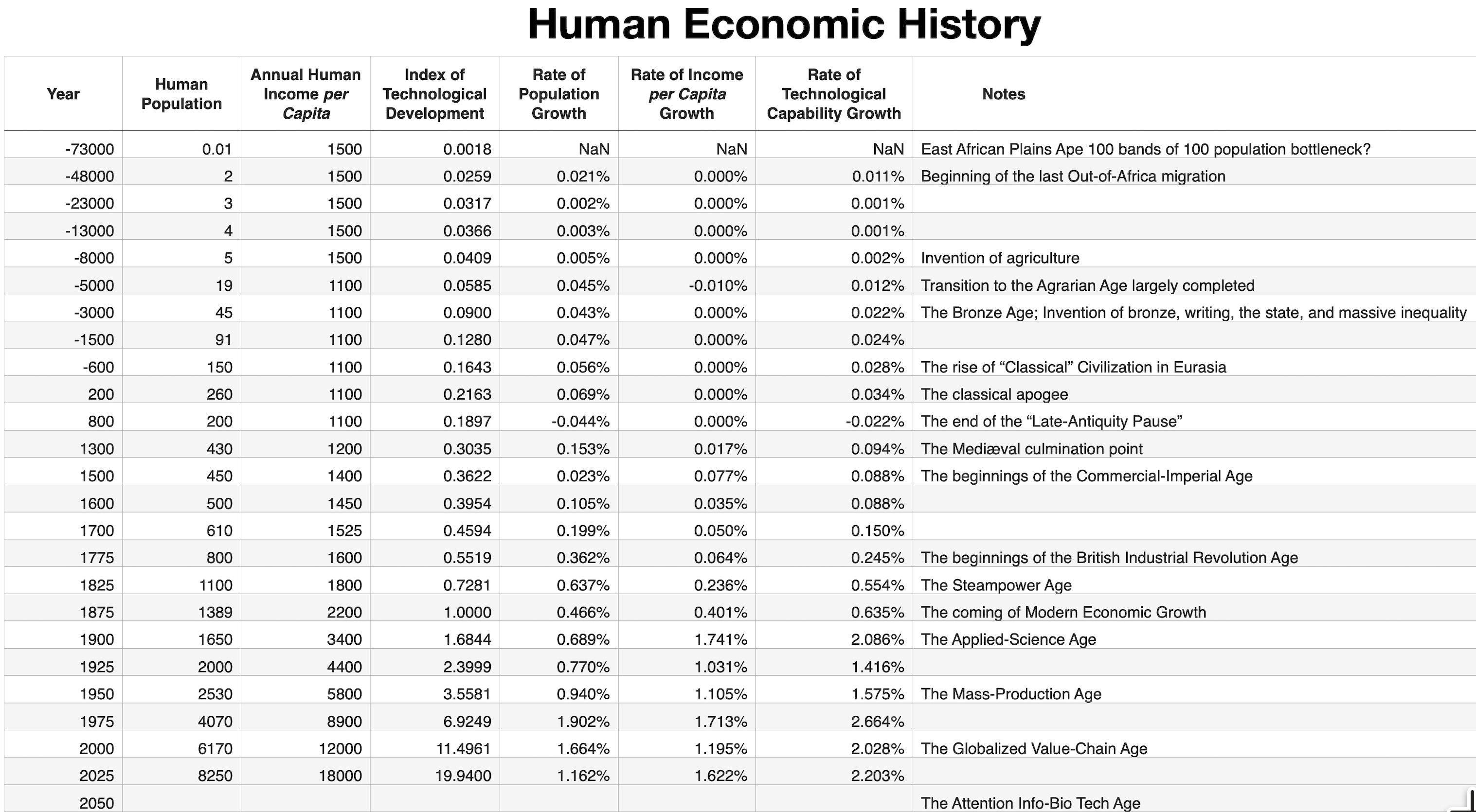
We have been “cultural” specieses for millions of years, roving around in bands of at most 100 or so, with our band-level division of labor and generationally transmitted tool-making and tool-using “technologies” being our big edge. But even as of 50,000 years ago, we were not a huge Darwinian success. Yes: there were then perhaps 2 million of us scattered around Africa. Plus perhaps a couple of hundred thousand of our very close Homines Sapientes Neandertalenses and Homines Sapientes Longi cousins. But there were also 2 million other great apes scattered around Africa and greater Sundaland. And our “technology” was limited to (a) what we could carry, and (b) what we could remember down the generations, (c) as that fit with the varied environments in which we lived.
Then between the year -48000 and -8000 we spread Out-of-Africa across Eurasia, Australasia, and the Americas, intermarrying along the way with our close cousins, and greatly expanding our technological portfolio as we figured out how to successfully adapt to pretty much every ex-Antarctica environment on the globe. But, still, that rate of adaptive technology progress was very limited—1% per millennium, say, perhaps?
The sea-change came 10,000 years ago, when we became more sessile and invented agriculture. Then our “technology” could be not just what we could carry and remember, but what we could build and what our built environment could remind us of. And then 5,000 years ago we invented writing. And we became not just a cultural species, not just a technological species with what we could carry, build, remember, and have our built environment remind us with, but a genuine world-scale æon-scale time-binding space-binding anthology intelligence. Then the real ASI emerged. Not an Artificial Super-Intelligence constructed in a computer lab as some kind of silicon digital god that some want to teach the rest of us to worship and that Elon Musk wants to teach the rest of us to try to bang. But, rather, the distributed knowledge and thought base that is the Anthology Super-Intelligence that is humanity’s collective mind present and past stored in and as our information technology capital stock.
And since then, each generation, we have been seeing further than other humans and those before us. But it is not because we, individually, have been becoming (much) smarter and cleverer. It is because we have been finding ourselves, over and over again, standing on the shoulders of ever-taller pyramids of giants.
And so, as the scale of the number of currently thinking brains in the human race and the accessible storehouse of knowledge and the power of our information technology tools for accessing that storehouse have grown, the pace of technological advance has grown as well. Perhaps 3% per century during the Bronze-Writing and Iron-Antiquity ages up to the classical apogee with the Roman Empire at the west and the Han Empire at the east edge of Eurasia in the year 200. A seeming retrogression over the next 600 years as it really looks like knowledge of some technologies and of how to organize some of the division of labor falls away, and world population may have been smaller in 800 than in 200. Perhaps we should appease the sensibilities of snowflakes by calling this not a “Dark Age” but rather a “Late-Antiquity Pause”.
But technological progress during the long Agrarian Age after -8000 was not guaranteed. After -3000 these societies were largely societies-of-domination, in which ideas were primarily judged not by whether they were true about the world but whether they were useful in helping a predatory élite extract a third of the crafts and a third of the crops by force, fraud, and rigged-price market exchange.
With the coming of the mediæval period around 800 or so, however, standing-on-the-shoulders of giants regained its mojo: rates of technological progress of perhaps 10% per century up until 1600. At that time people were beginning to look around—Francis Bacon and his New Atlantis and Tommaso Campanella with his City of the Sun are my poster boys—and note that there did seem to be an arrow of technological progress in history. Before that had not been the case. Consider the “Nine Worthies” of Jacques de Longuyon’s The Peacock’s Vows—pagans Hektor of Troy, Aleksander of Makedon, and Gaius Iulius Cæsar of Roma; Jews Joshua the Prophet, David the King, and Judah the Hammer; and Christians King Arthur Pendragon of Britain, Emperor Charles le Magne of the Franks, and Advocate of the Holy Sepulcher Godfrei de Bouillon; all seen on a level as behaving like 1300s-era knightly aristocrats.
Then the gears shift:
The Columbian Exchange, the growth of a commerce-mediateed global division of labor, and the intellectual sea-change with respect to ideas that was the nullius in verbo, the “we believe nothing simply because somebody says it” of the Royal Society sets the Commercial-Imperial Age rate of technology growth at 25% per century.
The coming of the GPTs of steampower and textile machinery sets the Industrial-Revolution Age rate of technology growth at 100% per century.
The 1875 combo of the invention of the process of invention hallmarked by the appearance of the railroad-and-screw-propeller-driven global economy, the modern corporation, the industrial research lab, and the backing science complex pushes the rate of technology growth up to 2% per year in terms of our improving our ability to make what we make more efficiently, plus whatever the value is in the expansion of the kinds of commodities, objects, and services we can produce:
But there is more.
It’s now that that 2% per year—that doubling every 35 years—is spread out evenly across the economy.
It is, rather, that a generation sees about 80% of the economy grow in technology by about 1/4 in efficiency.
While about 20% is upended and revolutionized: grows five-fold in efficiency and capability—or more.
And this generation-after-generation successive leading-sector Schumpterian creative-destruction upending of orders and institutions as everything established and fixed is steamed away produces major qualitative changes in society.
Marx and Engels had talked of tribal, ancient, feudal, bourgeois, and socialists modes of production succeeding each other on a time scale of millennia or centuries, with plenty of time for changes in the productive technology and division-of-labor base to shape the societal superstructure.
Since 1875 we have seen: Steampower, Applied-Science, Mass-Production, Globalized Value-Chain, and now Attention Info-Bio Tech modes—of production, but also distribution, communication, and domination—equivalent scale transformations shake society every single generation, with societal superstructures always lagging far behind and desperately shaking themselves to pieces in attempts to cope.
That is the big-scale picture of human history.
Now, in our generation, the leading-sector Schumpterian creative-destruction upending of orders and institutions as everything established and fixed is steamed away process has set its bulls-eye on the learned intellectual professions that Matt and I specialize in. And it is not a comfortable thing to be in the bulls-eye. But neither was it comfortable to be John Henry vs. the steam-drill. Nor was King Arkhidamos III the Europontid (reigned -360 to -338) pleased to see Philippos II of Makedon introduce, alongside his military innovations of the sarissa-phalanx and the companion shock-cavalry, the torsion catapult: “By Hercules! Man’s bravery is ended!”
But I am a Gopnikist. Much better ways at accessing and remixing the real ASI—the Anthology Super-Intelligence of human collective wisdom—is not a Digital God. It is natural-language front-ends to structured and unstructured databases: something that, given our mental affordances, is of immense value. It is very large-scale, very big-data, very high-dimension, very flexible-function regression-and-classification analysis tools: also something of immense value. These are our tools, not our masters, with unanticipated and often adverse consequences as tool development often brings. These are not our adversaries who are going to outthink and outsmart and dominate us.
What we do about our problems over the next decade matters to us. A large part of what we do about our problems today is to invest in boosting the capabilities of our successors a decade from now to master the problems they will face then. How much and how to invest is worth thinking about, hard. Dealing with our problems as we face them over the next decade is worth thinking about, hard. Throwing up our hands because maybe not just the learned intellectual professions but much more will be overthrown over the next decade or two is certainly not helpful, and hence almost surely not rational.