MEMO TO SELF: What It Looks Like I Will Actually Have Managed to Cover in My Half of Econ 210a This Semester...
Less than one third of the topics I wanted to, and all at much less depth than they deserve. But ars longa, vita brevis…
All stories, all Grand Narratives, begin in some medias res.
I choose to begin my story, my Grand Narrative, in the year -3000.
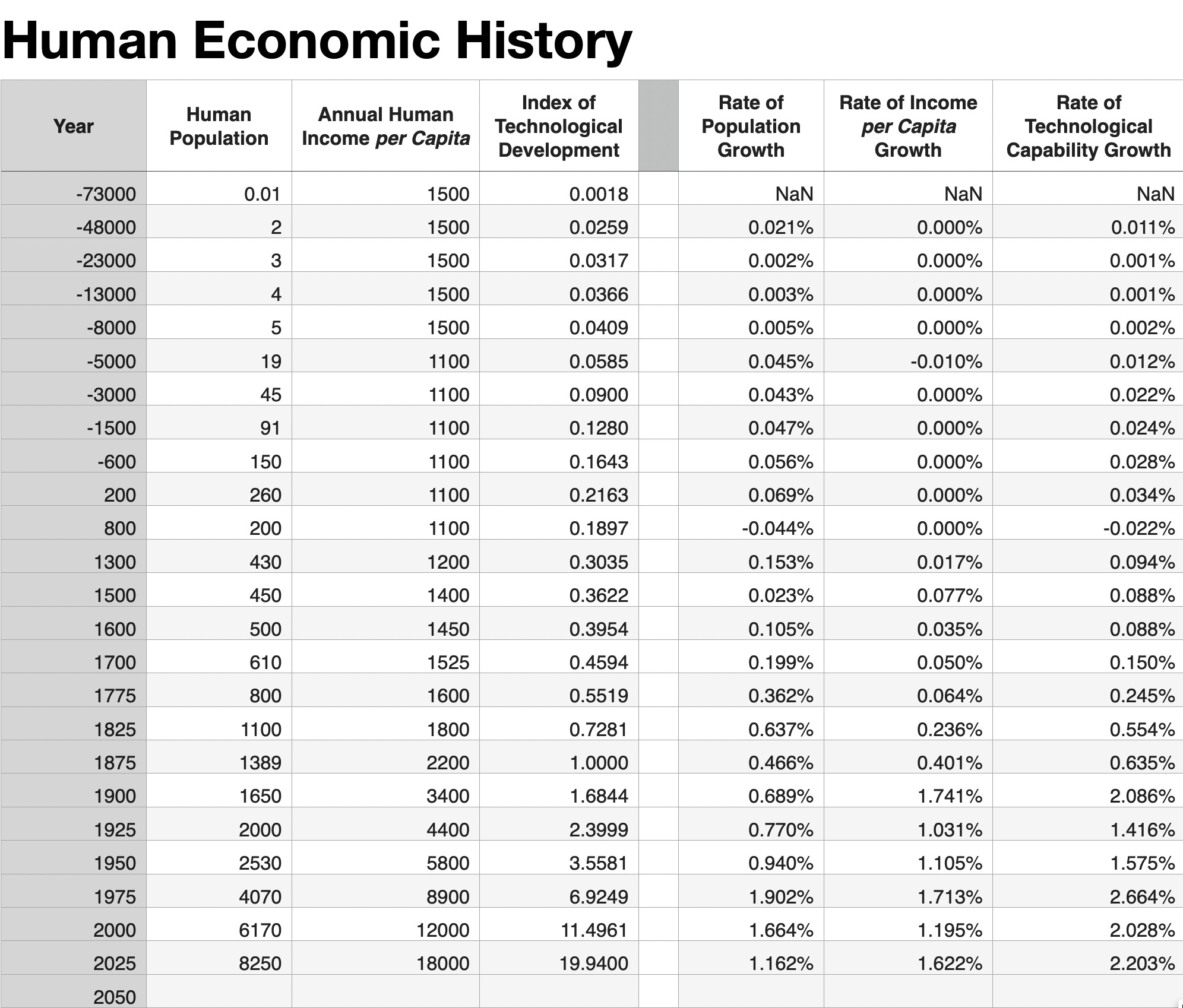
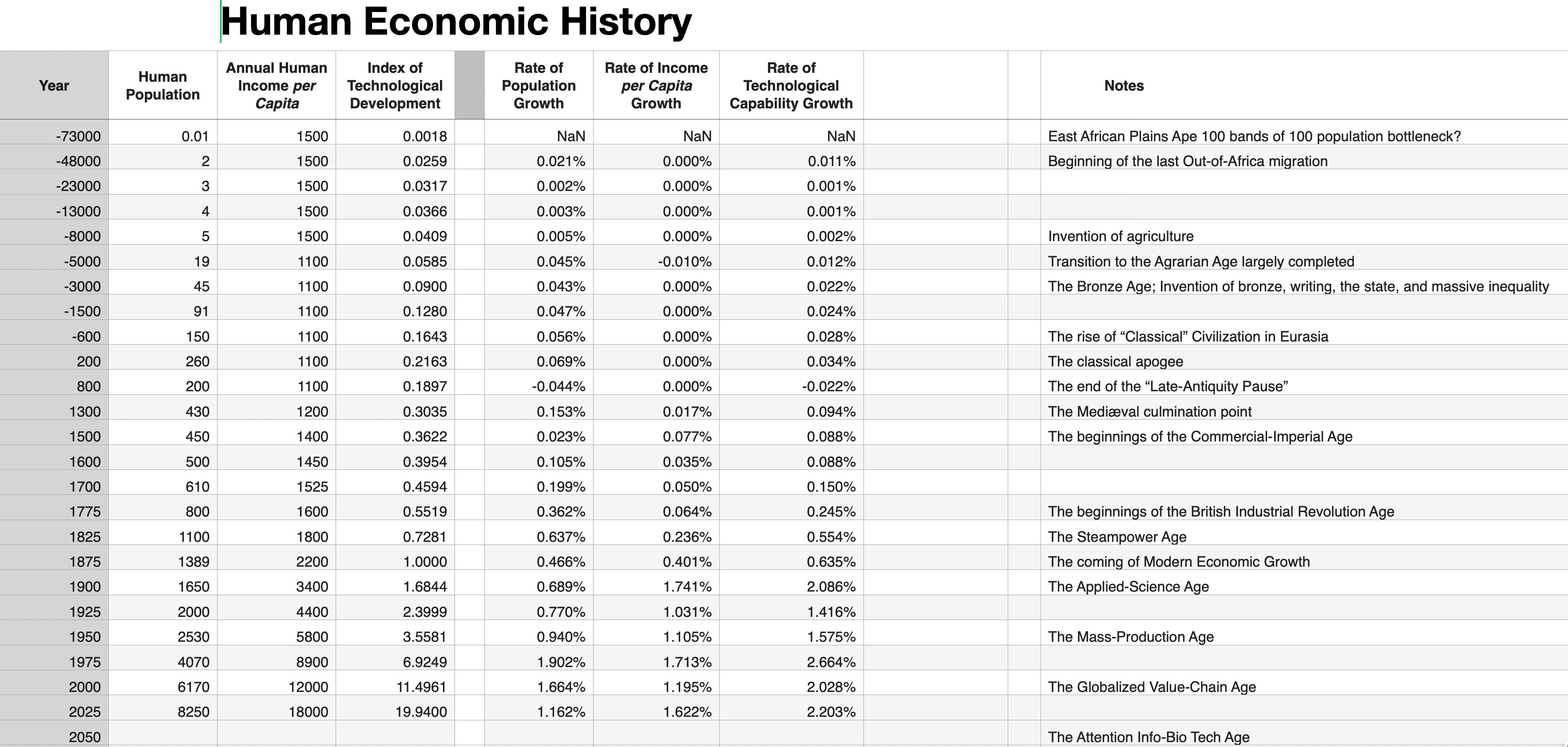
70,000 years earlier we had been a not-terribly-successful Great Ape subspecies. We homines sapientes sapientes, we East African Plains Apes, were then, in the year -73000, perhaps:
between 100 and 1000 groups, averaging 100 each, wandering around East Africa.
cf. a perhaps equal number of phenotypically indistinguishable Southern African Plains Apes whose powerful genetic imprint we see in today’s Khoesan;
equal numbers of each of the other homo sapiens subspecies that were our very close cousins:
the Central Asia and farther west homines sapientes neandertalenses,
the Central Asia and farther east homines sapientes denisovenses,
“ghost homo sapiens” lineages seen only in the imprint left in markers in our genes today;
plus back then the much larger populations of the other hominids—perhaps 2 million:
chimpanzees,
bonobos,
gorillas,
orangutans,
outnumbering all the then-numbers of all the world’s homo sapiens subspecies together by maybe five to one.
But by the year -3000 much had changed. By then there were nearly 50 million of us. For we had been fruitful, and multiplied, and subdued the earth. And so by the year -3000 we were exercising dominion as apex predators over every living thing that moveth, and taking every herb-bearing seed and also fruit-yielding tree as also our meat.
The year -3000 was well after the invention of agriculture and the domestication of animals. The year -3000 was the moment of the coming of bronze tools and weapons, of the calculating and writing of records, and of complex societies with deep and sophisticated divisions of labor. Those were therafter powered by four factors:
Gossip
Prestige
Domination
Gift-exchange
By this point in time, humans had been a cultural species for so long that it had substantially affected our genetic endowment, albeit in ways we do not terribly well understand. By this point in time, we had long been an anthology-intelligence—what our extraordinarily abilities to communicate complexity and to gossip had given us was that what one East African Plains Ape in the band learned, all would soon know; and with many eyes looking at problems, not all but a very substantial proportion of bugs and difficulties proved shallow.
After this point in time, moreover, we were no longer merely a cultural anthology-intelligence species. After this point in time, we were an ASI—a time-binding and space-binding ASI—an Anthology Super-Intelligence with a scope covering the entire globe and all time since, wreaking mighty works indeed of nature-manipulation and social-organization via our fine and deep cognitive and productive divisions of labor.
That is the medias res at which I began. What followed that was what I have tried to teach.
All stories, all Grand Narratives, cut themselves short by chopping things off at some arbitrary end—if not before now, at the current now after which we do not know what will happen next.
I cut my story short at the year 1875.
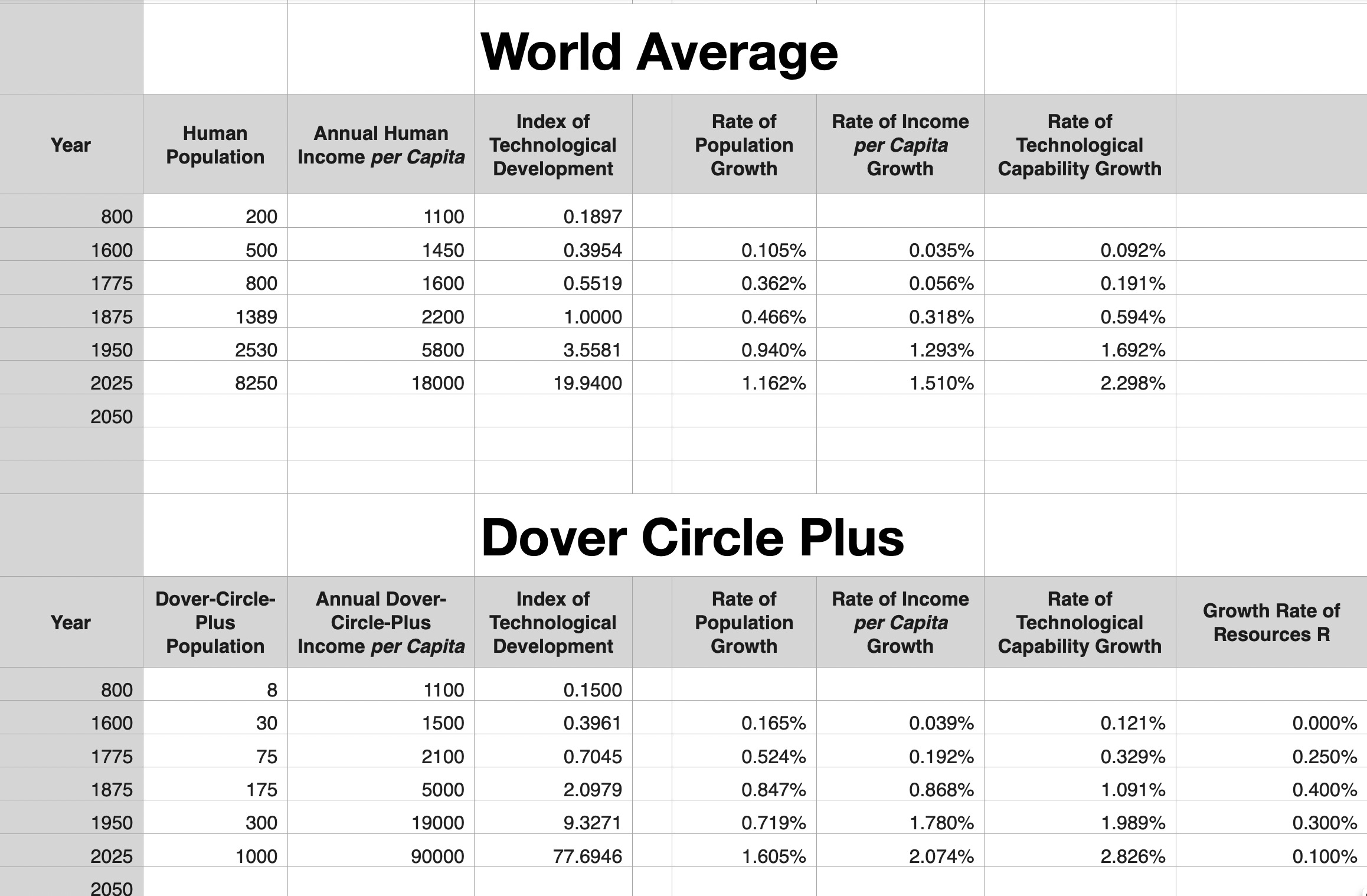
That 1875 was the moment of what Simon Kuznets identified and labeled as the coming of Modern Economic Growth. In our era of Modern Economic Growth we see the capabilities of the human ASI to manipulate nature and coöperatively organize ourselves grow by at least 2% per year. Cf. a value-of-the-human-ideas-stock growth rate only 1/100 as much from the start of the Bronze Age in the year -3000 to the end of the Late-Antiquity Pause in the year 800. We see in one year since 1875 the same amount of proportional “technological” change—on a much higher base!—that we saw in a century back in Agrarian-Age Malthusian civilization.
Since then we have speed-run through Applied-Science Belle-Époque, Mass-Production Social-Democratic, Globalized Value-Chain Neoliberal, and now are passing through the gate to Attention Info-Bio Tech Civilization. There is a strong sense in which there has been more economic history since 1875 than in all the eras and æons before.
But I pass the baton off to Chenzi Xu. She gets to cover: post-1875 market integration, capital markets , international money and finance, the Great Depression, financial crises, industrial policy, and economic development.
Not, mind you, that there was little economic history from the year -3000 to the year 1875. At that moment of 1875 Steampower Civilization had become well-established. At that moment our numbers had grown from the 50 million of the year -3000 to 1.4 billion—nearly thirty-fold. At that moment my crude guesstimate of the value of the stock of human ideas for manipulating nature and coöperatively organize ourselves had grown to a value I set at 1.00 from a value of 0.09 in the year -3000—eleven-fold. Civilizational accomplishments over -3000 to 1875 in culture and technology had been mighty indeed. The kinds and counts of luxuries that the rich and famous could utilize was at least one singularity-transformation’s worth above those found in the year -3000, when the luxuries available to King Gilgamesh were limited to perfume, cedar, wool, and beer. And yet the average material standard of living of humanity, as far as necessities and conveniences were concerned, was perhaps only twice what it had been in the near-subsistence Malthusian Agrarian Age—and was by 1875 astonishingly unequally distributed not just within individul societies but across the globe.
Between -3000 and 1875, a ten-fold increase in human technological capability. A thirty-fold increase in human numbers. Yet only a two-fold increase in human prosperity. And yet the stage then set for the post-1875 Modern Economic Growth explosion.
Just how did all that happen? And what were all of its ramifications?
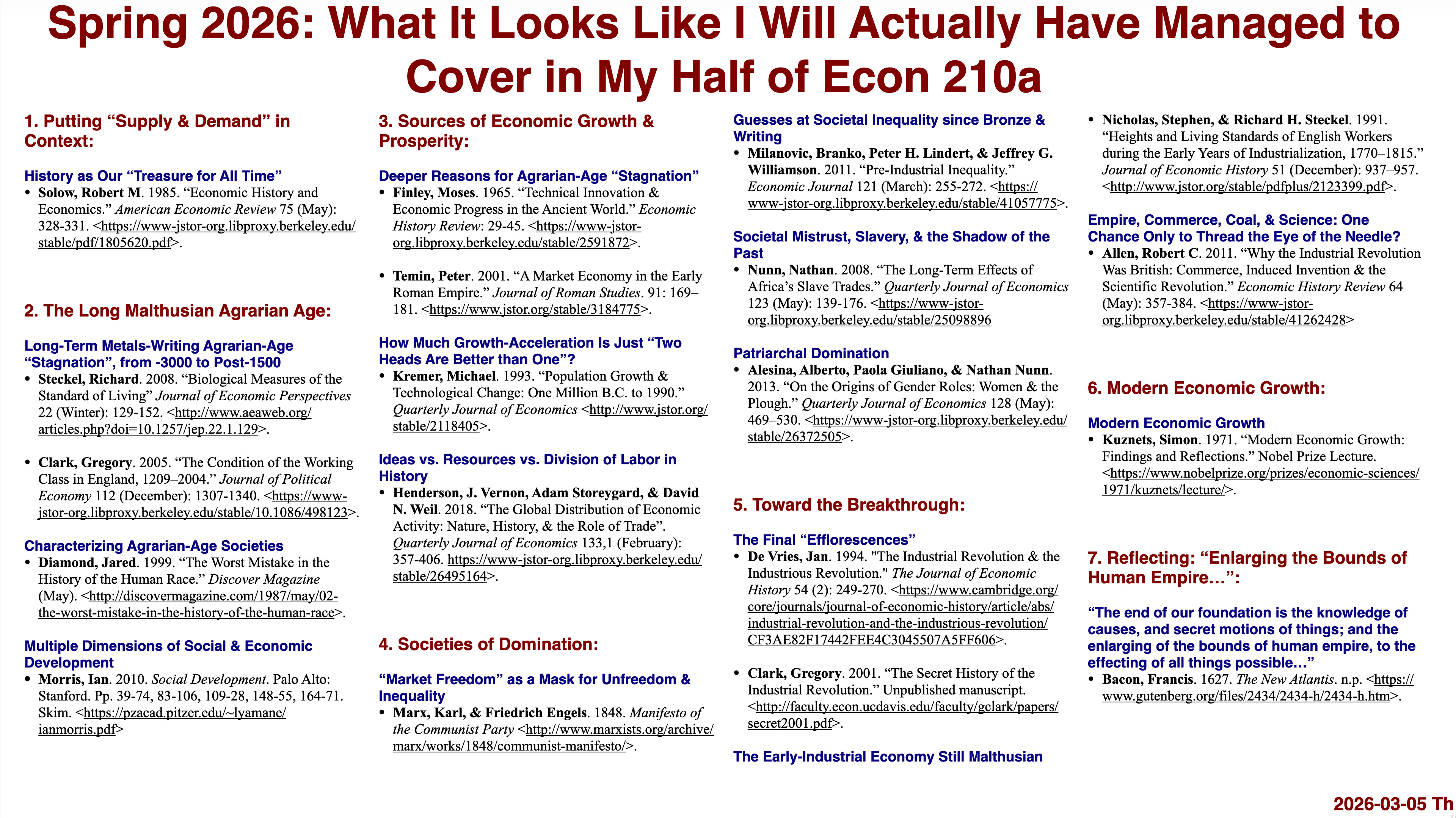
1. Putting “Supply & Demand” in Context:
History as Our “Treasure for All Time”
Solow, Robert M. 1985. “Economic History and Economics.” American Economic Review 75 (May): 328-331. <https://www-jstor-org.libproxy.berkeley.edu/stable/pdf/1805620.pdf>.
2. The Long Malthusian Agrarian Age:
Long-Term Metals-Writing Agrarian-Age “Stagnation”, from -3000 to Post-1500
Steckel, Richard. 2008. “Biological Measures of the Standard of Living” Journal of Economic Perspectives 22 (Winter): 129-152. <http://www.aeaweb.org/articles.php?doi=10.1257/jep.22.1.129>.
Clark, Gregory. 2005. “The Condition of the Working Class in England, 1209–2004.” Journal of Political Economy 112 (December): 1307-1340. <https://www-jstor-org.libproxy.berkeley.edu/stable/10.1086/498123>.
Characterizing Agrarian-Age Societies
Diamond, Jared. 1999. “The Worst Mistake in the History of the Human Race.” Discover Magazine (May). <http://discovermagazine.com/1987/may/02-the-worst-mistake-in-the-history-of-the-human-race>.
Multiple Dimensions of Social & Economic Development
Morris, Ian. 2010. Social Development. Palo Alto: Stanford. Pp. 39-74, 83-106, 109-28, 148-55, 164-71. Skim. <https://pzacad.pitzer.edu/~lyamane/ianmorris.pdf>
3. Sources of Economic Growth & Prosperity:
Deeper Reasons for Agrarian-Age “Stagnation”
Finley, Moses. 1965. “Technical Innovation & Economic Progress in the Ancient World.” Economic History Review: 29-45. <https://www-jstor-org.libproxy.berkeley.edu/stable/2591872>.
Temin, Peter. 2001. “A Market Economy in the Early Roman Empire.” Journal of Roman Studies. 91: 169–181. <https://www.jstor.org/stable/3184775>.
How Much Growth-Acceleration Is Just “Two Heads Are Better than One”?
Kremer, Michael. 1993. “Population Growth & Technological Change: One Million B.C. to 1990.” Quarterly Journal of Economics <http://www.jstor.org/stable/2118405>.
Ideas vs. Resources vs. Division of Labor in History
Henderson, J. Vernon, Adam Storeygard, & David N. Weil. 2018. “The Global Distribution of Economic Activity: Nature, History, & the Role of Trade”. Quarterly Journal of Economics 133,1 (February): 357-406. https://www-jstor-org.libproxy.berkeley.edu/stable/26495164>.
4. Societies of Domination:
“Market Freedom” as a Mask for Unfreedom & Inequality
Marx, Karl, & Friedrich Engels. 1848. Manifesto of the Communist Party <http://www.marxists.org/archive/marx/works/1848/communist-manifesto/>.
Guesses at Societal Inequality since Bronze & Writing
Milanovic, Branko, Peter H. Lindert, & Jeffrey G. Williamson. 2011. “Pre-Industrial Inequality.” Economic Journal 121 (March): 255-272. <https://www-jstor-org.libproxy.berkeley.edu/stable/41057775>.
Societal Mistrust, Slavery, & the Shadow of the Past
Nunn, Nathan. 2008. “The Long-Term Effects of Africa’s Slave Trades.” Quarterly Journal of Economics 123 (May): 139-176. <https://www-jstor-org.libproxy.berkeley.edu/stable/25098896
Patriarchal Domination
Alesina, Alberto, Paola Giuliano, & Nathan Nunn. 2013. “On the Origins of Gender Roles: Women & the Plough.” Quarterly Journal of Economics 128 (May): 469–530. <https://www-jstor-org.libproxy.berkeley.edu/stable/26372505>.
5. Toward the Breakthrough:
The Final “Efflorescences”
De Vries, Jan. 1994. “The Industrial Revolution & the Industrious Revolution.” The Journal of Economic History 54 (2): 249-270. <https://www.cambridge.org/core/journals/journal-of-economic-history/article/abs/industrial-revolution-and-the-industrious-revolution/CF3AE82F17442FEE4C3045507A5FF606>.
Clark, Gregory. 2001. “The Secret History of the Industrial Revolution.” Unpublished manuscript. <http://faculty.econ.ucdavis.edu/faculty/gclark/papers/secret2001.pdf>.
The Early-Industrial Economy Still Malthusian
Nicholas, Stephen, & Richard H. Steckel. 1991. “Heights and Living Standards of English Workers during the Early Years of Industrialization, 1770–1815.” Journal of Economic History 51 (December): 937–957. <http://www.jstor.org/stable/pdfplus/2123399.pdf>.
Empire, Commerce, Coal, & Science: One Chance Only to Thread the Eye of the Needle?
Allen, Robert C. 2011. “Why the Industrial Revolution Was British: Commerce, Induced Invention & the Scientific Revolution.” Economic History Review 64 (May): 357-384. <https://www-jstor-org.libproxy.berkeley.edu/stable/41262428>
6. Modern Economic Growth:
Modern Economic Growth
Kuznets, Simon. 1971. “Modern Economic Growth: Findings and Reflections.” Nobel Prize Lecture. <https://www.nobelprize.org/prizes/economic-sciences/1971/kuznets/lecture/>.
7. Reflecting: “Enlarging the Bounds of Human Empire…”:
“The end of our foundation is the knowledge of causes, and secret motions of things; and the enlarging of the bounds of human empire, to the effecting of all things possible…”
Bacon, Francis. 1627. The New Atlantis. n.p. <https://www.gutenberg.org/files/2434/2434-h/2434-h.htm>.