
Killing Khamenei: Regime-Change Roulette in a Powder-Keg World
But Trump insisted he already destroyed the Islamic Republic of Iran’s nuclear-weapons program! A sudden U.S.–Israeli decapitation campaign against Iran and the killing of Supreme Leader Khamenei shatters nuclear diplomacy, destabilizes energy markets, and teaches every medium power the same lesson: get an operational deterrent—nuclear-threat or leader-family threat, by bomb, missile, drone, or assassin—fast. This war is less a precision strike than a stress test of a wobbling world order, from Hormuz to Kyiv to the South China Sea and beyond…
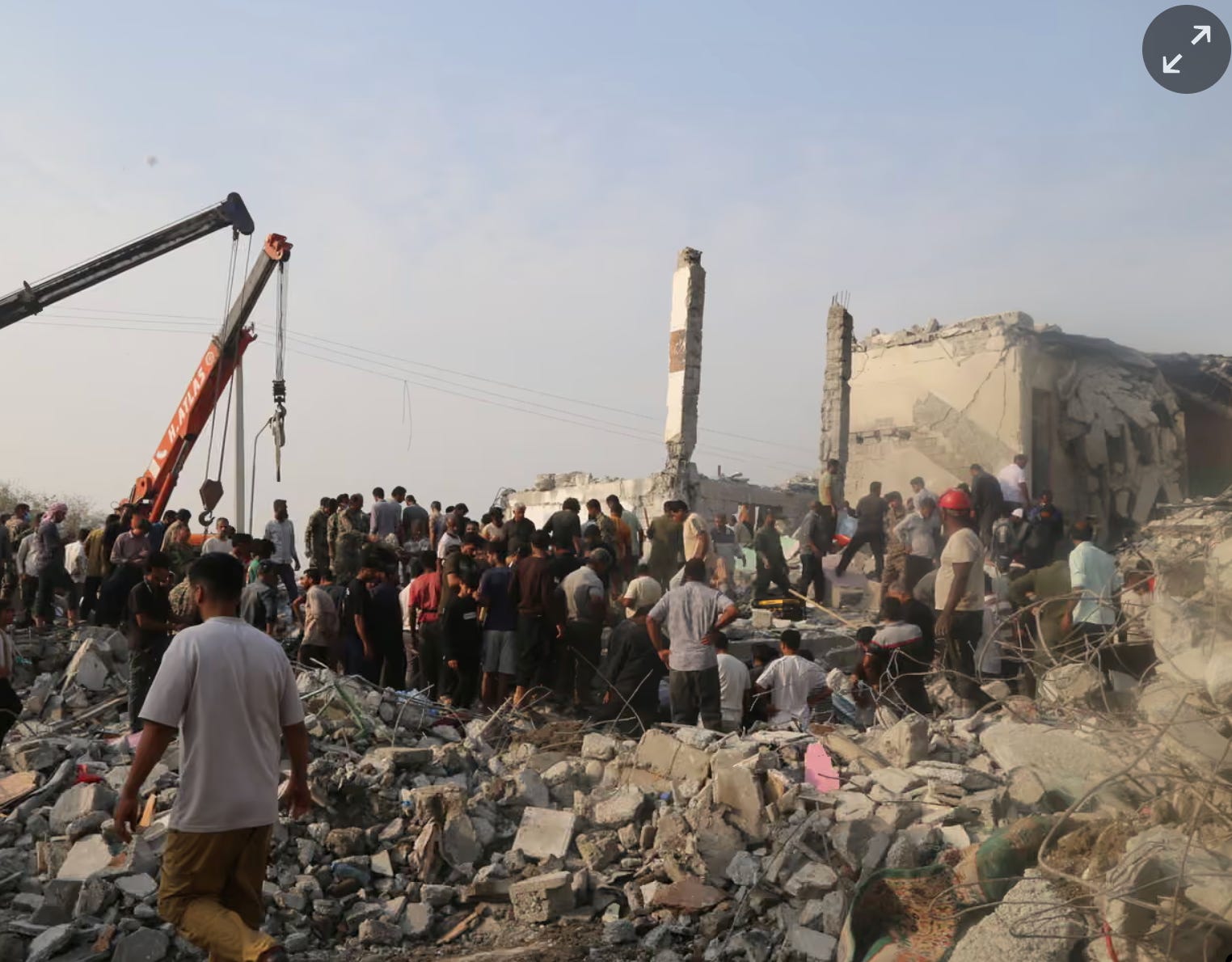
The most important thing this morning, Sunday March 1: The chances that in fifty years Tel Aviv, Damascus, and more are seas of radioactive glass. Have those fallen or risen as a result of the unconstitutional war against the government of the Islamic Republic of Iran launched this weekend?
I cannot judge. But that is the most important thing people should be thinking about this morning.
Meanwhile—and far out of my wheelhouse—my notes so far:
In the early hours of 28 February 2026, U.S. and Israeli forces began a substantial coordinated air and missile campaign against Iran with the declared U.S. objectives, according to Donald Trump, (i) of toppling the Islamic Republic government, (ii) destroying its nuclear and missile capabilities (which had, Trump claimed, already been destroyed), and (iii) crippling its navy <https://www.cfr.org/articles/gauging-the-impact-of-massive-u-s-israeli-strikes-on-iran>. Perhaps 900 strikes in the first twelve hours.
Let’s pause on that (ii). The White House was still, as the attack went on, calling “fake news” on reports that Iran still had a nuclear-weapons program:
Secretary Marco Rubio (Jun 25, 2025) <[twitter.com/SecRubio/...](https://twitter.com/SecRubio/status/1937879123285663831)>: ‘This is the game these intelligence leakers play. They characterize and spin the intelligence the way they want to because they have an agenda. Here’s the truth: Iran‘s nuclear sites are destroyed…
@RapidResponse47 (Jun 25, 2025) <https://x.com/RapidResponse47/status/1937932160146772449>: ‘@PressSec: “That CNN story does not change the facts: There was a TOTAL and COMPLETE obliteration of Iran‘s nuclear facilities, and because of @POTUS‘ strike... Iran no longer has the capability to produce a nuclear weapon...”
Of course, Donald Trump is not a reliable narrator. No one in the Trump administration is a reliable narrator. Plus the U.S. these days cannot be understood, even as shorthand, to be a unitary actor with coherent objectives. It is chaos monkeys all the way down.
Trump has offered no endgame: there are no articulated conditions for success beyond the fall of the regime, no explanation of what follows if Iran fragments or descends into civil war, and no domestic debate rallying support comparable to 2002–03. <https://www.atlanticcouncil.org/dispatches/experts-react-the-us-and-israel-just-unleashed-a-major-attack-on-iran-whats-next/>. Every sortie, carrier deployment, and Patriot battery shifted to the Gulf is something not available for deterring Russia in Eastern Europe or China in the Western Pacific. How big will the strain be on U.S. readiness in Asia <https://mickryan.substack.com/p/the-new-iran-war-trajectory-of-the>? This war is a gamble, taken with incomplete information and in the teeth of historical experience that suggests such gambles often go badly—above all for the people living under the bombs. As Michael Hirst wrote the line in the screenplay for the 1998 Elizabeth for Queen Elizabeth I: “I do not like wars. They have uncertain outcomes”.
U.S.–Israeli operational coordination appears exceptionally tight: target lists, sequencing, and timing suggest a jointly conceived decapitation campaign <https://www.atlanticcouncil.org/dispatches/experts-react-the-us-and-israel-just-unleashed-a-major-attack-on-iran-whats-next/>. Initial waves focused on: (a) command-and-control, (b) leadership compounds, including the supreme leader complex, (c) nuclear and missile infrastructure, and (d) air defenses, IRGC bases, and naval facilities. The Iranian Red Crescent and human‑rights monitors report several hundred killed and many more injured, with a very high civilian share because of strikes near or on dual‑use and urban targets <https://en.wikipedia.org/wiki/2026_Israeli%E2%80%93United_States_strikes_on_Iran>.
The most dramatic event is that Supreme Leader Ali Khamenei has been killed. The U.S.–Israeli campaign has already achieved a central decapitation objective. But here, history leans over our shoulder and coughs politely. Regimes do not always die when leaders do. The Islamic Republic is a system, not a one‑man show:
It has overlapping elite networks in the IRGC, clerical establishment, and bureaucracy.
It has, despite all the protests and repression of recent years, a residual base of loyalists willing to use force.
It has long anticipated precisely this contingency and built redundancy into its command structure <https://www.cfr.org/articles/gauging-the-impact-of-massive-u-s-israeli-strikes-on-iran> <https://www.atlanticcouncil.org/dispatches/experts-react-the-us-and-israel-just-unleashed-a-major-attack-on-iran-whats-next/>.
So the decapitation gamble creates, perhaps:
Replacement of the current leadership with a more openly military‑security junta—what one analyst dubs the risk of “IRGCistan”: fewer turbans, more uniforms, and an even harder line at home and abroad;
A drawn‑out internal power struggle in which multiple factions—IRGC commanders, clerics, technocrats, and street‑level protesters—compete in the shadow of an ongoing foreign air campaign; or
Rapid collapse of the regime and some form of opposition‑led transition—what the more optimistic U.S. hawks implicitly hope for.
The structural odds do not favor (3).
The Iranian response? Consider the UAE. The defense ministry reports 165 ballistic missiles and 541 drones launched at the country, with most intercepted but some getting through, leaving three dead (migrant workers) and dozens lightly injured; debris has hit Dubai and Abu Dhabi, including the Etihad Towers complex and Jebel Ali port. Civilian air travel is in chaos, with Dubai and Abu Dhabi airports damaged and airspace closures cascading through the regional network. The war is now a multi‑node regional air and missile war. Inside Iran, the regime has moved—remarkably quickly, given the shock—to institutionalize succession. The system has flipped to “continuity mode.” The rhetoric from President Masoud Pezeshkian is maximalist—condemning Khamenei’s killing as a “declaration of war against Muslims” and pledging retaliation as a “duty”—but the institutional move is conservative: preserve the system, then sort out who wears which turban (or uniform) later.
The Islamic Republic government has immediate aims: to survive the onslaught, impose enough costs on the United States and Israel to complicate further attacks, and maintain internal control. The Islamic Republic government has medium‑term aims: inflict politically painful casualties on U.S. forces, and raising the global economic price of war—principally via threats to Gulf oil infrastructure and shipping through the Strait of Hormuz <https://www.cfr.org/articles/gauging-the-impact-of-massive-u-s-israeli-strikes-on-iran>.
Pause for the Strait of Hormuz at the entrance to the Persian/Arabian Gulf. 1000 miles to the west-southwest, the Houthis succeeded in their operational aim: closing the Bab el-Mandeb at the southern end of the Red Sea and convincing the U.S. Navy that continued retaliatory strikes attrit the U.S. Navy more than Houthi capabilities. They did this for nearly two years until the October 2025 ceasefire. They exploited the asymmetry between how much it cost them to keep shooting, how much it cost the U.S. Navy to suppress their capabilities, and how much it costs everyone else to keep sailing. The Houthis are now doing again, as MAERSK reroutes away from the Suez Canal to the Cape of Good Hope. Only a sliver of the 20 mb/d of oil that transits the Strait of Hormuz has pipeline alternatives. An Omani-via-land bridge is OK for high-value but not for bulk commodities. Thus adding enough stochastic risk to effectively close the Strait of Hormuz may be possible even for a substantially degraded Islamic Republic military.
From an arms‑control perspective, this is catastrophic. It signals to Iranian elites—and many other governments—that engaging in negotiations with the United States does not insure against force; it may even be a prelude to it. It teaches future leaders everywhere that nuclear forces are the only reliable deterrent against regime‑change campaigns. It complicates non‑proliferation norms globally: why would other regional actors trust complex deals if they can be swept away by a change of administration and a few high‑octane speeches? The combination of “we destroyed their nukes” rhetoric from Washington and clear evidence that this is not, in fact, true, is exactly the kind of thing that will teach every future regime: if you are going to rely on nuclear capability as a deterrent, build more, spread it out, harden it, and never trust U.S. claims about what they have taken out.
By killing Khamenei in a foreign strike, Washington and Jerusalem have made a particular kind of example: a long‑serving leader, deeply invested in the nuclear program, dies under bombs rather than in his bed. The “lesson” for medium powers is to grab whatever nuclear leverage they can, as fast as they can, before the next Epic Fury. That is likely to be read in Pyongyang, Islamabad, New Delhi, and elsewhere as a case study in why you want not just a program but an operational deterrent in place before you cross certain political red lines.
And the death of Khamenei may transform what the human social practice of war becomes in the rest of the century of the 2000s. Deterrence may begin to start taking the form of personal threats—whether by bomb, missile, drone, or assassin—against the lives of leaders and their families. I recall Thomas More’s Utopia <https://ttu-ir.tdl.org/server/api/core/bitstreams/415992b4-9019-427c-a6d3-e16b842c319d/content>:
As soon as they declare war, they take care to have a great many schedules, that are sealed with their common seal, affixed in the most conspicuous places of their enemies' country. This is carried secretly, and done in many places all at once. In these they promise great rewards to such as shall kill the prince, and lesser in proportion to such as shall kill any other persons who are those on whom, next to the prince himself, they cast the chief balance of the war. And they double the sum to him that, instead of killing the person so marked out, shall take him alive, and put him in their hands.
They offer not only indemnity, but rewards, to such of the persons themselves that are so marked, if they will act against their countrymen. By this means those that are named in their schedules become not only distrustful of their fellow-citizens, but are jealous of one another, and are much distracted by fear and danger; for it has often fallen out that many of them, and even the prince himself, have been betrayed by those in whom they have trusted most; for the rewards that the Utopians offer are so immeasurably great, that there is no sort of crime to which men cannot be drawn by them. They consider the risk that those run who undertake such services, and offer a recompense proportioned to the danger—not only a vast deal of gold, but great revenues in lands, that lie among other nations that are their friends, where they may go and enjoy them very securely; and they observe the promises they make of this kind most religiously.
They very much approve of this way of corrupting their enemies, though it appears to others to be base and cruel; but they look on it as a wise course, to make an end of what would be otherwise a long war, without so much as hazarding one battle to decide it. They think it likewise an act of mercy and love to mankind to prevent the great slaughter of those that must otherwise be killed in the progress of the war, both on their own side and on that of their enemies, by the death of a few that are most guilty; and that in so doing; they are kind even to their enemies, and pity them no less than their own people, as knowing that the greater part of them do not engage in the war of their own accord, but are driven into it by the passions of their prince.
If this method does not succeed with them, then they sow seeds of contention among their enemies, and animate the prince's brother, or some of the nobility, to aspire to the crown. If they cannot disunite them by domestic broils, then they engage their neighbours against them, and make them set on foot some old pretensions, which are never wanting to princes when they have occasion for them. These they plentifully supply with money, though but very sparingly with any auxiliary troops; for they are so tender of their own people that they would not willingly exchange one of them, even with the prince of their enemies' country…
Is this a pivotal moment in the global security order? It undermines negotiation for arms‑control credibility. It incentivizes nuclear proliferation. It risks severe energy and economic disruption via Hormuz. It upends the U.S. military bandwidth vis‑à‑vis Russia and China. It normalizes leader‑targeting and preventive decapitation strikes. These are changes that will shape strategic behavior, nuclear choices, and the odds of catastrophe for decades.
Wars are stochastic processes with fat tails. The first 24 hours of this one have not closed off the worst tails; they have thickened them.