
From Plato to NATO to MAGA: Marco Rubio’s Myths & the Real "Western Alliance"
Reässessing the “West” from John Winthrop to Marco Rubio…
I see in my feed this AM that Marco Rubio is a moron. Excellent! I am always for a good Trump grifter smackdown.
The smartest and most incisive things I skimmed were by Dan Drezner: <https://danieldrezner.substack.com/p/five-thoughts-about-marco-rubios> <https://danieldrezner.substack.com/p/frank-talk-and-limited-action>.
But the most interesting, however, was by the extremely sharp Arthur Goldhammer:
Arthur Goldhammer: <https://arthurgoldhammer356783.substack.com/p/inventing-tradition>: ‘[Rubio’s] was an artful portrait, slyly conceived to obscure crucial features…. The history… would have taken the story too far from the Plato-to-NATO fairy tale that our national mythmaker hoped to fob off…. There once was a Western alliance. Its roots can be traced not to Solon’s or Socrates’ Greece or the garden of Gethsemane but to the aftermath of World War II. An exsanguinated Europe needed the aid of the United States…. The triumphantly ascendant United States needed Europe as a market for its wares and a bulwark against its erstwhile Soviet ally…. A similar confluence of interests could plausibly be invoked to underwrite Rubio’s apparent desire to perpetuate the postwar alliance under somewhat altered terms. His mythification of the past is unlikely to result in a new understanding, however. He might begin by asking himself whether the people he ought to be consulting about Europe’s future are Fico and Orban or Merz and Macron, Meloni and Starmer. In the MAGA… such questions cannot be asked…. Trump’s America swaggers abroad demanding fealty from its former allies, despite having proven itself to be completely untrustworthy and unreliable. To escape from this abyss will require more art than Secretary Rubio or his master is capable of…
So I find I have four points to make, dissenting in part and concurring in part:
First, I have a bone to pick with Arthur, with respect to “markets for its wares”. This phrase here is a badly thought a contemporary intellectual echo of a not-very-good theory of Belle Époque imperialism, which was a horse saddled by John A. Hobson, promoted by Rosa Luxemburg, and then ridden to exhaustion and collapse by Vladimir Lenin. This horses was then revved by not very careful and ideology-driven American new leftist historians feeling their oats, and desperate to somehow argue that evil Amerikkkan capitalism was responsible for staging the Cold War in order to turn western Europe into its-neocolony. (And I do hear a further echo of this in the sparse and spare description of Stalin’s Soviet Union merely as America’s “erstwhile… ally”, rather than as the aggressive super-genocidal totalitarian dictatorship ruled by paranoid psychopathic madman that it was.)
This line of argument i s largely false. Keynesian arguments that Marshall Plan and other aid would redound to America’s prosperity were made to try to make the political coalition against an isolationist post-WWII American policy viable. But they were a tertiary add-on to further justify a policy path overwhelmingly chosen for other reasons, not something to be listed first among the reasons that the post-WWII U.S. “needed” western Europe.
That makes me reach, not for any metaphorical revolver—well, let’s put it this way: when I was learning to drive, we had a Chevy Impala with a faulty electrical system that would deliver a nine-volt shock every time I used the horn; I used not to overuse the horn, a valuable thing to have learned.
Second, I do wish Rubio knew enough American history to understand that our American Errand Unto the Wilderness was not undertaken not because we here in the New World want to share “the deepest bonds that nations can share” with the Old World.
It was, rather, undertaken because we wanted to break them.
I do not think Rubio has ever bothered to read my ancestor John Winthrop’s “Model of Christian Charity” sermon describing how he hoped things would be different in Massachusetts: that it would be a City upon a Hill:
John Winthrop (1630): A Model of Christian Charity <https://minio.la.utexas.edu/webeditor-files/coretexts/pdf/163020model20of20christian20charity.pdf>: ‘The work we have in hand… is by a mutual consent, through a speciall overvaluing providence and a more than an ordinary approbation of the Churches of Christ, to seek out a place of cohabitation and consortship under a due form of government both civil and ecclesiastical….
The end is to improve our lives to do more service to the Lord; the comfort and encrease of the body of Christ, whereof we are members; that ourselves and posterity may be the better preserved from the common corruptions of this evil world, to serve the Lord and work out our salvation under the power and purity of his holy ordinances…. The work and end we aim at… are extraordinary…. Whatsoever we did, or ought to have done, when we lived in England, the same must we do, and more allso, where we go….
We must love brotherly without dissimulation, we must love one another with a pure heart fervently. We must bear one another’s burthens. We must not look only on our own things, but allso on the things of our brethren. Neither must we think that the Lord will bearewith such failings at our hands as he doth from those among whom we have lived….
When God gives a special commission he looks to have it strictly observed in every article…. Thus stands the cause between God and us. We are entered into [a] covenant with Him for this worke. We have taken out a commission…. We have hereupon besought Him of favour and blessing. Now if the Lord shall please to hear us, and bring us in peace to the place we desire, then hath he ratified this covenant and sealed our commission, and will expect a strict performance…. If we shall… fall to… prosecute our carnal intentions… the Lord will surely break out in wrath against us; be revenged of such a [sinful] people and make us know the price of the breach of such a covenant.
Now the only way to avoid this shipwreck… is to followe the counsellof Micah, to do justly, to love mercy, to walk humbly with our God…. [Then] the Lord will be our God, and delight to dwell among us, as his own people, and will command a blessing upon us in all our wayes. So that wee shall see much more of his wisdom, power, goodness and truth, than formerly wee have been acquainted with…. He shall make us a praise and glory that men shall say of succeeding plantations, "the Lord make it like that of New England." For we must consider that we shall be as a city upon a hill. The eyes of all people are upon us…
And consider:
Noble_Devil_Boruta (2019): <https://www.reddit.com/r/AskHistorians/comments/hkfbsj/what_did_john_winthrops_city_on_a_hill_phrase/>: ‘The expression… inspired by… the Parable of Salt and Light (Matthew 5:14-16), that… John Winthrop… [knew] as… “Ye are the light of the world. A city that is set on an hill cannot be hid. Neither do men light a candle, and put it under a bushel, but on a candlestick; and it giveth light unto all that are in the house. Let your light so shine before men, that they may see your good works…”
But the idea of the city or a kingdom on top of the hill that would welcome all the worthy people is far older…. Isaiah (Is 2:2)…. “In the last days… the mountain of the Lord’s house shall be established in the top of the mountains, and shall be exalted above the hills; and all nations shall flow unto it…”.
Winthrop speaks clearly, that “So that if we shall deal falsely with our God in this work we have undertaken, and so cause Him to withdraw His present help from us, we shall be made a story and a by-word through the world… [by doing so] we shall shame the faces of many of God’s worthy servants, and cause their prayers to be turned into curses…”…
The term… was used by at least one American president before Reagan…. Kennedy in 1961 precisely in the context… [of] Winthrop…. “‘We must always consider', [Winthrop] said, 'that we shall be as a city upon a hill—the eyes of all people are upon us'. Today the eyes of all people are truly upon us—and our governments, in every branch, at every level, national, state and local, must be as a city upon a hill - constructed and inhabited by men aware of their great trust and their great responsibilities…”
This hope and dream of John Winthrop indeed came true to an astonishing and unlikely degree—although in a way and in a form that would certainly horrify him in many of its particulars—cf. <http://onlyfans.com>, for example. America, starting in 1776, did indeed find a way while Europe was losing it. And by the end of 1940 continental Europe, at least, had decisively lost its way:
But from 1942 to 1945 and after we came, highly effectively, to the rescue. Yes, Winston Churchill and his Britons (and Charles de Gaulle and his Free French) can grumble that we arrived very late to the picnic that was World War II, but when we did arrive we brought a hell of a lot of refreshments. And we kept bringing additional tranches—financially, politically, ideologically—for decades after.
Third, Arthur Goldhammer correctly notes that the “NATO” part of the Plato-to-NATO arc was made in post-WWII Washington DC, and that the Plato-to-NATO arc itself was largely invented out of whole cloth by tame propagandists for the good cause of containing Stalin’s Soviet Union who, in the words of my old teacher Judith Shklar:
Judith Shklar: A Life of Learning <https://www.acls.org/wp-content/uploads/2021/11/Haskins_1989_JudithNShklar.pdf>: ‘I knew what had happened in Europe between 1940 and 1945…. Most people at Harvard also were aware of the physical, political, and moral calamity…. A look at the famous "Redbook"… is very revealing. Its authors were determined to immunize the young against fascism and its temptations so that "it" would never happen again. There was to be a reinforcement of The Western Tradition… to show up fascism as an aberration, never to be repeated. I would guess that in the pre-war Depression years some of the young men who devised this pedagogic ideology may have been tempted by attitudes that eventually coalesced into fascism, and now recoiled at what they knew it had wrought. They wanted a different past, a "good" West, a "real" West, not the actual one that had marched into the First World War and onward. They wanted a past fit for a better denouement. I found most of this unconvincing…
But this was in a good cause.
Picking out heroes from the past whom you admire, retrospectively adopting them as your ancestors, and then trying hard to live up to their virtues is a very human practice, and a virtue-enhancing one, even though it is not a rational one. One of the best and weirdest novels I have read this past decade—Graydon Saunders’s The March North—has a very nice putting of this. The first-person protagonist is dismissing his troops—a bunch of militia who have just been to a hell from which some of them have come back:
Graydon Saunders: The March North <https://books.apple.com/book/id1003510474>: ‘“If you want to go forward with the [professional army that is the] Line [of the Commonweal], great. The Line’s going to need you. If you figure it’s time for another job, you did this job better than anybody had a right to expect.”
This next bit is a Sergeant-Major thing, but I’ll have to do.
“Sometimes, when it gets bad, you’ll hear the Part-Captain or the Sergeant-Major say that it’s time to fight so we do not shame the Foremost.”
Who didn’t have anything to do with the Line of the Commonweal, and, if they still exist, might not know we do, but never mind. Hardly anybody’s standing in the Line for the sake of facts.
“It got more than that bad.” Much more.
“In, or out, or just don’t know, you’ve all served the Line so the Foremost would call any of you comrades, and be proud. Remember that”…
Mythmaking in a good cause is a different human social practice than history, but it is a useful (and valid?) social practice. Historians do the second. Politicians are supposed to balance off the two. Good ones succeed. But mythmaking in a fascist cause? No thanks. No thanks indeed. And shame on those who put and keep that on the menu.
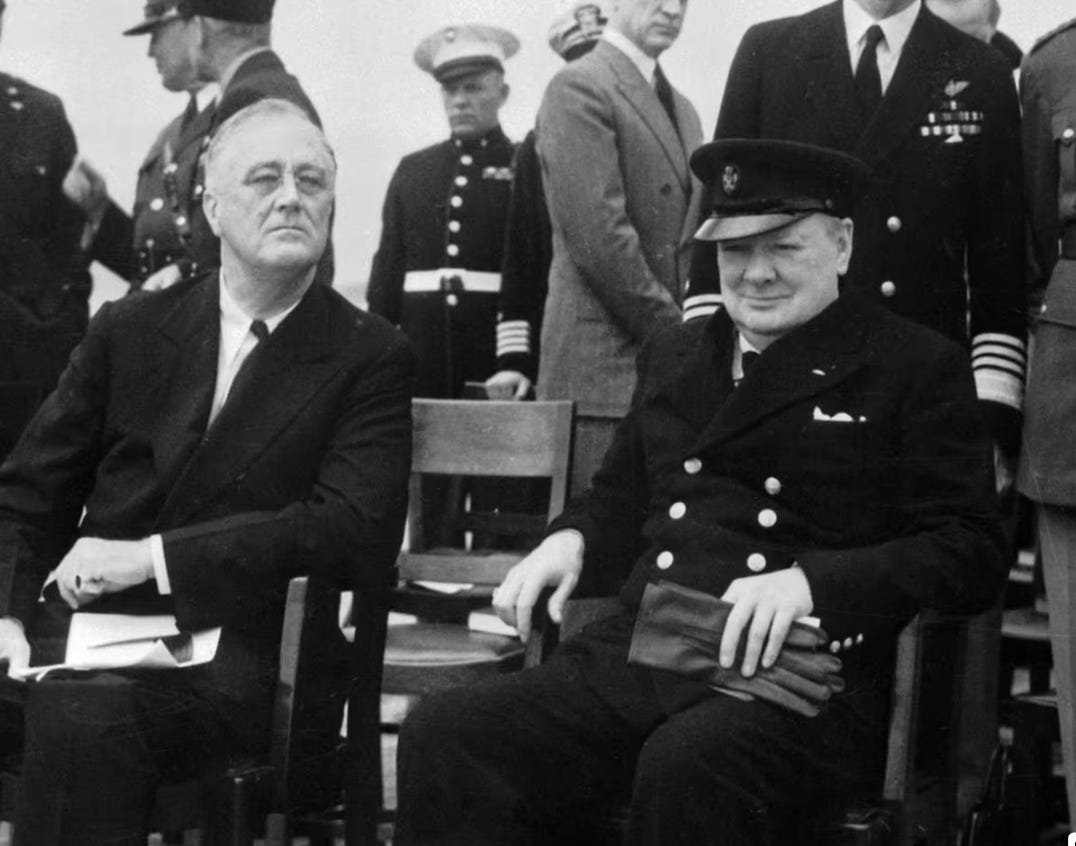
Fourth, as I said, Arthur Goldhammer correctly notes that the “NATO” part of the Plato-to-NATO arc was made in post-WWII Washington DC. But Europe—especially Britain—was not without agency here. Step back, and it is valid historically to interpret U.S. foreign policy from 1939 to 1953 as largely made in the Palace of Westminster over the previous near-century, and the actual policy choices made in Washington DC then as the turning-over by the British Empire of the hole cards that it had dealt itself from the bottom of the deck, revealing that it had hidden wired aces and so would decisively win the poker game of 1900s great power politics. What were those hidden wired aces? That somehow, between 1861 and 1939, Britain had effectively reäbsorbed the United States into the British Empire as a late-mobilizing but by far the most powerful part, in the sense that it could draw on all of its resources when the chips were truly down.
This did not happen purely by accident.
I have not, however, seen the history well-told. Back in 1861 the Jacksonian American élite loathed Britain—who, after all, had Andrew Jackson won his great victory over?—and at the mass level the political juice was and long would remain generated by Irish-Americans memories of the genocidal British Empire of the Potato Famine. (Ask yourself where the FBI deployed its counterterrorism resources in the 1980s, and realize that it was in South Boston against the funding channels for the Irish Republican Army.) On the other side, the realpolitikers in Westminster saw dividing the U.S. into two or more as a great source of potential benefit; the Tory landlord-and-professions élite saw the hierarchy-loving plantation slave-owning wannabe gentry of the American South as much more their kinds of people than the commercial-industrial Yankees of the American North, and only the Liberal Party’s commitment to antislavery keeping Britain from intervening on the side of the South in the Civil War to support the noble principle of Free Trade.
Yet eighty years later it had all profoundly shifted. Why? How?
References:
Drezner, Daniel W. 2026. “Five Thoughts about Marco Rubio’s Foreign Policy Speech.” Drezner’s World. February 15. <https://danieldrezner.substack.com/p/five-thoughts-about-marco-rubios>.
Drezner, Daniel W. 2026. “Frank Talk and Limited Action.” Drezner’s World. February 16. <https://danieldrezner.substack.com/p/frank-talk-and-limited-action>.
Goldhammer, Arthur. 2026. “Inventing Tradition.” The Sense of an Ending. February 16. <https://arthurgoldhammer356783.substack.com/p/inventing-tradition>.
Noble_Devil_Boruta. 2019. “What Did John Winthrop’s ‘City on a Hill’ Phrase Originally Mean?” Reddit. <https://www.reddit.com/r/AskHistorians/comments/hkfbsj/what_did_john_winthrops_city_on_a_hill_phrase/>.
OnlyFans. 2026. Accessed February 16. <http://onlyfans.com>.
Saunders, Graydon. 2014. The March North. <https://books.apple.com/book/id1003510474>.
Shklar, Judith N. 1989. A Life of Learning. Charles Homer Haskins Lecture. New York: American Council of Learned Societies. <https://www.acls.org/wp-content/uploads/2021/11/Haskins_1989_JudithNShklar.pdf>.
Winthrop, John. 1630. “A Model of Christian Charity.” <https://minio.la.utexas.edu/webeditor-files/coretexts/pdf/163020model20of20christian20charity.pdf>.