Academic Responsibility & Freedom: TUESDAY TRENDS & TURMOIL
My first reaction: This is a very dangerous hire for the SCL to undertake. A new institution’s academic culture is profoundly shaped by the moral character of its initial senior hires. Getting people with a very strong belief in academic freedom is essential. And whatever John Yoo is, he is not a person psychologically capable of exercising academic freedom. Why not? Because its essentials are not just the freedom to say what you really conclude, but also powerful obligations: to ignore the demands of your would-be political masters, to always give it your very best shot at finding truth and insight, and to be willing to listen to and be potentially persuaded by other scholars who practice academic freedom:
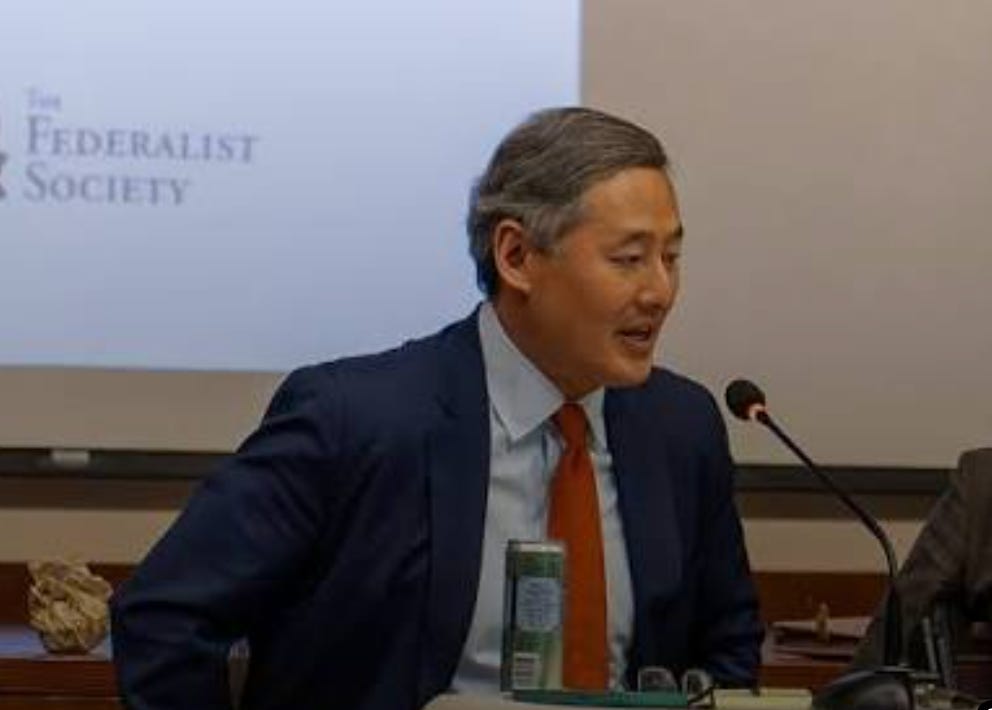
An essay by Berkeley Law’s John Yoo crosses my screen. The text begins:
‘Last week the Daily Californian, the University of California at Berkeley’s student newspaper, finally figured out I’d decided to move to Texas…. The story attracted more notice than the Daily Cal’s usual most-read feature, the student sex advice column…. My departure will reduce the number of conservatives teaching constitutional law and history at Berkeley by 100% (our students used to be good at math, but I’m not sure the editors understood that this works out to zero)…
Ooh boy. Ooh boy indeed. Wow. I assume I do not need to point out that this opening contains two big lies? Berkeley students these days are neither lazy and unobservant, nor innumerate.
Back up: I hold, with the extraordinarily sharp Jacob Levy <https://braddelong.substack.com/p/semi-crosspost-jacob-levy-conceptualizing>, that academic freedom is not a sub-class of free speech, but rather an animal that comes from a very different phylum of the animal kingdom.
I also hold that it is misnamed: It should be called “academic obligation and freedom” instead.
Let me put it as best I can, admitting that I put it badly, because it is something that I much more feel and believe than something but I can reason my way to. I try to induce principles from my observations of the world, then reason in an air-tight fashion to conclusions, and so arrive at a well-grounded argument and understanding of what academic obligation and freedom is. But even I do not find my reasoning fully convincing.
Anyway: Academic freedom is the obligation to give it your very best shot at understanding the world in the context of a scholarly community. And it is, given that you have taken on that obligation, the freedom that no outside power keep your mind from chasing down truth and insight and then spreading your conclusions about what is true and what is insightful to others; while also being obligated to listening thoughtfully, respectfully, and charitably to their similar attempts to explain to you their conclusions about what is true and insightful; plus the obligation to be willing to be persuaded by evidence, insight, and logic.
Let me give an extended example:
Cast your mind back 26 years and more to the summer of 2000 when it was largely anticipated that Al Gore would win the 2000 presidential election. That summer the Cato Institute armed up to fight the forthcoming Gore presidency and so began preparing the ground for a campaign of legal and political harassment against, well, pretty much anything the future expected Gore administration might desire to do. As part of that effort, John Yoo wrote a very shoddy essay called “The Imperial Presidency Abroad” for Cato:
John Yoo: The Imperial Presidency Abroad <https://www.google.com/books/edition/The_Rule_of_Law_in_the_Wake_of_Clinton/Ga7jCxf1fZAC>: ‘President Clinton[’s] imperial presidency… in… foreign [affairs].... The record… has not been a happy one… costs to the Constitution and the American legal system… accelerated disturbing trends… undermin[ing] notions of democratic accountability and respect for the rule of law…
You offers particulars of the undermining of the constitution, of democracy, of accountability, and of the rule of law:
When it comes to using the American military, no president in recent times has had a quicker trigger finger…. In none of those cases did Congress provide authorization for the Clinton administration’s decision to use force abroad…
And:
The Clinton administration has rushed to embrace multilateralism… delegate governmental power to international institutions to achieve dubious foreign policy goals…. During the Reagan and Bush administrations, the United States often intervened unilaterally, quickly, and generally in pursuit of purely American interests…. Intervention during the Clinton years…has been anything but unilateral…
And:
During the Kosovo air war… American troops… serve[d] under… non-American[s]… such as British General MichaelJackson…. President Clinton’s willingness to send American troops into combat under non-U.S. officers is for the most part unprecedented…. the Clinton administration has claimed a broad constitutional power in the president to delegate military command authority to any person…. That position has serious constitutional and policy defects…. Though the president has broad discretion to delegate authority to his subordinates within the executive branch, the Constitution nowhere permits the president, the treatymakers, or Congress to delegate federal power completely outside of the national government…
And:
During the Cold War, the United States engaged the military primarily in nation-state to nation-state conflicts, in which the goal was both military and political victory. Under President Clinton, however, the nation has become involved… in employ[ing] military force for more diffuse objects, such as rebuilding nations, enforcing international peace or the status quo, and imposing costs on a hostile regime that fall short of total military and political victory…. [Using] troops not to achieve total victory or to contain the spread of Soviet influence but to achieve more limited goals… whose long-term benefits for American security are unclear….
And:
In areas such as foreign affairs and the separation of powers, in which the courts exercise judicial review only sparingly, the executive branch has an important duty in establishing and maintaining constitutional precedent that may guide the interaction of the branches. In Kosovo, the Clinton administration ignored its obligation on this score in favor of achieving its short-term political goals abroad….
And the concluding peroration:
President Clinton… [has made] extensive use of the powers of the imperial presidency to ignore constitutional limitations on government, all in the service of his foreign policy goals. It is too soon to tell whether the achievement of those goals will bring about tangible improvements to American national security, but we have some experience in predicting that the costs to constitutional government of delegating power outside of the government will not be small. It will be up to the next president to decide whether to allow those developments to continue, or to restore the rule of law in foreign affairs…
In short with respect to foreign-affairs, Yoo claims, Clinton had broken not just the Constitution’s restraints on absolute presidential power but had destroyed the rule of law itself, which now needed to be restored.
You can read the whole thing. But I would not recommend it as a wise use of your time. I find the logic and evidence shoddy:
To recap, Yoo’s particulars are that Clinton broke the rule of law by:
unilaterally on the president’s say-so alone using military force excessively often.
cooperating with allies.
putting American troops under foreign command.
engaging in military operations that were limited rather than total wars.
contradicted his own expressed principles of constitutional government.
And his piece ends with Yoo’s final peroration: that the rule of law needs to be “restored”.
Shoddy much? Well, for (1), one could say that John Adams was the last president in 1797 to scrupulously follow intended procedure by calling Congress into a special session in 1797 to handle the crisis with Republican France that was the quasi-war. Things changed in 1802, when Jefferson sent ships and started the shooting in his undeclared war against the slave-raiding Barbary states of the Mediterranean. And judgments of “excess” are here always in the eye of the beholder.
Shoddy much? Well, for (2), one could say that the U.S. military has cooperated with allies and set and followed jointly determined plans whenever we have been lucky enough to have any.
Shoddy much? Well, for (3), one could say that George Washington, Theodore Roosevelt, Woodrow Wilson, Franklin Roosevelt, Harry Truman and every president since has put American troops under “foreign command”. Moreover, George Washington put American troops under the command of a French teenager, a man who had no place in the command structure of any ally, a man who never swore any oath to the United States. And George Washington put American troops under the command of an unemployed German adventurer who had falsely claimed to have been a lieutenant-general in the Prussian army, when he had actually been only a captain.
Shoddy much? One could say that seeking total victory rather than situation containment followed by a negotiated peace when facing anything other than a trivial adversary is something that we have seen only three times in American history: World War II, Bush ‘43’s attack on Iraq, and the Civil War.
I do give you that Yoo is right about (5): Clinton’s people, especially his State Department, loved to talk about the foreign-affairs responsibility of the president to congress.
Was John Yoo exercising academic freedom when he wrote this piece. I would say no: the reasoning and evidence is far too shoddy. This cannot be anyone’s best shot at understanding the world, chasing down truth and insight, and listening thoughtfully, respectfully, and charitably to people who point out that George Washington gave command over American troops to a French teenager who had no place in the command structure of any ally. Yoo here is an example of exercising his free speech. He is not an example of exercising his academic freedom.
Now focus on the 180-degree pirouette that John Yoo performed form his arguments in “The Imperial Presidency Abroad”. He performed that pirouette in 2001. Afterwards, nothing a Republican president could do with the military was in any way beyond constitutional bounds. For example:
John Yoo (2020): Defender in Chief: Donald Trump’s Fight for Presidential Power <https://www.amazon.com/Defender-Chief-Donald-Trumps-Constitution/>: ‘In Defender in Chief, celebrated constitutional scholar John Yoo makes a provocative case against Donald Trump’s alleged disruption of constitutional rules and norms.
Donald Trump isn’t shredding the Constitution―he’s its greatest defender. Ask any liberal―and many moderate conservatives―and they’ll tell you that Donald Trump is a threat to the rule of law and the U.S. Constitution. Mainstream media outlets have reported fresh examples of alleged executive overreach or authoritarian White House decisions nearly every day of his presidency. In the 2020 primaries, the candidates have rushed to accuse Trump of destroying our democracy and jeopardizing our nation’s very existence.
Yoo argues that this charge has things exactly backwards. Far from considering Trump an inherent threat to our nation’s founding principles, Yoo convincingly argues that Washington, Jefferson, Madison and Hamilton would have seen Trump as returning to their vision of presidential power, even at his most controversial. It is instead liberal opponents who would overthrow existing constitutional understanding in order to unseat Trump, but in getting their man would inflict permanent damage on the office of the presidency, the most important office in our constitutional system and the world. This provocative and engaging work is a compelling defense of an embattled president’s ideas and actions…
Why the pirouette, the sudden pirouette, starting with his 2001 appointment as Deputy Assistant Attorney General in the Cheney-Bush administration?
To my knowledge, the only explanation Yoo has ever offered of his pirouette is that his (1) is not complaint, but merely value-neutral description. But I defy you to read “The Imperial Presidency Abroad” and claim that you believe him. And I continue to look for explanations and defenses of his pirouette with respect to (2), (3), and (4).
Let me repeat myself: Academic freedom is the obligation to give it your very best shot at understanding the world in the context of a scholarly community. And it is, given that you have taken on that obligation, the freedom that no outside power keep your mind from chasing down truth and insight and then spreading your conclusions about what is true and what is insightful to others; while also being obligated to listening thoughtfully, respectfully, and charitably to their similar attempts to explain to you their conclusions about what is true and insightful; plus the obligation to be willing to be persuaded by evidence, insight, and logic.
Maybe I am old-fashioned. But I think professors should believe in the ideas that they put forward as their scholarly positions? That we in the university should be greatly distressed when someone claiming to be a scholar hears some political master of theirs say “toad” and abandon what they have written before and start hopping? Being unwilling to be persuaded of truth and insight by logic and evidence, but rather looking to centers of wealth and power for cues as to what they should say next?
Why would such a person think that they belong in a university? It is a puzzle.
I am writing about this today because I see this:
John Yoo: Why I’m Leaving Berkeley: Lefty Groupthink Smothers College Excellence <https://nypost.com/2026/11/22/opinion/why-im-leaving-berkeley-leftists-smother-college-excellence/>: ‘We must counter the self-hating Marxism at the heart of this cancer…. [by] refocusing… on… Western civilization… ideals [that[ run directly counter to the poison…. But my Berkeley colleagues could never accept the institutional reboot necessary…. I’m moving to the School of Civic Leadership at the University of Texas at Austin…. I’m eager to join the Texans who want to defend free speech and thought, and to leave behind a California that rejects the West…
Yes, John Yoo is decamping for the University of Texas. I think the quality of his arguments for why is well-expressed by how he beings his essay:
‘Last week the Daily Californian, the University of California at Berkeley’s student newspaper, finally figured out I’d decided to move to Texas. Judging by the emails I received, the story attracted more notice than the Daily Cal’s usual most-read feature, the student sex advice column…. As I told the Daily Cal, my departure will reduce the number of conservatives teaching constitutional law and history at Berkeley by 100% (our students used to be good at math, but I’m not sure the editors understood that this works out to zero)…
He falsely accuses Berkeley students—among the hardest working, best prepared, and most luckily naturally gifted students in the world—of being lazy, innumerate, and of having sex on the brain.
That is definitely how one begins a reasoned search for truth and insight.
(One is allowed to note that college students are typically highly interested in sex. 1960s Berkeley Chancellor Clark Kerr did. But Clark Kerr was fair. He immediately after noted that alumni are just as interested in football. And he then noted that faculty are just as interested in parking.)
How is the University of Texas and its School of Civic Leadership these days with respect to academic freedom? We have:
Forrest Wilder: Inside the Conservative Takeover of the University of Texas <https://www.texasmonthly.com/news-politics/university-of-texas-conservative-takeover/>: ‘[Lieutenant Governor Dan] Patrick announced that he was so sick of the “indoctrination” happening on college campuses—with critical race theory taught by “looney Marxist UT professors”—that he supported… the abolition of tenure for new faculty….
The Texas Travesty, a satirical student newspaper that was founded in 1997, whipped up its take on the news…. The Travesty’s adviser—a staff member with Texas Student Media—warned the newspaper’s leaders that they had upset Davis. “The underlying message was sort of, ‘Hey, we are funded [by UT]. Jim Davis has control over TSM’s money to a degree,’ ” said Nick Morris, the Travesty’s managing editor. “And if he responded like that to something so minuscule, then how would he react to something bigger?”…
As the fall semester began, details about a plan to overhaul the core curriculum surfaced…. History of College Football would no longer count toward the core requirements, but neither would Slavery and Its Legacies; United States Women, Sexuality, and Gender to 1865; or The History of Money and Corruption. Most pointedly, [Provost] Inboden’s office rejected all the women’s, gender, and sexuality studies classes that were submitted for approval….
The School of Civic Leadership… announced its latest tranche of hires—26 new faculty, all but two of them men. In April, the SCL hosted its signal event of the past academic year: a speech from Supreme Court Justice Clarence Thomas in which he linked progressives to the atrocities committed by Mao, Stalin, and Hitler…
You can look at the SCL’s faculty page <https://civicleadership.utexas.edu/people>. I recognize four names:
William Imboden, from the Texas Monthly article: the provost who banned all women’s, gender, and sexuality courses from the core curriculum;
the notable Robert Kaplan: author, foreign correspondent, geopolitics <https://robertdkaplan.com/>;
my onetime student and superb macroeconomist-economic historian Carola Binder <https://www.youtube.com/watch?v=vJSwzfDzgcA>;
the young Max Lykins, whose has a very interesting article I skimmed on Livy’s reaction to Augustus’s falsification f history in the interest of power <https://brill-com.libproxy.berkeley.edu/view/journals/agpt/40/2/article-p282_7.xml>.
On the page, you see five women and 39 men; you see two of predominantly East Asian descent; one of South Asian descent; and 41 of predominantly European descent. If I were Dean Justin Dyer, I would, given the demography of scholars in the world today, find that troubling: Is it really the case that only 11% of those promising enough in the pool you can hire from are female? Is it really the case that 92% are white? I would be very worried that the net your hiring committees are casting is not nearly broad enough and that you are missing out on a good man of the best and brightest who are not male and do not look white.
I would also urge Justin Dyer to think hard about who he is hiring. The academic culture of any new institution is largely set by its most eminent initial faculty. It is more important than usual that they feel the cause of academic freedom in their bones—have the willingness to tolerate and applaud those whose best-shot inquiries lead to conclusions different them, to listen and to be persuaded, and to ignore outsiders not committed to Enlightenment academic freedom shouting “toad” hoping in the expectation that it will make them hop.
Does John Yoo really fit that bill? I urge Dean Dyer to think very hard about this. Very hard indeed.