
The Versatility Human-Evolution Hypothesis & Climate Vibration: CHART OF THE DAY
Responding to one environmental shock is easy for evolution; evolving a system for responding to shocks in general is much harder. That gap is where I think the “survival of the versatile” story runs into trouble:
The ice-age climate vibrations started in earnest about 1.75 million years ago.
The coming of that to the Pleistocene followed a 1 million-year period of temperature decline. Was that thing that appeared after 1.75 million years ago an essential or an important driver of the evolutionary process that has made us into us?
Larry Barham and company say: yes. Via Ilari Mäkelä <https://onhumans.substack.com/p/from-ancient-climate-swings-to-the>:
The Versatility Human-Evolution Hypothesis & Climate Vibration
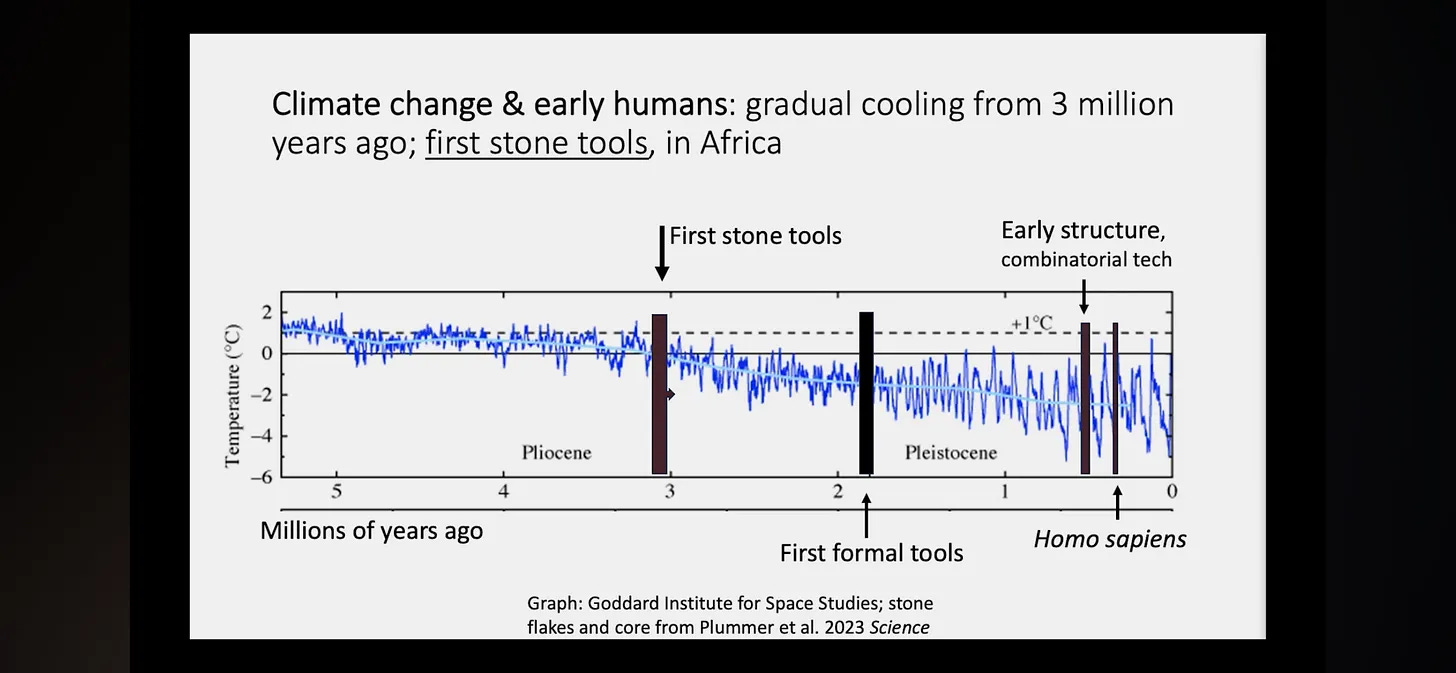
From: Larry Barham (2024): <https://www.youtube.com/watch?v=jK9Pykp-Qiw&t=180s>:
<http://carta.anthropogeny.org>
Brad DeLong: My view: Beliefs that humans evolved to be “versatile” because of climate vibration seem to be, largely, confused.
We only have nine or so serious ice ages in the past two million years. The coming of or the end of an ice age certainly change environments a lot, and animals are then under substantial evolutionary pressure to respond as the world changes around them. But systems to respond not just to a shock but to the coming of more frequent shocks are much harder to evolve. We can imagine a one-off shift to a cultural-learning system, and that then becomes strengthened with every ice age vibration. But that is a lucky one-off rather than the result of systematic pressure. After all, nobody else evolved for this “versatility” over the past two million years, did they? And yet the consequences of an ice-age shock in terms of creating benefits to “versatility” are the same across the large-animal kingdoms.
Yes, baboons became generalists. But they didn’t build Acheulean hand axes. Even if you buy climate variability, it cannot be the whole cause. It has to have interacted with something already set up. Climate looks more like the amplifier than the source. Plus I am always very uneasy about the netless high-wire act that any venture into ‘sociobiology’ requires.
Moreover, there is a speed condition here. Culture beats genes when the environment changes at an in-between rate. If it changes too slowly, genes catch up and instinct does the job more cheaply. If it changes too fast, what the band knows from its ancestors is already out of date. (That is the situation we find ourselves in.) The pace of glacial cycles is roughly 41,000 years, then 100,000 years after about a million years ago. Set against hominin generation lengths of 20–25 years, is that an intermediate speed? That is a testable question.