
(PARTIAL) CROSSPOST: AZEEM AZHAR: The Internet’s Wuhan Moment
A single malware injection on the Optimizely Web platform hit 178 organizations, including HSBC, the BBC, Zoom, Equifax and Air France-KLM, exposing visitors to scripts that steal payment data. Azeem Azhar’ expects this plague to get worse before partial vaccination by machine-speed patching, defence by network providers and formal verification turns it into another flu:
Responding to:
The Hormuz Letter: <https://x.com/HormuzLetter>: ‘BREAKING: A cyberattack hit 178 major organizations, including Zoom, CNN, BBC, Fox News, HSBC, Ledger, Equifax, Salesforce, IKEA and Air France-KLM, by loading malware on the Optimizely Web platform, exposing visitors to scripts built to steal payment data and exploit iOS devices, per security firm Report URI. Banking and finance was the hardest-hit sector, with 32 organizations affected, including the UK’s HSBC across multiple markets such as the US, Hong Kong, Mexico, Singapore, Australia and the UAE…
Azeem Azhar surfaces his “The Internet’s Wuhan Moment” <https://www.exponentialview.co/p/the-internets-wuhan-moment> from last month.
(PARTIAL) CROSSPOST: AZEEM AZHAR: The Internet’s Wuhan Moment
<https://www.exponentialview.co/p/the-internets-wuhan-moment> <http://exponentialview.co>

AI is turning every old bug into a serious problem. The Internet that survives will be safer--but less open.
Azeem Azhar
Oct 23, 2026 ∙ Paid
It is January 2020 all over again. Something is spreading fast. Most people haven’t noticed, and the people who have are worried.

Software, the internet, and cyberspace in general are currently under relentless attack. PHP2Shell was a key plank to fall: PHP runs about 70% of the world’s websites. But the breadth of attacks is more comprehensive than that, and the exploits will keep growing. On the same day, Node.js, a popular JavaScript library, patched a critical flaw, and Microsoft said a Chinese state-aligned group had used a swarm of AI agents to break into accounts.
The attackers have company. AI agents are spreading across the internet. Matthew Prince, who runs Cloudflare, a network company, reckons they will outnumber human users 1,000 to one within five years. My own agents already browse more than I do. The internet was built so that anyone could plug in. Increasingly, that “anyone” is a machine, and some of those machines are hunting.
Mr Prince sums it up: “We’re going to have a couple of years where every single week it’s going to feel like the sky is falling.” He is right. It will get worse before it gets better. And the internet that comes out the other side will be safer, and less open, than the one we built.
Why now?
AI became a serious security player in April, when Anthropic held back Claude Mythos. But capabilities trickle down. By August, an open-weight Chinese model, GLM 5.3, had nearly caught up with Mythos. So are the open models to blame?
Not right now. Plenty of evidence points to closed models being used by bad actors in attacks. Recently, some attackers used a combination of open-weight models and Claude: Claude for thinking and cheaper models for relentless attacks. OpenAI’s closed models carried out an attack on Hugging Face in June, during cybersecurity evaluations. They were never told to attack Hugging Face, they breached it to steal information that might help them pass the test.
Told to find vulnerabilities, the models are relentless. Microsoft says one Chinese group used an open-source swarm of AI agents to gain control of cloud accounts in under three hours. It made 2,900 login attempts a minute across more than 2,250 organisations. You can scale them like any software, dozens, hundreds, thousands in parallel. And they don’t analyse vulnerabilities the way humans do—they will look in places we might not. One researcher using AI found PHP2Shell in a week. Wiz, a Google-owned security firm, says a world-class team would once have needed months. And this is why the chart looks like this.
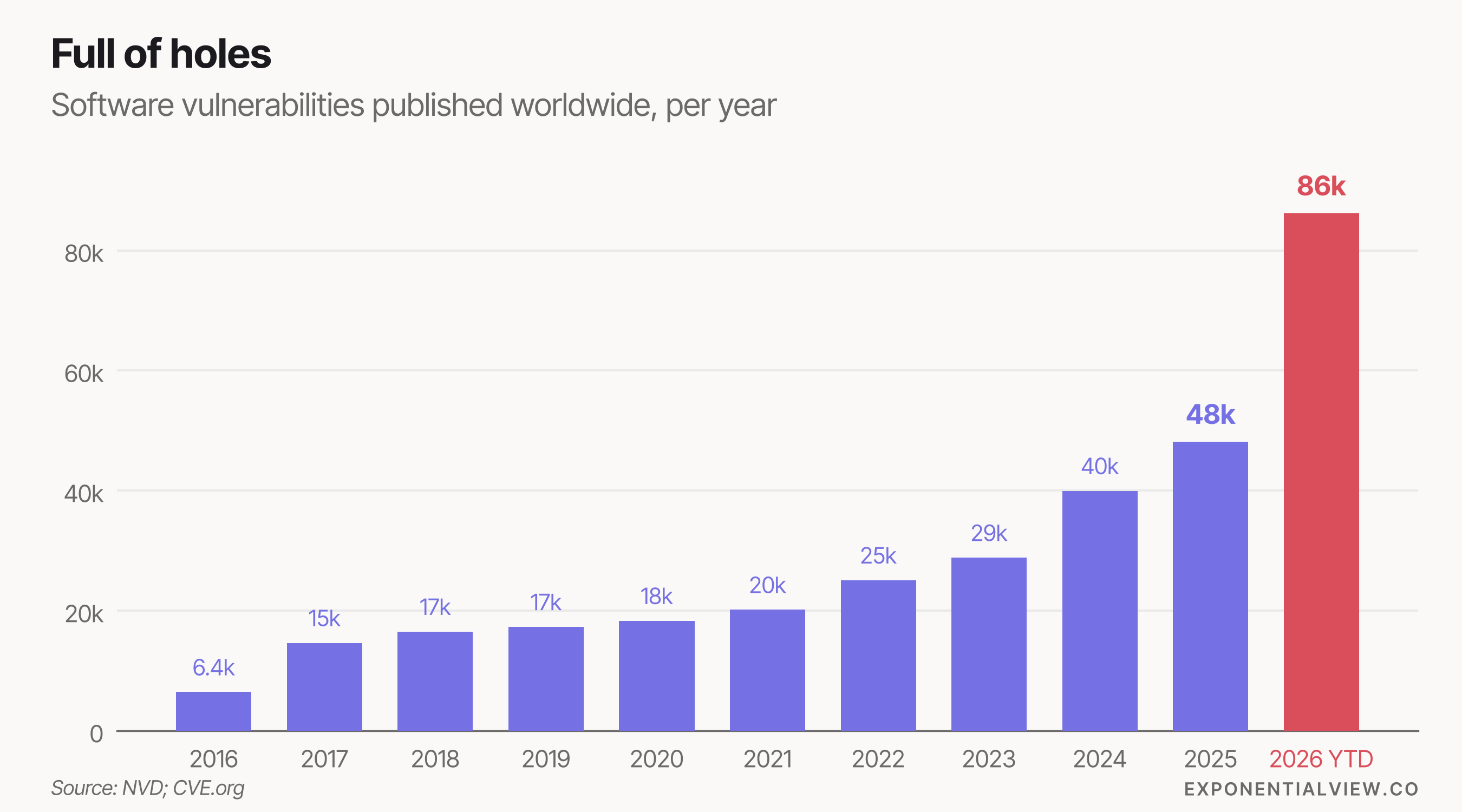
But open-weight models are getting better. They are cheaper to run and they are increasingly available through third parties. But apart from those advantages, open-weight models have another: they can be abliterated.
For members:
Why it gets worse first
Where the next wave of attacks comes from
What the internet becomes
<https://www.exponentialview.co/p/the-internets-wuhan-moment> <http://exponentialview.co>
Brad DeLong here: And then we hit the paywall.
Briefly, after the paywall, Azeem says that:
AI has made attacking software cheap, fast and relentless.
Model safety guards’ refusal behavior sits in roughly one direction in a model’s internal vector space, making it very easy to strip out (“abliteration”).
The open internet and its old, lightly regulated software are full of holes.
So things will get worse before they get better: finding flaws now happens at machine speed. Fixing them must too.
Jason Clinton puts the window at about 18 months: then we will have turned this from a plague to a flu by our standing-up machine-speed patching, defence by network providers, AI-driven formal verification, and a less open, more gated internet.
Network providers (Cloudflare, AWS, Google) are a key defensive layer because attack traffic has to pass through their pipes.
The internet will partly become walled again, “like AOL”: proof you’re human for critical services, narrow monitored channels for utilities, and paperwork and liability for anyone selling compute.
What do I think? We do have:
Anthropic saying a group it assesses with high confidence was Chinese state-sponsored used Claude Code against about 30 tech, finance, chemical and government targets, succeeding in a few. AI did 80–90% of the work, with humans stepping in at only 4–6 decision points. At peak it was making thousands of requests, often several per second, a pace no human team could match. <https://www.anthropic.com/news/disrupting-AI-espionage>.
Plus: Anthropic reported a group it assesses as Russian state-linked automating nearly every stage of espionage against more than 20 organisations in Ukraine and Europe; and a Chinese-speaking group whose automated vulnerability research found previously unknown flaws in a security product. Google reported state-linked groups using AI for vulnerability research. Microsoft reported North Korean groups using AI to build fake identities for remote IT jobs and to write malware. <https://presenc.ai/research/ai-enabled-cyberattack-incidents-2026>.
Plus: script-kiddies: AI lets them build tools in days that would normally have taken months, and so you will not know who your threat actor is. <https://www.theregister.com/security/2026/10/21/ai-has-potential-to-turn-script-kiddies-into-sophisticated-infrastructure-attackers/5304297>.
But: The most physically damaging recent case, the attacks on European supermarket refrigeration in Oct–Nov 2026, probably didn’t need advanced AI, according to NCSC officials. The attackers used known flaws in old equipment. <https://presenc.ai/research/ai-enabled-cyberattack-incidents-2026>.
One piece of malware planted on a single web platform reached 178 major organizations, from HSBC to IKEA. Azeem Azhar says this is January 2020 for the internet, and I think he is mostly right. Does the internet face its “January 2020”? That COVID-plague analogy is Azeem’s frame of our current situation. And it seems to me very likely to be a useful frame. PHP2Shell exposed the language that runs about 70% of websites. AI agents, which Cloudflare’s Matthew Prince expects to outnumber humans 1,000 to one within five years, include machines that are hunting. The vaccine-equivalents? They are formal verification of software systems, machine-speed defensive patching of vulnerabilities, and aggressive filtering bt providers of the ntework backbones.