Combine Blacks & the Moderate Non-Racist White Vote & You Ought to Have a Solid Majority in the South: TRENDS & TURMOIL
Mississippi, 2026: The biracial southern majority that Martin Luther King, Jr. & Lyndon Baines Johnson in 1965, Sam Rayburn in 1938, Joseph Bailey in 1913, and James Longstreet in had imagined, and that Republicans made sure never arrived, may now finally be at hand:
He is here to hope for a very different American South than we have had, well, ever:
Jamelle Bouie: <https://bsky.app/profile/jamellebouie.net/post/3mziatdhmuk2y>: ‘Not only was this the first truly decisive election in 15 years, not only was it the first real repudiation the MAGA Republican Party has experienced, but it is an earthquake in the South. with investment — and with laws protecting the right to vote — the whole region could be blue. The future of american politics is southern (laudatory)…
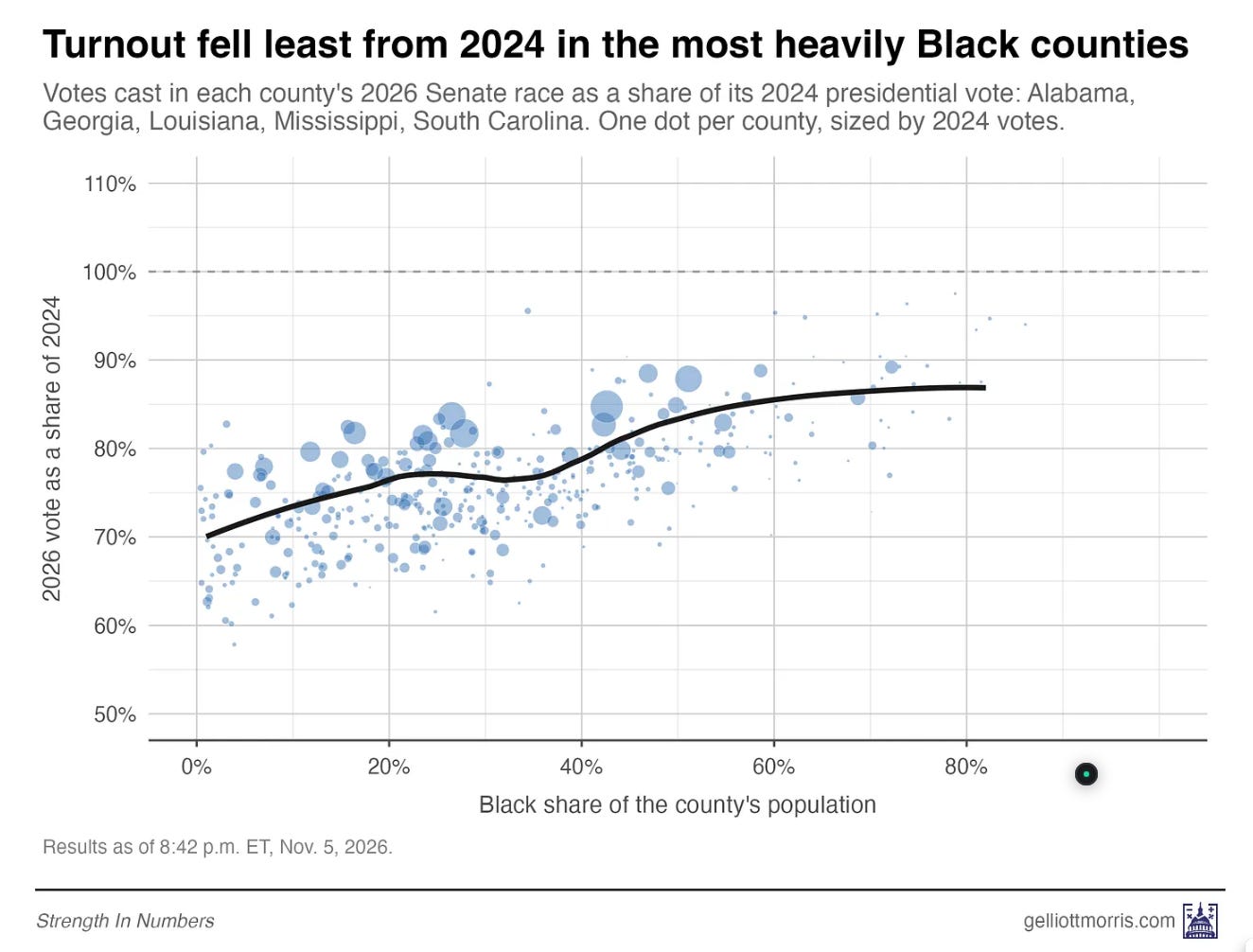
G. Elliott Morris: Turnout Among Black Voters Surged in the Deep South <https://www.gelliottmorris.com/p/2026-11-10-black-turnout-south>: ‘Black voters made up a larger share of the electorate than in 2024, helping to (maybe) flip a Senate seat in Mississippi…. Mississippi Democrat Scott Colom leads Republican Sen. Cindy Hyde-Smith by about 1,800 votes out of roughly 952,000 cast… with thousands of… ballots still being processed…. Trump carried Mississippi by 22 points two years ago…. White Mississippians… backed Trump by 67 points in 2024, [but] voted far less Republican this time around…. [Relative] turnout surged among Black voters; they made up 33% of Mississippi’s electorate this year, up from 30% in 2024….
In the counties in the Deep South where Black voters make up 0% of the population, the number of ballots cast for 2026 House races was about 70% of the number of ballots cast in the 2024 presidential election in the same counties. But in the counties with the largest share of Black residents — around 80 to 85% on the top end — turnout was about 90% of 2024 numbers….
[Part of] the story of the 2026 midterms in the South is… that Republicans spent the months before the election trying to cheat Black voters out of their votes, and Black voters responded by casting more of them. In Mississippi, that surge may have been enough to elect the… senator. In Alabama, it helped Shomari Figures survive a redistricting effort that stripped nearly 9 points off the Black voting-age share of his district. And in South Carolina, it helped deliver another Democratic Senate victory. We can’t know exactly how much of this turnout surge was a direct response to the Supreme Court’s decision in Callais. But the geographic pattern is striking…
Johnson: There’s not going to be anything, though, Doctor, as effective as all of them voting.
King: That’s right. [Unclear]
Johnson: That will get you a message that all the eloquence in the world won’t bring, because a fellow will be coming to you, then, instead of you calling him.
King: And it’s very interesting, Mr. President, to notice that the only states that you didn’t carry in the South—the five southern states—have less than 40 percent of the Negroes registered to vote. Very interesting to notice that. And I think a professor at the University of Texas, in a recent article, brought this out very clearly, so it demonstrates that it’s so important to get Negroes registered to vote in large numbers in the South. And it would be this coalition of the Negro vote and the moderate White vote that will really make the New South…
King was 100% wrong. The New South that was made was one in which the dominant political coalition was lily-white. It was solid Republican South that gloried in not seeking Black votes, and in casting off the Republican Party’s origins and its commitment to Negro Uplift.
But.
It could well happen. What King and Johnson could not bring to pass in the 1960s might come to pass in the 2020s. Here is Lyndon Johnson speaking at the Jung Hotel in New Orleans in 1964:
[Huey Long] never… ma[de] a speech that I didn’t think was calculated to do some good for some people who needed some speeches made for them and couldn’t make them for themselves…. The things I am talking about from coast to coast tonight and tomorrow and next week are the things that he talked about 30 years ago.
He thought that every man had a right to a job, and that was long before the Full Employment Act.
He thought that every boy and girl ought to have a chance for all the education they could take, and that is before the GI bill of rights.
He thought that the old folks ought to have social security and old age pensions, and I remember when he just scared the dickens out of Mr. Roosevelt and went on a nationwide radio hookup talking for old folks’ pensions. And out of this probably came our social security system.
He believed in medical care for those so that they could live indecency and dignity in their declining years, without their children having to come and move them into their house with them. He was against poverty and hated it with all his soul and spoke until his voice was hoarse.
Well, like Jack Kennedy, he believed in those same things. But their voices are still tonight, but they have left some to carry on. And as long as the good Lord permits me, I am going to carry on. Now, the people that would use us and destroy us first divide us…. If they divide us, they can make some hay. And all these years they have kept their foot on our necks by appealing to our animosities, and dividing us….
When Mr. [Sam] Rayburn came up as a young boy of the House, he went over to see the old [ex-Democratic Majority] Leader, one evening…. He was talking about economic problems. He was talking about how we had been at the mercy of certain economic interests, and how they had exploited us. They had worked our women for 5 cents an hour, they had worked our men for a dollar a day, they had exploited our soil, they had let our resources go to waste, they had taken everything out of the ground they could, and they had shipped it to other sections.
He was talking about the economy and what a great future we could have in the South, if we could just meet our economic problems, if we could just take a look at the resources of the South and develop them. And he said, “Sammy, I wish I felt a little better. I would like to go back down [home] there and make them one more Democratic speech. I just feel like I have one in me. The poor old State, they haven’t heard a Democratic speech in 30 years. All they ever hear at election time is “n_gger, n_gger, n_gger!”…
Sidney Blumenthal reports that Johnson then got an eight-minute standing ovation.
We had a very different opportunity in the American South open to us back then, in the mid-1960s. A very few Republicans tried to grasp it: Jack Kemp comes to mind. Barry Goldwater and Richard Nixon and Ronald Reagan and Newt Gingrich and many many others in their company made sure that trajectory was closed off because they thought it redounded to their clear electoral advantage not to try for the Black vote but, rather, to try 110% for the anti-Black vote.
Now the ice may be cracking and things may be in motion again. They certainly are in Georgia. Again, Jamelle:
Jamelle Bouie: <https://bsky.app/profile/jamellebouie.net/post/3mzl4p6chn22s>: ‘What i can't get over, looking at louisiana and mississippi and even alabama, is that the votes are *there*. It is absolutely possible with long term investment to make them competitive states…
You start out in 1954 by saying ‘n_gger, n_gger, n_gger’. By 1968... that hurts you.... You... get... abstract... talk... about... cutting taxes and all these things... totally economic things, and the byproduct often is Blacks get hurt worse than whites.... If it is getting that abstract and that coded, that we’re doing away with the racial problem one way or the other...
The Atwater quote is mentioned a lot. What is not mentioned so often is that Atwater is alluding to a 1964 speech by Lyndon Johnson. Here is the passage from Johnson:
Some of my political philosophy was born in this State. As a young secretary, I came to New Orleans before I ever went to Washington. I saw something about the political history of Louisiana. And I saw a man who was frequently praised, and a man who was frequently harassed and criticized, and I became an admirer of his because I thought he had a heart for the people.
When I went to Washington in the dark days of the Depression as a young country kid from the poor hills of Texas, I had a standing rule with the page office that every time Senator [Huey]Long took the floor, he would call me on the phone and I would go over there and perch in the Gallery and listen to every word he said. And I heard them all.
I heard a lot about the history of this State. I heard a lot of names in this State. But I never heard him make a speech that I didn’t think was calculated to do some good for some people who needed some speeches made for them and couldn’t make them for themselves.
The things that I am talking about from coast to coast--I talked to six New England States last week and I am going to speak in six western States next week--the things I am talking about from coast to coast tonight and tomorrow and next week are the things that he talked about 30 years ago.
He thought that every man had a right to a job, and that was long before the Full Employment Act.
He thought that every boy and girl ought to have a chance for all the education they could take, and that is before the GI bill of rights.
He thought that the old folks ought to have social security and old age pensions, and I remember when he just scared the dickens out of Mr. Roosevelt and went on a nationwide radio hookup talking for old folks’ pensions. And out of this probably came our social security system.
He believed in medical care for those so that they could live indecency and dignity in their declining years, without their children having to come and move them into their house with them. He was against poverty and hated it with all his soul and spoke until his voice was hoarse.
Well, like Jack Kennedy, he believed in those same things. But their voices are still tonight, but they have left some to carry on. And as long as the good Lord permits me, I am going to carry on.
Now, the people that would use us and destroy us first divide us. There is not any combination in the country that can take on Russell Long, Allen Ellender, Lyndon Johnson, and a few others if we are together. But if they divide us, they can make some hay. And all these years they have kept their foot on our necks by appealing to our animosities, and dividing us.
Whatever your views are, we have a Constitution and we have a Bill of Rights, and we have the law of the land, and two-thirds of the Democrats in the Senate voted for it and three-fourths of the Republicans. I signed it, and I am going to enforce it, and I am going to observe it, and I think any man that is worthy of the high office of President is going to do the same thing. But I am not going to let them build up the hate and try to buy my people by appealing to their prejudice.
I heard a great son of Texas who came from an adjoining State, whose name I won’t call, but he was expelled from the university over there and he started West, and he got to Texas as a boy and stopped to see a schoolmate of his.
He liked things so well in Texas that he just decided to make it his permanent address. In 4 years he went to the Congress. After he had been in the House 2 years, he became the Democratic leader, and he served a few years as Democratic leader. And he went to the Senate and he served in the Senate 4 years and he became the Democratic leader in the Senate. He served the district that Mr. Rayburn later served.
When Mr. Rayburn came up as a young boy of the House, he went over to see the old Senator, the leader, one evening, who had come from this Southern State, and he was talking about economic problems. He was talking about how we had been at the mercy of certain economic interests, and how they had exploited us. They had worked our women for 5 cents an hour, they had worked our men for a dollar a day, they had exploited our soil, they had let our resources go to waste, they had taken everything out of the ground they could, and they had shipped it to other sections.
He was talking about the economy and what a great future we could have in the South, if we could just meet our economic problems, if we could just take a look at the resources of the South and develop them. And he said, “Sammy, I wish I felt a little better. I would like to go back to old”—and I won’t call the name of the State; it wasn’t Louisiana and it wasn’t Texas: I would like to go back down there and make them one more Democratic speech. I just feel like I have one in me. The poor old State, they haven’t heard a Democratic speech in 30 years. All they ever hear at election time is “n_gger, n_gger, n_gger!”
Nobody from Texas before John Nance Garner in 1931 was Speaker of the House of Representatives—the leader of the majority party. The only representative from Texas nominated for Speaker from the minority party who could fit Johnson’s description of having been an old senator when Sam Rayburn showed up in 1913 was Joseph Weldon Bailey.
As Gerald Gamm says in email:
It took me a bit of time to piece this together, but you are absolutely right that this is Joseph Bailey. I just pulled down his biography (Acheson 1932), and he fits the description well.
Bailey was born in Mississippi in 1863, then enrolled at the University of Mississippi at the age of 17. At Ole Miss, he apparently fell in love with the sister of the local newspaper editor, which led to some sort of falling out. According to Acheson (1932, 13): ‘The young man’s bad temper and proud spirit seized upon some grievance with the university authorities and magnified it, so that he soon abruptly resigned from his courses and left Oxford. Then began his tortuous journey that would lead through two more universities and a separate law school and would end several years later in reuniting with the lady of his heart in the new world of Texas…’
Bailey served as minority leader of the House of Representatives in 1897-99, then entered the Senate in 1901. Although he was never formally elected caucus chairman or Democratic leader in the Senate, he was often regarded as his party’s de facto leader, given the failings of those holding the elected position. Bailey then served in the Senate from 1901 until January 1913, when he resigned. After leaving Congress, Bailey settled in Washington, D.C., where he remained active in public affairs and worked as an attorney. So, although Bailey was no longer in Congress when Sam Rayburn arrived in March 1913, it seems entirely plausible that their paths crossed and that Bailey was in a position to mentor and talk with the young congressman from Texas. And, yes, I just checked: Bailey and Rayburn represented the same congressional district in north Texas!
Lyndon Johnson in 1964 sets out his very strong desire for the South to reject the politics of using racial demagoguery—”n_gger, n_gger, n_gger”--to distract attention from populist, egalitarian, leveling political and policy goals.
Lee Atwater, by contrast, echoing and referencing Lyndon Johnson with the threefold repetition of “n_gger, n_gger, n_gger”, has an equally strong desire to use that racial demagoguery—in a highly “abstract” and “coded” form—to harness energy for what Johnson and his peers saw as the economic royalist platform of cutting taxes, social services, infrastructure investment, and avenues that might open opportunities for upward mobility. Johnson wants to break with the racist tradition in the interest of populist and progressive economic democracy—and because African-Americans are Americans. Atwater wants to transform it in the interests of economic royalism.
I am never sure whether it is entirely fair to take somebody’s unrehearsed and unpracticed off-the-cuff remarks as a true indication of their beliefs. Certainly if they had time to reflect and think about what they wanted to say and how they wanted to sound they would speak differently. Atwater opens this part of the interview with “don’t quote me”, after all: it knows that it will sound bad outside of its context.
Nevertheless, people’s unrehearsed and unpracticed off-the-cuff remarks do reveal a great deal about the deep structure of their thought, and do reveal inconsistencies—places where they have not thought things true, and where their set of beliefs departs from rational consistency because they are impelled—or compelled—by deeper forces than a rationally-judged evidence-based view of the world.
Atwater starts this part of his interview with:
Now you don’t quote me on this...
And with where the politics of racial demagoguery starts—with its echoing and thus reference to Johnson’s quote of Sam Rayburn quoting an unnamed Texas senator who was old when Rayburn was young:
...You start out in 1954 by saying ‘n_gger, n_gger, n_gger’...
But that appeal becomes useless, and must be transformed:
...By 1968 you can’t say ‘n_gger,’ that hurts you, backfires, so you say stuff like ‘forced bussing, states rights’ and all that stuff, and you’re getting so abstract. Now you’re talking about cutting taxes and all these things...
And so the energy has been transformed into what Atwater would say is a non-racist policy platform, non-racist because you are not talking about legal segregation or for suppressing the African-American vote :
...What you’re talking about are totally economic things...
That are nevertheless in the service of economic royalism:
...and the byproduct often is Blacks get hurt worse than whites...
Note: not “whites benefit but Blacks get hurt”—whites get hurt too. These policies are, Atwater says, not in the interest of the whites whom Atwater wants to support his bosses. But the message is effective because “Blacks get hurt worse”.
And the energy is still there:
...subconsciously maybe that is part of it, I’m not saying that. But I’m saying that if it is getting that abstract and that coded...
And, Atwater believes, “abstract” and “coded” dog-whistles are not a problem:
...we’re doing away with the racial problem one way or the other.Do you follow me? Because obviously sitting around saying, ‘we want to cut taxes, we want to cut this,’ is much more abstract than even the bussing thing, and a hell of lot more abstract than, ‘n_gger, n_gger’...
For Atwater in 1981, moving beyond racism is simply no longer calling for legal segregation or for the suppression of the Black vote. Calling for policies with a strong disparate impact—that are popular precisely because they have a strong disparate impact. They are not popular because they are beneficial—whites get hurt—but because “Blacks get hurt worse”.
Of course, today, when the Republican Party platform calls for the judicial nullification of the Voting Rights Act because it offends the equal dignity of the states, a consistent Lee Atwater would be saying that we have not done away with the racial problem.
But that still leaves one loose end. In his 1964 Jung Hotel New Orleans presidential campaign speech, Lyndon Johnson does not set out the declaration that Southern politics-as-usual is the destructive demagoguery of “n_gger, n_gger, n_gger” as his own original judgment.
He does not even set it out as the original judgment of his mentor Sam Rayburn.
He places it back when Sam Rayburn first came to Washington: back before World War I:
When Mr. Rayburn came up as a young boy of the House, he went over to see the old Senator...
And he places it in the mouth of this “old Senator... talking about economic problems... about how we had been at the mercy of certain economic interests, and how they had exploited us”. Johnson described this senator as:
a great son of Texas who came from an adjoining State... expelled from the university over there and he started West... liked things so well in Texas that he just decided to make it his permanent address... went to the Congress... became the Democratic leader,... went to the Senate... became the Democratic leader in the Senate... served the district that Mr. Rayburn later served...
And has Johnson approaches the climax of his Jung Hotel speech he outlines what--back before World War I—the economic royalists had done to the prosperity of the south:
They had worked our women for 5 cents an hour, they had worked our men for a dollar a day, they had exploited our soil, they had let our resources go to waste, they had taken everything out of the ground they could, and they had shipped it to other sections. He was talking about the economy and what a great future we could have in the South, if we could just meet our economic problems, if we could just take a look at the resources of the South and develop them...
And then Johnson reaches his punch paragraph:
And [the old senator, the leader] said, “Sammy [Rayburn], I wish I felt a little better. I would like to go back to old”—and I won’t call the name of the State; it wasn’t Louisiana and it wasn’t Texas: I would like to go back down there and make them one more Democratic speech. I just feel like I have one in me. The poor old State, they haven’t heard a Democratic speech in 30 years. All they ever hear at election time is “n_gger, n_gger, n_gger!”
It was Mississippi.
Sidney Blumenthal reports that Johnson then got an eight minute standing ovation.
I find it highly plausible that Joseph Bailey would have said that. I am confident Johnson was not just making up stuff. If he were making up stuff, why get so many details of Bailey’s biography right? He had a real person in mind—albeit one he did not want to name at that moment—when he told the story.
And that is not, usually, how one acts when one it making things up off-the-cuff.
And it casts a sharp and grim light on one of the claims Atwater makes at the start of the interview from which the “and you don’t quote me...” passage was taken. Atwater claims that:
Race was not really an issue... until 1954. Race could become an issue. But for that someone had to be soft on the issue, but no one was. So everyone was operating within the framework of a segregated society. So race never became an issue...
Joseph Bailey was damned certain back in 1913 that race—and the economic royalists’ use of it to split and hobble the populists and the progressives, those interested in broad-based middle-class prosperity and southern economic development—was in a sense always the issue. And Sam Rayburn was damned damned certain of it when he told this story to Johnson.
And Johnson was damned damned damned certain of it in October 1964.
If reading this gets you Value Above Replacement, then become a free subscriber to this newsletter. And forward it! And if your VAR from this newsletter is in the three digits or more each year, please become a paid subscriber! I am trying to make you readers—and myself—smarter. Please tell me if I succeed, or how I fail…