CROSSPOST: NIALL FERGUSON: The [Nixon-Like] Method to Trump’s Foreign Policy Madness
Nixon was smart. Really smart. Nixon knew where Hanoi was. Niall Ferguson has a uniquely stupidly timed grand-strategy apologia for Donald Trump. Ferguson sees a Kissinger in a man who could not find the capital of North Vietnam on a map:
I must say that seeing this in my feed this morning was quite a surprise:
Niall Ferguson: The [Nixon-Like] Method to Trump’s Foreign Policy Madness <https://niallferguson.substack.com/p/the-method-to-trumps-foreign-policy>: To understand Trump’s… foreign policy… you have to understand the debt he… owes to…. Richard Nixon…. We’re seeing a wave of Nixon revisionism, if not rehabilitation…. Both presidents consciously put… realpolitik in Otto von Bismarck’s sense… above… international idealism…. Nixon’s realism… was a grand strategy at its grandest, predicated on a clear-eyed calculation of American interest and an effective downgrading of the ideological schism that had characterized the early Cold War….
You should by now have divined where I am going with this. Like Nixon, Trump’s instinct is to negotiate superpower to superpower… without regard to the smaller players… to say nothing of the irritatingly idealistic Europeans with their nostalgia for the “liberal international order”….
It might seem to skeptics that the U.S. has no strategy beyond imperial caprice. But that is a misreading. At heart, Donald Trump is a Nixonian… with the sole difference that personal enrichment and the national interest were never conflated in Nixon’s mind. Like Nixon, Trump takes pleasure in cutting deals with dictators. Like Nixon, he has no patience with European lectures about morality…. The essential difference between Trump and Nixon is U.S. economic strength [today]…. Like Nixon’s, Trump’s grand strategy may unravel. It’s just less likely to unravel if the U.S. economy stays strong…
Nixon was smart and had views (even if they were, alternatingly, Kissinger’s and Moynihan’s). It takes a very special kind of person to publish thatin the context in which the other thing in my feed right now is this:
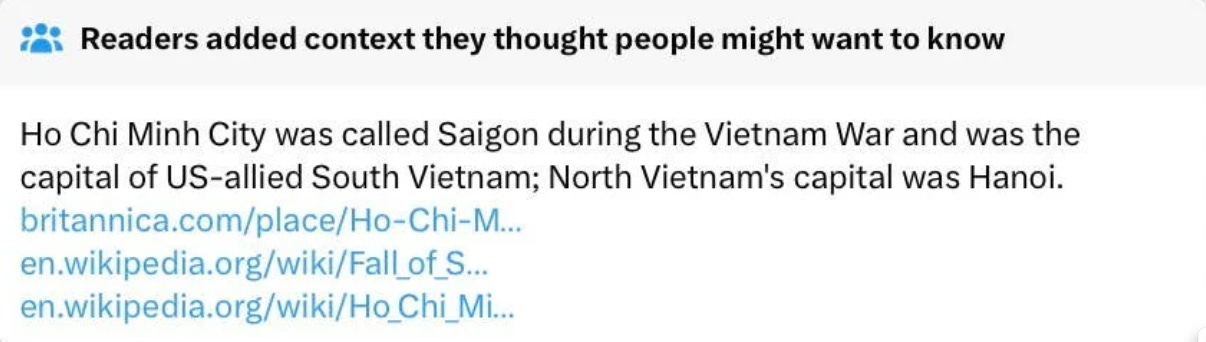
This called forth, not surprisingly, a community note:
And another note:
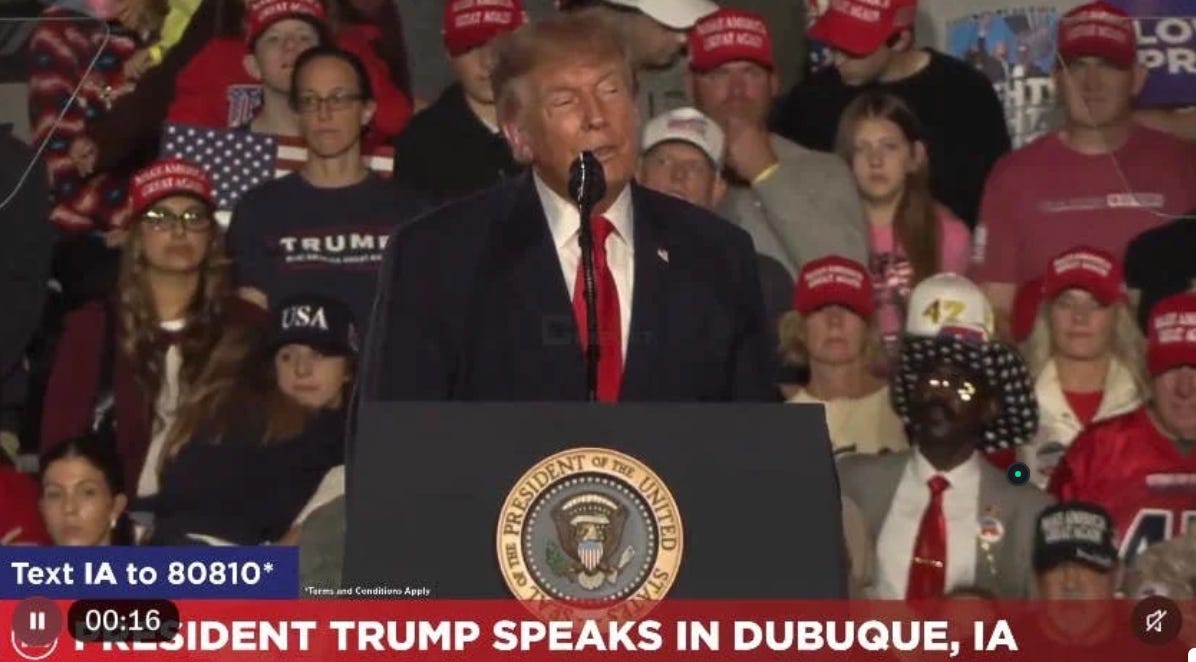
Hunter Biden: <[twitter.com/HunterBid...](https://twitter.com/HunterBiden/status/2117256121018912794)>: ‘Last night Trump said he could have won Vietnam in a week. His plan was “going after Ho Chi Minh City.” Ho Chi Minh City was Saigon, the capital of South Vietnam. Our ally. The enemy’s capital was Hanoi. We bombed it. He called the presidents who fought that war stupid, then explained how he’d have won it by attacking our own side.
58,220 Americans died in that war. Trump got five deferments. Now he’s telling the rest of us how easy it would have been. He’s had more than fifty years to learn which side we were on. He still hasn’t. That alone should disqualify him from sending anybody else’s kids to war. Instead, he’s weighing more strikes on Iran after Tuesday. His administration has reportedly considered using the “mother of all bombs,” the one he calls “like a tiny nuclear bomb.”
The man who thinks we should have bombed our ally’s capital gets to choose the targets…
Ferguson’s is the most curious-of-all reaction and response to Donald Trump’s belief that Johnson and Nixon could have won the Vietnam War “in a week” by bombing the then-Saigon, the capital of our South Vietnam ally. At 09:30 pst on November 2, 2026—18 hours after Trump’s Dubuque speech—we have Niall Ferguson publishing:
To understand Trump’s approach to Ukraine, Iran, and China, look to Richard Nixon. The president’s instinct for superpower dealmaking reflects a hard-nosed realism, backed by the American economy.
Each episode of the satirical 1970s show Soap always began with a convoluted plot summary. The catchphrase in the intro was: “Confused? You won’t be.”
Confused is how many people today feel about U.S. foreign policy. A Free Press editor recently put it this way:
If China, Russia, North Korea, and Iran are an Axis of Aggressors and we’re at war with them, why is it so hard to identify enemies and allies? Democrats who just voted to pass almost $2 billion in aid to Ukraine (with an assist from a small group of Republicans) are simultaneously promoting candidates who want to end support for the Iron Dome for Israel, which is at war with Iran and its satellites, who are attacking an assortment of our partial allies and getting help from Russia and China.
[Vice President] J.D. Vance talked about the moderates in Iran who want peace during his ill-fated ceasefire; Turkey works with the Axis but is part of NATO; France, Belgium, Spain, and the Netherlands import Russian gas; Hungary uses a Russian pipeline, etc. How can we be in “Cold War II” if those are our allies? Whose false narrative are we living in?…
Having coined the phrase Cold War II and encouraged the use of the term Axis, I get so much of this kind of thing these days that I feel like a geopolitical agony aunt. “Why is Musk fucking with Ukraine?” a friend messaged me on Wednesday, referring to reports that Elon Musk green-lit a slowdown in the military-grade Starlink coverage that Ukraine relies on for certain types of drones. “Why would Putin negotiate when he’s getting concessions without it? How does increasing his leverage help?” These questions were further fueled by the revelation at the beginning of the week that the Russian president had proposed a joint summit next month with Donald Trump and Xi Jinping to discuss Ukraine—without Ukrainian president Volodymyr Zelensky present. Trump reportedly did not reject the idea.
Confused? You will be. So how to make sense of the apparent contradictions of Cold War II? For some people, the only possible explanation for all of this is that President Donald Trump is simply a crazed man-child emperor. In the wake of the gladiatorial games staged outside the White House in June, the British writer Robert Harris (whose new book Agrippa depicts the rise of Augustus Caesar) remarked: “You can really see him in a toga with a gold laurel wreath on his head. . . . He is an imperial kind of president.”
And yet I have always doubted that Trump is an authentic Octavian, a would-be emperor, ushering the republic into its grave. Nor (despite the analogy drawn last year by Gideon Rachman) is Trump Pitt the Younger, carving up the world as Pitt did with the Emperor Napoleon in 1805 (the subject of a famous cartoon by James Gillray).
In many ways, Trump is no emperor but, as I have long insisted, a quintessentially 19th-century American figure: a composite of Andrew Jackson, William McKinley, Theodore Roosevelt, and P.T. Barnum. Nevertheless, to understand Trump’s approach to foreign policy, and particularly his counterintuitive approach to the war in Ukraine, you have to understand the debt he also owes to a 20th-century president: Richard Nixon.
In December 1987, Nixon wrote to Trump after his wife saw the swaggering young real estate developer on Phil Donahue’s talk show. “Mrs. Nixon told me you were great,” Nixon gushed. “As you can imagine, she is an expert on politics and she predicts that whenever you decide to run for office you will be a winner!” Prophetic words. Two years later, the two men were photographed together at a fundraiser in Houston. Small wonder Trump has a long-standing regard for the disgraced 37th president. Not many people took him seriously back then.
It’s no accident that we’re seeing a wave of Nixon revisionism, if not rehabilitation, in Trump’s second term. Clearly, Trump’s domestic enemies were once Nixon’s: Harvard, TheNew York Times and TheWashington Post, and the federal bureaucracy—known today as “the deep state.” Even more clearly, and most importantly for our purposes, both presidents consciously put the national interest—realpolitik in Otto von Bismarck’s sense—far above the international idealism we associate with Democratic presidents such as Woodrow Wilson or Jimmy Carter.
“We live in a world in which you can talk all you want about international niceties and everything else,” deputy chief of staff Stephen Miller told CNN’s Jake Tapper in January, shortly after the U.S. extracted the Venezuelan dictator Nicolás Maduro. “But we live in a world, in the real world . . . that is governed by strength, that is governed by force, that is governed by power.”
“These are the iron laws of the world,” Miller went on. “We’re a superpower. And under President Trump, we are going to conduct ourselves as a superpower.”
Nixon’s realism is best illustrated by the great “shocks” of the summer of 1971. In July, he stunned the world—particularly hawkish Cold Warriors at home and foreign allies such as Taiwan and Japan—by revealing his intention to fly to Beijing to meet the Chinese tyrant Mao Zedong. In August he shocked America’s European allies, too, by imposing across-the-board tariffs and taking the dollar off gold.
He and Henry Kissinger brilliantly sought to exploit the Sino-Soviet split to exert leverage over both Communist regimes, and in particular to put pressure on North Vietnam to agree to a peace deal that would get the United States out of Indochina while preserving the independence of South Vietnam, at least for “a decent interval.”
In 1972, Nixon’s summits in Beijing and Moscow paved the way for the January 1973 peace in Vietnam (after a final bout of “Christmas bombing” of Hanoi). It was a grand strategy at its grandest, predicated on a clear-eyed calculation of American interest and an effective downgrading of the ideological schism that had characterized the early Cold War.
Trump today is as unpopular a second-term president as George W. Bush was in October 2006.
Of course, the strategy—and Nixon’s presidency—unraveled in 1973 and 1974 because of Watergate, a war in the Middle East, and a massive energy price shock precipitated by the Saudi-led oil embargo on the United States, retaliation for U.S. military aid to Israel in the Yom Kippur War.
You should by now have divined where I am going with this. Like Nixon, Trump’s instinct is to negotiate superpower to superpower, regardless of ideological labels. He would indeed enjoy nothing more than a Big Three summit with Putin and Xi at the Asia-Pacific Economic Cooperation (APEC) leaders’ meeting in Shenzhen next month. His preference would be to settle the ongoing wars in Ukraine and Iran without regard to the smaller players involved, to say nothing of the irritatingly idealistic Europeans with their nostalgia for the “liberal international order.”
It is a mistake to read too much into his and his emissaries’ tendency to flatter Putin and Xi, to disparage Zelensky, to give his Taiwanese counterpart Lai Ching-te the cold shoulder, and generally to sneer at most European leaders. Trump has soft spots for a few countries—notably the United Kingdom and Israel. But that doesn’t prevent him from periodically yelling at their prime ministers when they stand in his way.
The paradox of Trump’s foreign policy is that his attempt to overthrow the Iranian regime this year was simultaneously the least Nixonian (and most Bush-like) thing he has ever done, and probably also his biggest mistake.
For the laws of 20th-century politics still apply, even in the mid 2020s—even in the age of Trump. Power nearly always drains away from a second-term president, especially after his party loses seats in Congress, as tends to happen. But a war in the Middle East can make the power drain especially fast. Trump today is as unpopular a second-term president as George W. Bush was in October 2006. Since 1945, only Nixon has had lower approval—and by October 1974 he had been out of the White House for two months. The war against Iran has aged much faster politically than the war against Iraq. And that’s in large measure because of its impact on energy prices, increasing crude oil prices by a factor of four, and gasoline prices by a factor of three.
To really put the crisis of Trump’s presidency in context, you need to go back a quarter century, to the era of Bush’s Global War on Terrorism, one the most idealistic enterprises in the history of U.S. foreign policy. In my book Colossus (2004), I predicted that the neoconservative project for “nation building” (empire in all but name) was doomed to fail. “There are three fundamental deficits,” I argued, “that together explain why the United States has been a less effective empire than its British predecessor. They are its economic deficit, its manpower deficit and—the most serious of the three—its attention deficit.”
The three deficits of Colossus have only deteriorated in the past 25 years. But there is now a fourth one: a geopolitical deficit. The United States is in Cold War II, regardless of who is president. China is the most formidable economic rival the U.S. has ever faced. And we have ended up in the most dangerous scenario envisioned by Zbigniew Brzezinski in The Grand Chessboard (1997)—facing “a grand coalition of China, Russia, and perhaps Iran, an ‘antihegemonic’ coalition united not by ideology but by complementary grievances.” (He should have added North Korea.)
The Axis of authoritarians meets regularly and appears to have a game plan: Think of Putin, Xi, and Kim Jong-Un rubbing shoulders at the 80th anniversary of the end of World War II in Beijing last year. By contrast, Trump has shaken up the U.S. system of alliances—not necessarily a bad thing, but in the short run a potential source of weakness.
Trump’s grand strategy of confronting the Axis was to start with the weakest link (Venezuela), then move on to Iran. The Iranian regime appeared to have been decisively disarmed in the opening phase of the war, Operation Economic Fury. But the closure of the Strait of Hormuz seemed to confront Trump with a choice between a hugely risky ground operation or abandoning the strait to Iran—a choice, in British imperial terms, between Gallipoli (1915) or Suez (1956).
Yet what I didn’t anticipate back in 2001 was that the U.S. would economically outperform both adversaries and allies.
At heart, Donald Trump is a Nixonian in foreign policy, with the sole difference that personal enrichment and the national interest were never conflated in Nixon’s mind.
Relative to other currencies, the dollar hasn’t weakened in 25 years, and the 10-year Treasury is still generally regarded as a “safe asset.” The real effective exchange rate did a round trip, and the new European currency didn’t really challenge dollar dominance of global reserves and transactions.
Toppling the Twin Towers was intended by Osama bin Laden as an economic as well as a symbolic act. But, since 2001, the U.S. stock market has crushed (nearly all) the competition. If you had invested all your savings in U.S. equities on September 10, 2001, you’d be up by a factor of seven. The equivalent for Germany is 3.3x, Japan 3x, China 2x, and the UK 1.8x. If you sold America and bought the BRICs in 2001, you are cursing Goldman Sachs, who coined that acronym for Brazil, Russia, India, and China. That has been the portfolio from hell.
The U.S. has led the charge in artificial intelligence, of course. It has 11 times the computational power of China, the other AI empire. But it has also surged back as a hydrocarbon power. Oil and gas production were both drifting down until the shale boom took hold around 2008–2012. U.S. natural gas production has since doubled. Oil output is up 130 percent. This helps explain why the economic consequences of the closure of the strait turned out to be less severe this year than the energy experts expected—though the key variable in keeping a lid on oil prices was the drastic decline in Chinese crude oil imports.
Now consider the predicament of the Axis powers today. There has been a slow but steady weakening of the Iranian grip on the strait. The Iranian currency is in free fall. Their economy is at rock bottom.
Meanwhile, Russia is now waging a relentless air war against Ukraine’s economy. Putin may grind out his victory in 2027. But the costs are already eye-watering. Russian casualties (killed and wounded) in July, August, and September were in excess of 42,000 per month.
True, the economic consequences of a closure of the Taiwan Strait—if China made a move against Taipei and the U.S. contested it—would be greater than the closure of Hormuz. And true, China has already understood how to exploit U.S.-PRC economic interdependence, particularly its near monopoly on rare-earth elements. But Chinese consumer confidence has not recovered from Covid, and the population is plunging. And whose fiscal problem would you rather have? Relative to GDP (especially if, as seems likely, China’s is overstated), Beijing’s is a much bigger headache; it’s just that most of its public sector deficit and debt are at the local level.
It might seem to skeptics that the U.S. has no strategy beyond imperial caprice. But that is a misreading. At heart, Donald Trump is a Nixonian in foreign policy, with the sole difference that personal enrichment and the national interest were never conflated in Nixon’s mind. Like Nixon, Trump takes pleasure in cutting deals with dictators. Like Nixon, he has no patience with European lectures about morality—especially when they are as hypocritical as the ones given by people still doing a roaring trade with Russia via third countries. Like Nixon, he feels entitled to the Nobel Peace Prize—and, like Nixon, he has no chance whatsoever of receiving it. Like Nixon, Trump drives both liberals and neoconservatives round the bend. And, like Nixon, he runs the risk that the list of enemies will become so long they will finally be able to undermine him altogether.
But the essential difference between Trump and Nixon is U.S. economic strength. When Richard Nixon resigned in August 1974, the inflation rate was 11 percent and the unemployment rate was 5.5 percent. Last month, those figures were, respectively, 3.7 percent and 4.2 percent. The U.S. economy was in recession between November 1973 and March 1975. Today, the U.S. economy is so red-hot, thanks to the AI investment boom, that the Federal Reserve is hitting the brakes.
Still confused? All I can tell you is that, like Nixon’s, Trump’s grand strategy may unravel. It’s just less likely to unravel if the U.S. economy stays strong. Indeed, that strength might (I stress might) even help end the conflicts in Eastern Europe and the Middle East, while deterring China from risking a confrontation in the Far East. Only if higher interest rates, plus a Democratic wave in the midterms, plus the public backlash against AI together burst the AI bubble—only then will Trump face a Nixonian reckoning. And then it will be a very different ’70s TV show we’ll be reminded of.
Brad DeLong here: Yes, Niall Ferguson did originally publish this ten days ago in the Free Press, Yes, this is perhaps an automatic repost to get it out from behind the paywall of the Free Press. Yes, perhaps Niall is too scatterbrained to have remembered that this was scheduled to post this on his SubStack this AM, and perhaps he should think, even if only a little, about the context in which it would land.
It may have looked marginally less moronic ten days ago.
Marginally.
No. The “essential difference between Trump and Nixon” is not:
U.S. economic strength [today]. When Richard Nixon resigned in August 1974, the inflation rate was 11 percent and the unemployment rate was 5.5 percent. Last month, those figures were, respectively, 3.7 percent and 4.2 percent. The U.S. economy was in recession between November 1973 and March 1975. Today, the U.S. economy is so red-hot, thanks to the AI investment boom, that the Federal Reserve is hitting the brakes…
I could go on. But this is a cognitive-DDOS attack on all of us.
And is Ferguson’s “Operation Economic Fury” a mind-o or joke?
If reading this gets you Value Above Replacement, then become a free subscriber to this newsletter. And forward it! And if your VAR from this newsletter is in the three digits or more each year, please become a paid subscriber! I am trying to make you readers—and myself—smarter. Please tell me if I succeed, or how I fail…