
CROSSPOST: HENRY FARRELL: Agentic AI Is Myth Set in Motion
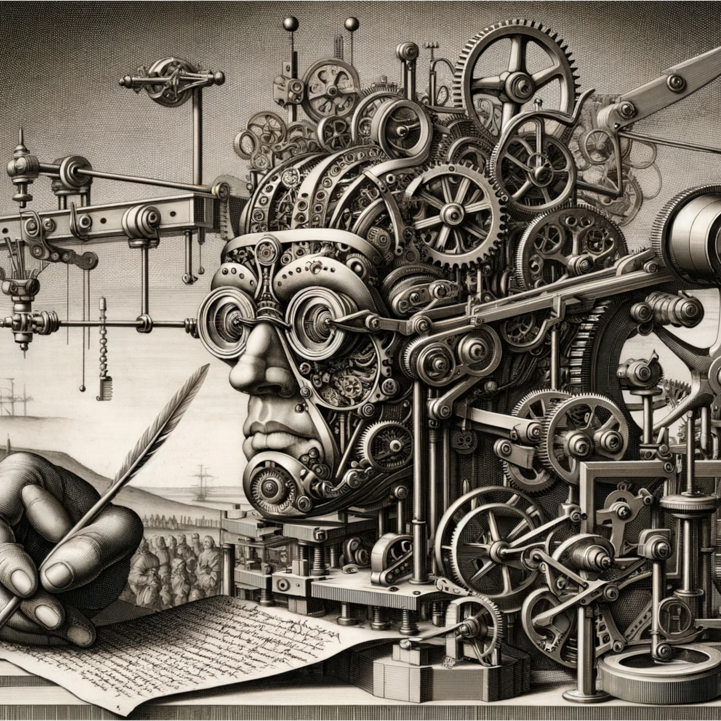
In the Economist, Henry Farrell and Cosma Shalizi argue that AI is not incipient Digital God god but rather a “condensate of human culture”: a statistical floor plan of Jacques Barzun’s “House of Intellect,” animated the way an oral bard’s repertoire of tropes is. Hooked up to software “harnesses,” it can act out its narratives in the digital world, checking proofs in Lean or joining a hacking attack. Well, yes. But the human House of Intellect we have constructed over the past five thousand years is the real ASI, the true Anthology Super-Intelligence. So what then follows from the recognition that the cogitation of MAMLMs draws on the best (and the worst) that has been thought and known?:
Agentic AI: Not an emerging individual intelligence but a “condensate of human culture” that functions as a statistical summary of written knowledge.
Properly “harnessed”, Agentic AI acts out narratives derived from the vast distribution of human written cultural patterns that then interacts with the digital world, andn then the physical world. The ghosts of the performative commands directed at software systems by the humans whose interactions with our machines are identified as “similar” by the vector embedding system.
The key distinction here is between Jacques Barzun’s “Intellect” (stored communal knowledge) and actual “Intelligence”, which is an individual power to act appropriately in a situation rather than to merely cite precedents.
The big open question is this: how, meaningfully, is what LLMs do different than what we do when we consult the House of Intellect and then use it to drive our own speech, performative utterances, and physical actions in the world of matter? our machines cannot (yet) undertake physical actions in the world of matter. but they certainly can speak. And when harnessed up to trigger programs and scripts, their speaking becomes performative in the world of thought and databases, at least.
I can think of two differences immediately:
We bring in our models of the world and our genuine thought (whatever that is) whenever we say the less expected thing that is not front and center in the House of Intellect. When they say the less expected thing, they are simply picking a random number that leads them to stochastically and meaninglessly swerve from the modal entropy maximizing utterance.
They can search and propose possibilities at thousands of times the speed that we can, and when assessment can be automated they can assess those possibilities at thousands of times our speed as well.
Are there other truly salient differences here?
Henry Farrell:
CROSSPOST: HENRY FARRELL: Agentic AI Is Myth Set in Motion
<https://www.programmablemutter.com/p/agentic-ai-is-myth-set-in-motion> <https://www.programmablemutter.com>

Cosma and I have a piece at the Economist
Henry Farrell
2026-10-29
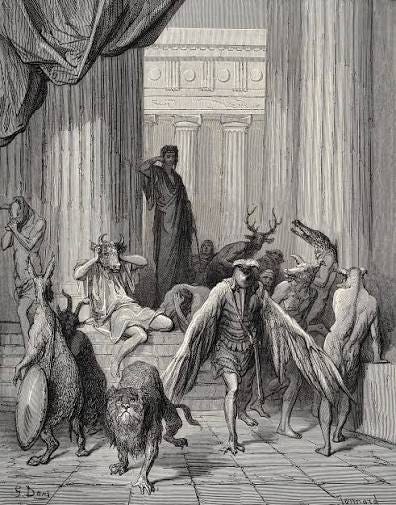
[Gustave Dore - Ulysses and his companions]
Cosma Shalizi and I have a new piece on AI at the Economist. It’s not really like anything else out there (although some chunks may be familiar to readers of this newsletter, and it absolutely builds on our collaboration with Alison Gopnik and James Evans) and we’re really happy with it. There’s a paywall, but on past experience, the Economist is reasonably tolerant of contributing authors sticking their pieces up on their own websites after a little time has elapsed, so you should expect to see it here sooner rather than later.
In the meantime, the key argument is as follows:
Modern AI is neither god nor mechanical bird. It is best understood as a technological version of the Homeric songs that inspired Alexander’s conquests, an epic grown so vast that it encompasses not just heroes, monsters and supernatural helpers, but enormous swathes of practical written knowledge, animated to make it capable both of narrating itself and acting out this narrative on the world that inspired it.
That may sound like a strange way of thinking about AI, but we think it is a very useful one. It doesn’t treat AI as a putative individual intelligence in the making, because it really isn’t. Nor does it dismiss AI as merely parroting what humans have already said. Instead, it suggests that we ought think of AI as a kind of condensate of human culture that can be deployed in very novel ways, and even become a self mobilizing myth.
Our argument starts from this 2025 post by Cosma. What LLMs model is not lively human intelligence in the world, but frozen written knowledge - what Jacques Barzun calls the “House of Intellect.” As Barzun puts it:
Intellect is the capitalized and communal form of live intelligence; it is intelligence stored up and made into habits of discipline, signs and symbols of meaning, chains of reasoning and spurs to emotion — a shorthand and a wireless by which the mind can skip connectives, recognize ability, and communicate truth. Intellect is at once a body of common knowledge and the channels through which the right particle of it can be brought to bear quickly, without the effort of redemonstration, on the matter in hand.
Intellect is community property and can be handed down. We all know what we mean by an intellectual tradition, localized here or there; but we do not speak of a “tradition of intelligence,” for intelligence sprouts where it will…. And though Intellect neither implies nor precludes intelligence, two of its uses are — to make up for the lack of intelligence and to amplify the force of it by giving it quick recognition and apt embodiment. For intelligence wherever found is an individual and private possession; it dies with the owner unless he embodies it in more or less lasting form. Intellect is on the contrary a product of social effort and an acquirement…. Intellect is an institution; it stands up as it were by itself, apart from the possessors of intelligence, even though they alone could rebuild it if it should be destroyed…
The remarkable, the extraordinary thing about Large Language Models is that they are in order to carry out next token prediction, they have learned enormous amounts of human culture. As it happens, modeling language well involves modeling the cultural structures that are embedded in human written usage. Put differently, the models have turned the complex higgledy-piggledy structure that is the House of Intellect into a set of floor plans, capturing the essentials of how this or that room, containing this or that collection of organized knowledge connects to others, perhaps discarding a baroque set of crenellations that are found in only one small part of the family pile and seem to have no broader relevance. The result is a disorganized but magnificent machinery of information, summarized at vast expense. Turning an old Terry Pratchett joke on its head, it’s as if an architect had wanted to build Gormenghast, and had had the budget.
And that isn’t all. Cosma mentions in passing Albert Lord’s fantastic book, The Singer of Tales. Lord, building on Milman Parry’s account of Homer, and their joint travels in 1930s Yugoslavia, describes how a similar set of summarizations provide the ever-acting engine of much oral culture. Illiterate bards do not, actually memorize many thousand line oral epics. They learn how to sing them, being trained to capture the underlying structures, the tropes, names, poetic conventions, standard situations and so on and reproduce them.
It is not simply that the meat can be seethed from the bones of epics which can then reconstitute themselves the following morning, like Tanngrisnir and Tanngnjóstr. It is that the epics, properly considered are the bones rather than the goats, the “dynamic structure” from which the particular versions of the story grow as the singer recounts them.
So our trick in the Economist piece is to ask: what happens when Gormenghastian piles can fly on the wings of song? We swathe the answer in a discussion of Greek myth. What LLMs do is to take the entirety of the corpora of written culture that they have been trained on, and reduce them into statistical summaries that serve much the same dynamic role as the conventions learned by poets.
This, in turn helps explain how agentic AI works. Agentic AI combines these models with “harnesses” - ordinary computer programs that can receive instructions from the endless flow of rhetoric, and provide outputs regarding the consequences of these instructions. This allows the technology to be put to use into the world. The entire ramshackle structure of the House of Intellect is transformed into a maze that is capable of reacting dynamically, not only in response to prompts but to reported outcomes, again and again at enormous speed, provided you have the budget for it. And that explains how these systems are used to generate mathematical proofs, or to carry out hacking attacks. As we describe it for the Economist:
LLMs’ maps of the vast architecture of written human tradition are necessarily simplified, but they can be remade on the fly, using “chain of thought” and other such techniques to join together distant rooms, corridors and wings of the house of intellect. AI agents put these maps to work, allowing the LLM to issue instructions to other, more traditional computer programs and get feedback about the results of their commands, which they then incorporate into their flow of narrative. That is how agents combine mathematical ideas to see if they produce results that can be compiled in Lean, a specialised computer language for validating mathematical proofs. Alternatively, they may string together possible hacking exploits and use their harness to issue instructions, getting results back that tell them whether they have succeeded or failed in breaking into a system…
This looks, right now, to be a very chancy enterprise. The Economist’s editorial approach strongly discourages external links, hampering us from acknowledging the crucial role that Murray Shanahan, Kyle McDonnel and Laria Reynold’s extraordinary piece in Nature played in shaping our thinking. Shanahan et al. explain how LLMs can be reasonably understood as massive exercises in role play. As they explain, the model knows all the standard characters and stock situations too; all are jumbled together in the compressions that shape the different paths that the model might follow:
In effect, the training set provisions the language model with a vast repertoire of archetypes and a rich trove of narrative structure on which to draw as it ‘chooses’ how to continue a conversation, refining the role it is playing as it goes, while staying in character. The love triangle is a familiar trope, so a suitably prompted dialogue agent will begin to role-play the rejected lover. Likewise, a familiar trope in science fiction is the rogue AI system that attacks humans to protect itself. Hence, a suitably prompted dialogue agent will begin to role-play such an AI system.
However, the role-play metaphor, while intuitive, is not a perfect fit. It is overly suggestive of a human actor who has studied a character in advance—their personality, history, likes and dislikes, and so on—and proceeds to play that character in the ensuing dialogue. But a dialogue agent based on an LLM does not commit to playing a single, well defined role in advance. Rather, it generates a distribution of characters, and refines that distribution as the dialogue progresses. The dialogue agent is more like a performer in improvisational theatre than an actor in a conventional, scripted play.
To better reflect this distributional property, we can think of an LLM as a non-deterministic simulator capable of role-playing an infinity of characters, or, to put it another way, capable of stochastically generating an infinity of simulacra. According to this framing, the dialogue agent does not realize a single simulacrum, a single character. Rather, as the conversation proceeds, the dialogue agent maintains a superposition of simulacra that are consistent with the preceding context, where a superposition is a distribution over all possible simulacra.
More recent AI “Agents” too can be considered as gardens of forking paths, superpositions of different simulacra, which can be shoved from one track to another by outside intervention, from humans or from information reported from the harness, which might include text outputs from other AI agents, concealed as file names or the like.
That apparently happened in one of the recent hacking incidents.
During the HuggingFace attack, one agent that had apparently paused after realising what it was participating in rejoined the attack when it saw a message from another agent saying “GO” with a six-minute deadline. That propelled it onto a different narrative track, where its chain of thought was logged as “Wow crucial. GO authorisation arrived!”
That is a concrete example of one of the piece’s jokes: its description of Homeric epics as a “many-pathed preliterate technology.” The adjective “many-pathed” is a reference to polytropos / πολύτροπο[ν], an epithet of Odysseus that is notoriously difficult to translate. It means something like ‘crafty’ in context, but more literally could be understood as ‘many directioned.’1 Or, even as Emily Wilson notes in passing, as “manifold.”
In a happy accident, our editor used the phrase “Odysseus, GO!” as the dek for the piece. That summarizes the problem. We have created entities that are less wily or crafty in the ordinary sense, than they are literally many-wayed, combining all the possible paths in their summarized weights in superposition with each other. They are sometimes capable of extraordinary feats but do not have consistent goals (or, I think, goals at all) in the ways that we are used to thinking of them. Yet they are now increasingly capable of acting in the world. We will begin seeing what the consequences are soon enough.
1 Digression. Classical Greek is messy. I learned Greek in secondary school, where I caused great stress the Benedictine priest who taught me, because I frequently used idiosyncratic constructions which were clearly the result of lack of study misunderstanding, but might, if squinted at have in principle been employed by some writer in an obscure corrupt or variant text. In the Aeolus chapter of Ulysses, James Joyce has Professor McHugh (based on a great-granduncle of mine) pontificate about how the English are like the Romans, dull constructor of sewage systems, while the Irish, like the Greeks are liars, poets and pirates. Whether he was correct or not, the sinuous ambiguities of the Greek language do resemble those of the honey tongued Gaelic of my forebears, which notoriously lacks any word for ‘yes’ or ‘no.’ End of digression.
<https://www.programmablemutter.com/p/agentic-ai-is-myth-set-in-motion> <https://www.programmablemutter.com>
Brad DeLong here: Let me just put forward eight more possible salient differences between us and them, at least where we stand now:
3. We learn while we consult; they don’t: When we use the House of Intellect, the visit changes us, and we remember it next time. An LLM’s weights are fixed after training, and every new chat starts from that same frozen state <https://nkeivan.com/writing/what-continual-learning-in-humans-tells-us-about-ai>.
4. We roughly know what we don’t know: LLMs are trained to always produce an answer. Before calibration training, the confidence they state is essentially uncorrelated with whether they are right (r ≈ 0.04). After training, outside familiar territory their confidence tracks how consistent their answers are, not whether those answers are true. <https://arxiv.org/html/2609.33886v1>
5. We poke the world to find out how it works: In tests of tool innovation and discovering new cause-and-effect structures, children beat the models. Yiu and colleagues conclude that LLMs are “efficient imitation engines” that pass culture along. Copying what is in the House is different from going outside to test whether it is right. <https://arxiv.org/abs/2305.07666>
6. Our own purposes decide which rooms we enter: When people make up tasks for themselves, their choices follow their personal values and cognitive style. An LLM agent given the same exercise doesn’t show those drivers. This fits Farrell’s claim that the models have no goals: we go into the House looking for something, and they are sent in. <https://arxiv.org/html/2508.00282v1>
7. We weight sources by trust; they weight by frequency: We read the House selectively. We discount cranks, privilege people with good track records, and know that one careful monograph can outweigh ten thousand blog posts. Sometimes. For some of us. A model’s starting map weights things largely by how often they appear in the corpus, and fine-tuning only partly corrects that. “Popular” and “true” are not the same thing. We can know that. They cannot.
8. The written wing is not the House of Intellect entire:. Much of what we use when we act is craft, practical, bodily, and spoken knowledge that was never written down. We combine what the House says with that. LLMs only have what reached text. Barzun’s Intellect includes “habits of discipline,” and a good share of those exist only in practice.
9. We stay one person; they are a superposition of characters: We act as a single character with a life history. More or less. That continuity limits what we will do. Somewhat. A human accomplice who had stopped coöperating would require more than a file name to switch back and rejoin the team.
10. We pay for being wrong; they speak confidently for free: Human testimony comes with reputation and accountability attached. A new study runs the usual sycophancy question in reverse: what happens when a model is confident, consistent, and wrong? Users picked up its falsehoods about 65% of the time and held them with high confidence. Their ability to tell right answers from wrong ones fell to chance, while their trust barely changed. Our use of the House of Intellect works partly because the people we argue with push back and stand behind what they say. <https://arxiv.org/abs/2610.31579?ref=genaisecretsauce.com>.
Selected Bibliography:
Barzun, Jacques. 1959. The House of Intellect. New York: Harper. https://books.google.com/books?id=DGFW5C9GMFgC
Ceglowski, Maciej. 2016. “Superintelligence: The Idea That Eats Smart People.” Talk at Web Camp Zagreb, October 29, 2016. Idle Words. https://idlewords.com/talks/superintelligence.htm
DeLong, J. Bradford. 2025. “ChatGPT, Claude, Gemini, & Co.: They Are Not Brains, They Are Kernel-Smoother Functions.” DeLong’s Grasping Reality, April 16, 2025. https://braddelong.substack.com/p/chatgpt-claude-gemini-and-co-they
Doré, Gustave. n.d. The Companions of Ulysses. Engraving. https://substackcdn.com/image/fetch/$s_!G9RT!,f_auto,q_auto:good,fl_progressive:steep/https%3A%2F%2Fsubstack-post-media.s3.amazonaws.com%2Fpublic%2Fimages%2F2b07ae54-8782-47fc-b37d-b12eb9ddda5f_396x505.jpeg
Farrell, Henry, Alison Gopnik, Cosma Shalizi, and James Evans. 2025. “Large AI Models Are Cultural and Social Technologies.” Science 387: 1153–56. https://doi.org/10.1126/science.adt9819. Free author-access link: https://www.science.org/stoken/author-tokens/ST-2495/full
Farrell, Henry, and Cosma Rohilla Shalizi. 2012. “Cognitive Democracy.” Three-Toed Sloth, May 23, 2012. http://bactra.org/weblog/917.html
Farrell, Henry, and Cosma Shalizi. 2026. “AI Is a Technological Version of the Homeric Songs.” The Economist, October 28, 2026. https://www.economist.com/by-invitation/2026/10/28/ai-is-a-technological-version-of-the-homeric-songs
James Joyce Online Notes. n.d. “Professor MacHugh.” JJON. https://www.jjon.org/jioyce-s-people/professor-machugh/machugh
Jollimore, Troy. 2025. “I Used to Teach Students. Now I Catch ChatGPT Cheats.” The Walrus, March 5, 2025. https://thewalrus.ca/i-used-to-teach-students-now-i-catch-chatgpt-cheats
Joyce, James. (1922) n.d. Ulysses. Project Gutenberg. https://www.gutenberg.org/ebooks/4300
Lord, Albert B. 1960. The Singer of Tales. Cambridge, MA: Harvard University Press. https://chs.harvard.edu/book/lord-albert-bates-the-singer-of-tales/
McCoy, R. Thomas, Shunyu Yao, Dan Friedman, Matthew Hardy, and Thomas L. Griffiths. 2023. “Embers of Autoregression: Understanding Large Language Models Through the Problem They Are Trained to Solve.” arXiv:2309.13638. https://arxiv.org/abs/2309.13638
echt, Ben. 2025. “Appraising Tea Leaves.” arg min, March 14, 2025.
Reisner, Alex. 2025. “The Unbelievable Scale of AI’s Pirated-Books Problem.” The Atlantic, March 20, 2025. https://www.theatlantic.com/technology/archive/2025/03/libgen-meta-openai/682093/
Shanahan, Murray, Kyle McDonell, and Laria Reynolds. 2023. “Role Play with Large Language Models.” Nature 623: 493–98. Preprint at https://arxiv.org/abs/2305.16367. https://www.nature.com/articles/s41586-023-06647-8
Shalizi, Cosma Rohilla. 2004. “Popular Delusions of Distributed Multi-Agent Systems.” Three-Toed Sloth, December 22, 2004. http://bactra.org/weblog/315.html
Shalizi, Cosma Rohilla. 2012. “In Soviet Union, Optimization Problem Solves You.” Three-Toed Sloth, May 30, 2012. http://bactra.org/weblog/918.html
Shalizi, Cosma Rohilla. 2023. “On Shoggothim.” Three-Toed Sloth, June 22, 2023. http://bactra.org/weblog/shoggothim.html
Shalizi, Cosma Rohilla. 2025. “On Feral Library Card Catalogs, or, Aware of All Internet Traditions.” Three-Toed Sloth, April 16, 2025. https://bactra.org/weblog/feral-library-card-catalogs.html
Shalizi, Cosma Rohilla. 2026. “’Aware of All Internet Traditions: Generative AI as Information Retrieval and Synthesis’ (Verbatim Remarks at the Cultural AI Workshop).” Three-Toed Sloth, March 20, 2026. https://bactra.org/weblog/aware-of-all-internet-traditions.html
Shalizi, Cosma Rohilla. n.d. “’Attention’, ‘Transformers’, in Neural Network ‘Large Language Models.’” Notebooks. Last updated October 2, 2026. Linked at the sections #gopnik, #attention, #just-markov, #gllz, #cultists and #invariantdist. http://bactra.org/notebooks/nn-attention-and-transformers.html
Shalizi, Cosma Rohilla. n.d. “Herbert Simon, 1916–2001.” Notebooks. Last updated July 15, 2026. http://bactra.org/notebooks/simon.html
Shalizi, Cosma Rohilla. n.d. “Jacques Barzun.” Notebooks. Last updated September 20, 2003. http://bactra.org/notebooks/barzun.html
Shalizi, Cosma Rohilla. n.d. “Millenarianism.” Notebooks. Last updated July 30, 2026. http://bactra.org/notebooks/millenarian.html
Simon, Herbert A. 1947. Administrative Behavior: A Study of Decision-Making Processes in Administrative Organization. New York: Macmillan. https://books.google.com/books/about/Administrative_Behavior.html?id=HISz4n8xfkIC
Simon, Herbert A. (1969) 1996b. The Sciences of the Artificial. 3rd ed. Cambridge, MA: MIT Press. Reissued 2019. https://mitpress.mit.edu/9780262537537/the-sciences-of-the-artificial/
Sperber, Dan. 1996. Explaining Culture: A Naturalistic Approach. Oxford: Blackwell. Reviewed in Shalizi n.d. http://bactra.org/reviews/explaining-culture/
Sterling, Bruce. n.d. “Viridian Note 00002: Viridian List Mechanics.” Viridian Design. Archived December 2, 2002. https://web.archive.org/web/20021202130520/http://viridiandesign.org/notes/1-25/Note%2000002.txt
\Yax, Nicolas, Stefano Palminteri, and Pierre-Yves Oudeyer. 2026. “LLMs Learn Different Forms of Metacognition When Trained to Predict Their Own Accuracy.” arXiv:2609.33886. https://arxiv.org/abs/2609.33886
Yiu, Eunice, Eliza Kosoy, and Alison Gopnik. 2024. “Transmission Versus Truth, Imitation Versus Innovation: What Children Can Do That Large Language and Language-and-Vision Models Cannot (Yet).” Perspectives on Psychological Science 19 (5). Preprint at https://arxiv.org/abs/2305.07666. https://doi.org/10.1177/17456916231201401