
Torsten Slok Beats the AI-Bear Drum: CHARTS OF THE DAY
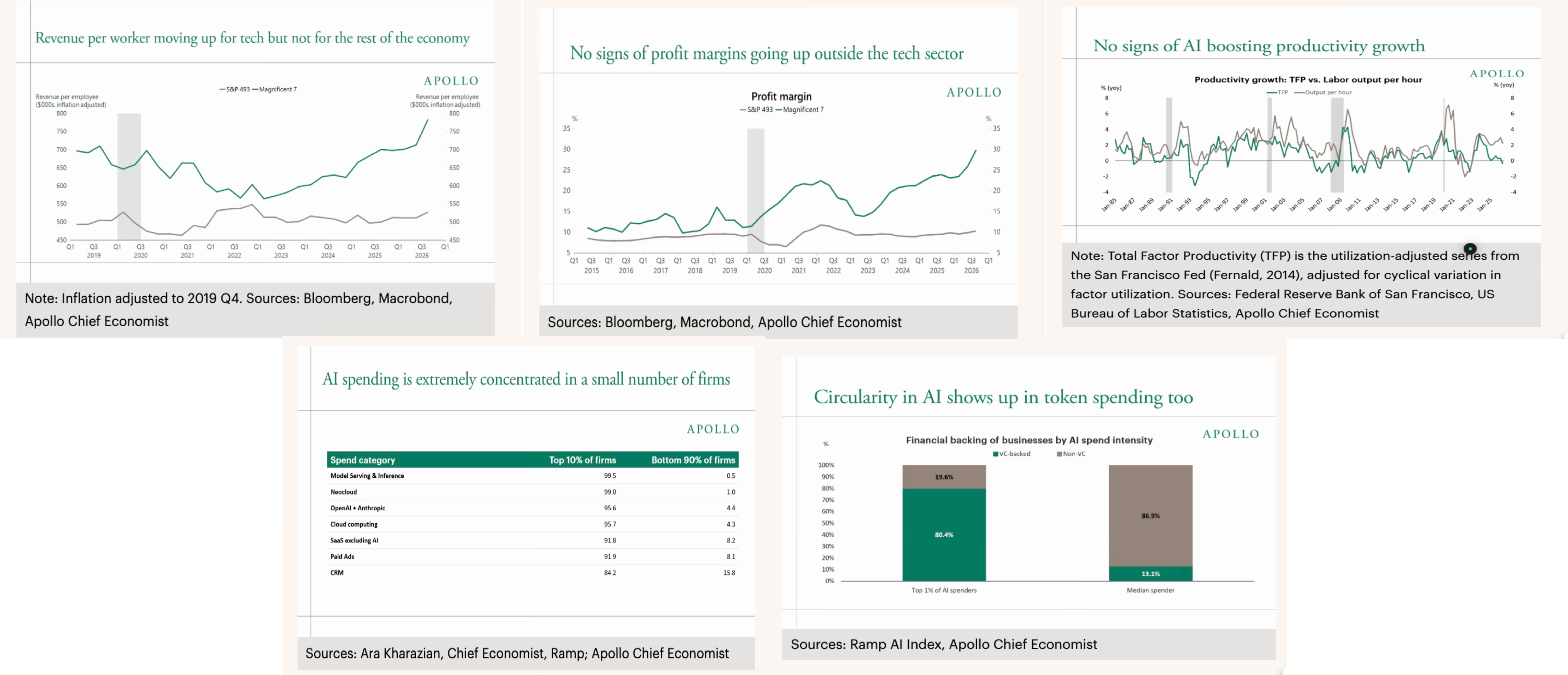
Torsten Slok’s charts show AI’s bullwhip in motion. The tip cracks and the body moves fast, but the handle, the S&P 493, doesn’t budge. Outside tech, revenue per worker and profit margins are flat, and measured productivity shows no AI boost. AI’s biggest effects are comeingthrough channels shareholders can’t easily capture: surplus going to users, new businesses entering, and platform incumbents locking customers in tighter. And last one helps a few firms, not the S&P 493…
Torsten Slok’s reading:
Yes, the bullwhip cracks at the tip, and the body of the whip is moving very fast, but the handle and the wielder are not moving at all. These things are simply not very useful. At least, not yet. And not for the existing firms that are in the S&P 493:
He comments:
Torsten Slok: No Signs of AI Payoff Outside the Tech Sector <https://www.apollo.com/wealth/insights-news/insights/daily-spark/no-signs-of-ai-payoff-outside-the-tech-sector>: ‘Despite massive investments and widespread hype around artificial intelligence, the technology has delivered zero financial payoff to corporate America outside of tech. Revenue per worker is… flat for the S&P 493…. Profit margins are… flat for the S&P 493…. No signs of AI boosting [measured] productivity growth…. Mainstream corporate America is pulling back and starting to view token spending… as a cost center…. Mainstream corporate America does not need the latest model and is unwilling to pay for it. As long as agentic AI and token spending are confined to a small part of the economy, the macroeconomic effects of AI will be very limited, see the fourth and fifth charts…
User surplus, which I think is massive. (But beware the monkey’s paw! Whether we actually need what we think we want in terms of information and communications technology is a deep and complicated multi-dimensional question.) New businesses. And whether the existing platform monopolists will be able to capture more money by finding ways to use “AI” to deepen their moats and further lock-in their customers. Those seem to me more likely to be the big issues than a massive boom in measured GDP and measurable productivity.
If so, one has to really be a debbie-downer with respect to the rationality of current market valuations.
Additional, important things for me to go and read (or reread) now:
REREAD: Brynjolfsson, Collis, Eggers, Kazinnik & Nguyen, “What is Generative AI Worth?” (Stanford Digital Economy Lab, April 13, 2026): Consumer surplus “substantially exceeds” generative AI revenue… <https://digitaleconomy.stanford.edu/publication/what-is-generative-ai-worth/>
Noah Smith, “What the AI boom is doing for Americans” (Noahpinion, Oct 5, 2026): Pushback using Brynjolfsson & al. user surplus, data-center construction, local tax windfalls, boom as a demand-side prop against Trump-era policy chaos; case resting on spending and surplus, not on S&P 493 productivity… <https://www.noahpinion.blog/p/what-the-ai-boom-is-doing-for-americans>
REREAD: Paul Krugman, “AI Versus Everything Else” (Oct 6, 2026): Datacenter boom crowding out other investment through higher long rates, and that other investment certainly having higher private and probably having higher societal retuns… <https://paulkrugman.substack.com/p/ai-versus-everything-else>
Fed Governor Lisa Cook, “An Update on AI and the Economy” (Sept 28, 2026, Oakland): Linking AI tools to the recent boom in new business formation, and warning about risk that “market concentration leads to less competition and higher markups” via platform-moat entrenchment… <https://www.federalreserve.gov/newsevents/speech/cook20260928a.htm>
Sacher, Cotter, Charles I. Jones, Anton Korinek, & Peter McCrory, “The AI expectations gap” (Anthropic research): Among U.S. adults using workj AI, 26% say it cuts a task to a quarter of the time or less, against 59% of Anthropic staff; 5% of workers vs. over half of staff say AI could do 80% of their own jobs by 2030… <https://www.anthropic.com/research/ai-expectations-gap>
User surplus and moat-deepening are huge stories and lf first-order importance for understanding the arriving attention info-bio tech mode of production. But they do not produce a hyperboom in measured GDP or an explosion in profits that justifies current market valuations.