
Spending on “Tokens”: CHART OF THE DAY
Why are there now signs that corporate AI spending has stopped growing? Usage is still rising, but token prices are falling. Anthropic's Claude premium over OpenAI shrank from roughly 2.4 times OpenAI's price in March to 1.67 times in October. Meanwhile OpenAI cut its own prices by about a third, both to compete with Anthropic and to keep firms from building on cheap or free models. The counterfactual matters most: what would spending look like if prices had held at spring levels? Nobody knows. It is way too early to declare AI demand exhausted because of a lack of actual profitable usage cases:
Thus I see it differently than Torsten Slok.
He sees AI infrastructure spending continuing at a high pace only if the corporate profits of AI-adopters explode upwards.
I see it being driven partly by greed, which does need to be validated by results, but mostly by fear, which does not.
Companies are being driven to be AI-adopters out of the fear that if they do not have natural-language interfaces, or if their natural-language interfaces are too slow or error-prone, then competitors who do have the cloud mojo to deliver accurate instant natural-language interfaces will insert themselves between the laggard company and its customers, and the laggard companies’ profits will evaporate.
Hyperscaler platform-monopolists have platform-monopoly profits to protect. Anthropic and Open AI have Digital Gods to build, and spending so much on access to datacenters that their nascent future Singularities can be the things inserting themselves between customers and laggard companies is a way to demonstrate that they can earn revenue to keep funders’ wallets open. Plus a lot of engineers want to play with powerful new technologies, have fun, maybe find a market niche, and get it all paid by the startup-investor ecosystem. And then there are all the “number go up!” people who were desensitized to fundamentals by BitCoin.
So I do not see token spend by corporations seeing out-of-control costs for no visible return as dispositive in any way <https://techcrunch.com/2026/09/09/ai-spend-per-employee-slumped-at-top-firms-in-august-summer-doldrums-or-a-warning-sign/>. Yet.
Torsten Slok sends us to the “RAMP AI” data survey:
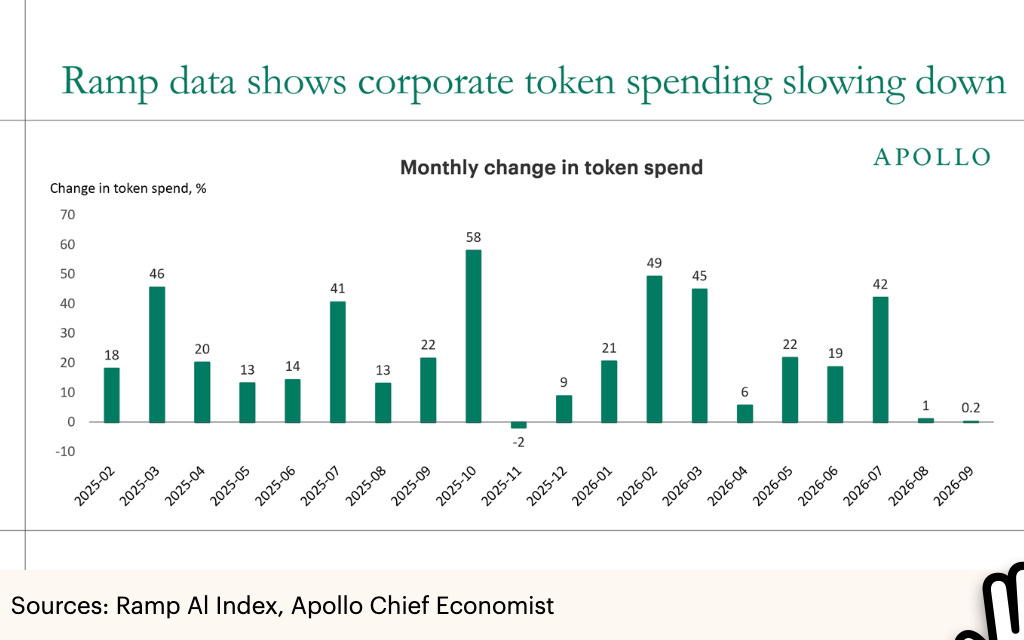
And he comments:
Torsten Slok: Slowing Token Spend Shows Compute Demand Isn’t Unlimited <https://www.apollo.com/wealth/insights-news/insights/daily-spark/slowing-token-spend-shows-compute-demand-is-not-unlimited>: ‘Compute appears to face a flat, highly price-sensitive demand curve, where even modest changes in token prices can drive buyers to throttle usage or substitute cheap open-source alternatives…. The squeeze is showing up on the supply side too. Return on invested capital for the five largest hyperscalers is declining, as invested capital grows faster than the earnings it generates….
[If] the marginal cost of producing compute exceeds the marginal benefit it delivers to users, [that] rais[es]… questions about claims of unlimited demand for data centers…. So far, the AI payoff for firms has been slow to materialize…. Companies will only pay a high price for that compute if they are able to turn the compute into higher top-line growth… little of which is showing up at scale yet. Maybe that will come in the future…
Ramp <http://ramp.com> is a corporate credit-card and bill-pay company. Its chief economist, Ara Kharazian, started the Ramp AI Index building from Ramp’s transactions data in the early spring of 2025. It now covers, I am told, about 70,000 companies. And Kharazian has hit the visibility jackpot with the recent addition of his series (also broken down by provider, by industry, and by firm customer size) to <https://fred.stlouisfed.org/blog/2026/10/which-businesses-are-using-ai-technology> the Federal Reserve Bank of St. Louis’s FRED database:
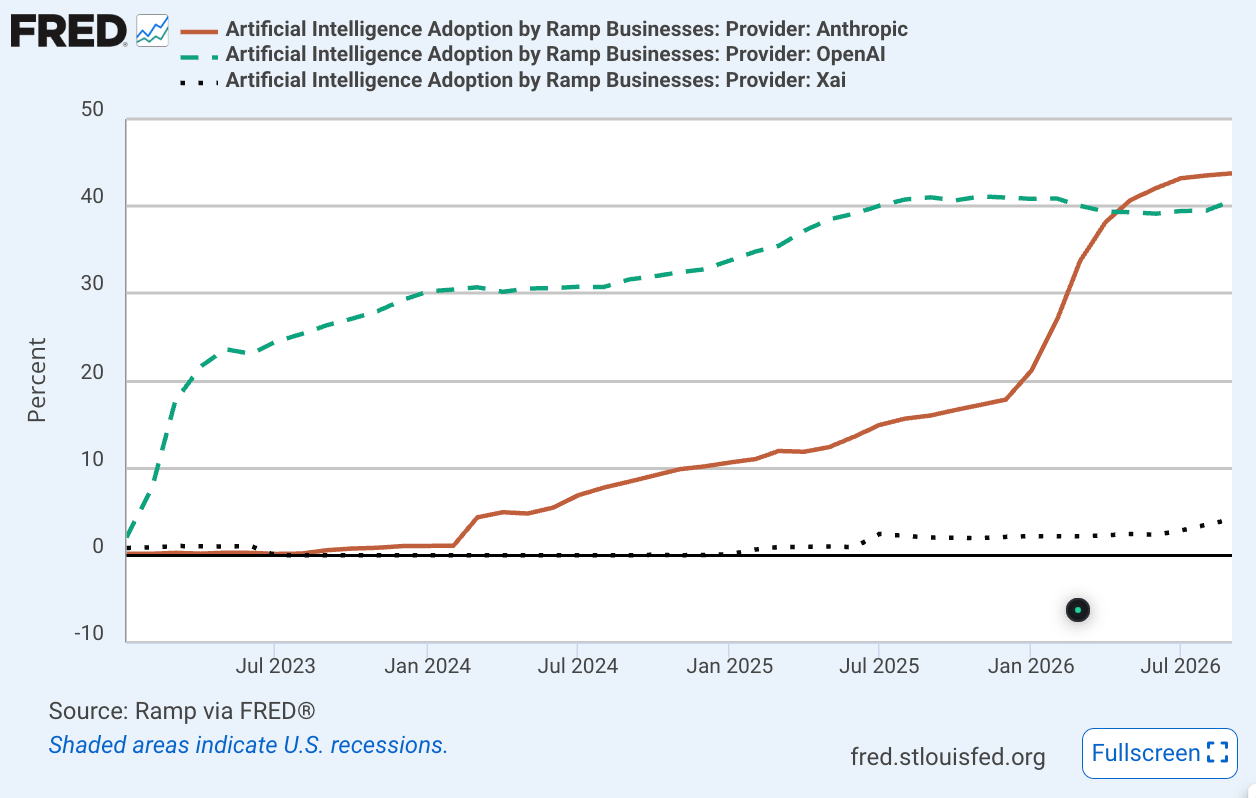
Yes, Ramp customers are massively tech-forward. Yes, it does not capture free tools or employees’ personal accounts or spending that flows through intermediaries that do not use Ramp. Yes, spending is concentrated, with 80% coming from the top 1% of Ramp customers. But it is what we got.
Kharajian himself recommends looking not just at spending but at the volume of use, and at prices:
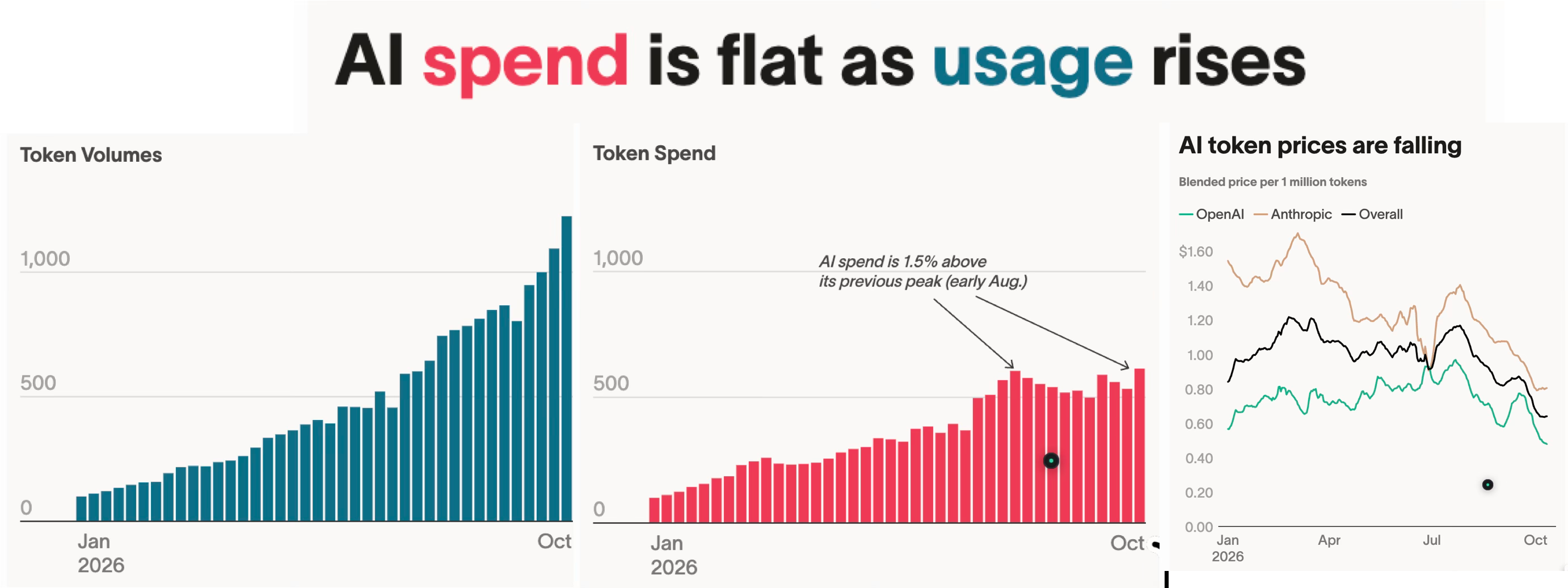
In Kharajian’s data, in October Anthropic was charging an average of $0.0000008 per token, while Open AI was charging $0.00000048: 2/3 more for Anthropic. At the height of Claude-Codeism last March it was $0.00000170 and $0.0000007: just a hair under 1 1/2 times more for Anthropic <https://ramp.com/data/ai-index-oct-2026>. Some of the slowdown in token spending growth is Anthropic’s Claude premium under massive pressure. Rather more of the slowdown in token spending growth is OpenAI’s cutting its prices by 1/3 since March, partly to gain traction against Anthropic and partly to try to keep people from investigating and building cheap- and free-model usage capabilities. Very little of the slowdown in token spending growth is a slowdown in the rate of growth of use of tokens, at least in Ramp’s data.
What would have happened had OpenAI maintained its prices at their spring levels and had Anthropic maintained its then-massive Claude premium? I would dearly love to know. I do not know. I would dearly love to.