
In Which a Pedagogical Decision to Keep People from Majoring in Economics Has Massive Consequences: CHART/ANNOYANCE OF THE DAY
Freddie deBoer says everyone ignores high-quality evidence that pedagogy and policy make little difference. Test-score gains fade. And, indeed, I could not come close today to the scores I got long ago on my linear algebra exams without a lot of boning-up on the subject. But look at the labor-market evidence. California’s top-4% from each high school’s admissions rule raised early-career wages of compliers by $20,000 a year or more. Proposition 209’s affirmative-action ban cost complying underrepresented-minority students about 5% a year. Papers on the other side suffer from weak instruments, file drawers, and forking paths. Policy matters. Pedagogy matters. The question is which ones, and how…
Consider forcing people to spend a lot of time arguing with the bureaucracy if they want to major in economics if their Econ 1 & 2 grade is less than 2.75. That is a pedagogy decision. And, boy, at UC Santa Cruz, that pedagogical choice had a hell of a big effect on what people learned in banana-slug land that thereafter made them useful to employers:
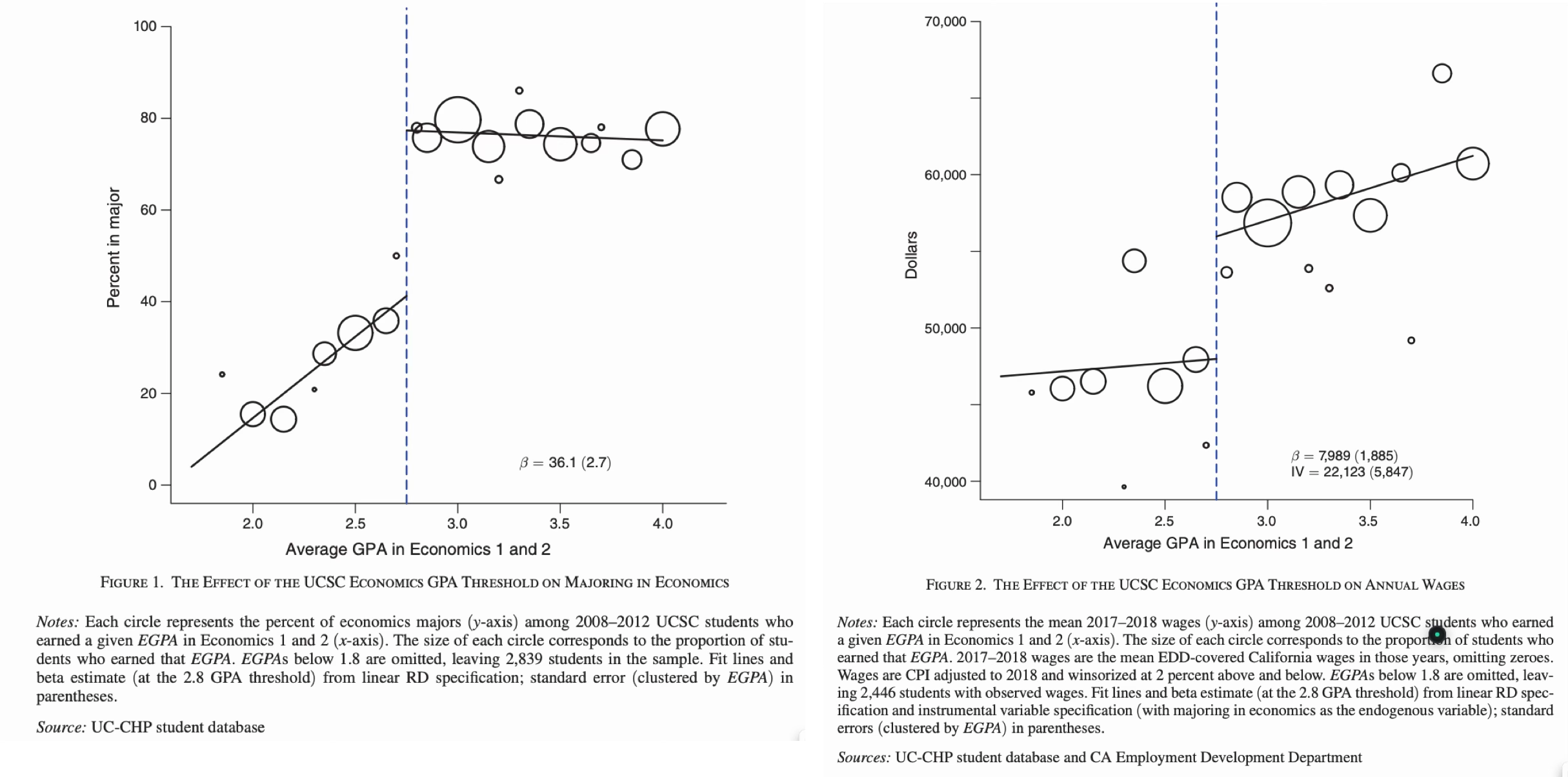
Posting provoked by:
Jack Despain Zhou: <twitter.com/tracewood…>: ‘One time, I went to school for a year and a half of full-time Chinese study and came away speaking Chinese. I would say this made me learn Chinese, but since Freddie deBoer taught me that education doesn’t work, I now understand that I was always going to have learned Chinese. deBoer has no move—none whatsoever—when you readily nod along to his central point, that education won’t meaningfully shift the bell curve of aptitude, and then say you intend to find the most effective ways to teach people all along that curve anyway. Just bounces off.
So this is the thing, right? He says education obviously helps people learn in an absolute sense, nobody would deny that, of course it does. But then he insists that all we care about in practice is relative learning, so that’s all meaningless…. I think he would benefit from taking expertise research, which looks at disciplines like that, much more seriously rather than simply leaning on “bell curve stays” results in classrooms….
If Freddie deBoer didn’t keep trying to sneak fatalism about absolute learning in based on his assessment that the rank order of students won’t change and that’s what everyone really cares about, using that to attack every attempt to improve pedagogy, I wouldn’t respond…
Freddie deBoer: ‘I think this whole “Sold a Story” podcast thing is the perfect example of how in education—to a degree that is unseen in any other subject or field—everyone has simply agreed to ignore decades of high-quality research demonstrating that pedagogical and policy decisions simply don’t make much meaningful difference in outcomes. This is a recurring theme, of course, but it’s remarkable how much unanimity of purpose there is in that regard, the degree to which everyone involved seems to understand that they have no coherent response to that evidence and so simply circle the wagons and forbid anyone from discussing it.
See, for example, Derek Thompson’s recent podcast in which he invited a propagandist who literally works for the Mississippi school system to spout their usual propaganda without an ounce of pushback, despite the fact that most of what she said was tendentious and unjustified by evidence. See Jerusalem Demsas’s The Argument, which has never presented any of this evidence, even to rebut it. See Matthew Yglesias, who will glancingly admit that the dominant determiner of academic outputs is individual student intrinsic aptitude, then scurry in the other direction to advance the same tired neoliberal “accountability” charade. Again, it’s not just the refusal to come to the obvious conclusions, it’s the absolute dedication to making sure that the evidence and arguments simply don’t enter into the conversation. It’s consensus-making via quarantine…
Brad DeLong here: I come to this via the economics-of-education literature. In that literature, the overwhelming weight of evidence is that if you attend, successfully, an actual educational institution, you will get 6% per year in higher income afterwards. Or more. If you work very hard to achieve your result, you can maybe get that 2%-points of that is sorting, but probably not. If you work very hard to achieve your result, you can maybe get that 1%-point of that is signalling, but probably not. From that, by continuity, policy and pedagogy have to matter: they are what make the difference between, say, the University of California at Berkeley on the one hand and, say, the educational grifting operation of Stanley Kaplan University run by the Grahams of the Washington Post on the other.
My first guru for this, of course, given where I am, is a guy named David Card: