CROSSPOST: CLAUDIA SAHM: Hand the Pen to the Committee
Warsh’s press conference and the FOMC committee statements he is letting through are pointlessly opaque. Pointlessly, that is, if the idea is to make good monetary economy and have a stabilized high-growth sustainable-employment low-inflation economy. Warsh’s opaqueness, however, does have a point if you think that Warsh’s principal objective is to delay the day of reckoning when he has to choose between having Trump conclude that he has been betrayed and having the bond market conclude that it is being betrayed by Warsh. He will ultimately have to choose between one or the other, but each day that choice is delayed is a victory for him, if not for the economy, the country, and the world:
We have Claudia Sahm this morning.
She is stressing that:
Under Warsh, the FOMC statement is less than half its old length.
Under Warsh, what he says at the press conference doesn’t track the Committee’s views.
As a result, markets initially filled the gap by pricing in more tightening than the Fed in fact intended—and than it would have known had Warsh not messed up both the statement and the press conference.
Be clear: Claudia Sahm agrees 100% with the Fed’s September rate hike. Her objection is to how it was explained. And her objection is very cogent.
This is, to say, the least, unprofessional.
Claudia went on to say that a rate hike that is (a) insurance is small and conditional, while one that is (b) forced by the Fed’s beliefs about the inflation outlook is not. Since, on decision day, Mademoiselle Marchée couldn’t tell which kind she was getting, she split the difference when in fact she was getting (a). Fifty more words in the statement could have saved two Fed officials from talking down expectations of a further rate hike that the Committee had never seriously considered.
This time, Warsh’s opacity both confused markets and annoyed Donald Trump. No man can serve two masters, although Warsh tries. And this time he did not serve either one. As Claudia further points out, when the Chair is the Committee’s outlier, the statement has to carry the Committee’s reasoning. It didn’t. And it doesn’t.
Claudia Sahm:
CROSSPOST: CLAUDIA SAHM: Hand the Pen to the Committee
<https://stayathomemacro.substack.com> <https://stayathomemacro.substack.com/p/hand-the-pen-to-the-committee>

The Fed’s main reason for raising rates took three weeks to reach the public. The statement should carry it on decision day.
Claudia Sahm
2026-10-12

Three meetings make a trend. Under Chair Warsh, we no longer learn the Committee’s reasoning on the day of the decision. Instead, we must wait three weeks for the FOMC minutes. The statement has been cut by more than half, and the press conference no longer sticks closely to the Committee’s views. The cost of that delay showed up in markets this time, which priced in more rate hikes than the Committee itself projects.
My complaint is with the communications, not the decision. I agree with the quarter-point rate increase and share the risk-management reasoning of many Fed officials.
There is a straightforward solution, and it’s one for the Committee: put the rationale for the decision in the statement. The public and markets need to understand why you voted the way you did. The minutes can add details three weeks later, but the statement should make the story clear, including where views diverge. Today’s post traces the Fed’s information flow on the September decision, shows what the confusion cost in interest rates, and proposes what the statement could say on decision day.
What we learned, and when, on why the Fed raised rates.
The fundamental tension in Fed communications now is that Chair Warsh approaches monetary policy differently than the rest of the Committee. This should surprise no one. Even as a Governor, Warsh stood out as a monetary policy outlier. Now the outlier is the Chair. Chairs Bernanke, Yellen, and Powell, who had the same set of communication tools, were much closer to the Committee’s thinking, though each, on the margin, shaped the approach.
Here is what we learned about why the Federal Reserve raised interest rates on September 16, in the order we learned it. Emphasis added in bold.
FOMC statement (2:00 pm, decision day):
Inflation remains elevated. Today’s policy action will support a timelier return to the Committee’s 2 percent goal. The Committee will deliver price stability…
Summary of Economic Projections (2:00 pm, decision day):
While the SEP does not provide a rationale for the policy decision, the dot plot, with its appropriate path of monetary policy, offers a sense of how much tightening the Committee had in mind. The median Fed official (excluding Warsh, who did not submit projections) viewed one more quarter-point increase this year, on top of September’s, with no further increase by the end of next year, as appropriate. That half-percentage-point total is markedly less than the 3-percentage-point increase in a typical hiking cycle. In addition, 17 of 18 participants said inflation risks were weighted to the upside.
Chair’s press conference (2:30 pm, decision day). In his prepared remarks, Warsh repeated the statement language above and offered details:
Our decision comes at a time when the American economy appears to be strengthening. New hiring, private-sector earnings, business capital investment—each of these markers has improved in recent months and is pointing in a good direction. Credit flows have been robust, particularly for businesses. And, as I said at the policy symposium in Jackson Hole, I would be hard pressed to describe broad financial conditions as restrictive. This view was widely shared by the Committee. So we removed a dose of accommodation…
Key speeches by Fed officials (about two weeks later):
Several Fed officials spoke after the FOMC meeting. Two speeches received considerable attention: those by New York Fed President John Williams and Board Vice Chair Philip Jefferson, who, along with Warsh, make up the FOMC’s leadership.
Based on the totality of the data, the balance of risks to achieving our dual mandate has evolved in recent months. With the economy proving resilient in the face of shocks and with underlying demand strengthening, the risk to maximum employment has receded. At the same time, the risk to achieving price stability has increased. In particular, the inflationary impact of the AI-related demand shock is increasingly salient, and I now expect somewhat larger and longer-lasting effects from energy prices on inflation…
Considering the economic conditions that persisted through mid-September, the FOMC voted last month to raise the target range for the federal funds rate by a 1/4 percentage point to 3-3/4 to 4 percent ... I supported that decision because I saw it as the appropriate policy to pursue the Fed’s dual mandate. This was an important step to ensure longer-term inflation expectations remain well anchored and to validate the public’s confidence that we will achieve our 2 percent inflation objective in a timely manner…
Finally, the FOMC minutes (three weeks later) offered the definitive view on why the Committee raised rates in September:
In their consideration of monetary policy at this meeting, all participants supported raising the target range for the federal funds rate 1/4 percentage point to 3-3/4 to 4 percent. Participants generally emphasized that inflation remained elevated while the labor market appeared to be near full employment, with some signs of strengthening, and that economic activity was expanding at a solid pace. Furthermore, almost all participants assessed that, while inflation risks were tilted to the upside, risks to the labor market had diminished and were now broadly balanced. Based on the outlook and the changing balance of risks, all participants viewed a higher target range for the federal funds rate as appropriate. Participants judged that this would support a timelier return of inflation to the Committee’s 2 percent goal. Many participants emphasized that a higher path for the target range would be prudent on risk-management grounds, providing insurance against inflation remaining persistently above target due to stronger-than-expected demand or further adverse supply shocks. A number of participants viewed a higher path for the target range as necessary based on their modal outlooks rather than on risk-management grounds. Some participants remarked that a higher policy rate would diminish the risk of persistently elevated inflation unanchoring inflation expectations and becoming further entrenched…
On the day of the decision, we did not get a complete picture of the Committee’s reasoning. The subsequent Fed speeches helped fill some of the gaps, but it wasn’t until the minutes came out that the theme of risk management came through clearly. According to the minutes, risk management was the most common reason for raising rates, followed by participants’ baseline forecasts for inflation and concerns about anchoring expectations.
“The economy is strengthening,” as conveyed in the press conference, is a very different reason to raise rates than “we are concerned about the risk that inflation stays high.” The former supports several rate hikes; the latter supports a small rate adjustment.
The minutes also reveal another problem with the statement. The Committee was united in raising rates but divided on why. Nothing in the statement alerted us to these divergent views. A “timelier return” to 2 percent inflation is probably something all three groups can sign on to, but it left out a lot of information. It also sat awkwardly with the SEP, where the median does not reach 2 percent until 2029, and led to a confusing exchange with a journalist in the press conference when Warsh said the projections were not his.
Confusing communication is costly.
The September meeting offers a clear example. The market odds of rate hikes this year, and especially next, rose during the press conference, as Warsh’s words were viewed as more hawkish than the statement or the dot plot. Market pricing continued to rise in the weeks after.
The growing gap between more aggressive market pricing and the modest increases in the dot plot likely shaped what Williams and Jefferson said two weeks after the meeting. Before they spoke, the odds of a rate hike in October had climbed to about 70% (chart below). In addition to sharing their reasons for raising rates, they had a message of patience. Williams said there was “no need for urgency” and that they have “time to gather more information.” The market odds dropped 20 percentage points. Jefferson noted that yields had risen further since the meeting and reinforced the theme of patience, saying it “may take more time” to form judgments about policy. The odds dropped another 13 percentage points.
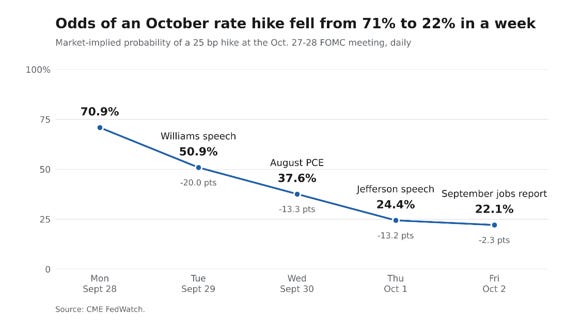
With more favorable inflation data and softer-than-expected payroll data also that week, the odds of an October hike ended the week just over 20%. Two thirds of the decline came on the days of the two Fed speeches.
Confusion about the Fed’s reasons for the hike on the day of the meeting helped create the need for this post-meeting correction. A hike explained as insurance is limited and conditional, and one taken because the inflation baseline requires it is not. In the minutes, many participants called a higher path “prudent” on risk-management grounds, and fewer called it “necessary.” Had the motive been clear on decision day, markets could have worked out the pace themselves, and two officials would not have needed to give explicit guidance about October. Warsh is right that explicit forward guidance should not be necessary right now. But that depends on clear communication from the Fed about its policy decisions.
The October meeting is the easiest case to document, but the larger gap between market pricing and the SEP is for next year, and it remains. Higher-than-intended interest rates cost borrowers. When unclear communication pushes rates above what the Committee intends, that is unintended tightening.
Cleaning up decision day: let the Committee speak.
On the day of the decision, we must understand the reasons for the Committee’s decision. The statement is the best place for the Committee’s thinking to live. Clarity should take precedence over brevity. Accuracy should take precedence over the appearance of consensus. If there were three reasons behind a vote, then share the three reasons, as the minutes do. If it takes a few sentences to get the main ideas across, then use them. Only the FOMC knows why it voted the way it did. Tell us, so outsiders aren’t guessing or filling in the blanks.
Given what we know now from the minutes, my suggestion (added text in yellow) for the September statement would have been something like:
(My proposed last paragraph for the September statement)
Inflation remains elevated. Risks to inflation are tilted to the upside, while risks to the labor market are now broadly balanced. The reasons for the increase varied across the Committee. The most common was to insure against inflation staying persistently above target. Smaller groups cited their baseline outlook for inflation and the need to keep inflation expectations anchored. Today’s policy action will support a timelier return to the Committee’s 2 percent goal. The Committee will deliver price stability…
This adds about 50 words, and the statement would still be shorter than a year ago.
Unanimous in purpose and in action, but divergent in the specific reasons. That’s an honest assessment of where the Committee is. It’s good for accountability, and it’s also good for markets trying to figure out where the Fed is headed next. Understanding where the Committee is right now in its thinking is valuable. Waiting three weeks to get a clear picture is unacceptable.
The Chair is the only person on the Committee who is allowed to speak for the Committee, but that doesn’t mean the Chair is the only possible messenger. The statement, like the minutes, is a Committee document. Hand the pen to the Committee and give Warsh the mic at the presser.
In closing.
The goal is good policy. Good policy is best served by good communication. For three FOMC meetings in a row, the reason for the vote has not been fully communicated on the day of the decision. Waiting three weeks for the minutes is too long.
I agreed with the decision to raise rates in September. My own shift from hold to hike came from heightened upside risks to inflation. The FOMC said it is trying to support a “timelier return” to 2% inflation. Good, now I want to see them deliver timelier information on their thinking. Explain the decisions when they are made.
<https://stayathomemacro.substack.com/p/hand-the-pen-to-the-committee> <https://stayathomemacro.substack.com>
Brad DeLong here: Odds of an October hike reached about 70% before New York Fed President John Williams and Vice Chair Philip Jefferson stepped in to calm things down. Two-thirds of the drop that followed came on the two days they spoke. There was a cost to this round-trip, an avoidable cost. It was the result of a statement that said too little, and a press conference that said even less that was true about the FOMC’s frame of mind.
You already know why I think this is happening. What are the implications?
Well, look at the September information flow:
The post-meeting statement said only that inflation “remains elevated” and that the hike would support “a timelier return” to 2%.