
Henry Farrell of Johns Hopkins Agora Comes to Berkeley: FOG & FLATLANDS
Farrell treats AI as one more of the information-processing social institutions Herbert Simon described, alongside markets and bureaucracy, rather than as the buliding of a Machine God-Overlord:
Now comes Henry Farrell to to BESI—to the Berkeley Economy & Society Initiative’s “Capitalism & Democracy” lectur series.
Henry is here to:
Title: “AI as Social Technology: A Research Agenda for Political Science”
When: Friday, October 9, 2026, 4–5:30 p.m.
Where: 820 Social Sciences Building, UC Berkeley
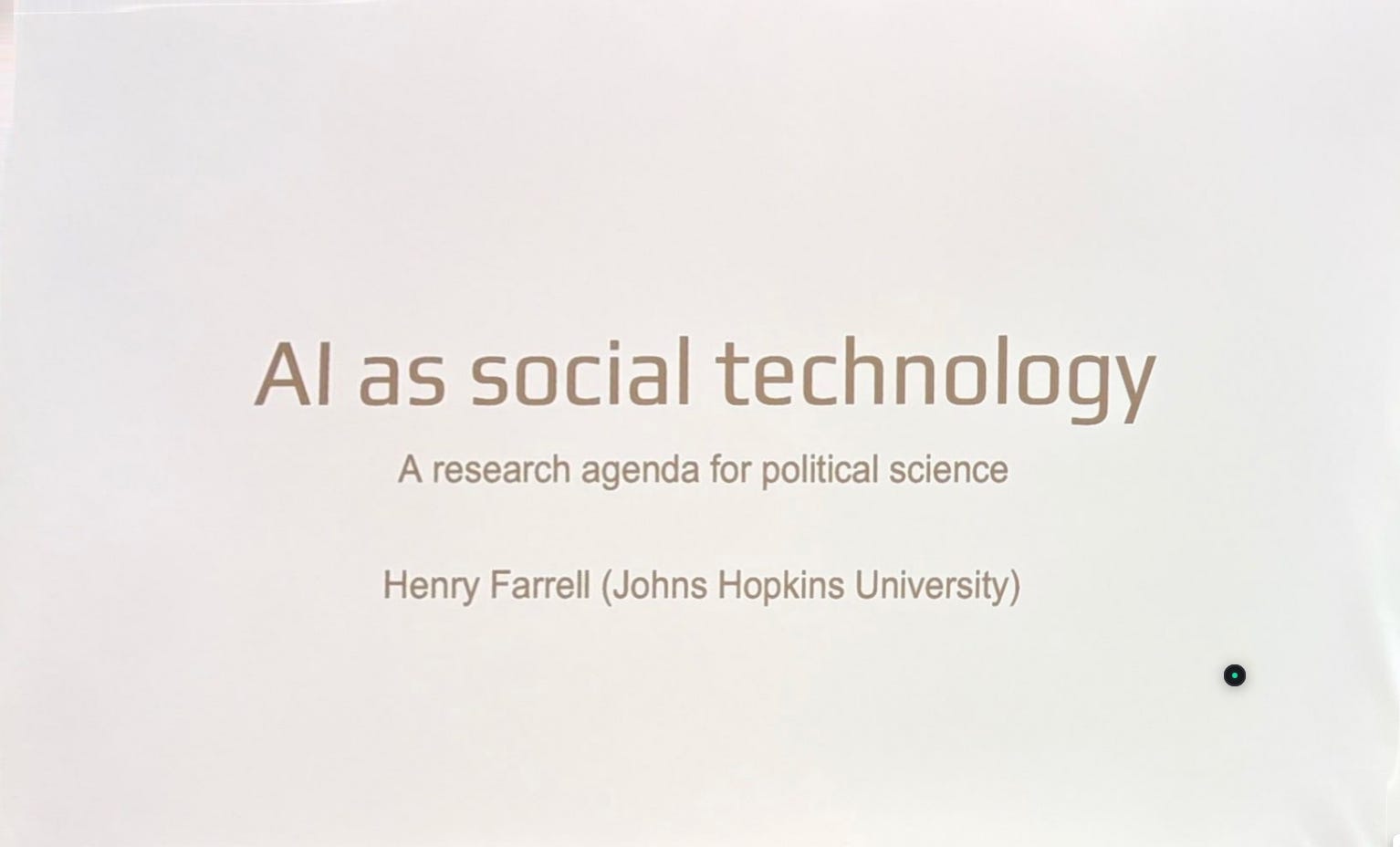
Henry has a teaser:
Henry Farrell: Event Information <https://besi.berkeley.edu/event/ai-as-social-technology-a-research-agenda-for-political-science/>: ‘Political scientists are only beginning to think systematically about how AI may reshape the topics they study, even though one of the founders of the field of AI, Herbert Simon, was a political scientist. In this talk, Johns Hopkins political scientist Henry Farrell will leverage ongoing work with collaborators (including Alison Gopnik, James Evans, Cosma Shalizi, and Hahrie Han) to argue that Simon’s work on collective information processing provides a useful foundation for political scientists to think about how AI affects politics.
Simon argued that individual human cognitive capacities are limited, and larger-scale institutions such as markets and bureaucracy provide means of collectively processing information and reducing down the complexities of the world to make them more manageable. More recently, computer scientists and physicists have begun to use concepts such as lossy representations and coarse graining to make closely related arguments.
In his presentation, Farrell will explain how large language models provide just such lossy representations, as previous technologies have done before. Recognizing this opens up new possible research questions for political science and political theory, says Farrell. He’ll lay out the beginnings of one new agenda item: how lossy technologies of representation affect the formation of democratic publics.
And Paul Pierson says:
Henry Farrell is the SNF Agora Professor of International Affairs at Johns Hopkins School of Advanced International Studies. He is the 2019 recipient of the Friedrich Schiedel Prize for Politics and Technology, a prize for “outstanding individuals who contribute to inter- and trans-disciplinary projects linking politics and technology,” awarded jointly by the Friedrich Schiedel Foundation and the Technical University of Munich. Previously, he was professor at George Washington University’s Department of Political Science and Elliott School of International Affairs.
He works on a variety of topics, including the relationship between democracy and information, the security consequences of international economic networks, and international political economy. He is the co-author, with Abraham Newman, of Underground Empire: How America Weaponized the World Economy <https://us.macmillan.com/books/9781250840554/undergroundempire/> (2023), which was awarded the Council of Foreign Relations Arthur Ross Book Award Bronze Medal.
And I have a question (many questions, actually, but here is just one) for Henry:
As of 1880, when he was writing Socialism: Utopian & Scientific Friedrich Engels had what he thought were reasonable hopes and reasoned faith that the lived experience of the steampower economy—enormous human productive power, substantial interchangeability of individual human cogs in the productive machine, the insubstantial relative nature of all potential divisions between humans in the face of the techno-organizational requirements of the steam engine—would make it obvious that we should all dress in identical blue overalls, call one another “comrade”, share the enormous productive dividends of steampower and science equally, and build a free society of associated producers, replacing politics as the domination of man over man with the mere administration of things and coördination of processes of production.
But the steampower economy was succeeded by the applied-science economy of the Second Industrial Revolution GPTs in which divisions of skill, experience, industry location, and ethnicity were to “play the serpent to this paradise” of the Belle Époque. Could anyone in 1880 have been reasonably expected to anticipate much of anything about the shit was going to go down over the next sixty years? How soon could people have been expected to inclue themselves to pieces of it?
And what lessons from the transition from the steampower to the applied-science modes of production can we learn as we confront the transition from the globalized value-chain to the info-bio tech-attention mode of production?
Thinking about the political-science research program that Henry is working to, I find myself thinking right now about:
The Herbert Simon Frame: Political science already has the tools to understand “AI”. It has simply forgotten them. Herbert Simon held that individual minds are limited, so markets & bureaucracies process information collectively by simplifying the world. Large language models do the same thing: they are new and powerful ways of accessing the real-ASI the Anthology Super-Intelligence of the collective human mind, and put it to use via the management-cybernetics trick of creating a useful coarse-graining of information for action in the current situation. Seeing LLMs as social & cultural technologies akin to writing and recording, print distribution, markets, bureaucracies, feudal hierarchies, democracies, ideologies, and so forth rather than nascent godlike minds opens new questions.
The Shoggoth Frame: Doomerscasts LLMs as alien minds behind a smiley mask, waiting to devour us. Henry Farrell & Cosma Shalizi turn it aroundL The self-regulating market & the iron cage-building Weberian bureaucracy were the first vast, inhuman information-processing systems. And “he Singularity” began with the Industrial Revolution. LLMs are a newer, smaller shoggoth. They condense human writing into useful but lossy summaries, no lossier than prices, bureaucratic categories, & opinion polls. The real questions are how these systems compete & hybridize. Could LLMs capture Hayek’s tacit knowledge better than prices do? Will they make Kafka’s bureaucracies saner, or more arbitrary & opaque?
The Democratic-Publics Frame: Much prominent work on AI & democracy imagines algorithms perfecting deliberation, with randomly chosen mini-publics reasoning their way to consensus. Henry Farrell & Hahrie Han call that a mirage. Real democracy runs on enduring, interested publics: parties, movements, & coalitions like Minnesota’s ISAIAH. Feedback loops of negotiation, loyalty, & power hold them together. Does AI strengthen those loops, or replace them with brittle, microtargeted crowds of outraged consumers?
Further Reading:
<https://www.programmablemutter.com/p/shoggoths-amongst-us> <https://knightcolumbia.org/content/ai-and-democratic-publics> <https://www.science.org/doi/10.1126/science.adt9819>