
CROSSPOST: NOAH SMITH: There Is No “Indian Question”
What kind of a nation America is going to be? It will be what it has been: A country composed of all those who escape from the Old World and all of its mistakes and tyrannies to build a god-fearing prosperous utopia here in the New World: that is our errand unto the wilderness, and that has been constant since 1630. Rufo and Lomez’s “question” is part nativist panic and part knife aimed at JD Vance. The answer was given aboard the Arbella: come to the New World to avoid all the mistakes and the tyrannies of the Old World, and to build a god-fearing prosperous utopia, take up that commission, and become one of us. Hazing makes ethnic enclaves. Covenants make Americans. Ask George Mitchell, Irish-Levantine Maronite altar boy turned Bowdoin College graduate and Yankee Senate Majority Leader...
Let me just turn the intro for this over to Ta-Nehisi Quotes:
Ta-Nehisi Quotes: <https://x.com/steady_drumbeat/status/2107552860380582132>: ‘@L0m3z, sputtering, red-faced, pleading w/ Noah Smith that he’s only bullying Indian kids to HELP them integrate. Noah’s the wrong guy to try this kind of argument on. It’s like trying to bullshit about wine to a dog. He calls @l0m3z a Pakistani. @L0m3z is left stunned. He’s been bodied. Noah Smith is not the hero we deserve, but he is the hero we need. Noah Smith’s power is his dumb guy confidence. The left is a nest of vipers waiting to pounce on anyone who expresses a positive stand on anything. Ezra Klein meekly suggests relaxing zoning rules on setbacks and lefty twitter reacts like he punched a pregnant woman in the in the stomach. In such an environment, it is the guileless moron who attains the status of sage. Because he just blithely says stuff..
Yes. Saying what you think, and giving reasons for it, is a superpower!:

CROSSPOST: NOAH SMITH: There Is No “Indian Question”
<https://www.noahpinion.blog/p/there-is-no-indian-question> <https://www.noahpinion.blog>

The actual question is what kind of a nation America is going to be.
Noah Smith
2026-10-07
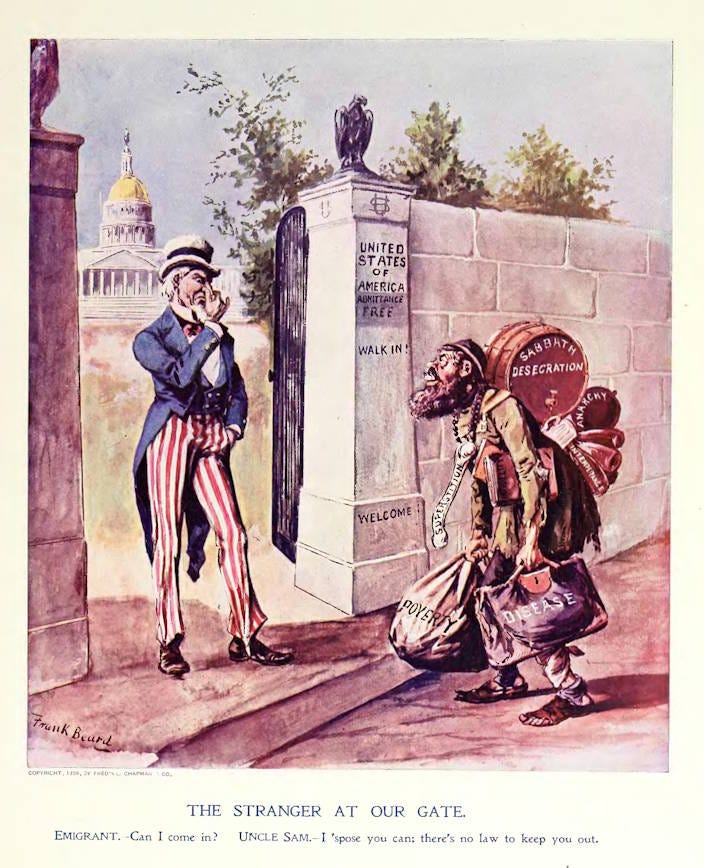

“Our nation was founded to perpetuate democratic principles. These principles are that each man is to be treated on his worth as a man without regard to the land from which his forefathers came and without regard to the creed which he professes. If the United States proves false to these principles of civil and religious liberty, it will have inflicted the greatest blow on the system of free popular government that has ever been inflicted. Here we have had a virgin continent on which to try the experiment of making out of divers race stocks a new nation[.]” — Teddy Roosevelt
The other day, Chris Rufo of the Manhattan Institute and right-wing pundit Jonathan Keeperman (also known as “Lomez”) aired an episode of their podcast entitled “The Indian Question”:
The title of the episode seems to be a reference to “the Jewish Question”, a term in 18th and 19th century Europe for the question of how Jews should be treated in European society. That term, of course, became notorious when it was associated with the Nazis’ “Final Solution”, which was billed as being a final solution to “the Jewish Question”. I assume that Rufo and Keeperman chose this rather incendiary title in order to grab attention. Well, they succeeded.
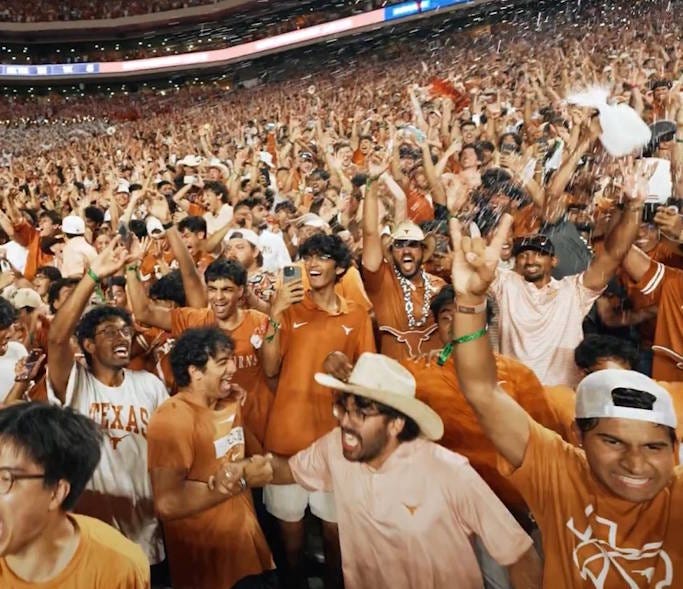
The episode was motivated by a debate that’s been raging across social media for weeks. It was kicked off by Bo French, the Republican nominee for Texas Railroad Commissioner, who tweeted outrage at a group of Indian American kids attending a University of Texas football game. I already wrote about that controversy three weeks ago:
The anti-American Right Noah Smith Sep 15 Read full story
Jonathan Keeperman (“Lomez”) invited me on his podcast to share my views and debate him, so I did. Here’s the episode that resulted:
Rufo was busy, so it was just Keeperman and me.1
Anyway, before I talk about the substance, I thought I should say something about the side debate of whether a liberal like myself should even go on right-wing podcasts like “Rufo and Lomez”. Throughout most of the 2010s, there was a popular notion that society should basically ignore and shun people like that, and that if we all simply shunned them, and pressured our friends and colleagues to shun them, they and their views would vanish from American society — or at least remain marginalized.
That approach failed. Anti-immigrant ideas didn’t remain marginalized — in fact, they took over the country, despite their continued unpopularity among the general American public. Are Rufo and Lomez pushing xenophobic ideas? Yes, of course they are. I’m not going to sugarcoat that fact just to be polite. But simply shouting “Those guys are XENOPHOBES!!” and keeping those guys out of polite society would be doubling down on a foolish, self-defeating strategy. The alternative was always to confront those viewpoints directly and defeat them in the court of public opinion, so that’s what I set out to do.
OK, anyway, on to the substance of the debate.
Keeperman and I began the debate by finding common ground. We both basically subscribe to the principle of nationalism — we believe that nation-states are exclusive clubs that exist for the benefit of their members, and that this is a basically good way to organize human society. We both think the United States of America is basically good — or at least, has been basically good throughout most of its history.
I explained my belief that liberal nationalism is the best ideology available — maybe for other countries, but certainly for the United States. All of our greatest successes as a country — victories in wars, successful policy reforms, integration of past waves of immigrants — have come from our use of the nation-state as a tool to promote individual rights, dignity, and empowerment. I told Keeperman that the Abundance Agenda is, at least implicitly, an expression of liberal nationalism — the movement is about creating abundance for Americans specifically, with the implicit premise being that Americans deserve abundance.
Keeperman disagrees about the liberal part, of course, but he does feel that he has the best interests of the United States in mind. His worry is that immigration is stoking ethnic conflict in America, because recent immigrant groups — for example, Indians — are not assimilating into American society like previous groups did.
To me, assimilation has always been about measurable behavior. If the children and grandchildren of immigrants act culturally American — if they speak English, intermarry, give their kids typical American names, go to college football games, climb the income ladder, move out of enclaves, and so on — then they’re assimilated. By all of these standards, the recent waves of immigrants — Mexicans, Chinese people, Indians, and so on — are assimilating just as fast as or faster than the East and South European wave did a century ago, or than the Irish and the Germans did two centuries ago.
The aspect of assimilation that Keeperman worries about most is national identity — the degree to which the children and grandchildren of immigrants feel bound up in a shared community and a shared identity with countrymen of different backgrounds. I agree that this is extremely important; many of the benefits of the nation-state, like the ability to provide public goods and welfare states, come from this sort of shared identity. It also probably leads to greater toleration of minorities (including immigrants). All of those goals should be very important to liberal nationalists.
Lomez — who is not a liberal, but cares about national cohesion nonetheless — worries that identity assimilation is lacking in the modern day. He argues that today’s immigrants retain their old-world allegiances much more strongly than the immigrants of a century ago — that second-generation Indian Americans in Texas still think of themselves as Indians rather than as Americans, and so on.
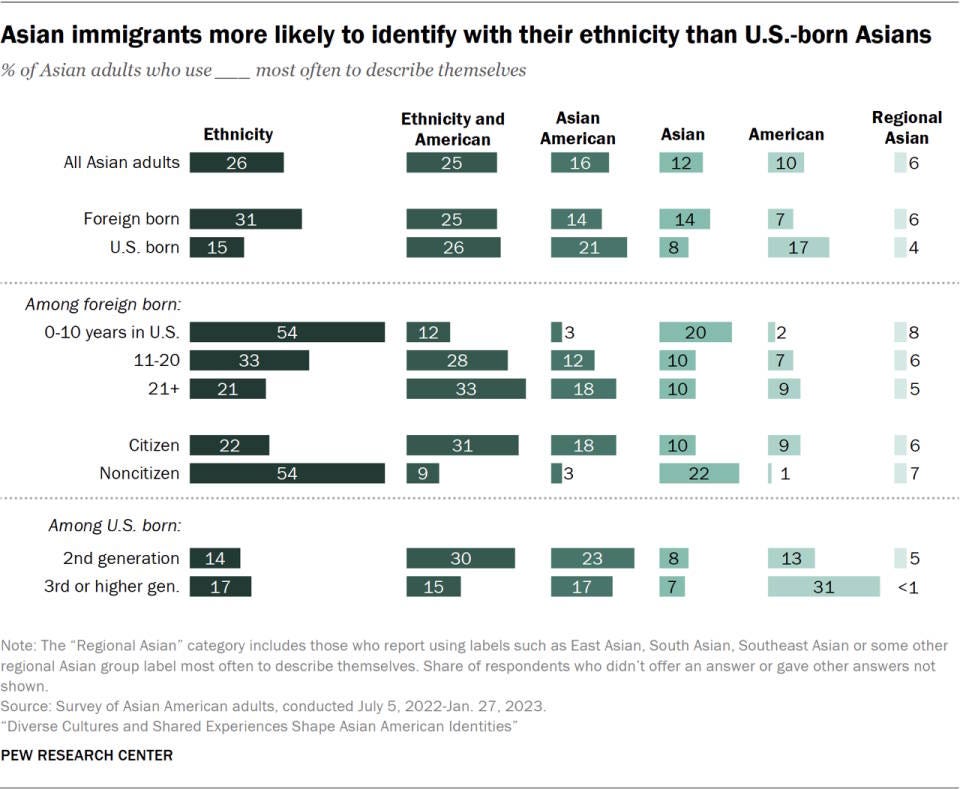
We do have lots of surveys about this, in fact. There’s a clear pattern — immigrants tend to identify more as their ethnicity than as “American”, but later generations are more likely to identify as “American”. Here’s a survey showing that third-generation Asian Americans are a lot more likely to identify as just “American”:
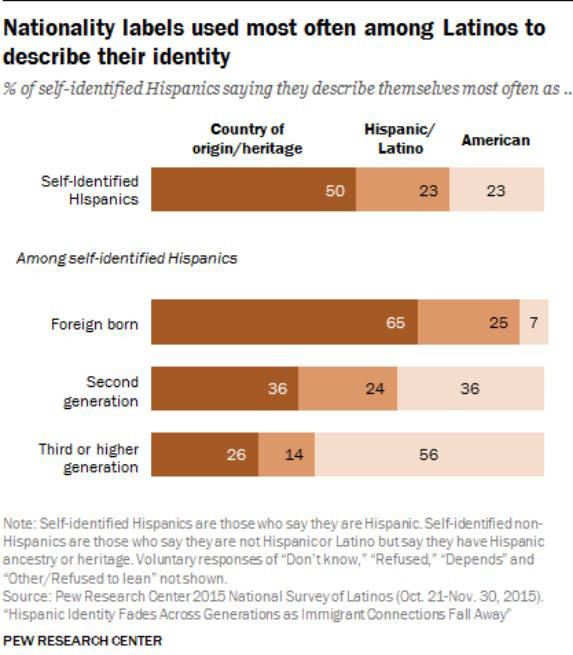
We see the same pattern even more strongly among Hispanics:
Second and third generation immigrants are also a lot less likely to describe themselves as “global citizens”.
Now, these could be generational effects — people identifying more as “American” as their families stay in America for longer — or they could be cohort effects. It’s possible that due to identity politics, plummeting patriotism, or to the ability to connect with co-ethnics abroad on the internet, recent cohorts of immigrants are less likely to want to identify as “American”.
In fact, we have some evidence that this is happening for Indians, specifically. In 2020, the Indian American Attitudes Survey found that the second generation was a lot more likely than the first (i.e., immigrant) generation to identify as “more American than Indian”:
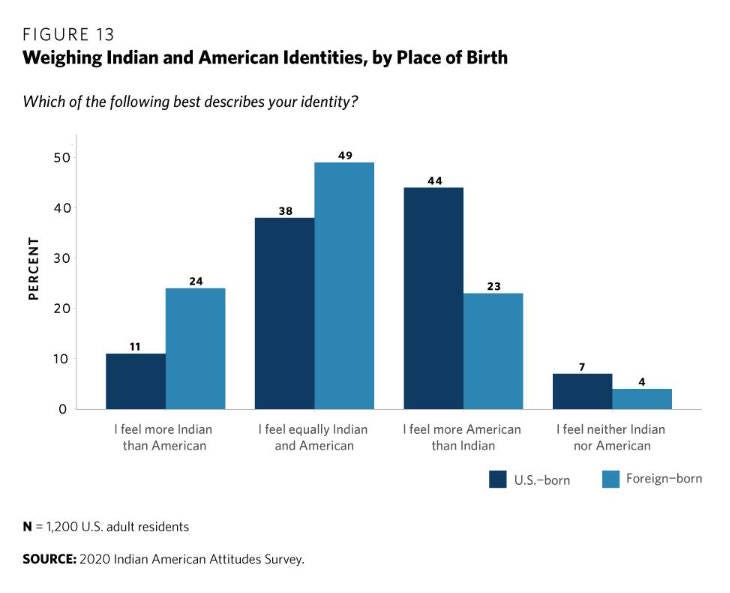
But by 2024, that pattern was somewhat weaker, with more U.S.-born Indian Americans identifying as “more Indian than American” and “equally Indian and American” than four years prior:
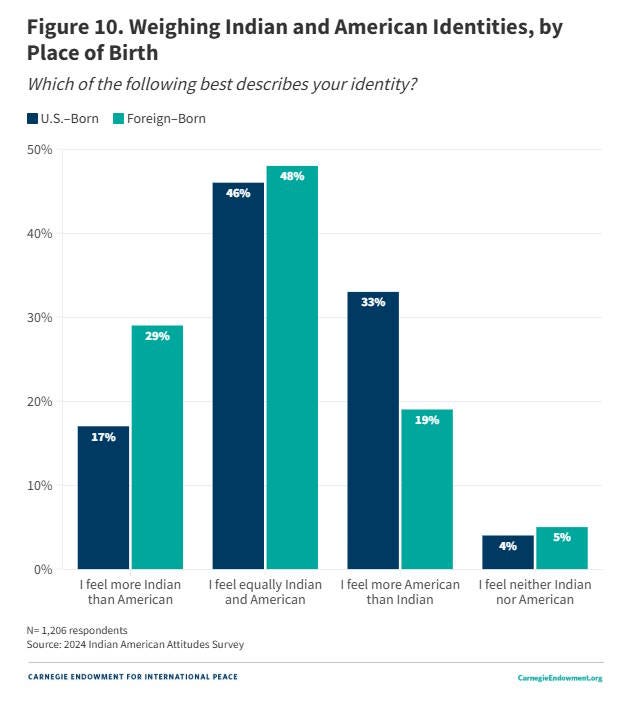
This is just two survey snapshots, a few years apart. It would be helpful if we had had good longitudinal surveys asking people about American identity versus ethnic identity for decades. But we don’t, so we’re left to worry and speculate.
Without longer-term data, my guess is that this identity shift — to the degree that it’s real and not just survey noise — is a short-term response to political conditions. Indian Americans had full access to the internet in 2020, and they were just as able to talk to ethnic Indians in India or Australia or Canada. Identity politics — including institutions such as ethnic clubs at universities — had been around for decades, and the sentiment behind it was probably at its height in 2020.
Instead, my bet is that we’re seeing a reaction to the rise of the MAGA Right itself. It was in 2024 — right before the second survey wave — that anti-Indian attitudes became extremely popular among the online Right. 2024 is also when it became clear that a wave of anti-immigrant sentiment was sweeping the nation. My guess is that stronger ethnic identification among Indian Americans was probably a reaction to the perception that a substantial part of America was attacking Indians.
Keeperman — like other rightists I’ve talked to — seems to think that immigrant groups assimilate only under aggressive pressure from the majority. The model I usually hear is that of German Americans in World War I, who were the subject of feverish forced-assimilation campaigns — pressured to change their names, stop speaking German, and profess allegiance to America. In his discussion with Rufo, Keeperman argued that vocal anti-Indian racism was part of a “hazing process”.
My argument is that this is exactly backwards. Ethnic identity is fundamentally defensive in nature. Identity groups are like gangs — if you no longer feel like a part of the big gang (the nation), you’re probably going to turn to a smaller gang (your ethnic group) for protection and support. For this reason, forced-assimilation campaigns can suppress visible expressions of ethnic difference, but they strengthen ethnic identity itself.
There’s plenty of evidence to support this. Although forced-assimilation campaigns in WWI made some Germans change their names, they caused Germans as a whole to intermarry less and to volunteer less in World War II. Anti-Hispanic rhetoric tends to increase Hispanic identification, and perceived discrimination makes Hispanics more likely to identify with their ethnicity.
This pattern is likely to play out again, with the new rightist fad for anti-Indian bigotry. Bo French’s tweet, and the outpouring of support it received from the grassroots Right, is going to make some Indian Americans question whether America really accepts them — and whether they might have to turn to other Indians for support rather than their countrymen of other races.
Rufo and Keeperman’s “Indian Question” podcast is, of course, only going to make things worse. When your race’s mere existence in America is being described as a “question” by a senior fellow in the Manhattan Institute, you naturally tend to get a bit apprehensive — and a bit defensive. In the last ten minutes of my debate with Keeperman, I got very vehement and animated about the counterproductive nature of the anti-Indian rhetoric.
Keeperman argued that assimilation only worked so well in the 19th and 20th centuries because of “ethnogenesis” — we took a bunch of disparate European groups and made them all “White”. But I don’t think this is quite right. Yes, assimilation succeeded because of ethnogenesis, and yes, “White” ethnicity became more salient. But the ethnicity we tried to create in the 20th century was actually something else. It was “American”.
Attempts to create an “American” ethnicity date at least back to Teddy Roosevelt.2 These intensified in the New Deal years, and during and after World War II. This effort partially failed. Black Americans never became part of the “American” ethnicity, for a variety of reasons — geographic and legal segregation, linguistic differences, pervasive anti-Black racism, the memory of slavery, the rise of Black Nationalism, and so on. But for other racial minorities — Asians, Hispanics, and Middle Easterners — it partially succeeded.
The idea that the efforts of FDR, Truman, Eisenhower, LBJ, and other liberal nationalists of the mid 20th century were all about creating White identity is a recent conceit; if you read anything from the time period, you realize that this wasn’t the goal, even if it was one of the lasting results. To understand the mood of the time, you should listen to the patriotic song “Ballad for Americans”, by Paul Robeson, which was sung at the 1940 Republican national convention.3 Here’s a key excerpt:
Now hold on here.
What are you trying to give us?
Are you an American?Am I an American?
I’m just an….
Irish, Negro, Jewish, Italian,
French and English, Spanish, Russian,
Chinese, Polish, Scot, Hungarian,
Litvak, Swedish, Finnish, Canadian,
Greek and Turk and Czech,
And double-check American!
And that ain’t all!
I was baptized Baptist, Methodist,
Congregationalist,
Lutheran, Atheist, Roman Catholic,
Orthodox Jewish, Presbyterian,
Seventh Day Adventist, Mormon, Quaker,
Christian Scientist,
And lots more!You sure are something!
Our country’s strong, our country’s young,
And her greatest songs are yet unsung,
From her plains and mountains,
We have sprung to keep the faith
With those who went before.
We nobodies who are anybodies believe it.
We anybodies who are everybodies have no doubts!
This mood is utterly absent from both the modern Right and the modern Left. On the Right, there is no attempt at ethnogenesis — only perpetual fragmentation, suspicion, and finger-pointing. Here is what I wrote in my post three weeks ago:
It’s this pathological inability to understand alliances and coalition-building that will ultimately doom the New Right. Like the far Left, this is a movement built to exclude and divide and splinter — both because of the querulous personalities of rightists themselves, and because of the intransigence of a racial ideology that abhors any impurity. If they ever managed to see off the Hispanics and the Asians, the rightists would start in on the Greeks and the Italians, and so on. There’s no victory in sight — only eternal conflict. These are not nation-builders; they are nation-dismantlers…
Meanwhile, the progressive movement has tried its hand at ethnogenesis — POC and BIPOC were both essentially attempts to create new racial categories defined in opposition to the White category. But these attempts fell apart. And there hasn’t been an attempt to create a broadly shared American ethnicity, because the modern progressive movement is also obsessed with purity, exclusion, and tent-shrinking.
But if we are going to flourish as a nation, the project of creating an American ethnicity is essential. The rightist approach — bullying nonwhite people until they meekly suppress any evidence of their backgrounds — will backfire spectacularly. In fact, it is already backfiring. Instead, the right approach is the liberal nationalist one — to allow or even encourage people to value their roots, while also emphasizing that they’re all one unified people now. When it comes to assimilation, a big tent beats a small one, and carrots work better than sticks.
That’s why there is no “Indian Question”. There is only the question of what sort of nation America is to be. We must pick up the discarded project of our 20th century forebears, and make it work completely this time.
1 This made me sad, both because I wanted the chance to challenge Rufo in person over his promulgation of the “Hatians eating cats” rumor in 2024, and I thought it would be deliciously ironic to have a podcast in which two Jews and a second-generation Italian American with a Southeast Asian immigrant wife debated whether Indians belong in America. Oh well, maybe next time.
2 For a good history of Teddy Roosevelt’s racial ideas, I recommend the book American Crucible, by Gary Gerstle.
3 And, interestingly, at the Communist Party convention!
<https://www.noahpinion.blog/p/there-is-no-indian-question> <https://www.noahpinion.blog>
Brad DeLong here: I may have this wrong, but the first thing that came to my mind when Christopher Rufo and Company began raising the “Indian question” of whether or not Indian Americans should all be induced to self-deport was this: These people are trying to play 11-dimensional chess in an attempt to diminish the standing of JD Vance. JD Vance’s wife and children are Indian-Americans. If he fails to defend them, he not only looks weak, but he is very weak. If he defends them, he loses standing among the blood-and-soil racist-nativists who will dominate the cadres of activists willing to work for candidates in the 2028 Republican presidential primaries. If you are for somebody other than JD Vance to lead the post-Trump Republican Party, doing an anti-Indian-American racism might seem an attractive thing to do.
I do believe that I am right here. The “Indian Question” on the right is not entirely but is indeed substantially an anti-JD Vance campaign. It was not anti-JD Vance in its origins. Anti-Indian sentiment grew from the H-1B fight, from status resentment of Indian-Americans’ high incomes and prominence in the leading-sector tech economy, with anti-Kamala Harris and anti-Zohran Mamdani racism as a bonus impetus. Vivek Ramaswamy, Kash Patel and Dinesh D’Souza have all been targets before and still now in addition to JD Vance.
Now, however, people competing for the racist-ethnicist lane in the Republican Party, Nick Fuentes openly. Tucker Carlson, and many others implicitly, are trying to use it as a wedge against Vance. Fuentes, the white-nationalist streamer to “groypers,” calls Vance “a fat race mixer”, uses anti-Indian slurs about his children, and has vowed to disrupt Vance’s likely 2028 campaign if Vance gets too close to what he calls “the Israel First lobby.” I read Joe Kent saying that freak-show Republicans want Tucker Carlson to run in 2028 because they see Vance as “too compromised.” I read Nick Catoggio agreeing. And I am told that a good 1/3 of Republican young staffers under 35 these days are groypers.
Second, Noah Smith writes:
Attempts to create an “American” ethnicity date at least back to Teddy Roosevelt.2 These intensified in the New Deal years, and during and after World War II. This effort partially failed. Black Americans never became part of the “American” ethnicity, for a variety of reasons — geographic and legal segregation, linguistic differences, pervasive anti-Black racism, the memory of slavery, the rise of Black Nationalism, and so on. But for other racial minorities — Asians, Hispanics, and Middle Easterners — it partially succeeded…
This massively misses the nearly complete success of the creation of an American identity.
Consider the former U.S. Senate Majority Leader, Gama, the master politician George Mitchell. He walked and talked like a high Yankee WASP from Waterville, Maine—someone who had graduated with distinction from Bowdoin College, which he had. But he was half-Irish half-Lebanese. His father was born in Ireland. His mother was born in Lebanon, immigrated at the age of 18, and worked for decades in Waterville textile mills. Arabic may well have been his milk tongue—he evaded the question, pausing and then saying “for my father it was all about assimilation”. His childhood church was not Protestant; he was a Maronite altar boy.
Yet he was the whitest white guy I have ever met.
Everywhere else in the world, people who seek to preserve their ethnic identity are absolutely terrified that their children will become Americanized, whether they move to America or not. Only the American racist right is fearful that immigrants are not assimilating.
And while Noah believes that on the left:
The progressive movement has tried its hand at ethnogenesis — POC and BIPOC were both essentially attempts to create new racial categories defined in opposition to the White category…
I see the left differently. I see that attempt at labeling much more a “let us in! there are lots of us who you are not letting in!” than as an attempt at ethnogenesis. For one thing, if you cannot stay at POC but have to move to BIPOC, ethnogenesis—if that is what you are attempting—has failed. Or the narrower category of Asian-American: if you then slide to AAPINH, you have failed to establish an alternative to the American identity. Rather, what you have is what Dean Acheson saw as the motivating energy of the Democratic Party since its earliest days:
Dean Acheson (1956): A Democrat Looks at His Party <https://archive.org/details/democratlooksath00ache/>: ‘From the very beginning the Democratic party has beenvbroadly based… the party of the many. These were the urban worker; the backwoods merchant and banker; the small farmer, whether he was a cotton, tobacco, or grain grower; the large landholders of the South, who saw themselves being milked by the commercial and financial magnates gathered under Hamil¬ ton’s banner; the newly arrived immigrants—then chiefly Scotch-Irish—who were peopling the western wilderness, and who saw in Jefferson’s party, the party of the underdog. (These Scotch-Irish, incidentally, men of “long-limbs, long knives, long guns and long memories,” were called “foreign savages” and “liars” by the Federalists. And it was to curb the accretions of strength they gave the Jeffersonian cause, as they took possession of the wilderness, that the Alien part of the Alien and Sedition Laws was explicitly framed later on.)…
The party’s earliest efforts were to bring the many into control of government through the extension of the franchise and through frequent elections in state and nation to make the voter, thus multiplied, sovereign. This is what the word democracy meant from its Greek roots….
In considering the attributes of a political association… the many have an important and most relevant characteristic. They have many interests, many points of view, many purposes to accomplish, and a party which represents them will have their many interests, many points of view, and many purposes also. It is this multiplicity of interests which, I submit, is the principal clue in understanding…
It is an attempt to form a movement of those who see themselves as not being properly respected by the rest of the community: either because they have insufficient wealth, or because they have the wrong accent or are of the wrong color. And so it can be nothing other than an attempt to say that we are not the same, we are not one—Native Hawai’ians defining themselves as not Asian-Americans and definitely not Pacific Islanders—but we are alike and need to have one another’s backs to try to get the system to give us sufficient respect.
That’s very different than saying: Indian-Americans need to self-deport now.
Third, let me return to the question of American identity. What is this American identity? It is not ethnic, not blood-and-soil. It is the opposite.
Let me turn the microphone over to something one of my ancestors said in a sermon on the ship Arbella back in 1630:
John Winthrop (1630): A Model of Christian Charity <https://web.archive.org/web/20110718070346/http://www.winthropsociety.com/doc_charity.php>: When God gives a special commission He looks to have it strictly observed…. Thus stands the cause between God and us. We are entered into covenant with Him for this work. We have taken out a commission. The Lord hath given us leave to draw our own articles. We have professed to enterprise these and those accounts, upon these and those ends. We have hereupon besought Him of favor and blessing….
Now the only way… to provide for our posterity, is to follow the counsel of Micah, to do justly, to love mercy, to walk humbly with our God. For this end, we must be knit together, in this work, as one man. We must entertain each other in brotherly affection. We must be willing to abridge ourselves of our superfluities, for the supply of others’ necessities. We must uphold a familiar commerce together in all meekness, gentleness, patience and liberality. We must delight in each other; make others’ conditions our own; rejoice together, mourn together, labor and suffer together, always having before our eyes our commission and community in the work, as members of the same body….
We shall find that the God of Israel is among us…. He shall make us a praise and glory that men shall say of succeeding plantations, “may the Lord make it like that of New England.” For we must consider that we shall be as a city upon a hill. The eyes of all people are upon us. So that if we shall deal falsely with our God in this work we have undertaken, and so cause Him to withdraw His present help from us, we shall be made a story and a by-word through the world….
To shut this discourse… [consider] Moses… in his last farewell to Israel, Deut. 30. “Beloved, there is now set before us life and death, good and evil,” in that we are commanded this day to love the Lord our God, and to love one another, to walk in his ways and to keep his Commandments and his ordinance and his laws, and the articles of our Covenant with Him, that we may live and be multiplied, and that the Lord our God may bless us in the land whither we go to possess it…
John Winthrop would be appalled in many ways at what we have done with his commission, his duty to lead his people to build a god-fearing utopian commonwealth in this New World, escaping from the Old World and its mistakes and tyrannies to build things fresh and build things aright.
But that—that particular errand unto the wilderness—that was his commission is ours.