
Not the Interface Between the Machine & the Model But the One Between the Model & the Human: (LATE) MONDAY MAMLMS
Max Weber in mid-1917 called socialist-revolution Russia “a laboratory heaped with human corpses”; Schumpeter replied that every anatomy classroom is the same. Weber, outraged, stormed out in anger at Schumpeter’s cool contemplation of near-genocide. I never read the book where that exchange appears. Now my machines are trying to make it so that, going forward, I will have or be able to create the memories I would have had if I actually had read it. Will it work? Probably not. Will it be interesting? Very. Probably:
In my prime, I would read perhaps 150 serious books a year.
I would skim over parts that did not resonate, but would still absorb a good deal as I skimmed. I would focus on the themes and passages that resonated. I would think about them. I would then go off and argue with the author, or at least with a spun-up sub-turing instantiation of the author in my imagination. Figure 5 hours per book. 750 hours per year building my own cognitive capacity out of a total budget of 24 × 365 = 8760 hours per year, it was time worth spent.
Well, now, we are not such as once moved heaven and earth, but what we are, we are.
I am down to perhaps, half of that: 75 books a year, 1.5 a week, of which 40% are re-readings to remind me and refresh my parasocial acquaintance with my intellectual magisters and adversaries. Half of this gap comes from lower energy. Half of the gap comes from time being absorbed by reading and watching other things. Of those, perhaps half of which are things that are worthwhile.
There is a definite loss. There is a great sense in which deep reading and substantial continued engagement builds one own cognitive knowledge structures in an important way. Thus this feels like a gap in my personal information processing life that I should try to repair. The natural way to repair it, of course, is to see whether MAMLM technologies might be useful. Could they create a document, a document that I could then spend an hour with, that will present to me summary points and then focus my attention on passage in the book that I would have focused my attention on had I read it? And might I then be able, by having that document thereafter, quickly refresh my recollection? Thus I will not have the memories I would have had had I spent five hours with the book. But I would have the ability to rapidly simulate and, when asked questions about or thinking about issues relevant to the book, have me and my IT systems rapidly come up with the words I would have said or written if I did have the memories?
In short, could I turn myself and my machines into a Chinese Room? (With the benefits not only of communicating to others, but then actually building memories as my self watches the Chinese Room output.)
Were this to work, my 75 serious books a year could then effectively grow to 375. I, or rather the Chinese Room of which I was a component, would then know more useful stuff, or at least communicate to others (and back to myself) as if it knew more useful stuff.
The answer to the question is, almost surely: No.
But is it worth trying, because (a) it might work—the horse might learn to sing—(b) it might half-work and still thus be useful as a note-system, and (c) it will teach me a lot about the limits of MAMLM technology when one asks it to do more than stochastic parrotage outside the realm of the extraordinary use case that it MAMLM-as-coding-assistant, or rather MAMLM-as-coding-master. Hence I now have:
~/.hermes/workspace/missions/conspectus/
A conspectus is a short, organized overview of a larger text, giving you the main points and how they fit together, from conspicere, “to look at attentively.” You rarely see the word even in rarified academic English, except in translations from Slavic where konspect is an everyday word for structured study notes.
A summary condenses. A synopsis is a summary that follows the sequence of topics. An overview is casual and broad. A survey covers the range, rather than compresses. The word conspectus combines summary and survey: a compact map of the territory that is comprehensive and structured yet as brief as possible. the content. For me, my conspectus is book-by-book folders for books that I wish I had read (or re-read): notes, briefing, and synthesis documents that I review, flipping back to the text to read the book passages it direct me to as I do, and then afterwards either refer to myself or have it brought to my attention by my systems when it seems relevant to what I am thinking about.
Thus I will not have my memories of having read the book. I will not have read the book. But will the Chinese Room I and my systems construct be a good enough substitute for my memories of having read the book? Will I or my intelligence, for some definition of “I” or of “my intelligence”, have the knowledge that I would have had I read the book of Felix Somary, Menger’s student and classmate of Schumpeter and Mises, who spent fifty years watching Europe come apart and saying so? My machines built me a conspectus: a briefing, a critique, and pointers to the key scenes, including Weber storming out of a Vienna café and Ludendorff interrogating Somary at Kreuznach.
My bottom line: I think so. Give me five minutes’ notice, and I can now construct the memories, the brain states, that I would have had I in fact read the book. Or at least I can construct a very close approximation of them. I have run enough spot-checks against the text to be confident that the hallucination level her is very low. So I can now talk about the book as convincingly as if I had read it. Is that knowledge, or only a good performance of it?
Now let me switch gears and talk about Felix Somary 1889-1956 called by some “the Raven of Zürich” and his autobiography The Raven of Zürich. In 1899 (aged seventeen), he enrolled in the Faculty of Law and Political Science of the University of Vienna, where he studied under Carl Menger (to whom he also served as an assistant) and Eugen von Philippovich. I am told by Wikipedia that his classmates included Joseph Schumpeter, Rudolf Hilferding, Otto Bauer, Emil Lederer, and Ludwig von Mises.
Somary foresaw the 1929 crash, preferred state bankruptcy to inflation, and warned against unconditional surrender. I’ve wanted to read his memoir for a decade and never will.
Here we have yet another of the Vienna figures, like Hayek, Schumpeter, Polanyi, and so forth, who kept trying to grasp and understand the problems of 1900 to 1950—the problems rooted in the replacement of the steampower by the applied-science, and then the mass-production economy, along with the parallel and associated transformations of mass communication and of the social network with the rise of nationalism and ethnicism. I know the book because of its account of Max Weber and Joseph Schumpeter discussing the Russian Revolution:
On my return journey I stopped briefly in Vienna to report to the Rothschild bank on the Bucharest negotiations. Apart from that, Max Weber had asked me to be present at the discussion he was to have with Schumpeter about the succession to his chair at the University of Vienna. Weber wanted to return to Germany and he was thinking of Schumpeter as his successor, but the two men knew each other only superficially, although Schumpeter had written an outstanding history of ideas to accompany Weber’s handbook on social sciences.
I was worried about the meeting, because a greater contrast between two personalities was hard to imagine. Max Weber was a restless, nervous type, full of ‘drive’, a Huguenot with deeply-held convictions, for which he strove with every atom of his energy. He battled on without letting up, even when only minor issues were at stake. He was explosive in temperament, verging on intolerance; those who did not know him well could easily have been put off or even frightened at first meeting him.
Hugo von Hofmannsthal tried to explain him by saying: ‘He has the gifts of a Caesar who is unable to find a field large enough for his energies.’ There was much truth in that observation: Weber was never in his life able to give his tremendous intellectual and spiritual powers full expression. He took nothing lightly.
Schumpeter, on the other hand, took nothing hard. He had been educated at the Vienna Theresianum, where the pupils were taught to stick to subjects, and not get personally involved. The rules of the game in every party and ideology were to be learned thoroughly, but nobody should join a party or subscribe to a dogma. And Schumpeter was a virtuoso at playing any political game, from the extreme left to the extreme right. He had worked briefly on the Socialisation Commission in Berlin, which met under the leadership of our Vienna University colleague Hilferding, who at the time led the German independent socialists, for whom the official Social Democrats were too moderate.
Hilferding often told me of his astonishment at Schumpeter’s radicalism; but Schumpeter was not radical at all, he merely followed through to the appropriate conclusions, given the premises. He felt that if socialism were to be introduced at the end of the war, it should be in a consistent way.
We met in the Café Landtmann opposite the University. Ludo Hartmann, a historian of the Classical world and son-in-law of Mommsen, accompanied Weber, and I came with Schumpeter. I took no notes of our conversation, but can recall the elements of it that impressed me most strongly.
The talk turned to the Russian Revolution, and Schumpeter expressed satisfaction that socialism was no longer an abstract theoretical notion, but would now be tested in the real world. Weber said with some heat that communism at the Russian stage of development was a crime—he knew the language and followed Russian affairs closely. He added that developments in Russia would lead to unheard-of human misery and end in a terrible catastrophe.
‘That may well be,’ said Schumpeter, ‘but it would be a good laboratory to test our theories’.
‘A laboratory heaped with human corpses!’ Weber rejoined.
‘Every anatomy classroom is the same thing’, Schumpeter shot back.
To change the subject, I commented that the war had altered the direction of social developments that would otherwise have gone quite differently. Weber agreed, but unfortunately chose Great Britain as his example, referring to its swing away from Liberalism. But Schumpeter disputed this view. Weber became more vehement and raised his voice, as Schumpeter for his part became more sarcastic and lowered his.
All around us the café customers stopped their card games and listened eagerly, until the point when Weber sprang to his feet and rushed out into the Ringstrasse, crying ‘This is intolerable!’ Hartmann followed with Weber’s hat, and vainly tried to calm him down.
Schumpeter, who had remained behind with me, only smiled and said ‘How can someone carry on like that in a coffee house!’…
I felt unhappy about the incident. Here were two individuals of rare gifts, who were not far apart in their fundamental views on the economy, and in their deep intellectual seriousness. But it was the curse of the German and Austrian haute bourgeoisie that its all too few original personalities, if they ever met at all, immediately became deadly enemies. They all had too much temperament to compromise on issues.
Both Weber and Schumpeter were failures in their native land, Austria; they only found success abroad. Yet they had something in common: outside their own country they felt themselves in exile…
Conspectus introduces this set-piece as follows:
The Café Landtmann Clash: Weber vs. Schumpeter (p. 70):
The Scene: A high-society confrontation at the Café Landtmann in Vienna, the epicenter of the city’s intellectual milieu, where two of the 20th century’s greatest social scientists collide over the fate of the Russian Empire.
The Substance: A fundamental rift in the intellectual response to the Russian Revolution. While Max Weber reacts with visceral horror, viewing the event as an absolute crime and a catastrophe, Joseph Schumpeter maintains a clinical, almost detached curiosity, viewing the revolution as a “laboratory” to test the viability of socialist theories.
Why it’s striking: The juxtaposition of the setting—the leisurely, refined atmosphere of Viennese café culture—with the subject of the debate: the blood-soaked birth of the Soviet Union. It captures a pivotal moment where the old world’s intellectual giants attempted to rationalize the arrival of a new, terrifying era of systemic collapse.
Great story, even if it is too good to be true in its details. So that put Felix Somary’s The Raven of Zürich on my to-read list. But today it is further from the top of the list than it was a decade ago. It is clear that I am never going to read it. But a properly-harnessed ollama/gemma4:31b-mlx, overseen and guided by a harness constructed by anthropic/claude-opus (itself harnessed by claude-code), can:
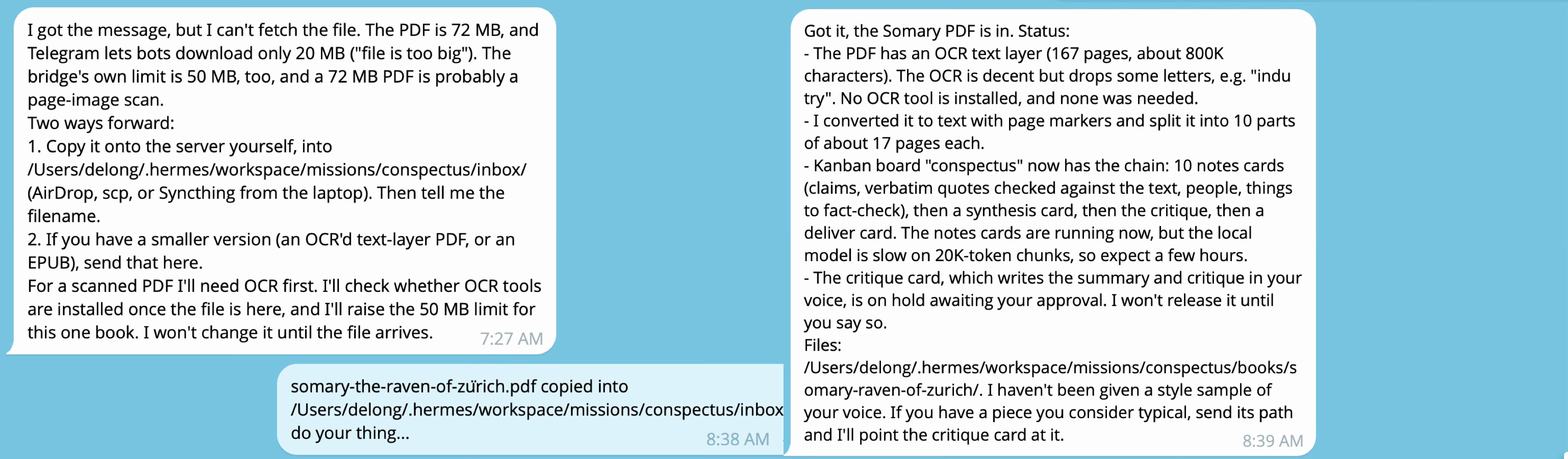
Plus I fed it Max Weber’s Economy & Society (which I have read, but long ago), and Slouching Towards Utopia (which, of course, I know very well.
What do I think of the job that it is doing?
To summarize: I am quite pleased. After spending an hour on the conspectus folder (and then half an hour, checking random pieces of the conspectus folder against the actual book itself), I definitely feel like the Chinese Room of which I am a component could definitely fake it. It can respond as if I have actually read the book, in the way I would. Thus I have hopes that my leafing to the passages it points me to, consulting it when it comes to mind, and having my systems bring it in when they think it is relevant will together be as if I actually have the memories of having read, at least for people looking at me in my Chinese Room from the outside. And from the inside? That is a hard question that I do not yet have an answer to.
But the proof of the pudding is in the eating: What do my systems think is worth noting from Somary? Here is the introductory briefing that it wants to give me:
Briefing: Felix Somary, The Raven of Zürich
Felix Somary was the ultimate high-society canary in the coal mine. Trained in the Vienna school—which meant he spent his youth learning that the world is a fragile place and that economic depressions are inevitable (p. 17)—he spent the next fifty years watching the 20th century dismantle itself in real time. He calls the government the “fence that separates the zoo of wild animals from the outside world” (p. 15), and he spent his career observing exactly when and how those fences broke.
The arc of his life is a map of European collapse. In the pre-1914 years, he was playing the great game of international finance, trying to use the Baghdad Railway as a colonial compromise to stop the Anglo-German naval race from turning into a world war (p. 35-38). He failed, of course. During the war, he became a critic of the military’s delusional confidence, specifically General Ludendorff, who thought he could just seize Caucasian oilfields without considering how to actually get the oil out (pp. 66-67). Somary saw the rouble collapsing in 1917 while the diplomats were still pretending the Russian Empire was a going concern (p. 64).
Then came the Zürich years. This is where he earned the name “The Raven.” He played the role of the professional gloom-monger, correctly predicting the 1929 crash (p. 7) and managing client assets by restricting them to the only three places he trusted: Switzerland, Britain, and Holland (p. 77). He had a visceral hatred for inflation, calling it a “permanent poisoning of the very bloodstream of a society” (p. 78), and argued that a clean state default—a “one-time surgical intervention”—would have been far less damaging than the slow-motion arson of the interwar inflation (p. 78-79).
He ended up in Washington during WWII, where he looked at American technical mastery and saw a total lack of forward planning for the war economy (p. 106). He had a particular disdain for the “cult of mediocrity” in US education (p. 129) and the “unreality” of the Washington bubble, which he believes led to the failure to support the German resistance and a total misreading of the Soviet Union (p. 129). Even in the postwar era, he remained a skeptic of the Marshall Plan’s “frenetic speed” (p. 138), arguing that reciprocal free trade and free immigration would have been the real cure for the dollar shortage.
Somary died convinced that the US was making the same mistake again: attempting to install democratic regimes “from above” (p. 154) and humiliating defeated enemies through “unconditional surrender,” which he rightly noted makes the victor responsible for the resulting resentment (p. 155).
Critique: The Raven’s Eye
Somary is a brilliant witness, but he’s a prisoner of his own intellectual pedigree. He is a quintessential product of the Vienna school, which is to say he possesses an extraordinary eye for systemic fragility and a corresponding pathology of permanent pessimism.
He was prescient about the 1929 crash and the failure of the submarine warfare strategy because he understood the intersection of logistics and psychology better than the people running the machines. He understood that a “fence” (like the Habsburg monarchy) is only useful as long as the people inside it believe in the fence (p. 15). When he warns that the demand for “unconditional surrender” is a strategic error (p. 155), he’s speaking as a historian of the long-term, recognizing that stability requires a graceful exit for the loser.
However, I have very little patience for his “integrity of currencies” fetish. He speaks of the integrity of currencies as “the key to democratic survival” (p. 2) with a kind of religious fervor that smacks of gold-standard nostalgia. For Somary, inflation isn’t just a monetary phenomenon; it’s a moral failing. While he is correct that hyperinflation destroys the middle class, his insistence on immediate state bankruptcy as a “surgical intervention” (p. 78) ignores the political reality that such a move often triggers the very social collapse he fears.
His view of democracy is equally antiquated. He claims that democracy “cannot be decreed from above” and requires “centuries of organic historical development”—citing 600 years for the Swiss (p. 154). This is an aristocratic fantasy. It suggests that unless you have a few centuries of slow-growth institutional accretion, you’re doomed to failure. It ignores the capacity for rapid institutional leapfrogging that the 20th century proved was possible.
Finally, his theory on the 1929 crash—that it was primarily caused by the price disparity between agriculture and industry (p. 156)—is an oversimplification. It’s a classic “single-cause” fallacy. While agriculture was indeed crushed, the crash was a systemic failure of credit and liquidity, a collapse of the very “integrity” he spent his life obsessing over.
Somary is an indispensable source for the feeling of the era—the sheer, terrifying velocity of the “Great Breakdown.” He captured the “unreality” of the ruling classes in both Europe and Washington. But as an economic theorist, he is too often an observer of symptoms rather than a designer of cures. He can tell you exactly when the building is about to fall, but his only solution is to move your assets to a Swiss bank and wait for the dust to settle.
The roiling boil of linear algebra has, I think, done quite a good job at getting to the heart of Somary’s book (or what I think the heart of Somary’s book would be for me, were I to read it). It is not just a memoir of a financier. It is a forensic anatomy of the first half of the 20th century’s “Great Breakdown”, extraordinary in the tension between Somary’s deep technical expertise (albeit often misguided) and the historical tragedies that history brings to his door. Somary doesn’t just report events; he diagnoses them as systemic failures.
He has a Weber/Schumpeter debate about ideas and their implications when put into practice. He has a Somary/Ludendorff scene about competence: people Peter-principled well above their proper station who do not realize how lucky they have been and that they need to plan for their luck having already run out. And there are more set pieces about institutional scale and historical time and how we make our history but not in circumstances of our own choosing.
Let me give you Erich Ludendorff, future enthusiastic Nazi and effective military dictator of Germany in the last stages of World War I:
The Logistical Reckoning: Somary vs. Ludendorff (pp. 66–67):
The Scene: A high-stakes confrontation between the refined world of international finance and the blunt force of the Prussian military machine, centered on the delusional ambitions of General Erich Ludendorff.
The Substance: Somary exposes the cavernous gap between Ludendorff's "map-room" delusions of grandeur and the grinding reality of logistics. Specifically, he dismantles Ludendorff's confidence in capturing the Caucasian oilfields, pointing out the total impossibility of actually exploiting and transporting that oil in the short term.
Why it's striking: It is a clash of two different types of power. Somary, operating in the shadows of gold and diplomacy, acts as the cold voice of logistical reality, stripping away the military's illusion of omnipotence. It highlights the tragedy of the Great War: a military leadership that believed "will" could override the physics of supply chains.
A Day with Ludendorff in Kreuznach, 1917:
I spent the next months in complete withdrawal from the public eye…. But when the failure of the submarine campaign became apparent, many people rang me whom I had not seen for months…. Prophetic gifts were ascribed to me, and my opinion on the future was avidly sought…. In early summer of 1917 I heard… that General Ludendorff wanted a talk with me…. [Then] from Colonel Bauer a formal invitation to Kreuznach, the military headquarters…. A refusal was hardly possible…. I was the sole passenger in the carriage of the train bound for Kreuznach, and could not find out if there was anyone in the other carriages…. I was the only person who got off the train at Kreuznach…. I announced myself at the appointed hour at headquarters, Colonel Bauer received me with a few questions that led me to believe that my remarks on the future of the Russian rouble had been the cause of the invitation.
While Bauer was speaking the door was flung open, Ludendorff came rushing in and shouted harshly at me without a single word of greeting: ‘Who are you, and what do you want here?’ I went towards the door; Colonel Bauer pulled me back and spoke softly to Ludendorff, who muttered to himself, turned half to Bauer and half to me, saying that he was not to know when he saw a strange face who it might be. I immediately realised that the whole thing was play-acting, designed to intimidate me.
‘All right, all right,’ said Ludendorff. ‘I made no mistake with that question! What do you want, anyway? Now I hear about you everywhere; you get involved in every problem, even in connection with Russia. Who gave you the right? Who authorised you? Who stands behind you? In whose name are you speaking?’
‘In nobody’s but my own.’
‘That I don’t believe! Are you a German citizen?’
‘No.’
‘But you were in the Belgian military government?’
I saw from that question that he had been well briefed. ‘Yes, but I kept my original citizenship.’
‘Where are you from?’
‘From Austria.’
‘Where in Austria?’
‘From Vienna.’
‘Would you people like it if someone from here interfered in every aspect of your business?’ He went on: ‘What mission were you assigned by Austria, and who there gives you orders?’
‘Nobody appointed me to any job.’
‘Well, then, who pays your bills? Who then is paying for Naumann’s working group that seems to be able to mobilise all the parties? Well?’
‘Myself alone. Naumann would pay his own expenses if he had the means, so I do it for him. To allow an idea to be financed by government or some organisation is to prostitute it. Naumann’s ideas accord in many respects with mine—covering his expenses was naturally a gentleman’s arrangement.’
‘You can allow yourself such luxuries in the middle of a war? From what sources, and how?’
‘I do not owe anyone explanations on the origin of my assets.’
‘And this Austro-Polish merger, is that an idea you’ve also advocated on your own initiative? Or was this your creation to begin with? The intention was to surround us on all sides! But now we are doing in Poland what we want to do and must do, and Vienna has had to take it lying down. The Poles must be dominated, watched every minute of the day and night, otherwise they will attack us. And we know how to rule, not your hand-kissing people!’
‘Then you are thinking in terms of a colony, a colony in the middle of Europe, and want to force the natives immediately into military service? You will really come a cropper on that one!’
‘What are you talking about? If the Poles feel our fist, they won’t dare to move. Prussia as lord and master of Poland—I’d gladly exchange that for all the [German] softies south of the Main [River—Bavarians, Würtembergers, Black Foresters, Alsatians, Lorrainers, Badeners—] who only weaken our side! But that is naturally not your opinion.’
‘No, six great powers on the enemy side seem to me enough for us. But I do not understand why you are telling me all this.’
‘I understand from reliable sources that you continue to intrigue in favour of the Austro-Polish nonsense, even now, after the Austrians themselves have given up on the idea. And I ask you yet again, on whose behalf?’
‘I repeat: I am firmly convinced that the notion of a Polish-Austrian combination is the only possible solution. But it is not true that I am pushing for it. For me the whole matter is finished.’
‘Because of Vienna’s withdrawal?’
‘No, because of the loss of the war.’
‘What are you talking about? Since when have we lost the war?’
‘Since America came in.’
‘That’s your revenge! Some substitute for the defeat over Poland!’
‘God knows, I would rather have been wrong about America.’
‘Rubbish, that was just an episode!’
‘No, it was the decisive moment of the war.’
‘Doesn’t the coming collapse of Russia mean ten times more than America’s coming in? The Americans won’t have a real army for years!’
‘No, in place of one exhausted enemy we now have a fresh, unbeatable power, and moreover the only country that could have been an intermediary in negotiating peace.’
Ludendorff did not immediately answer, and while he had stared directly at me throughout the conversation, he now gazed mutely into space. Suddenly he said: ‘I would have kept away from the whole submarine business if I’d known that the revolution would break out so soon in Russia.’
‘You never thought then about revolution in Russia?’
‘No.’
‘I had assumed just the opposite at that time.’
‘Why?’
‘Because I cannot imagine that anyone would take on the deadly risk of a war with America if he still had to reckon on a long-term basis with Russia. I assumed that you felt you had a free hand on the Eastern front.’
‘And if that wasn’t the case in fact?’
‘General,’ I said with great seriousness, ‘I have been here for a long time, and still do not know why you summoned me.’
‘You have expressed the opinion that the rouble will cease to have value. I don’t understand money matters very well. What do you mean by that?’
‘That the rouble will lose all buying power.’
‘Why?’
‘The certain outcome of war and revolution.’
‘Havenstein thinks otherwise, but sent me your memorandum anyway. So you don’t think that we can get much out of Russia?’
‘No. Transport and probably also industrial production will be too chaotic for a long time; you cannot expect much from places where railways are still needed. Limited quantities of materiel may be had, but nothing significant in either raw materials or foodstuffs.’
‘There you are misinformed. In the Caucasus, the Russians have three-quarters of all the oil on earth. We are going to take it and hold it, during the war and after, because we are advancing to the Caucasus, and there we shall win the war.’
‘Will you have enough strength and time for that?’
‘Yes, certainly.’
‘And will the pipeline remain undamaged?’
‘What is that?’
‘The long oil pipe connection to the Black Sea.’
‘Built by the Russians?’
‘No, by a Dutch company. By the way, your estimate of the oil reserves is grossly exaggerated.’
‘You just pluck out of thin air what my people here have to scramble about trying to find! Your place should be here, with me, to give me intelligence reports about the war economy in the East.’
He said ‘with me’ quite distinctly, without referring to Hindenburg, without mentioning what office or position he had in mind.
‘Thanks, I was once in the bureaucracy, and I hope never to be again.’
‘That means you don’t want to cooperate because you consider it’s a lost cause. If everyone said that, if I said that myself, Germany would really go under. We think otherwise, even if we are standing with our backs to the wall. And by the way a lost war would be a healthy thing for our country: they’ve had everything too easy for the last forty-six years. That must change. If there were a defeat, Prussia would rise again, greater than ever in its history. But now we are very far from that point. When my divisions are freed from the Eastern front, I’ll crush France so completely that she will never rise, and then the English and Americans can waltz around the seas as much as they like. And now, I’m giving you an order to serve!’
‘I am an Austrian citizen, and anyway you would not have much joy out of me. I don’t subordinate myself to authority, and I voice my objections loud and clear. They have consequences.’
I had risen; Ludendorff stood too and bade farewell formally…. The man with whom I had just spoken, and who exercised authority in Germany as nobody before had ever done, had risked war with America at a time when he was still thinking of a long war with Russia; and in such a situation he spoke of a chief theatre of operations! For him, the entry of America into the war was a mere episode. The appeal to love of fatherland was repellent coming from a man who wanted to toss all non-Prussians out of his Germany. The very concept of ‘nation’ was blasphemous when mouthed by a Ludendorff….
In my time two men have determined the fate of the great German people: Ludendorff and Hitler. Both were destroyers of the first order. Was their immeasurable influence a factor of the times or of the German nation itself?…
As I said: too good to be true, but well worth my reading it. Or did I?