
The Highly-Cultured Vladimir Lenin: SANEWASHING OF THE DAY
Much better for the world and, almost surely, for Lenin, had he been a little less quick-witted, a little less a practical man of affairs, and a better Marxist theorist, like. Someone like, say, the Menshevik Yuliy Martov:
Adam Tooze has, I think, picked up the wrong quote about Lenin this morning.
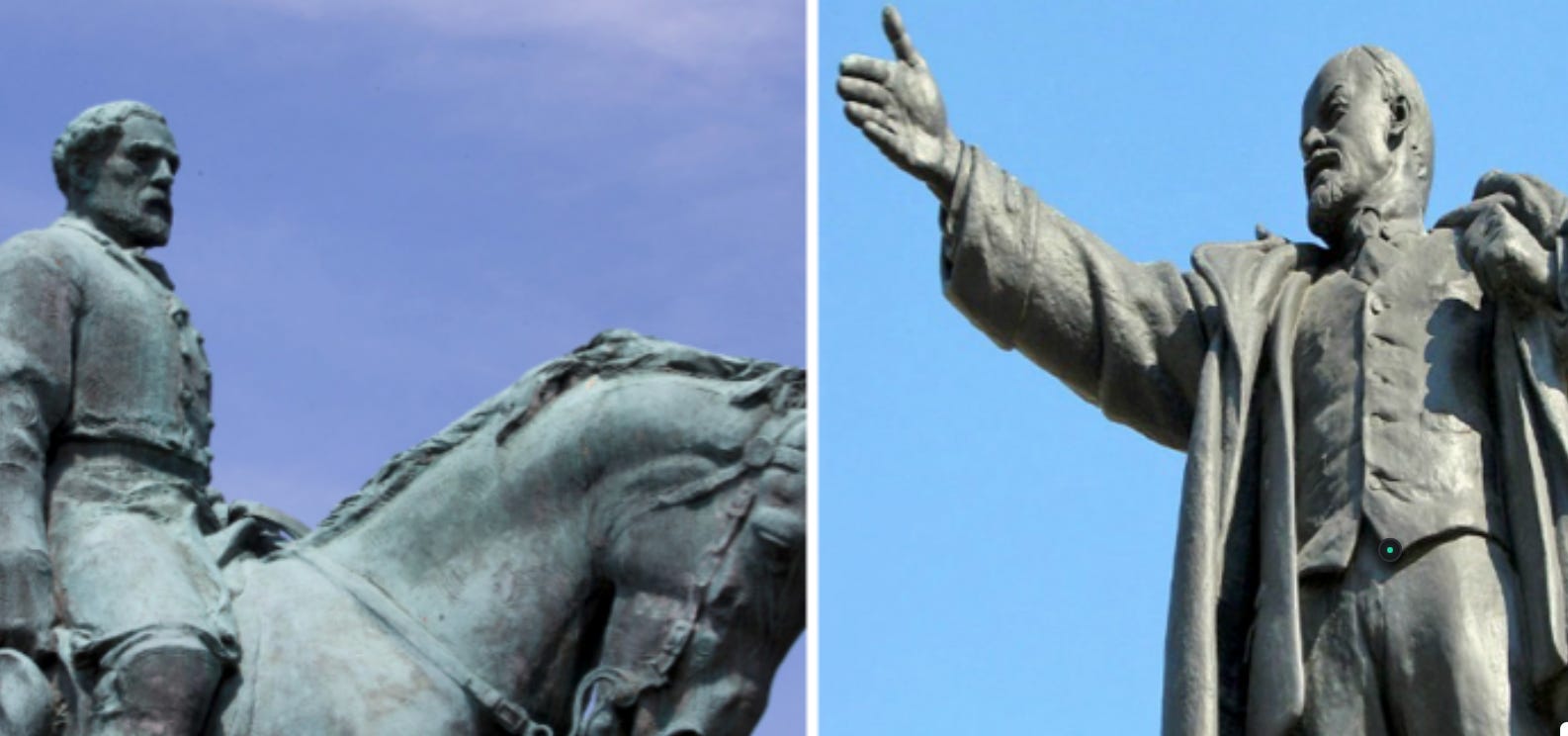
Tariq Ali wants to give us a highly-cultured Vladimir Lenin, a man of dilemmas and revolutionary possibility tragically overtaken by circumstances—looking past the dissolved parliaments, the secret police terrors, and the shootings of hostages. Like, on a much larger and more terrible scale, the verbal and artistic portraits of Kindly General Lee.
Adam picks this one up from Tariq Ali from nearly a decade ago <https://adamtooze.substack.com/p/top-links-1245-jobs-in-health-care>:
Tariq Ali (2017): How Lenin’s love of literature shaped the Russian Revolution: The father of the Soviet Union was also a Latin buff who adored Goethe and liked to compare his enemies to figures in novels <https://www.theguardian.com/books/2017/mar/25/lenin-love-literature-russian-revolution-soviet-union-goethe>: ‘This, then, was the intellectual atmosphere in which Lenin came of age. His father, a highly cultured conservative, was the chief inspector of schools in his region and much respected as an educationalist. At home, Shakespeare, Goethe and Pushkin, among others, were read aloud on Sunday afternoons. It was impossible for the Ulyanov family—“Lenin” was a pseudonym adopted to outwit the tsarist secret police—to escape high culture. At high school, Lenin fell in love with Latin. His headteacher had high hopes that he might become a philologist and Latin scholar. History willed otherwise, but Lenin’s passion for Latin, and taste for the classics, never left him. He read Virgil, Ovid, Horace and Juvenal in the original, as well as Roman senatorial orations. He devoured Goethe during his two decades in exile, reading and rereading Faust many times.
Lenin put his knowledge of the classics to good use in the time leading up to the October revolution of 1917. In April of that year, he broke with Russian social-democratic orthodoxy and, in a set of radical theses, called for a socialist revolution in Russia. A number of his own close comrades denounced him. In a sharp riposte, Lenin quoted Mephistopheles from Goethe’s masterwork: “Theory, my friend, is grey, but green is the eternal tree of life”…
Much better to have picked up this quote from Edmund Wilson:
Edmund Wilson (1940): To the Finland Station: A Study in the Writing & Acting of History <https://cdnrepositorios.march.es/sites/default/files/images/node-5451-document.pdf>: ‘[Lenin] and [Maksim] Gorky were listening to Beethoven’s Appassionata: “I know nothing [Lenin said] that is greater than the Appassionata; I’d like to listen to it every day. It is marvelous superhuman music. I always think with pride—perhaps it is naive of me—what marvelous things human beings can do!’
Then screwing up his eyes and smiling, he added, rather sadly: ‘But I can’t listen to music too often. It affects your nerves, makes you want to say stupid nice things and stroke the heads of people who could create such beauty while living in this vile hell. And now you mustn’t stroke anyone’s head—you might get your hand bitten off. You have to hit them on the head, without any mercy, although our ideal is not to use force against anyone. Hm, hm, our duty is in- fernally hard’”…
Of course, the most ironic thing Tariq Ali is that he still, writing 100 years after Lenin’s coup, is trying to pretend that Lenin won something of value with that classical allusion to Goethe of his.
We, more than 100 years later, know that the Marxist theory-based condemnations of Lenin by Rosa Luxemburg and others were not 100% accurate. If anything was wrong with them, it was that they did not go nearly far enough. They imagined disaster. They did not imagine the worst régimes in human history.
Marx wanted a revolution in a rich technologically advanced industrial society that would create a temporary dictatorship of the industrial proletariat that would lead to a utopian free society of associated producers.
Rosa Luxemburg (and many others!) pointed out that trying to run that playbook in a poor technologically retarded agricultural society would produce nothing good. And she was right:
(1) Rosa Luxemberg:
The tacit assumption… is… socialist transformation is something for which a ready-made formula lies completed in the pocket of the revolutionary party…. [But] what we possess… is nothing but a few main signposts which indicate the general direction… and the indications are mainly negative in character…. Socialism by its very nature cannot be decreed or introduced by ukase…. The whole mass of the people must take part in it. Otherwise, socialism will be decreed from behind a few official desks by a dozen intellectuals…. Decree, dictatorial force of the factory overseer, draconian penalties, rule by terror… demoralizes…. Without general elections, without unrestricted freedom of press and assembly, without a free struggle of opinion, life dies out in every public institution, becomes a mere semblance of life, in which only the bureaucracy remains as the active element…. A few dozen party leaders of inexhaustible energy and boundless experience direct and rule…. An elite of the working class is invited from time to time to meetings where they are to applaud… and to approve proposed resolutions unanimously… The dictatorship of a handful of politicians… caus[ing] a brutalization of public life: attempted assassinations, shooting of hostages, etc… <https://www.marxists.org/ebooks/luxemburg/The_Russian_Revolution_-_Luxemburg.pdf>
(2) Also worth noting: Felix Somary on Max Weber & Josef Schumpeter:
On my return journey I stopped briefly in Vienna to report to the Rothschild bank on the Bucharest negotiations. Apart from that, Max Weber had asked me to be present at the discussion he was to have with Schumpeter about the succession to his chair at the University of Vienna, Weber wanted to return to Germany and he was thinking of Schumpeter as his successor, but the two men knew each other only superficially although Schumpeter had written an outstanding history of ideas to accompany Weber’s handbook on social sciences. I was worried about the meeting, because a greater contrast between two personalities was hard to imagine.
Max Weber was a restless, nervous type, full of ‘drive’, a Huguenot with deeply-held convictions, for which he strove with every atom of his energy. He battled on without letting up, even when only minor issues were at stake. He was explosive in temperament, verging on intolerance; those who did not know him well could easily have been put off or even frightened at first meeting him. Hugo von Hofmannsthal tried to explain him by saying: ‘He has the gifts of a Caesar who is unable to find a field large enough for his energies.’ There was much truth in that observation: Weber was never in his life able to give his tremendous intellectual and spiritual powers full expression. He took nothing lightly.
Schumpeter on the other hand took nothing hard. He had been educated at the Vienna Theresianum, where the pupils were taught to stick to subjects, and not get personally involved. The rules of the game in every party and ideology were to be learned thoroughly, but nobody should join a party or subscribe to adogma. And Schumpeter was a virtuoso at playing any political game, from the extreme left to the extreme tight. He had worked briefly on the Socialisation Commission in Berlin, which met under the leadership of our Vienna University colleague Hilferding, who at the time led the German independent socialists, for whom the official Social Democrats were too moderate. Hilferding often told me of his astonishment at Schumpeter’s radicalism; but Schumpeter was not radical at all, he merely followed through to the appropriate conclusions, given the premises. He felt that if socialism were to be introduced at the end of the war, it should be in a consistent way.
We met in the Café Landmann opposite the University. Ludo Hartmann, a historian of the Classical world and son-in-law of Mommsen, accompanied Weber, and I came with Schumpeter. I took no notes of our conversation, but can recall the elements of it that impressed me most strongly. The talk turned to the Russian Revolution, and Schumpeter expressed satisfaction that socialism was no longer an abstract theoretical notion, but would now be tested in the real world. Weber said with some heat that communism at the Russian stage of development was a crime — he knew the language and followed Russian affairs closely. He added that developments in Russia would lead to unheard-of human misery and end in a terrible catastrophe.
‘That may well be,’ said Schumpeter, ‘but it would be a good laboratory to test our theories.”
‘A laboratory heaped with human corpses!’ Weber rejoined.
‘Every anatomy classroom is the same thing,’ Schumpeter shot back.
To change the subject, I commented that the war had altered the direction of social developments that would otherwise have gone quite differently. Weber agreed, but unfortunately chose Great Britain as his example, referring to its swing away from Liberalism. But Schumpeter disputed this view. Weber became more vehement and raised his voice, as Schumpeter for his part became more sarcastic and lowered his. All around us the café customers stopped their card games and listened eagerly, until the point when Weber sprang to his feet and rushed out into the Ringstrasse, crying ‘This is intolerable!’ Hartmann followed with Weber’s hat, and vainly tried to calm him down. Schumpeter, who had remained behind with me, only smiled and said ‘How can someone carry on like that in a coffee house!’
I felt unhappy about the incident. Here were two individuals of rare gifts, who were not far apart in their fundamental views on the economy, and in their deep intellectual seriousness. But it was the curse of the German and Austrian haute bourgeoisie that its all too few original personalities, if they ever met at all, immediately became deadly enemies. They all had too much temperament to compromise on issues… <https://archive.org/details/the-raven-of-zurich/>
(3) & more from Max Weber:
Take as an extreme example the authoritative power of the State or of the municipality in a monarchical constitution: it is strikingly reminiscent of the ancient kingdom of Egypt, in which the system of the ‘minor official’ prevailed at all levels. To this day there has never existed a bureaucracy which could compare with that of Egypt. This is known to everyone who knows the social history of ancient times; and it is equally apparent that to-day we are proceeding towards an evolution which resembles that system in every detail, except that it is built on other foundations, on technically more perfect, more rationalized, and therefore much more mechanized foundations. It is still more horrible to think that the world could one day be filled with nothing but those little cogs, little men clinging to little jobs and striving towards bigger ones—a state of affairs which is to be seen once more, as in the Egyptian records, playing an ever-increasing part in the spirit of our present administrative system… <https://faculty.rsu.edu/users/f/felwell/www/Theorists/Weber/Weber1909.htm>
and:
A progressive elimination of private capitalism is theoreticalIy conceivable, although it is surely not so easy as imagined in the dreamging of some literati who· do not know what it is all about…. Let us assume that some time in the future it will be done away. with. What would be the practical mult? The destruction of the steel frame of modem industrial work? No! The abolition of private capitalism would simply mean that also the top management of the nationalized or socialized enterprises would become bureaucratic.
Are the daily working conditions of the salaried employees and the workers in the state-owned Prussian mines and railroads really perceptibly different from those in big business enterprises? It is true that there is even less freedom, since every power struggle with a state bureaucracy is hopeless and since there is no appeal to an agency which as a matter of principle would be interested in limiting the employer’s power, such as there is in the case of a private enterprise. That would be the whole difference. State bureaucracy would rule alone if private capitalism were eliminated. The private and public bureaucracies, which now work next to, and potentially against, each other and hence check one another to a degree, would be merged into a single hierarchy.
This would be similar to the situation in ancient Egypt, but it would occur in a much more rational—and hence unbreakable—form…. Objectified intelligence is also that animated machine, the bureaucratic organizatlon, with its specialization of trained skills, its division of jurisdiction, its rule and hierarchical relations of authority. Together with the inanimate machine it is busy fabricating the shell of bondage which men will perhaps be forced to inhabit some day, as powerless as the fellahs of ancient Egypt…. It would be made all the more indestructible if in the social sphere a status order were then to be imposed upon the ruled, linked to the bureaucracy and in truth subordinate to it, as in the forced-labor states of the past. An “organic” social stratification, similar to the Oriental-Egyptian type, would then arise, but in contrast to the latter it would be as austerely rational as a machine. Who would want to deny that such a potentiality lies in the womb of the future?…
and:
When one has discussions with present-day socialists… in good faith… it will be found that, except in Russia, they all adhere to this standpoint… the time is as yet nowhere ripe…. When asked for an honest reply, every socialist intellectual will have to give this answer…. In Russia… the so-called Mensheviks… think that the Bolshevik experiment of imposing a socialist order from above, at the present stage of bourgeois society is not only nonsense but also a sin against Marxist dogma. The terrible hatred of these two parties for one another has its roots in this dogmatic accusation of heresy….
It is obviously justifiable to ask[:]… what can a revolution under these circumstances be expected to achieve, expecially during the war? It may well cause a civil war… but it could not bring about a socialist society… <https://opendocs.ids.ac.uk/articles/report/Socialism/26481607/1/files/48256639.pdf>
No more time this AM, but I would note that I have always found Tariq Ali to be a really weird and somewhat sinister dude.