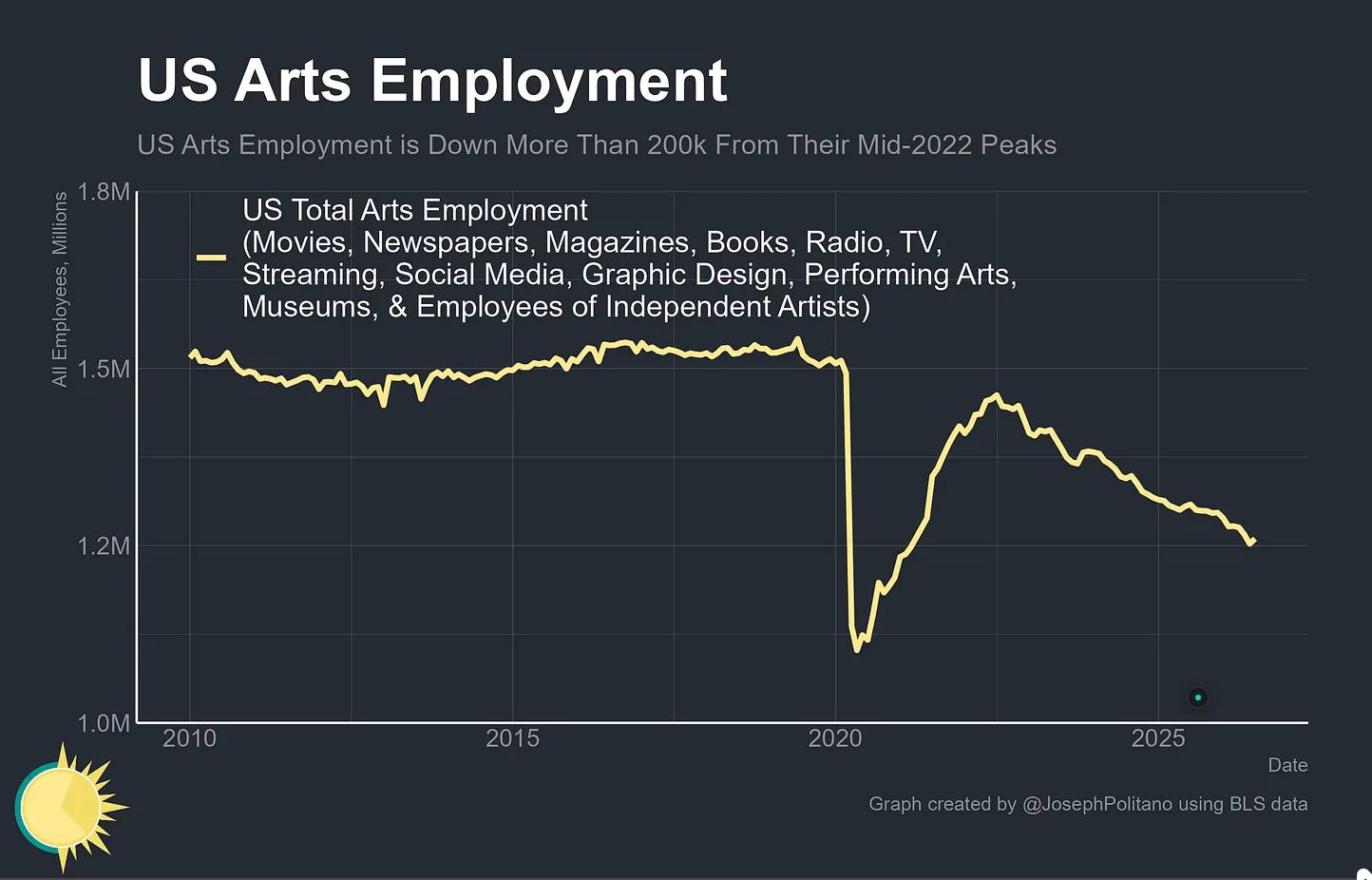
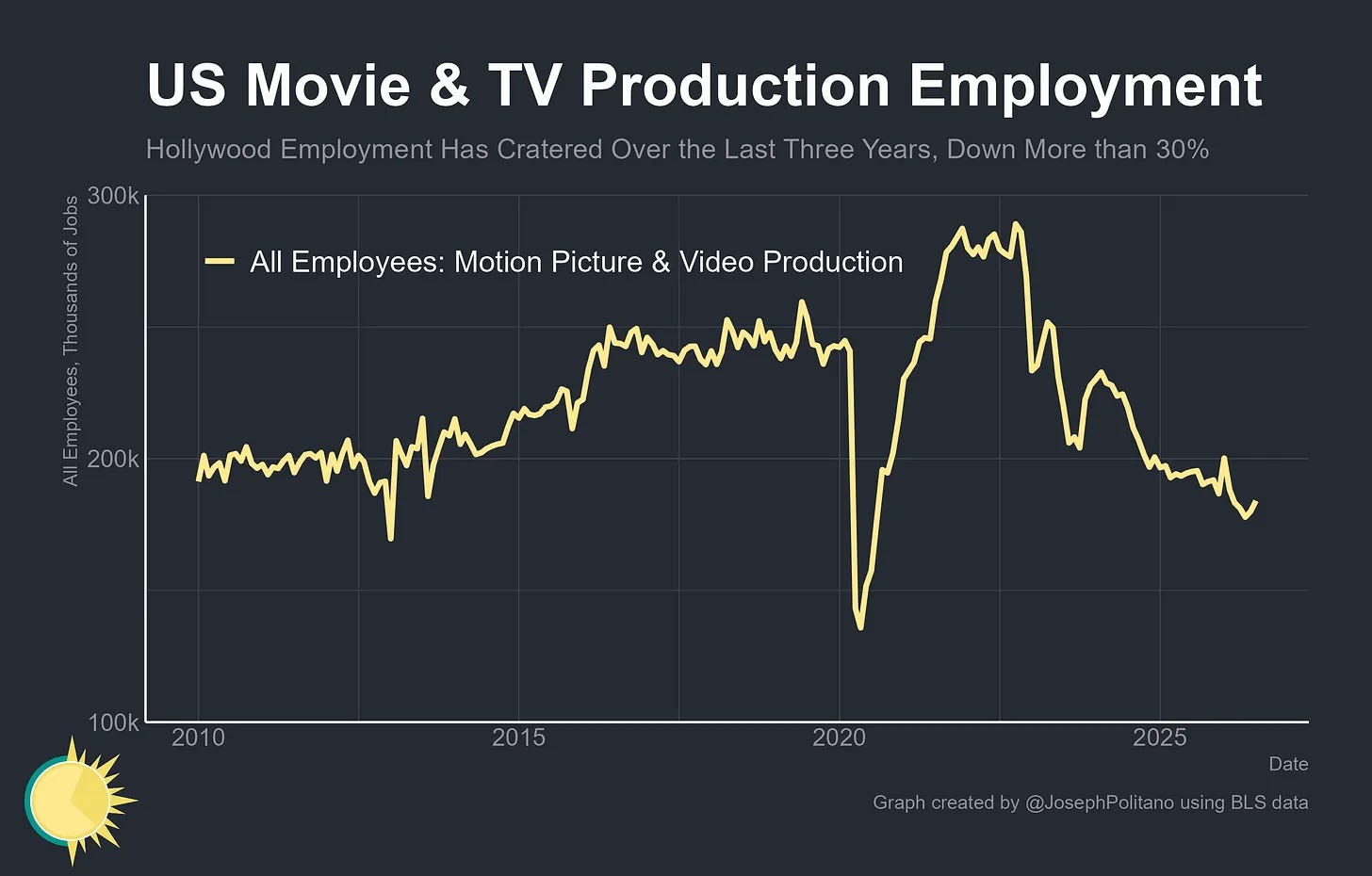
300,000 fewer than the 2010-2019 level. 100,000 is a fall in employment in movie and TV production. But how much of that 100K is the streaming disruption, how much is “AI”, and how much is something else? And how much of the remaining 200K decline can be traced to “AI”?
Joey Politano: AI & the Fall? of the Creative Class <https://www.apricitas.io/p/ai-and-the-fall-of-the-creative-class>: ‘Media firms are decidedly coy about their AI use…. The effects of AI are also hard to disentangle from other factors currently affecting arts businesses…. Yet perhaps the clearest evidence of AI’s influence is just that all subsectors of the digital arts industry are losing jobs, while in-person entertainment is still growing at a healthy pace…. The worst-hit sector [is] movie & sound recording, which has been bleeding jobs at a nearly unprecedented pace over the last three years.
Hollywood has never seen a stretch as bad as the last four years….The streaming era has proven an extremely difficult transition, with traditional films and TV shows losing watch time to user-generated and increasingly AI-assisted or AI-generated content flows….
it’s difficult to meaningfully predict how new technologies will interact with existing arts businesses. Take the unexpected resurgence in book sales over the last four years…. The unlikely savior of the printed word came from perhaps its polar opposite—TikTok… [with] “BookTok” became a new way to source reviews, analysis, discourse, and community in a way that boosted the reading experience and absolutely turbocharged book sales. It’s possible that AI tools could have those same totally unpredictable spillovers….
Arts jobs might be a microcosm for other “creative-adjacent” work… AI-driven job displacement has been relatively minor…. Some white-collar sectors that looked prime for AI automation have even been on a hiring spree over the last few years…. Yet if the economic impact of AI ends up being anywhere near large enough to validate the trillions of dollars investors are currently betting on it, these economic disruptions will only spread from here…
Brad DeLong here: With marginal-cost pricing, Jevons’s Law’s operation requires a price-elasticity of demand greater than one. The problem with the arts is that demanders pay not just with money but also with attention-time. Creative-arts attention-time is also, already, a very high proportion of non-work non-sleep time. Those two factors make the creative-arts sector perhaps the heaviest of heaviest lifts as far as paid employment and technological change are concerned.
If reading this gets you Value Above Replacement, then become a free subscriber to this newsletter. And forward it! And if your VAR from this newsletter is in the three digits or more each year, please become a paid subscriber! I am trying to make you readers—and myself—smarter. Please tell me if I succeed, or how I fail…