
Rooftop Solar Rules Elsewhere!: CHART OF THE DAY
The core hardware cost collapsed to $0.12/W — so why is a California rooftop still costing $3.00/W, and the market shrinking while Pakistan’s is booming? Soft costs, a dead tax credit, and a net-billing rule rewrote the arithmetic: in the U.S., policy and plumbing now matter more than the price of a panel. Chinese export deflation liberated the Punjab and electrified Perth; in California it ran straight into the Net Billing Tariff and stalled:
Globally, solar’s rise is a supply-side story: Chinese overcapacity, panels at $0.12/W, households and businesses defecting from the grid.
But here in California the drivers of stagnation are policy shifts: a repealed tax credit, and a backflow compensation rule that turned the battery, not the panel, into the thing worth buying.
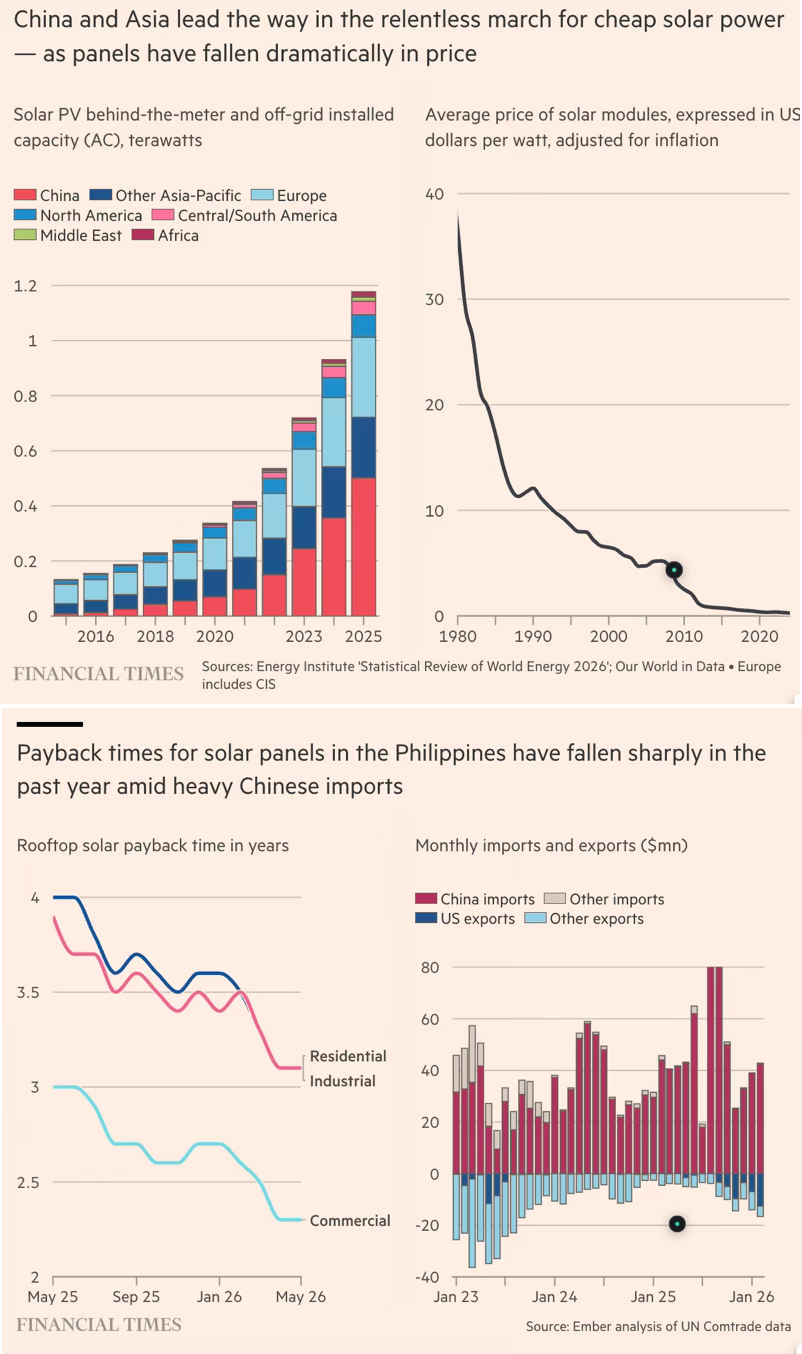
And the context, from the FT:
Rachel Millard, Humza Jilani, Monica Mark, & Krishn Kaushik: ‘Offensively Cheap’: Solar Power Is Looking Up <https://www.ft.com/content/8b704ae0-1fa2-4303-925f-170fa5d935b3?syn-25a6b1a6=1>: ‘In the badlands of Chakwal, in north-central Pakistan, Bestway Cement is transforming plots of dry earth and olive and peach groves into a forest of solar panels. Its efforts will add 6.34 megawatts of generation capacity by the end of the year…. Already, solar generates over a quarter of the electricity powering its cement plant…. The solar revolution made possible by cheap Chinese photovoltaic panels — and the rise of small-scale, individual power generation — is transforming energy…. Cheaper panels enabled a vast rollout in China itself and helped solar generation evolve from a subsidised technology deployed mostly in markets looking to decarbonise to a vital source of electricity in areas where power is scarce, expensive or unreliable. That process started in countries like Pakistan, Brazil and South Africa and has now spread….
The fallout from the US-Iran war has led to more interest in rooftop solar in Britain, where since the end of August households have been able to buy 800-watt solar panels in supermarkets or DIY stores to plug in at home…. Plug-and-play panels are proving popular in the US despite President Trump’s general antipathy to renewables and his decision to eliminate a tax credit for rooftop solar systems….
“Perth, for example, is covered in rooftop solar,” says Pierluigi Mancarella, chair professor of electrical power systems at the University of Melbourne. “If you have a massive cloud formation, the rooftop PV production can drop by so much that it looks like you have lost basically almost a nuclear power station.”… The system operator has very little visibility over the aggregate gigawatt of generation capacity thus created…
Two big questions:
First, is $0.12/W Chinese solar-panel export price a stable equilibrium price, one that is going to fall further, or a temporary low driven by overcapacity, dumping, and state subsidy?
Second, what is going on here in the United States, where things seem to have stalled even as they accelerate elsewhere?
I do not know the answer to the first. I think I understand the second (but I may not). Let me put this under the fold for now because I am not sure I am right here: