
The Ten-Year Treasury Bond: CHART OF THE DAY
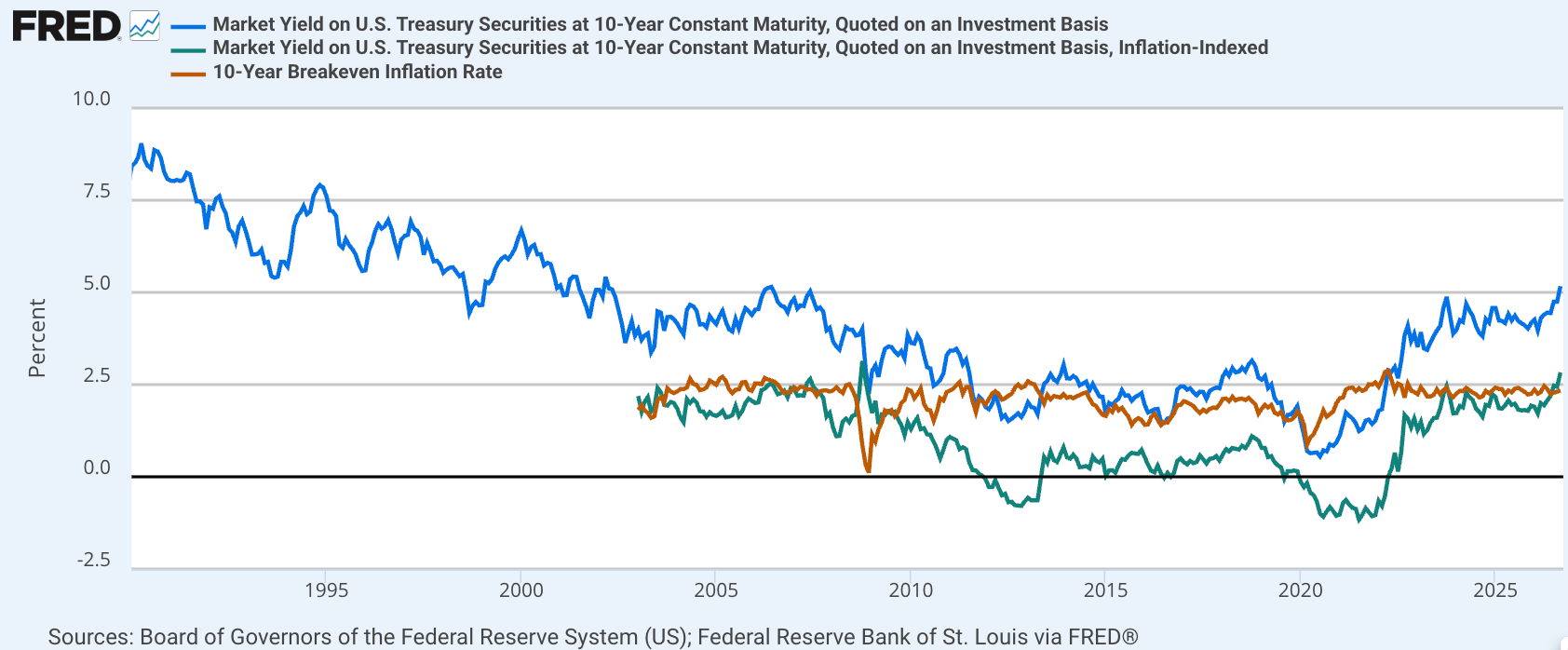
Everyone wants to blame the Iran War for 5% yields. But the inflation-breakeven line on my chart that should have jumped if they were right never moved — and that changes the diagnosis. I think we are driven back on (a) the “AI” investment book, and (b) a pronounced expectations-based tail-chasing non-linearity in transformation of the safe-asset shortage into a safe-asset glut:
Why have ten-year US Treasury interest rates jumped to 5.25%? The lazy answer blames the Iran War and the resulting inflation surge. I suspect otherwise. We have the extraordinary “AI”-driven investment boom. We have the erosion of the safe-asset premium that had been the result of the great post-2008 safe-asset shortage. My view: the truth is probably a combination — with the safe-asset piece probably the more worrisome.
Nominal yield, TIPS yield, and inflation-breakeven: the current ten-year matures in late 2036:
And we have Paul Krugman writing:
Paul Krugman: Booms, Bombs & Bonds: Interest Rates, Part I <https://paulkrugman.substack.com/p/booms-bombs-and-bonds-interest-rates>: ‘My best guess is that [right now] we’re mainly looking at the effects of the immense boom in AI-driven investment, but that the inflationary impact of the Iran War has reinforced those effects by triggering a change in the policy “narrative”…
He sees four serious possibilities out there in the literature:
Serious economic analysts are currently telling four main stories…
They are:
War & inflation. The Iran war disrupted world oil supplies, compounding the Russia-Ukraine war’s earlier constriction of diesel and refined-product markets. The resulting inflationary surge prompted central banks to raise rates. The conjunction of higher short-term inflation and short-term policy has crystalized a shift in expectations about the longer-run.
The AI boom. Firms are investing on a vast scale (even though the ultimate economic payoff remains uncertain). Against the backdrop of an investment boom of this magnitude, interest rates at least this elevated are precisely what we would expect to see.
The erosion of the safe-asset premium. The United States has long borrowed cheaply because its debt was regarded as uniquely “safe.” That premium presupposes relative scarcity—and the sheer quantity of debt now outstanding has begun to erode it.
Debasement. Finally, the fiscal predicament is not America’s alone: France and the United Kingdom are likewise running large deficits while proving politically incapable of decisive correction. In an emerging economy, one would openly entertain the prospect of engineering inflation to erode the real value of the debt. At least some analysts contend that precisely that is already under way.
If (1) or (4) were the main factor pushing the rise in long-term interest rates, however, we would expect to see the red inflation-breakeven line tilt up when the bond interest-rate line tilted up. It didn’t. Thus we are driven back to (2) and (3). There is an argument that (3) has to be a gradual process, and that what we are seeing now is not a gradual process. I think that argument is wrong. What we are talking about here is an expectational equilibrium in which the safe asset premium on U.S. Treasuries depends on everyone else believing that there is a safe asset premium on U.S. Treasuries. And such equilibria, when they unwind, can unwind suddenly and completely. So I see (2) and (3) as each live possibilities, and the truth probably a combination of the two.