
Sana’a Café: Dwight & Telegraph: FRIDAY FOG & FLATLANDS
Annals of Technologies of Cognitive Alertness: Qahveh Khaneh Comes to Telegraph Avenue: How Coffee’s 600-Year-Old Birthplace Has Filled a Peet’s-Shaped Hole:
There is a Peet’s-shaped hole in my memory of the corner of Dwight & Telegraph, Peet’s! The ur-roaster. The place from which the founders of Starbucks learned their trade in the early 1970s. The fountainhead of the entire American specialty-coffee revolution that the—alas! now-late but then-assistant economics professor Suzanne Scotchmer introduced me to, back when I was a undergraduate junior in 1980-1981 at George Howell’s Coffee Connection in The Garage at the corner, of Mt. Auburn St. and Kennedy St. in Cambridge.
I cannot say Peet’s abandoned a prime piece of Southside retail frontage. Telegraph Avenue had better days back when bookstores were still magnets. Traffic at that Peet’s was never anything like, say, Caffé Strada which does an extraordinary land-office business all the time during term time when it is not raining. But Peet’s did abandon a piece of frontage that was, objectively, a very well-placed perching spot for people coming up to campus from the south and west.
Replacing it is something called Sana’a Café.
The Sana’a Café (or, rather, a Sana’a Café) <https://thesanaacafe.com/> has opened with a bracing very strong pull—lots of grounds in the bottom of the cup:
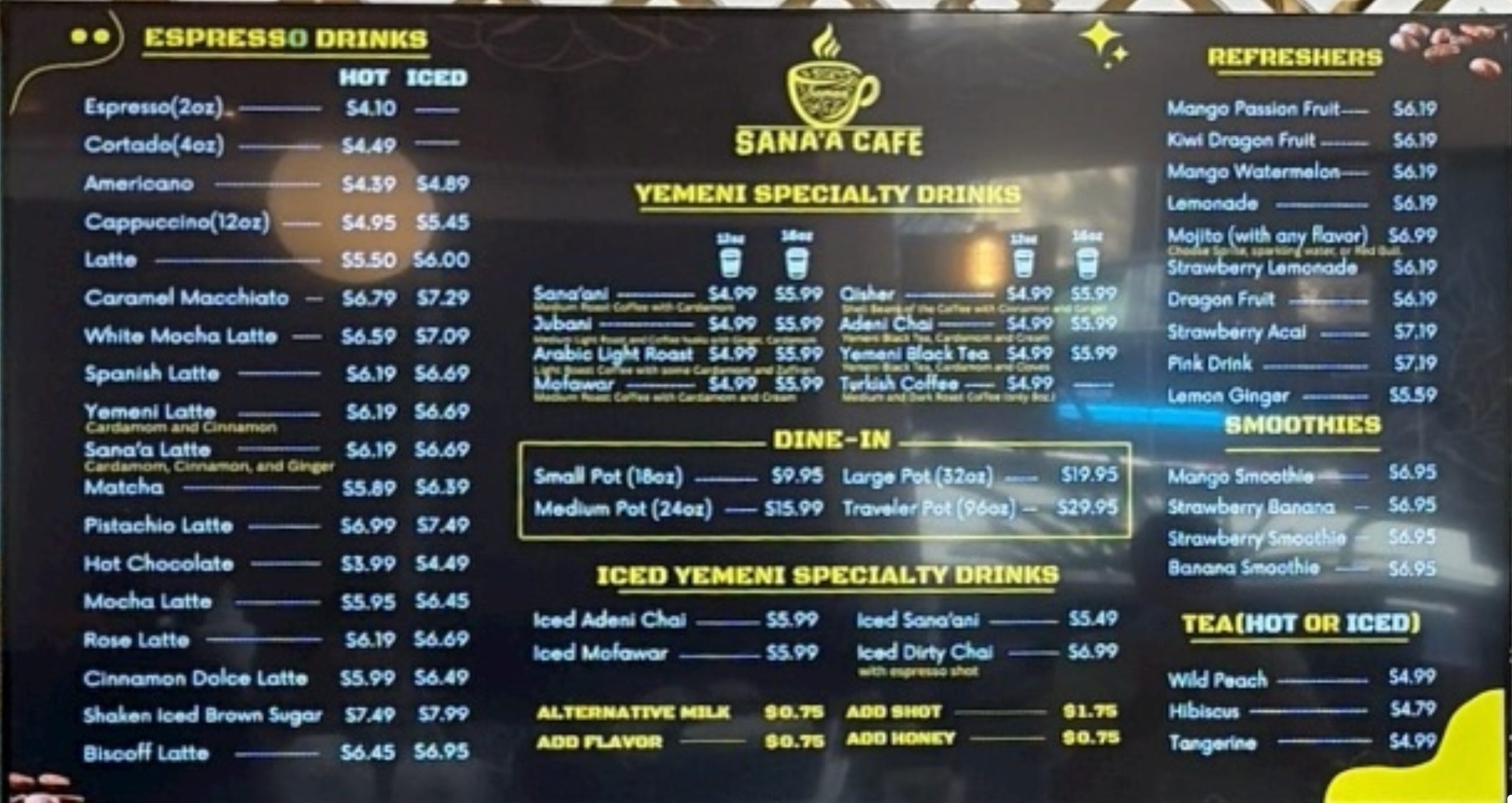
Thats blurry. Here’s the text OCR’d and reformatted:
SANA’A CAFÉ
ESPRESSO DRINKS (Hot | Iced)
Espresso (2oz) — $4.10
Cortado (4oz) — $4.49
Americano — $4.39 / $4.89
Cappuccino (12oz) — $4.95 / $5.45
Latte — $5.50 / $6.00
Caramel Macchiato — $6.79 / $7.29
White Mocha Latte — $6.59 / $7.09
Spanish Latte — $6.19 / $6.69
Yemeni Latte (Cardamom and Cinnamon) — $6.19 / $6.69
Sana’a Latte (Cardamom, Cinnamon, and Ginger) — $6.19 / $6.69
Matcha — $5.89 / $6.39
Pistachio Latte — $6.99 / $7.49
Hot Chocolate — $3.99 / $4.49
Mocha Latte — $5.95 / $6.45
Rose Latte — $6.19 / $6.69
Cinnamon Dolce Latte — $5.99 / $6.49
Shaken Iced Brown Sugar — $7.49 / $7.99
Biscoff Latte — $6.45 / $6.95
YEMENI SPECIALTY DRINKS (12oz | 16oz)
Sana’ani (Coffee with Cardamom and Cinnamon) — $4.99 / $5.99
Jubani (Coffee with Cardamom and Cinnamon) — $4.99 / $5.99
Arabic Light Roast (Light Roast Coffee with Cardamom and Cinnamon) — $4.99 / $5.99
Mofawar (Medium Roast Coffee with Cardamom and Cinnamon) — $4.99 / $5.99
Qishr (Coffee with Husk of the Coffee with Cardamom and Cinnamon) — $4.99 / $5.99
Adeni Chai (Yemeni Chai with Cardamom and Cinnamon) — $4.99 / $5.99
Yemeni Black Tea (Yemeni Black Tea, Cardamom and Cloves) — $4.99 / $5.99
Turkish Coffee (Medium and Dark Roast Coffee Only) — $4.99 / $5.99
DINE-IN
Small Pot (18oz) — $9.95
Medium Pot (24oz) — $15.95
Large Pot (32oz) — $19.95
Traveler Pot (96oz) — $29.95
ICED YEMENI SPECIALTY DRINKS
Iced Adeni Chai — $5.99
Iced Mofawar — $5.99
Iced Sana’ani — $5.49
Iced Dirty Chai (with espresso shot) — $6.99
ADD-ONS
Alternative Milk — $0.75
Add Flavor — $0.75
Add Shot — $1.75
Add Honey — $0.75
REFRESHERS
Mango Passion Fruit — $6.19
Kiwi Dragon Fruit — $6.19
Mango Watermelon — $6.19
Lemonade — $6.19
Mojito (with any flavor) — $6.99 (Choice of sparkling, water, or milk base)
Strawberry Lemonade — $6.19
Dragon Fruit — $6.19
Strawberry Acai — $7.19
Pink Drink — $7.19
Lemon Ginger — $5.59
SMOOTHIES
Mango Smoothie — $6.95
Strawberry Banana — $6.95
Strawberry Smoothie — $6.95
Banana Smoothie — $6.95
TEA (Hot or Iced)
Wild Peach — $4.99
Hibiscus — $4.79
Tangerine — $4.99
It is one node in a rapidly branching network that did not exist anywhere on earth four years ago.
We tell ourselves that coffee comes from Ethiopia. That is true, in the narrow botanical sense. Coffea arabica is native to the highland forests of Kaffa, in the southwest of Ethiopia, where it grew wild and largely unregarded for a very long time. But a wild plant is not a beverage. And a beverage is not a culture. The plant is an accident of biogeography. The drink—coffee as a thing you brew, share, argue over, and organize your social life around—was a human invention. It was invented in Yemen.
Sometime soon after 1400, coffee made the short but decisive hop across the Red Sea, and it was Yemeni Sufi mystics who first put it to systematic use: they brewed the seeds and husks of the coffee cherry to stay awake through their long nocturnal devotions. Coffee was at the get-go not a consumer pleasure but a religious productive—salvation-generating—technology of wakefulness—a productivity enhancement for the spiritually ambitious. Graduate students bent over their laptops in the new Sana’a frantically booting their am or pm wakefulness are, whether they know it or not, the direct cultural descendants of 1400s dervishes trying to squeeze more devotional hours. The application has secularized. The pharmacology and, largely, the sociology have not changed.
From the Sufi lodges, the practice diffused outward. It reached into ordinary Yemeni society. By the middle of the 1400s, we are told the qahveh khaneh had opened their doors in Yemeni cities. Everything downstream of that traces its lineage back to Yemen: the coffeehouses of Cairo and Constantinople, of Mecca and Isfahan, and eventually the London coffeehouses, out of which Lloyd’s of London and the stock exchange and a good chunk of the eighteenth-century public sphere would crystallize. When Jürgen Habermas wants to locate the birthplace of the bourgeois public sphere, he points to the coffeehouse. He might have pointed further back to Yemen and to the qahveh khaneh of Coffea arabica, with caffeine-laden coffee being (along with caffeine-laden tea and nicotine) one of the three major early modern biotechnologies of cognitive alertness.
There is the port. For roughly three centuries, from 1450 to 1650, the bulk of the coffee that reached the wider world was grown in Yemen and then left through the single Red Sea harbor of al-Makha. The beans that passed through it became known simply as “mocha”. The name has outlived the port’s near-monopoly by three hundred years. It has now attached itself, with magnificent inaccuracy, to a drink of espresso and chocolate that has nothing whatever to do with al-Makha, but is instead a weird marketing accident. (Some claim that Yemeni beans, grown at altitude on ancient terraces and dried whole in the sun, carry a genuinely cocoa-like depth.)
Yemen, of course, understood exactly what it had. For nearly two hundred years it ran one of history’s most successful commodity cartels. Green beans were boiled or roasted before export so that they could not germinate abroad in an early-modern equivalent of DRM. Smuggling live plants out of the country was punishable. It worked, more or less, until it didn’t: by 1625 Dutch traders had gotten viable plants out into the botanical gardens of Amsterdam. Then they leaped, to Ceylon, to Java, and by the mid-1700s coffee was growing across the Americas, Yemen’s monopoly was simply gone, and the fact that all of coffee’s pests and parasites were located in the horn of Africa meant that Yemen and Ethiopia faced large production disadvantages vis-à-vis producers in the rest of the world.
What survived the collapse of the monopoly was the culture.
Qishr—brewed from the dried husks of the coffee cherry rather than the bean, spiced with ginger and cardamom, naturally low in caffeine, originally, I am told, a poor-man’s drink for coffee workers who could not afford beans that had had their price boosted by export demand—is still drunk across Yemen.
It is on the menu at Dwight and Telegraph, priced at $4.99 for twelve ounces. That is a sentence that would have been unintelligible to any human being alive before about 2023. (I have not yet tried it.)
There is now a Yemeni-style coffeehouse miniboom. The Associated Press tells me that the number of cafés operated by six Yemeni-style chains in the United States grew by fifty percent in 2025 to 136 locations. The oldest of these, Qahwah House, opened its first store in Dearborn, Michigan, in 2017—Dearborn being home to one of the largest Arab American communities in the country, a legacy of the auto industry’s twentieth-century labor demand. It now runs more than twenty locations.
There is a clear niche for a non-chain, single-location, local-focused coffeehouse in a world in which there are 700 Starbuckses and 130 Peet’ses in Greater San Francisco. But is there a niche for another chain? The idea isnot “beat Starbucks at being Starbucks”, but to occupy a position Starbucks structurally cannot occupy with a favorable cost structure. I see four things at work here:
Product differentiation: Starbuckses could add a cardamom latte tomorrow; it could never be Yemeni. That’s a moat made of identity, and it lets them sidestep price comparison, for there is no reference price for a Sana’ani.
Late-night: Starbuckses close early and have spent a decade engineering out lingering, and so there is a place for serving the 9 p.m. slot Starbuckses will not occupy.
Co-ethnicity: community financing, lower monitoring costs, and labor supplied by cousins and friends of cousins because it’s kin and it’s “purpose, not work”; the classic immigrant-entrepreneurship advantage of sweat equity, trust networks, and trade diasporas doing work.
Customer base: Arab-American and the broader “somewhere to go that isn’t a bar” crowd, plus the curious.
Incumbent retreat: Peet’ses and Starbuckses spent 40 years teaching Americans to pay $6. Sana’a inherits that trained demand and the physical carcasses. Low build-out cost, pre-qualified locations, demand already conditioned.
Of course, “authenticity”, “community”, and immigrant-networks and sweat equity powerfully erode with scale.
The city of Sana’a:
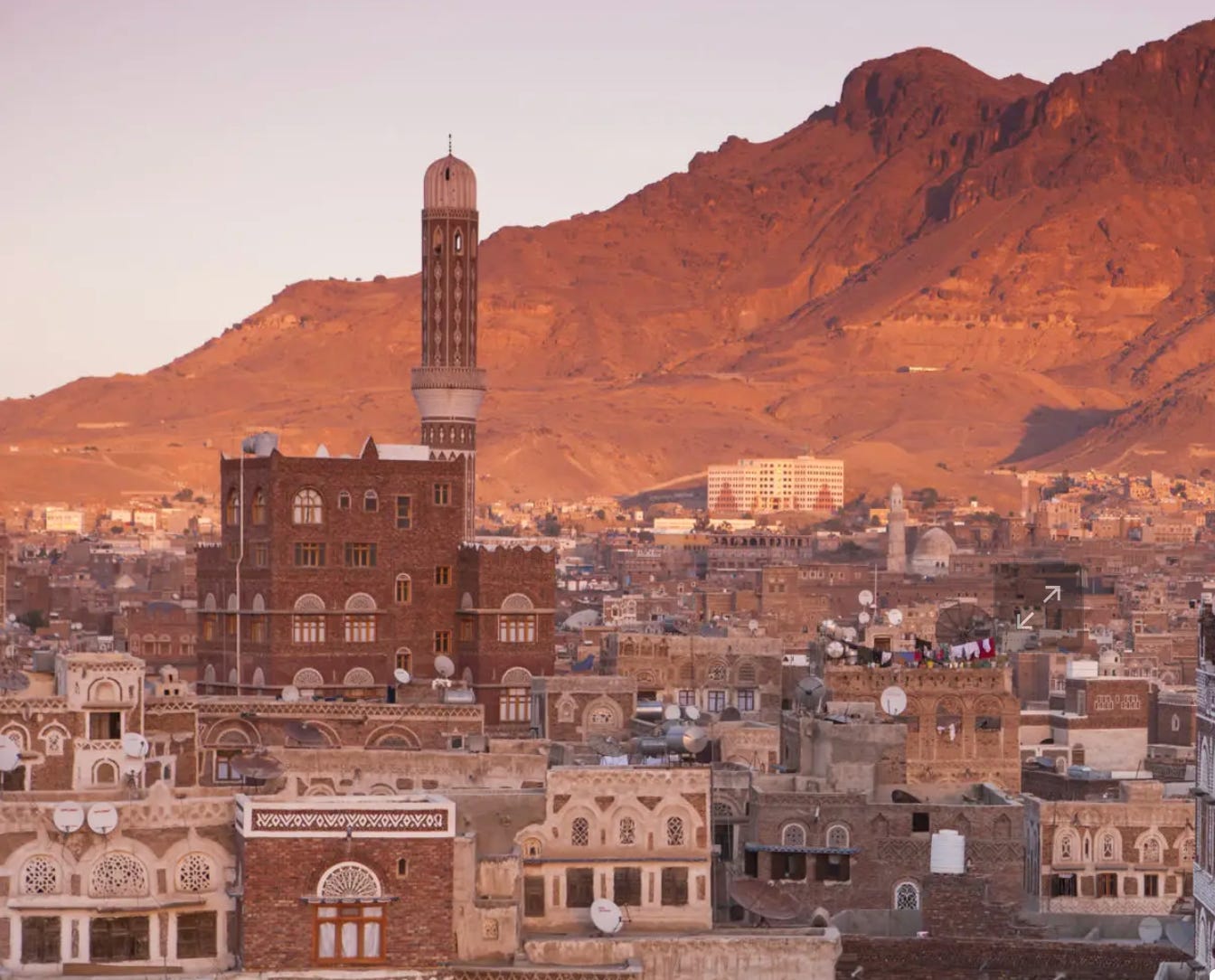
Sana’a is not on the seacoast. Sana’a is not a port. Sana’a is located in the western-highland geographic spine that is the terraced-slopes highland coffee-growing region. It is the traditional capital of Yemen. (It is the capital of the Houthi-controlled part of Yemen; the rest is ruled from Aden.) It is Yemen’s largest city, sitting at about 7,500 feet. Its old walled city is a UNESCO World Heritage Site.
Sana’a Café began in downtown San Francisco in 2023 as a family business. A cinnamon-cardamom combination in a strength never seen outside Yemen. Ginger, saffron, and honeycomb bread in an elaborate and very nonstandard pastry case (baklava, milk cakes, pistachio cheesecakes). Now Sana’a Café counts on the order of sixteen locations in California, plus one in Washington state; has taken over a former Starbucks in San Francisco’s Financial District at 27 Drumm Street; has three storefronts in the Sacramento area; and has one in Hollywood and one in Orange County. In the words of co-founder Sadeq Aleqel:
Sadeq Aleqel: Exploring Life & Business <https://voyagela.com/interview/exploring-life-business-with-sadeq-alaqel-of-sanaa-cafe/>: ‘The response from the community was immediate and heartfelt—people weren’t just discovering coffee, they were experiencing a culture, a story, and a centuries-old tradition in every cup…. Our focus is on Yemeni-style coffee and drinks, prepared with care and authenticity…. Serving Yemeni coffee and sharing our heritage doesn’t feel like work; it feels like purpose…. For us, the greatest risk would be not sharing Yemen’s coffee heritage at all….
The Dwight & Telegrph in Berkeley café location opened up, I have been told, in late July. The Daily Cal was soon reporting that at 11 pm you could see it full of summer-school students, heads down, studying, drawn by the midnight closing time, and by coffee mixed with amounts of cardomom, cinnamon, and other spices that you would never find in Italy or France.
And by the honeycomb pastries.
But how is it going to do for me this fall? The floors from the subbasement through four of Evans Hall have now been shut. The occupied floors are reduced to five through ten, with economics on floors five and six, and math on floors seven through ten. (You may ask: Why? Doesn’t economics have as many professors, more graduate students, and nearly aleph-null times as many undergraduates majors as math? Don’t ask.) That closing-off of the bottom half of the building does have consequences. For one thing, no drink vending machines. for another, no library on floor one to pick up things delivered from the remote book stacks. So I find myself going over to the main library, and then finding a chair there and perching with my laptop rather than going back up the seven flights of stairs. (Elevators, you say? Don’t ask.)
Could Sana’a Café this fall be, for me, a place to (a) drink good coffee, (b) hold office hours that are enjoyable for people to come to, and (c) have a chance of running into people by accident?
The dervishes knew coffee as a biotechnological device for extending the productive day, for wringing more devotional hours out of a body that wanted to sleep. That function has not gone anywhere. But three others have grown up around it, for the coffeehouse also matters. The drink narrows and sharpens attention. The room does more.
One defining pathology of intellectual life since about 2010 is that we have become extraordinarily good at finding exactly the information and exactly the people we already know we want, and correspondingly terrible at encountering the ones we did not know to look for. The search bar, the calendar invite, the scheduled Zoom—these are instruments of intention. They deliver what you asked for. They are useless for delivering what you had no way to ask for because you did not yet know it existed. As my teacher David Landes once said: you have to have a stack pass and go into the stacks of the library because the thing you want is not the thing you think you want but the thing three slots to the left.
The café is one of the last machines we have for manufacturing the unplanned collisions. Jane Jacobs had a vision of a dense and various public space that is useful precisely because you cannot predict what it will throw at you. A coffeehouse is such a sidewalk ballet with seating and a caffeine subsidy.
There is also the coffeehouse is a device for shifting frame. You think differently in a mild ambient hum than in silence. A change of physical location can unstick a stuck mental problem, that has you going in circles. Being among strangers who neither know nor care what you are working on can loosen the grip of a malevolent internal editor in a way that a familiar desk never will. The café supplies enough stimulation to keep the vigilance system idling, but not so much that it captures you.
Coffeehouses are an efficient bundling of: a legitimate reason to leave the house; a socially sanctioned excuse to be idle in public while your back-brain works; a stimulant delivered in a ritual that paces its consumption; and a nonzero probability of a useful accidental encounter.
Where else do you get all four for the price of a latte?
For me, it probably will not work for (c): Caffé Strada on eastsouthside is the champion, clearly; there is no parallel northside gathering place; and Sana’a’s location is very off of all beaten tracks for economists. (a) is very attainable. (b), perhaps as well.