
Real Price of Diesel: CHART OF THE DAY
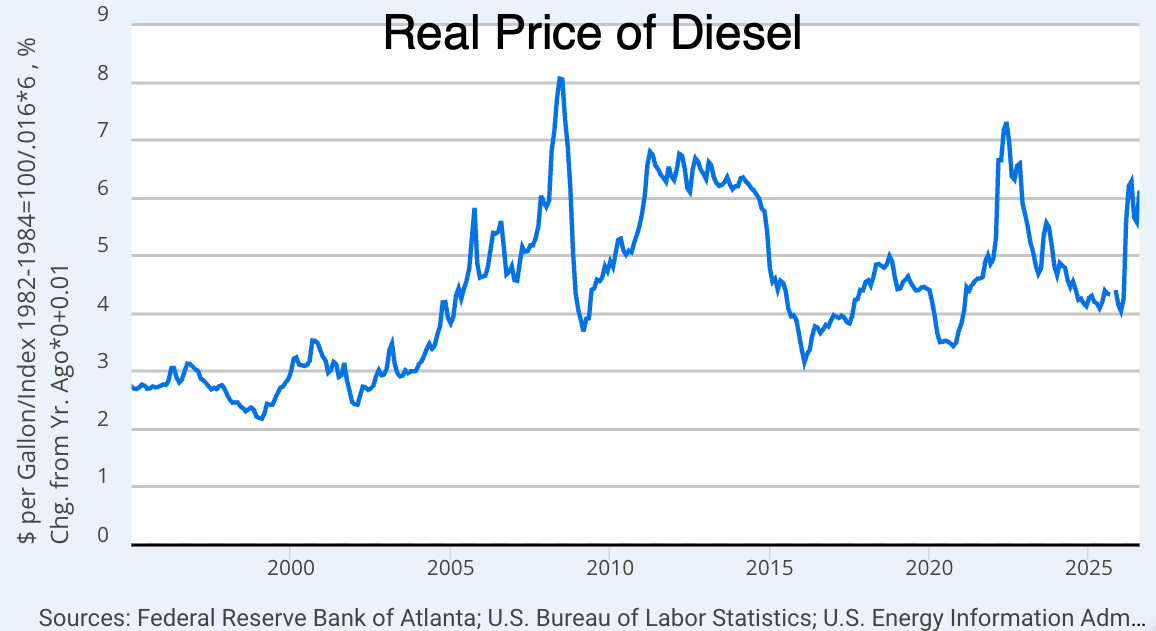
But two observations: (1) the spike is not that big, and (2) from an “affordability” perspective, this is the last thing one would want to generate from one’s foreign policy:
A real price series that I have been watching:
And we have a related observation from Matt Yglesias:
Matt Yglesias: The Republican Urge to Start Wars in the Middle East <https://www.slowboring.com/p/the-republican-urge-to-start-wars>: ‘Despite Trump’s anti-war rhetoric on the campaign trail, the national security team he announced shortly after the election was “an extremely hawkish group that screams ‘hot war with Iran’” <https://www.slowboring.com/p/how-donald-trump-could-succeed>. In retrospect, I wish I’d made a bigger deal about this….
There’s a weird finding in the economics literature that Democratic Party presidents enjoy systematically better economic performance even though they don’t pursue systematically better economic policy…. Alan Blinder and Mark Watson… [say] “the Democratic edge stems mainly from more benign oil shocks, superior total-factor-productivity (T.F.P.) performance, a more favorable international environment, and perhaps more optimistic consumer expectations about the near-term future.” They seem to primarily understand this as a question of good luck. But… Republicans have systematically bad foreign policy that is inattentive to the downside risk of saber-rattling and hawkishness…. The… problem with Bush-era foreign policy wasn’t belief in democracy; it was excessive belief in the potential upside of coercive military force. Trump has retained the error while reconfiguring the goals…
And the problems with Nixon-era foreign policy as it affected the economy was (a) Kissinger thought high oil prices were a good thing because they enabled the then-Shah of Iran to arm himself to the teeth and thus annoy the USSR on its southern border without Kissinger having to get congress to pass any military-aid bill, and (b) Nixon’s all-out rearmament of Israel in the 1973 war (against the wishes of his own Pentagon, which feared it would “blow any image we may have as an honest broker" and alienate the Arab states, which it did), thus provoking an OAPEC reaction in the form of the oil embargo.
MEMO:
Dine, Thomas A. 2022. “The Limits of Détente: The United States, the Soviet Union, & the Arab-Israeli Conflict”. Journal of Cold War Studies. 24:3. <https://direct.mit.edu/jcws/article-abstract/24/3/255/112894/The-Limits-of-Detente-The-United-States-the-Soviet>.
Nixon Foundation. 2023. “America’s Airlift in the 1973 Yom Kippur War.” Richard Nixon Foundation, October 10. <https://www.nixonfoundation.org/2023/10/americas-airlift-in-the-1973-yom-kippur-war/>.
Office of the Historian. n.d. “The 1973 Arab-Israeli War.” . U.S. Department of State <https://history.state.gov/milestones/1969-1976/arab-israeli-war-1973>.
Quandt, William B. 2001. Peace Process: American Diplomacy and the Arab-Israeli Conflict Since 1967. Washington, DC: Brookings Institution. <ISBN 9780520225152>.
Samet, Daniel J. n.d. “October 1973: Nixon’s Decision to Resupply Israel.” Not Even Past. University of Texas at Austin. <https://notevenpast.org/october-1973-nixons-decision-to-resupply-israel/>.
Tal, David. 2014. “A Tested Alliance: The American Airlift to Israel in the 1973 Yom Kippur War”. Israel Studies. 19:3 (Fall). <https://doi.org/10.2979/israelstudies.19.3.29>.
Wikipedia. n.d. “Operation Nickel Grass.” Wikipedia: The Free Encyclopedia. <https://en.wikipedia.org/wiki/Operation_Nickel_Grass>.
Yglesias, Matt. 2026. “The Republican Urge to Start Wars in the Middle East”. Slow Boring. September 23. <https://www.slowboring.com/p/the-republican-urge-to-start-wars>.
Yglesias, Matt. 2024. “How Donald Trump Could Succeed: Or, More Likely, Fail”. Slow Boring. November 14. <https://www.slowboring.com/p/how-donald-trump-could-succeed>.