
FaceBook’s Muse on the Apple iOS App Store: CHART OF THE DAY
My experiences with FaceBook products have always been that time spent getting up to speed on them is time wasted, and that time spent using them is time regretted. But if that is representative of anything, then there are hundreds of millions of addicted regretful regular users whose brains have been successfully hacked and hijacked and who then buy things based off of FaceBook/Instagram/WhatsApp ads. The market verdict is one of extraordinary success, with ads but only with ads:
All this is prelude to noting the sudden emergence of FaceBook Muse: an agentic AI system that has underlying economics I do not understand, but that Amazon fears enough to preëmptively block.
From Sensor Tower via Paul Kedrosky:
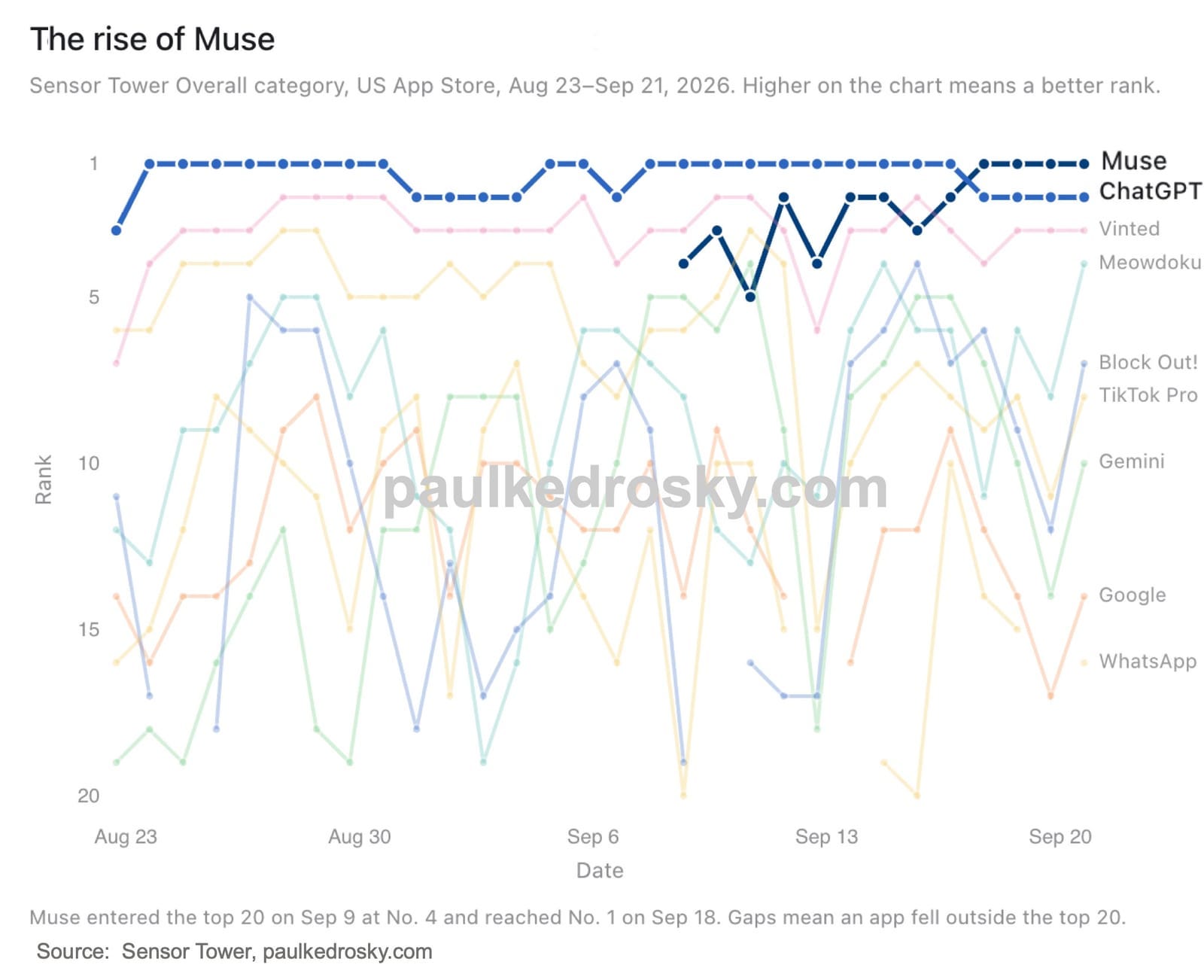
& Paul notes:
Paul Kedrosky: Meta’s Muse & Moat-less AI <https://paulkedrosky.com/metas-muse-and-moat-less-ai/>: ‘Meta's agentic AI app Muse entered the U.S. App Store’s top 20 on September 9 at No. 4. Nine days later, it was No. 1. Muse’s rise is a useful reminder that AI consumer products can gain share quickly, given buzz and distribution. Users can switch applications at negligible cost, while the underlying model intelligence is available to every serious competitor. The takeaway should be, in short, that there is, despite trillions in spending, minimal moat. The real assets are familiar ones: default placement, brand, habit, proprietary data, and an effective product loop. The AI itself is not a moat when competitors can access comparable models and cheaply reproduce the surrounding interface. Meta engineers concede as much in posts.
Muse may fall back out of the top 20 next month. Or it may get blocked everywhere, as has already happened at Amazon. That would make the point even more clearly: AI consumer software is beginning to look like a hit-driven market in which the model is rented, the interface is copied, and the users remain [—]mobile…
Brad DeLong here: The key question is this: What is FaceBook’s monetization strategy for Muse? FaceBook has a monetization strategy for everything, and it—at least for me—makes committing to using their programs painful, and something that after the fact I wish I had not done, I think that the monetization strategy is that FaceBook watches what you do with Muse and uses it to better target its Facebook/Instagram/WhatsApp ads, plus extorting money from shopping websites that are willing to pay to have Muse direct traffic to them. It would surely be a bad bet for me to commit to Muse, just as it would be a bad bet for me to commit to Threads.
But that is just me. I am not representative here. Of anything. Paul thinks the lesson is that “consumer AI” is becoming a hit-driven market where the model is rented, the interface copied, users stay mobile. This smells much more like the streaming-wars media financial disaster than like a new platform-monopoly in progress. But—nobody knows anything here.