
CROSSPOST: JOHN QUIGGIN: US Navy Defeated Again
As I read this, the story of navies these days—Ukraine-Russia, Houthis-Yemen, Iran-USN—is a clean case study in how a cost-exchange asymmetry (cheap offense vs. expensive defense) can render a weapons system obsolete — a technological-transition dynamic that shapes military and fiscal history, as what was seen as “strength” is actually useless because it is too precious to ever be put at risk in the field:
John Quiggin is not a naval expert. I am not a naval expert. But the real naval experts seem to be far too constrained by all kinds of factors and so they do not say the things that are true.
Six months into the war on Iran, the USS Abraham Lincoln is limping home, the Navy’s payroll has been raided to cover the campaign, and a former official says simply: “They’re f**ed.” Can anyone convince me John Quiggin has this wrong?
As John Quiggin writes:
As many people have pointed out to me over the years , I’m not a naval expert. But I can count…. Standard USN doctrine calls for the use of two defensive missiles against each incoming missile. On the assumption of 100 usable missiles per escort, that’s 50 defensive actions per escort or 200-250 in total…. A carrier-based bombing campaign couldn’t be sustained for even ten days without exhausting the carrier group’s defences, and requiring the USN “declare victory and go home”…. Pretty clearly, the US military drew the same conclusion, except for the bit about going home…. Meanwhile, it is reported that the costs of the futile campaign have wrecked the Navy’s budget…. But… I am confident that nothing will persuade navalists that their beloved flat-tops and frigates are little more than floating targets.
On the ocean, you cannot dig in, you cannot hide, and you cannot run very fast. So what are you to do in a world in which finding and hitting an attacking missile or drone is a much, much harder problem than for the attacking missile or drone to find a target?
Where is the hole in this logic?
CROSSPOST: JOHN QUIGGIN: US Navy Defeated Again
<https://johnquigginblog.substack.com/p/us-navy-defeated-again> <https://johnquigginblog.substack.com>
John Quiggin’s Blogstack
But that won’t change any minds
Aug 30, 2026
It’s now six months since US-Israel war on Iran began with air attacks which killed the Iranian leader Ayatollah Khamenei as well as around 200 schoolchildren. The war has dragged on a long time. But before that surprise attack, it had appeared that the US planned to rely on naval power to coerce the Iranian regime into submission.
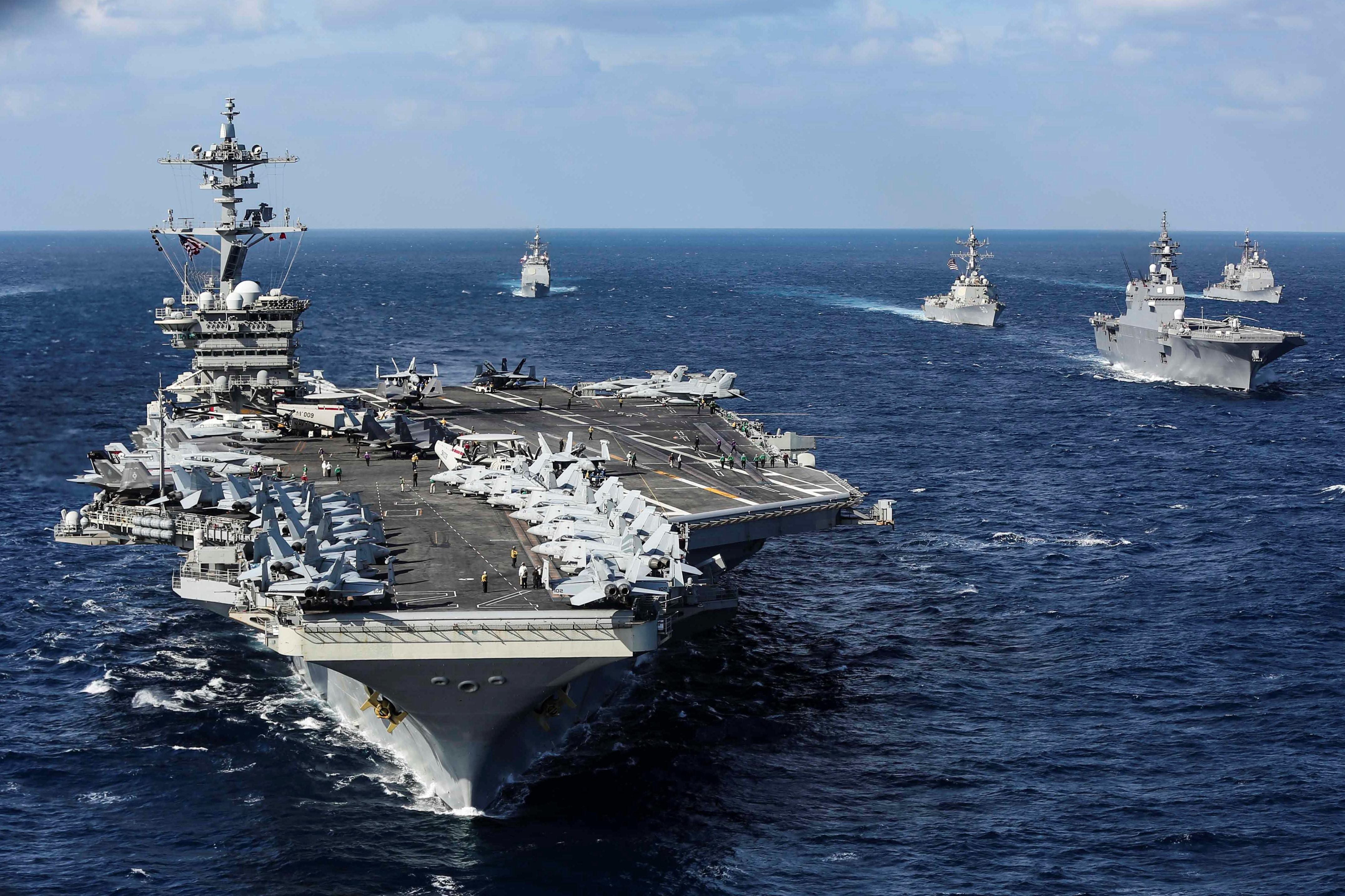
Early in February 2026, Trump deployed a carrier strike group (CSG) to the region, with a second arriving shortly afterwards. This show of force was described (with a striking lack of historical awareness) as an “armada”. The lead ship of that group, the USS Abraham Lincoln, is now limping home after what is generally admitted to have been a disastrous tour of duty.
As many people have pointed out to me over the years , I’m not a naval expert. But I can count. So, when the armada arrived, I checked the numbers and concluded that the threat was a hollow one.
The escorts are critical. They provide missile defence using AEGIS and Sea Sparrow systems, and once their interceptor stocks fall to low levels they must withdraw to be replaced or rearmed.
This creates an arithmetic problem. A Hobart-class destroyer has 48 blocks each capable of carrying one AEGIS controlled SM-2 or SM-6 interceptors. Alternatively, each block can carry four Sea Sparrows, but these are less capable.
Standard USN doctrine calls for the use of two defensive missiles against each incoming missile. On the assumption of 100 usable missiles per escort, that’s 50 defensive actions per escort or 200-250 in total. No one knows how many missiles Iran has available, but typical estimates suggest at least 3000, of which 1000 or more could be used in anti-ship capacity. Even assuming successful air attacks on launch sites, use of aircraft against missiles etc, hundreds of missiles will pose a threat, and at least some of them will cause enough damage to force escorts to withdraw.
A carrier-based bombing campaign couldn’t be sustained for even ten days without exhausting the carrier group’s defences, and requiring the USN “declare victory and go home”
As it turns out, I wasn’t the only one who could count. The Centre for Strategic and International Studies (a hawkish and generally navalist think tank) looked at the numbers and concluded that the available force could do some damage but not enough to produce regime change. And, pretty clearly, the US military drew the same conclusion, except for the bit about going home.
Like the CSIS, I didn’t expect a massive air campaign beginning with the killing of the top Iranian leadership. But once the full-scale war began, the vast majority of the attacks were made by land-based aircraft. Iran responded by attacking those bases with a level of success that could have produced a catastrophe if it had been focused on the navy.
The role of the USN was reduced to its long-stated mission of keeping vital sea lanes open. When that failed, it shifted to the secondary task of imposed a blockade on Iran. Unsurprisingly, this has not produced a surrender - no naval blockade in recorded history has forced an adversary to surrender without the deployment of land forces.
Meanwhile, it is reported that the costs of the futile campaign have wrecked the Navy’s budget. A navy official, quoted in the Guardian says
.The money for payroll was robbed to pay for overseas contingencies and is being backfilled by money that hasn’t been spent. They are backfilling payroll so we get enough money in our paycheck.
More succinctly, a former official said
They’re fucked. They shot all their weapons; they trashed all their ships; they ran out of their money
The 2020s haven’t been a great decade for navies. The Russian invasion of Ukraine began with the destruction or capture of almost the entire Ukrainian navy. Then, despite having no navy of their own, the Ukrainians wiped out much of the mighty Black Sea Fleet, with the remnants sheltering in a Russian port as far away from Ukraine as they can get.
The Iranian war began similarly. The destruction of the Iranian Navy was rapid and complete. The most notable feature was the perfidious sinking of a ship returning from a training exercise in India, with the survivors of the initial attack being left to drown, even though their rescue would have posed no risk.
The US Navy suffered nothing more than the failures described above, but that was bad enough. Following the earlier failure to dislodge the Houthis, who now control access to the Red Sea, it is clear that naval forces cannot reliably keep trade lanes open, or defeat even a low-level land-based opponent.
But having been through many rounds of this debate, I am confident that nothing will persuade navalists that their beloved flat-tops and frigates are little more than floating targets. Pirates, grey zones, reconnaissance, diplomatic visits, disaster relief and tiger-repelling rocks will all be wheeled out. Still, for any government in serious fiscal trouble (and aren’t they all) reducing the navy to a coast guard would save a heap of money that would otherwise be wasted.
Anticipating this, I won’t reply to any comments restating points of this kind. If you have something actually new to say, go ahead.
* I haven’t talked about submarines here. The doomsday machines waiting to unleash nuclear armageddon from the deep ocean floor are too much for me to think about. The ordinary kind, designed to sink ships from concealment, now seem like an expensive way of doing the job of a low-cost missile or drone, and even their invisibility is a depreciating asset.
<https://johnquigginblog.substack.com/p/us-navy-defeated-again> <https://johnquigginblog.substack.com>
Brad DeLong back here: Are not expensive, concentrated naval platforms are now floating targets in an era of cheap, abundant precision missiles and drones? The vibe I get is the vibe of the Japanese main battle line during World War II. The ships were very valuable but vulnerable, hence too valuable to be risked in any actual operation, hence completely useless until an attempt was finally made to use them at Leyte Gulf.
The only hole I see is if for some reason there is a truly open-ocean conflict. But then I think about drone-containing containers stacked on top of some of the 7000 container ships that traverse world’s oceans. And I think of those containers opening up and releasing their cargo swarms in the openest of opean-ocean places that can be.