In Memory of Jeffrey Williamson: SATURDAY “SLOUCHING” & FRIENDS
Forty-three years a teacher, a role model who treated every economy as a system worth understanding whole, and a friend to me, always insisting you check all the boxes—and then go away, think harder, and circle back.
My old friend Jeffrey Williamson—teacher, chair of my dissertation committee, role model, someone who woke up every morning eager to learn, eager to think, and eager to teach. I had known him for 43 years.
Thinking back, I find myself once again grappling with the fact that my relationship with him was predominantly parasocial: in that I was talking to him once a year or so, and exchanging short messages once a quarter or so, and yet reading or at least glancing at his works and discussing and arguing with him, watching him in my mind’s eye and hearing him in my mind’s ear, much more often than that.
I learned of his death from Vince Geloso, who wrote a very nice short appreciation of his work:
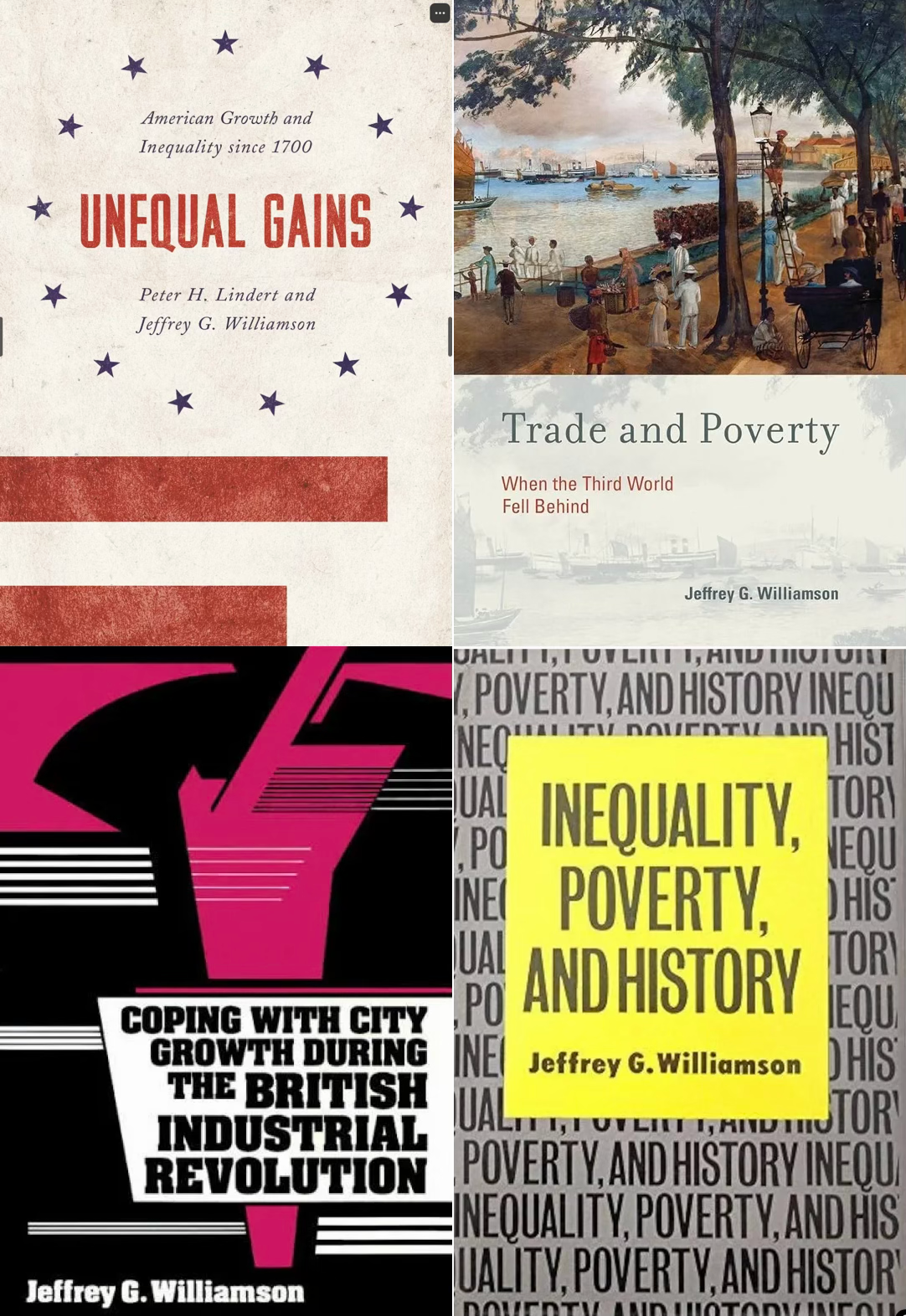
Since Jeff Williamson died today, I want to share his best works with all of you.
The first is my favorite: Unequal Gains: American Growth & Inequality since 1700. Its the price-theory based explanation of American inequality (and its measurement) from the colonial era to today. That book is simply superior in every way to what people tend to like more at the time it came out.
The second [Trade & Poverty: When the Third World Fell Behind] is really good and its also about inequality but between nations. Its basically how the West grew rich in the 1850s-1950s, while the rest grew rich too but more slowly. Its a history of how terms of trade affect institutions, and development paths through a variety of mechanisms. Its basically Jeff’s book to say that Marxists theories of “exploitation” and “imperialism” are basically rubbish junks that use some true facts here and there to weave an elaborate theory. An elaborate theory that basic economic (i.e., relative prices, terms of trade, institutions) theory simply beats like a tank over a piece of toast and without any normative priors. Its just a great work.
The third [Coping with City Growth During the British Industrial Revolution] is the underrated work of his. Its a history of how Britain adjusted to industrialization and rapid city growth. It wasn’t well received but, with hindsight and decades later, it has actually held up really well. Its a bit like the movie Event Horizon. It initially got thrashed but as time passed, it became appreciated. I was re-reading it for my EC365 class at GMU and its just fun and smart.
The fourth one [Inequality, Poverty, & History] is the fun one. Its the book that Jeff wrote soon after getting to Harvard I think. And in it, you see all the themes he is going to harp on for many years. Its basically the “distilled” Jeff that gives the great overview (at an early formative stage) of his views on inequality throughout history. Its just so much better than 99.99% of what is being commonly cited. Jeff was just great about thinking about inequality and how it emerged. And in this, you see that its coming from a pretty centrist guy. He just wanted good economics and you see it there. Its a fun read…
He was a great role model showing how one could have fun and do good by waking up early in the morning and keeping your mind focused on five things:
that economic history was economic development and economic development was economic history;
that each shed light on the other, and that the first was most useful as it informed your analysis of the second, and that no analysis of the first should be undertaken without looking about how what we now know about the second informed it;
that every economy is a system, and it is not worth looking at individual pieces unless you have previously done the work to understand how the system might fit together and the ways it might be working;
that the economist had a tremendously powerful conceptual toolkit: of incentives and opportunity costs, optimization and constraints and resources and the behavioral relationships that they induced, market equilibrium conditions, accounting identities, and accumulation and externalities;
that you always needed to do the work to check all the boxes;
that he was the best examplar ever of Robert Fogel’s line that the superpower of the economic historian is counting, for you needed to try as hard as you could to get the numbers right, for those constrained the analysis;
and, finally, that we never got the analysis exactly right, and should always go away, think harder, and someday circle back.
Johan Fourie: The Path of Clio <https://www.ourlongwalk.com/p/the-path-of-clio>: not an appreciation of Jeffrey, but an example of the kind of outside-the-box data-collection and then analysis that he would hae greatly appreciated.
If reading this gets you Value Above Replacement, then become a free subscriber to this newsletter. And forward it! And if your VAR from this newsletter is in the three digits or more each year, please become a paid subscriber! I am trying to make you readers—and myself—smarter. Please tell me if I succeed, or how I fail…