CROSSPOST: PAUL KRUGMAN: Imperialist Delusions & the Price of Fuel
Paul Krugman’s Substack has become essential reading, and this piece exemplifies why: a clean takedown of the Trump-Bessent claim that Ukraine and “the conflict Iran” bear responsibility for high fuel prices today:
PAUL KRUGMAN IS UNCHAINED!!
(And Robin Wells is no slacker at data analysis, data sniffing-out, and idea-finding either:
Paul Krugman: A Pause to Refresh <https://paulkrugman.substack.com/p/a-pause-to-refresh>: ‘Substack has become… a full-time job for two people, because Robin Wells… is deeply involved in researching and editing. That’s fine…. The newsletter has become a tool for informing as well as influencing…. I have >500K subscribers — 528,842, but who’s counting? Weekday posts, which are free, typically get around 500K views. So people are reading what I write…
)
Just imagine what an analytical asset the New York Times could have had! If it had not insisted on burning eight hours of Paul Krugman’s time a week resisting the editors, and if they had actually let him maintain his New York Times blog, rather than snuffing it out as embarrassingly showing up what the news pages were doing:
CROSSPOST: PAUL KRUGMAN: Imperialist Delusions & the Price of Fuel
<https://paulkrugman.substack.com/p/imperialist-delusions-and-the-price> <https://paulkrugman.substack.com>

Trump and Bessent tried to betray Ukraine. Now they don’t have any cards.
Paul Krugman
Sep 03, 2026
During the 2024 campaign Donald Trump promised to cut energy prices in half. He has, instead, presided over soaring prices at the pump, which have played an important role in his collapse in the polls.
Some might attribute this disaster to Trump’s decision to go to war with Iran, ignoring what appear to have been near-unanimous warnings by experienced military and intelligence officials that such a war would, in addition to disrupting oil supplies, overstretch the U.S. military and dangerously deplete stocks of munitions — which is exactly what happened.
But Scott Bessent, Trump’s Treasury secretary, has found someone else to blame: Ukraine.
Yesterday Bessent went on “Fox & Friends,” where he pinned the blame for high energy prices largely on Kyiv:
We are going through an energy shock right now due to both the war in Ukraine, because Ukraine has decided that they want to blow up Russian energy assets and refined properties, so that is creating upward price pressure on a global basis, and the conflict in Iran…
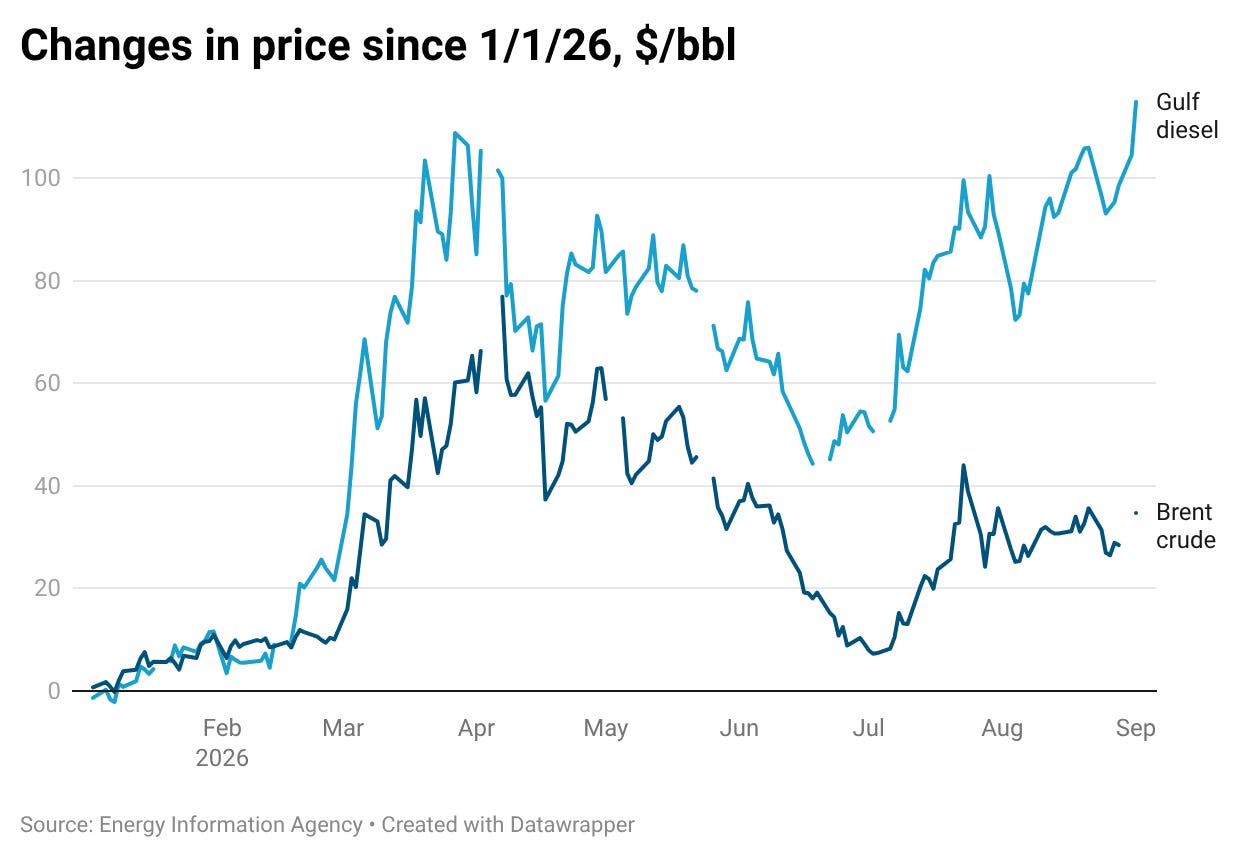
Now, Bessent isn’t wrong to say that bottlenecks in refining capacity are playing a major role in the current energy shock. The chart at the top of this post shows changes in the price of crude oil and diesel, both measured in dollars per barrel, since the beginning of this year. Crude oil is up a lot, although off its peak in early April. But diesel is up much more (so is gasoline, although not quite as much.) And Ukrainian strikes on Russian oil facilities are certainly playing a role in reducing global refining capacity.
But note Bessent’s wording: Ukraine “has decided that they want to blow up Russian energy assets.” Gosh, why would the Ukrainians want to do such a thing? Might it have something to do with the fact that they are engaged in an existential struggle against Vladimir Putin’s regime, which is in its fifth year of a war aimed at destroying their nation, and they need to hit back at Putin’s military and economic base?
Notice, also, that Bessent didn’t point out that these attacks on Russian oil would end if Russia were to end its attempted war of conquest. But far from demanding an end to Russian aggression, the Trump administration infuriated the democratic nations of Europe by inviting Russia’s finance minister, for the first time since the Ukraine war began, to Monday’s meeting of the Group of 20 major economies.
But wait: There’s more background here. Bessent, as much as or more than Trump, has been effectively an enemy of Ukraine from the beginning.
Right at the beginning of the Trump II administration Bessent flew to Kyiv to demand that the Ukrainian government in effect hand over a large share of its mineral resources to the United States. I described it at the time as a “Belgian Congo” deal:
What Trump suggested was that Ukraine give the United States half of the revenue it gets from resource extraction, as far as I can tell in perpetuity. Trump suggested that this would amount to $500 billion, although this seems like a wildly exaggerated sum. In return, Trump offered, well, zero. No additional aid, no security guarantees, no nothing…
Maggie Haberman and Jonathan Swan’s book Regime Change: Inside the Imperial Presidency of Donald Trump offers more, damning detail. There was apparently a shouting match between Bessent and Ukraine’s president Zelenskyy, in which Zelenskyy correctly described Bessent’s proposal as a shakedown unenforceable under Ukrainian law.
Bessent then returned to Washington and urged Trump not to even meet with Zelenskyy until he signed the minerals deal:
“I’ve dealt with this little fucker,” Bessent would say to associates about Zelensky. “He’s tricky. He’s like the special-needs child for the Europeans. And he’s acting like Mr. Bean on crack”…
Nonetheless, Trump did meet with Zelenskyy — and it was a disaster, including Trump’s famous insult, “You’re not in a good position. You don’t have the cards right now.”
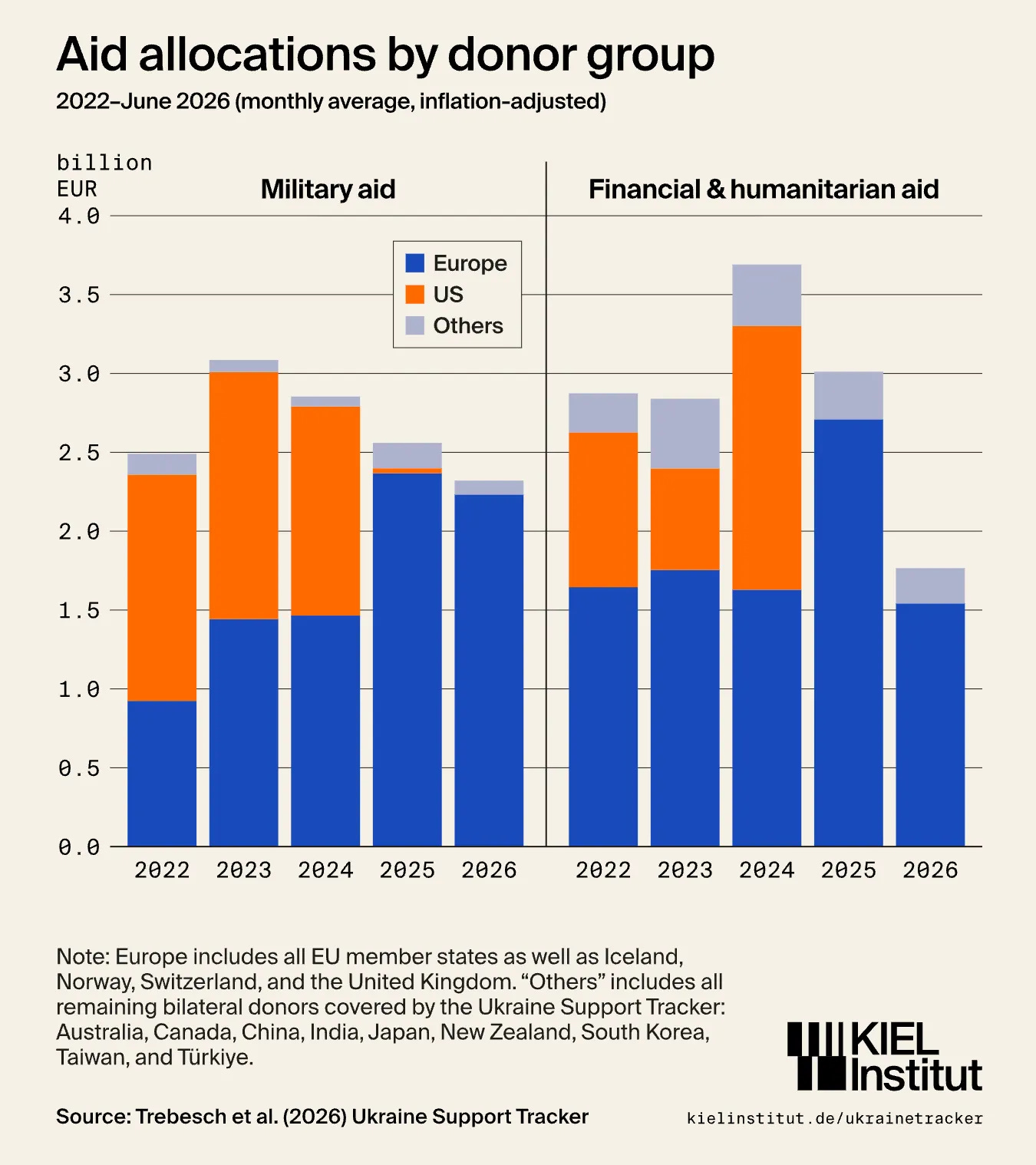
The Trump administration proceeded to cut off virtually all aid to Ukraine, presumably expecting Ukraine’s defense against Russia to collapse.
Ukraine, however, declined to collapse. Aid from Europe replaced much of the lost American support:
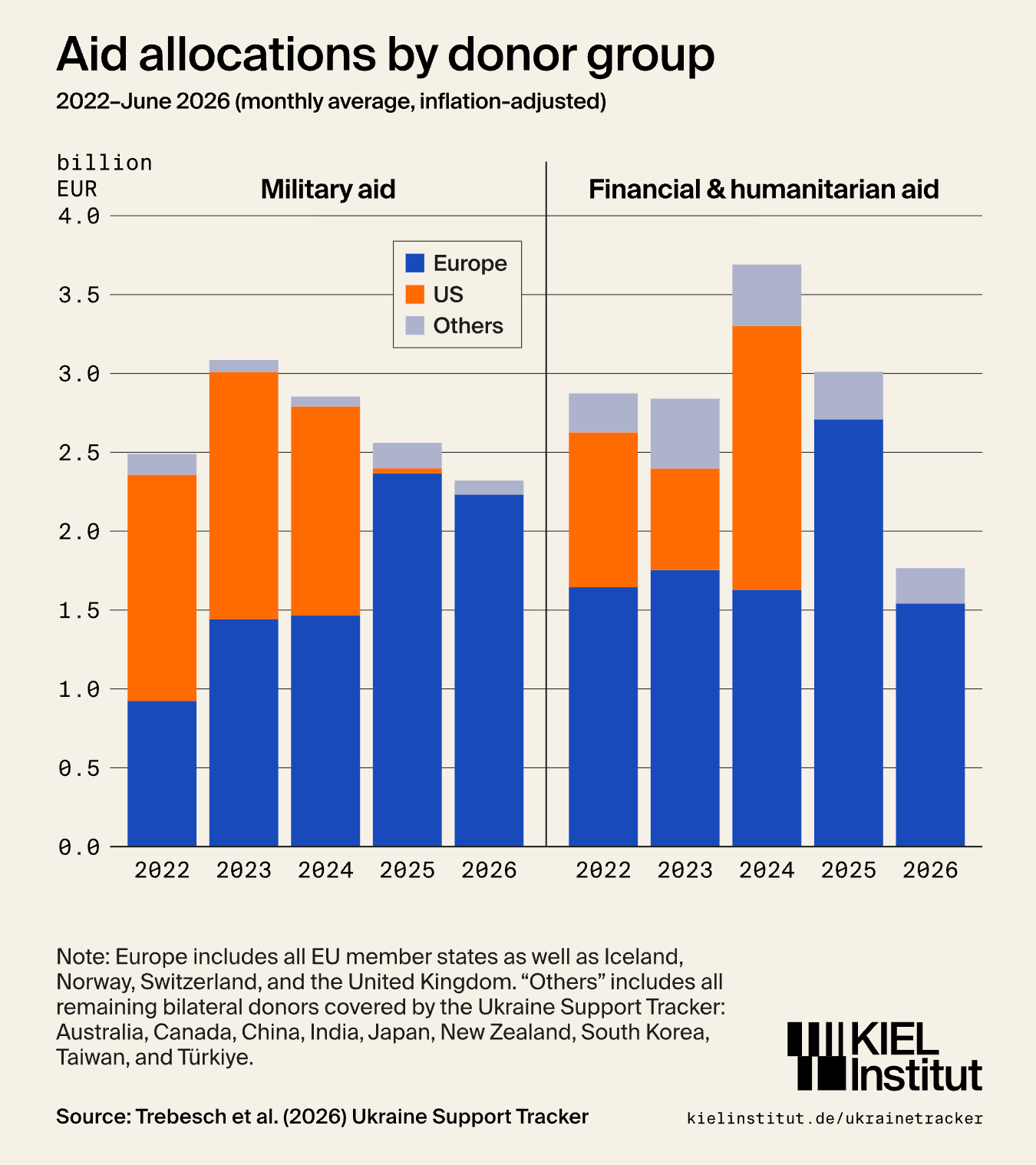
And the Ukrainians, though deprived of important U.S. weapons — especially Patriot interceptors — have if anything been gaining the upper hand in their war, thanks in part to their growing mastery of drone warfare. Russia’s ground offensive has stalled despite enormous casualties, while Ukraine is carrying out more and more long-range strikes, including, yes, strikes on Russia’s oil infrastructure.
By the way, Ukraine’s success in drone warfare suggests that the government in Kyiv could offer the U.S. military, which has fared so badly against Iranian drones, quite a lot of help. But don’t expect Pete Hegseth’s Pentagon to ask for or receive such help.
Anyway, now Bessent is blaming Ukraine for high fuel prices. Is he demanding, or maybe pleading, that the Ukrainians halt their strategic air campaign? If so, in return for what?
After all, the Trump administration can’t threaten to cut off aid — it already did that long ago. It can’t offer to help Ukraine plug the one big hole in its defense technology, its lack (so far) of effective interceptors against ballistic missiles, because the U.S. has depleted its own stock of such interceptors in its Iran debacle.
So while I’m sure that Bessent and Trump wish that Ukraine would stop blowing up Russian energy assets — they would demand that Ukraine stop, if they could — they can’t, in practice, do anything to change Ukraine’s war strategy. To put it bluntly, they’re not in a good position. They don’t have the cards.
No music. Sorry.
<https://paulkrugman.substack.com/p/imperialist-delusions-and-the-price> <http://paulkrugman.substack.com>
Brad DeLong here: What do I think?
First, I think that Paul Krugman’s SubStack is super-awesome.
I was talking to Suresh Naidu about this yesterday. We both agreed that it has become a first thing in the morning must-read, and that we had only one complaint. Let me get back to that later.
Second, I think Krugman is right that—surprise! surprise!—the Trump-Bessent scapegoating of Ukraine for high U.S. fuel prices is analytically dishonest and strategically hollow. It is not as though Ukraine just decided to blow up Russian refineries. It is that Russia earns money from those refineries that it uses to buy weapons to kill Ukrainians. And Ukraine’s drone mastery has flipped battlefield expectations and given Ukraine the ability to blow them up.
Trump and Bessent bet that by cutting off aid and by winking to their friend Vlad that he should stay the course that they could create a situation in which either Putin would win the war (and winning the war means the end of Ukraine as an independent state and the end of Ukraine as a nation), or in which they could plunder Ukraine’s resources.
They were wrong.
Now they face blowback.
And yet when Bessent goes on the TV, he says:
We are going through an energy shock… because Ukraine has decided that they want to blow up Russian energy assets and refined properties… and [because of] the conflict in Iran…
As Paul says:
Gosh, why would the Ukrainians want to do such a thing? Might it have something to do with the fact that they are engaged in an existential struggle against Vladimir Putin’s regime, which is in its fifth year of a war aimed at destroying their nation, and they need to hit back at Putin’s military and economic base?… Far from demanding an end to Russian aggression, the Trump administration infuriated the democratic nations of Europe by inviting Russia’s finance minister, for the first time since the Ukraine war began, to Monday’s meeting of the Group of 20 major economies…. Bessent, as much as or more than Trump, has been effectively an enemy of Ukraine from the beginning…
I mean: Trump promised to halve energy prices and instead presided over a spike at the pump. Bessent called Zelenskyy “the special-needs child for the Europeans” and bet Ukraine would fold. Ukraine declined—and mastered drone warfare on the way to gaining the upper hand. Perhaps things would be different if Bessent had helped Ukraine defend itself rather than spent his energy trying to shake it down?
My complaint about Paul Krugman’s SubStack? I would rather see it once every three days at three times the length, with an analytical economic model.
As Avinash Dixit wrote in his encomium for Paul Krugman on the occasion of his winning the Clark Medal, his intellectual style as an academic economics professor was more-or-less the following:
He spots an important economic issue.
He spots it years before anybody else—so far in advance that he has substantially difficulty in getting people to take it (and him)
seriously (cf.: Paul’s experience as an assistant professor at Yale).
He constructs a model of it that offers new, surprising, and important insights.
The model does not dot all of the currently-fashionable theoretical i’s or cross all the currently-fashionable theoretical t’s.
Eventually the issue receives general attention.
Other economists find that Paul’s model and paper are sitting there, waiting for them.
Some economists admire how Paul was there first.
Others are, principally, irritated. As Avinash wrote: “The model is wonderfully clear and simple. But it leaves out so much and relies on so many special assumptions, including specific functional forms, that they don’t think it could possibly do justice to the complexity of the issue...”
And so “armies of well-trained economists”—mostly hostile, or at least skeptical—”go to work... extend and generalize it to the point where it would get some respect from rigorous theorists...”
They then “as a rule... find... [that] Krugman’s special structure is so well-chosen that... its essential insights survive all the extension and generalization... go to the heart of the problem.... By contrast, the followers’ work... involv[es] much clumsy breaking of ribs; sometimes it proves no more than an autopsy of the issue...”
This is what Paul Krugman did again and again and again, whether the return of depression economics or monetary policy at the zero interest rate lower bound, increasing returns and big pushes, increasing returns and development economics, geographical concentration and diffusion, dirty exchange-rate floats, currency crises, strategic trade and industrial policy, increasing returns and the sectoral pattern of international trade, and more, and more, and more. Over and over again when you look at what is of enduring value in a huge fraction of macro and international finance sub-literatures it is Krugman’s contribution that stands out and is still the single thing you need to read to understand what is going on. Over and over again, he took a current policy concern and developed a small model to build a language for discussing the issue. And he loves the economics community. I recall him writing once, now long ago:
I have never left the academic circuit, and I never will. I have been a bit cynical about how that circuit works, but its members constitute a true, and wonderfully unpretentious, élite…. I attended an international trade conference held in a classroom in Milan. The room was shabby, with seats so uncomfortable that several older participants ended up with back problems. The hotel was decent but austere. Yet I can assure you that there was more real insight in the discussion than you will find in a dozen G7 summits. I hope that I never forget that it is young economists in blue jeans, not famous officials in pinstripes, who really have interesting things to say…
Well, Paul Krugman was forced out of that role—which is his singular absolute and comparative advantage—into the rôle of New York Times public intellectual who was for years and years the only person given regular space who would look around him, say what was going on, and not be a careerist liar. (In so doing, he annoyed the editors of publishers of the New York Times quite a bit, I understand.) Throughout that now quarter century, I always had this view:
Paul was doing the right thing in taking on this particular public intellectual role.
There were other people who probably could do it better and should have that task.
The chance the New York Times would hire any of them to do that task, which three quarters of their regular op-ed columnists should have been doing, were zero.
Hence he needed to stand his watch.
Now, however, that particular watch is done. And I want more of the model-building Paul back—the things he calls “wonkish” when he writes them, but I want them even wonkier.
It would, of course, be a substantial mistake if Paul were to shift the orientation of his SubStack to please me. But I am selfish and wish he would do it.
Coda:
Something I wrote, quite a while ago. The part I want to excerpt starts with a long quote from Michael Tomasky:
The pre-Bush Krugman... was always a liberal, to be sure, and highly critical of supply-side economics. But he also disparaged economists to his left.... Reviewing Peddling Prosperity... Benjamin M. Friedman took note of Krugman’s disdain for... ‘strategic traders’.... If you were a radical economist in those days, or a labor movement intellectual, or a left-leaning social scientist, chances are you weren’t a big fan of Paul Krugman....
About Bush v. Gore, he had little to say. After Bush took office, he savaged the administration’s regressive tax cuts. But it wasn’t really until the fall of 2002... that he began... extending his critique to the larger conservative movement and its modus operandi, and discussing the mainstream press’s failure to report....
So Krugman came a bit late to the political trenches—and perhaps a bit reluctantly. Just as Arnold Schoenberg said of himself, when asked by a stranger if he was indeed the controversial composer, that ‘nobody wanted to be, someone had to be, so I let it be me’, so I suspect Krugman might say that virtually no one on the leading Op-Ed pages was saying the things that so obviously needed to be said as the Iraq war approached, so he let it be himself who said them. And now, after years of twice-weekly deadlines, he appears to have decided that there’s no turning back...
This assumption of this role provoked huge amounts of pushback: denunciations of Krugman for having some good points to make, but being “too shrill”. The epitome of highbrow anti-Krugmanism probably came in Bill Emmott and Clive Crook’s Economist in 2003, which wrote about him as “the one-handed economist”:
Increasingly, people are asking whether Mr Krugman’s success as a journalist is now coming at the expense of, rather than as the result of, his economics. For while he has had some journalistic coups during his time as a columnist... the most striking thing about his writing these days is not its economic rigour but its political partisanship. Lyinginponds.com, a website that tracks partisanship among American political columnists, rates Mr Krugman second in the overall partisan slant....
[His critics] they cannot all be easily dismissed. The more reasonable ones allow that he is a gifted writer and economist, but also argue that these days his relentless partisanship is getting in the way of his argument. Is the American political and economic picture, they ask, really as one-sided as he paints it? And if not, should an economist of Mr Krugman’s prominence be telling the public that it is?
A glance through his past columns reveals a growing tendency to attribute all the world’s ills to George Bush. Regarding California’s energy crisis, for example, he berated the Bush administration and the Federal Energy Regulatory Commission for not imposing price caps sooner—but found no room to mention Bill Clinton… nor to attack… Gray Davis....
Even his economics is sometimes stretched. A recent piece accused conservatives of embracing the “lump of labour fallacy”... the paper he cited did not.... He used game theory to argue that, by criticising North Korea but not attacking it, and then going after Iraq instead, Mr Bush is “probably” encouraging North Korea to become a more dangerous nuclear power. This probably did not convince most game theorists.
Overall, the effect is to give lay readers the illusion that Mr Krugman’s perfectly respectable personal political beliefs can somehow be derived empirically from economic theory....
Krugman seems to have embraced the concept of the free lunch—even though as an economist he should know better. Every opportunity (including lunch, and even including Mr Krugman’s favoured policies) has a cost.... Surely one of an economist’s main tasks is to remind one-handed politicians, and their constituents, that economic choices generally come in shades of grey, not black and white—even when they are made by one’s political rivals.
Many of Mr Krugman’s fellow economists, jealous of his celebrity, comfort themselves with the thought that his angry rants have hurt his reputation enough to ensure he will not now win a Nobel prize.... [But] the Nobel committee has not been averse in the past to giving the prize to economists who have achieved popular notoriety, as its awards to Mr Friedman and, more recently, Joseph Stiglitz show...
That was appalling.
First, you cannot help but notice the extraordinary absence of quotes, of references to specifics, of references to identifiable cases and persons, and, indeed, the absence of the active voice. The only thing that can be called a citation is <http://lyinginponds.com/>. Everything else is: “people are asking…” cannot all be easily dismissed…” “reasonable ones allow…” “a recent piece…” “the paper…” “this probably did not convince…” “many of Mr Krugman’s fellow economists…”
Moreover:
Was there a need for FERC to impose price caps under the Clinton administration? No.
Which column and which paper brushed up against the lump-of-labor fallacy? Emmott and Crook do not say.
How and where have Krugman’s columns committed the free lunch fallacy? Again, Emmott and Crook does not say.
Who are the economists who are jealous of Krugman’s celebrity? Silence.
And are Emmott and Crook really arguing that it was smart of George W. Bush to slap the label “axis of evil” on three countries and then invade one of them given that he wanted to convince North Korea to halt its nuclear weapons program?
If this is the best bill of particulars that anti-Krugmanism can come up with—and it seems that it is—the natural conclusion is that Krugman was correct when he wrote that:
Many powerful people prefer to take advice from those who make them feel comfortable rather than from those who will force them to think hard. That is, those who really manage to influence policy are usually the best courtiers, not the best analysts. I like to think that I am a good analyst, but I am certainly a very bad courtier...
OK. Coming back to the present, I note that neither Emmott nor Crook has ever been able to be man enough to apologize.
Nor do I suppose that either of them ever will be.