The Fed Chairman Who Would Prefer Not to Say: Warsh’s Silence as a Position, Not a Puzzle: TUESDAY MACRO OUTLOOK
The factors of production are these: labor, capital accumulation, enterprise and innovation, and risk-bearing. The cost of risk-bearing is increased when there is an unstable standard of value. Kevin Warsh is manufacturing that instability by refusing to settle on a reaction function for the central bank. Read as a Fed Chair’s vision of the economy, Kevin Warsh’s Jackson Hole speech confuses. Read as fog-generation, it is crystal clear in its way:
Demoiselle Marchée Financiere thought that Kevin Warsh’s speech at Jackson hole was important enough to lower the real value of everything two years in the future relative to today by fully 0.16%. That is, the real wealth of worker skills, capital and infrastructure investments, and production networks we expect to see in two years lost $320 billion of its value relative to today as Kevin Warsh gave his speech:
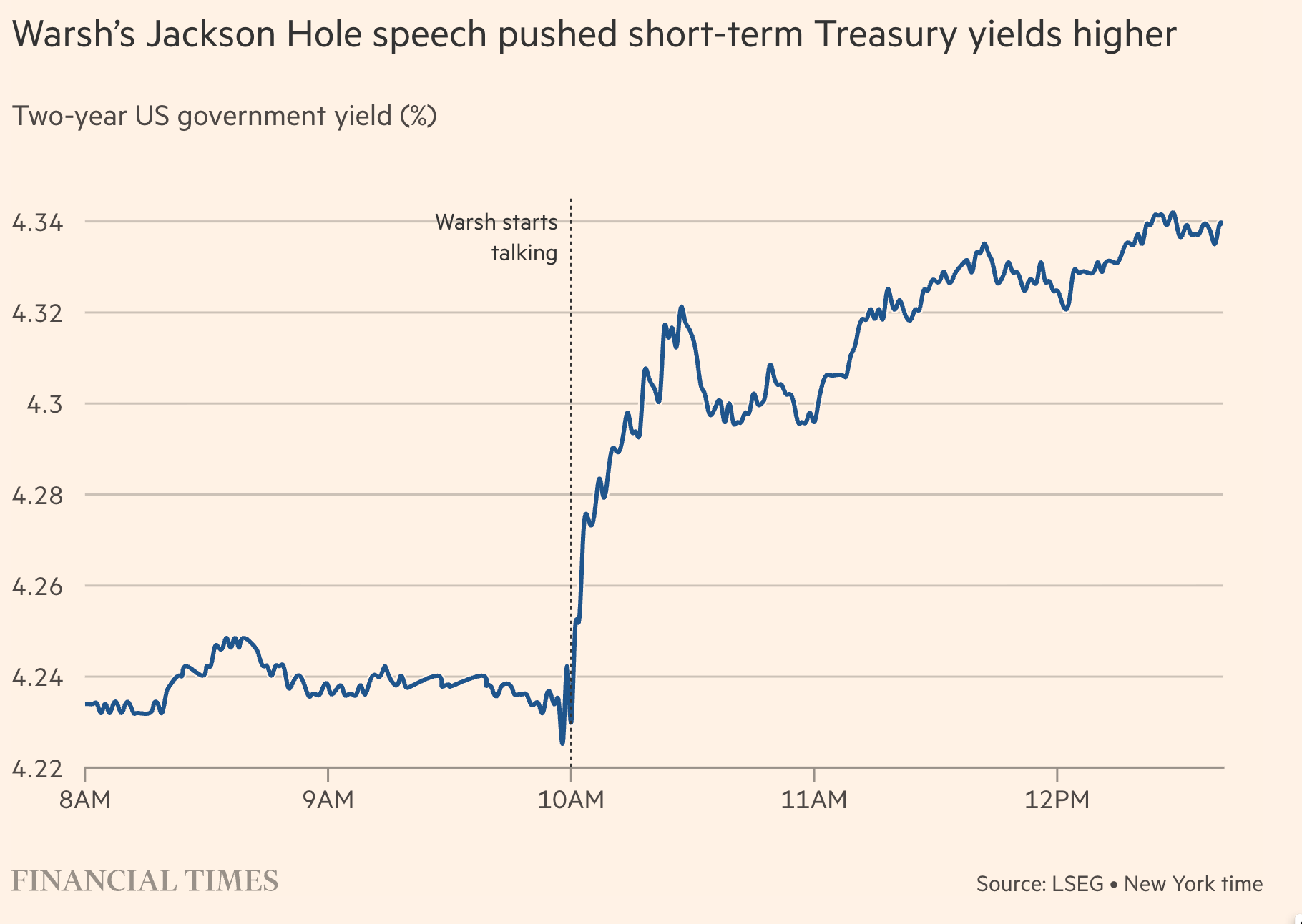
Interesting—and probably not what Warsh intended.
My theory of Federal Reserve Chair Kevin Warsh is this: he is way out over his skis, having gotten the job by promising Trump that he would lower inflation and lower interest rates, while reassuring the bond market that he was really a hard-money guy. Now he is stuck trying to create strategic ambiguity. I said this in June, and I said this in May. Having arrived at the top of the greasy pole, Warsh has discovered that the only move available to a man who has told incompatible things to incompatible audiences is to say as little as possible, for as long as possible. That is not a communications strategy. It is a hostage situation, and the hostage is the standard of value.
I have seen nothing to challenge that theory.
Thus, in my view, people who want to understand Warsh need to start with he is trying to create strategic ambiguity to avoid a full-fledged fundamental break with either Semi-Senile Chaos-Monkey Trump on the one hand or Demoiselle Marchée Financiere on the other. If they don’t start there, they wind up confused.
For example, the sharp Tim Duy yesterday morning:
Tim Duy: Fed Watch <sghmacro.com>: ‘Warsh… acknowledge[d] that rate hikes could be necessary to put inflation back on a path to 2%…. Warsh… [had] refused to make that one simple admission…. Warsh… did not provide a forward-looking assessment… nor did he provide a timeline…. We have been confident that the Fed will need to hike rates… [but] Warsh seeks to eliminate the certainty around individual rate decisions that market participants crave….
Warsh… outlined seven key principles…. Caution about using backward looking data to extrapolate forward…. Broadly align aggregate supply and aggregate demand…. The 2% PCE target…. Full employment, adding that it is compatible with price stability…. Policy acts through short term rates…. Money matters…. Less communication [from the Fed]….
Warsh add[ed] a fresh definition of underlying inflation…. By our count, this is Warsh’s fourth…. First… trimmed mean PCE. Second… the five hundred millionth and one price. Third… the median price at big box stores…. Fourth metric… “disaggregate the 199 individual components of the PCE price measure. Over the past 12 months, 54 percent… showed price increases above 3 percent. This is well below the post-pandemic highs of about 77 percent, but it remains well above the level of 32 percent in the two decades that preceded the pandemic…”.
Even after acknowledging the existing inflation pressures, Warsh doesn’t say that the trends represent upside risks for inflation…. Remember, he declared earlier in the speech the importance of not extrapolating trends…
Or Robert Armstrong:
Robert Armstrong: Warsh Settles Some Nerves at Jackson Hole <https://www.ft.com/content/646b812e-c9de-49ba-90f3-f9d12205f876>: ‘Speech… leaves open questions over Fed ‘reaction function’…. Friday’s speech… was a matter of incremental clarification…. For markets, the most important line of the speech was Warsh saying that this summer’s somewhat softer inflation readings did not convince him the underlying trend is improving.… Warsh did not do much to solve this puzzle, except to emphasise that he really, really does not like the Fed forecasting the economy and the future path of policy…. [But] the Fed’s credibility in markets hinges upon collective understanding of the bank’s “reaction function” — how and when it will respond to changes in the economy. If not through forecasts, how to make this known? Warsh raised this crucial question and answered it only with virtuous generalities about humbleness and empiricism. The market will not be satisfied with that for long…
Try to use this to construct insights into Warsh’s thinking, and you end up confused. Interpret this as an attempt to preserve strategic ambiguity, and it is crystal clear.
Armstrong and Duy are only two of the large number of very smart people in my feed trying, in good faith, to figure out what Kevin Warsh actually thinks. Each of them has come away holding a fistful of fog. Let me try to say what I mean by that: