
How Special Is Programming as a Token-Infall Attractor?: CHART OF THE DAY
Software developers are the AI industry’s best customers. Is their experience also the most misleading experience possible for its economy-wide scope? Roughly 80% of developers already use AI tools. Coding may now be more than half of OpenAI and Anthropic’s revenue, currenly running at $80 billion a year as of the second quarter of 2026. But to what else could that even roughly scale??
Matter spirals into a black hole, gaining speed and hence mass and energy as it moves closer converting its gravitational potential energy into kinetic-thermal and then, as particles collide, electromagnetic. It shines with the brightness of ten trillion suns: a quasar. Tokens spiral into an occupation, and are there harnessed to do the work of humanity, and shine—well, the metaphor is strained. But the point is that some occupations are, in the value of the work they can use tokens emitted by a properly harnessed LLM—Large Language Model—to do, like quasars. Others are not.
Paul Kedrosky picks this up from The Economist of London, and points out that computer programming is close to unique in how much LLM-generated tokens it can get ueul work out of:
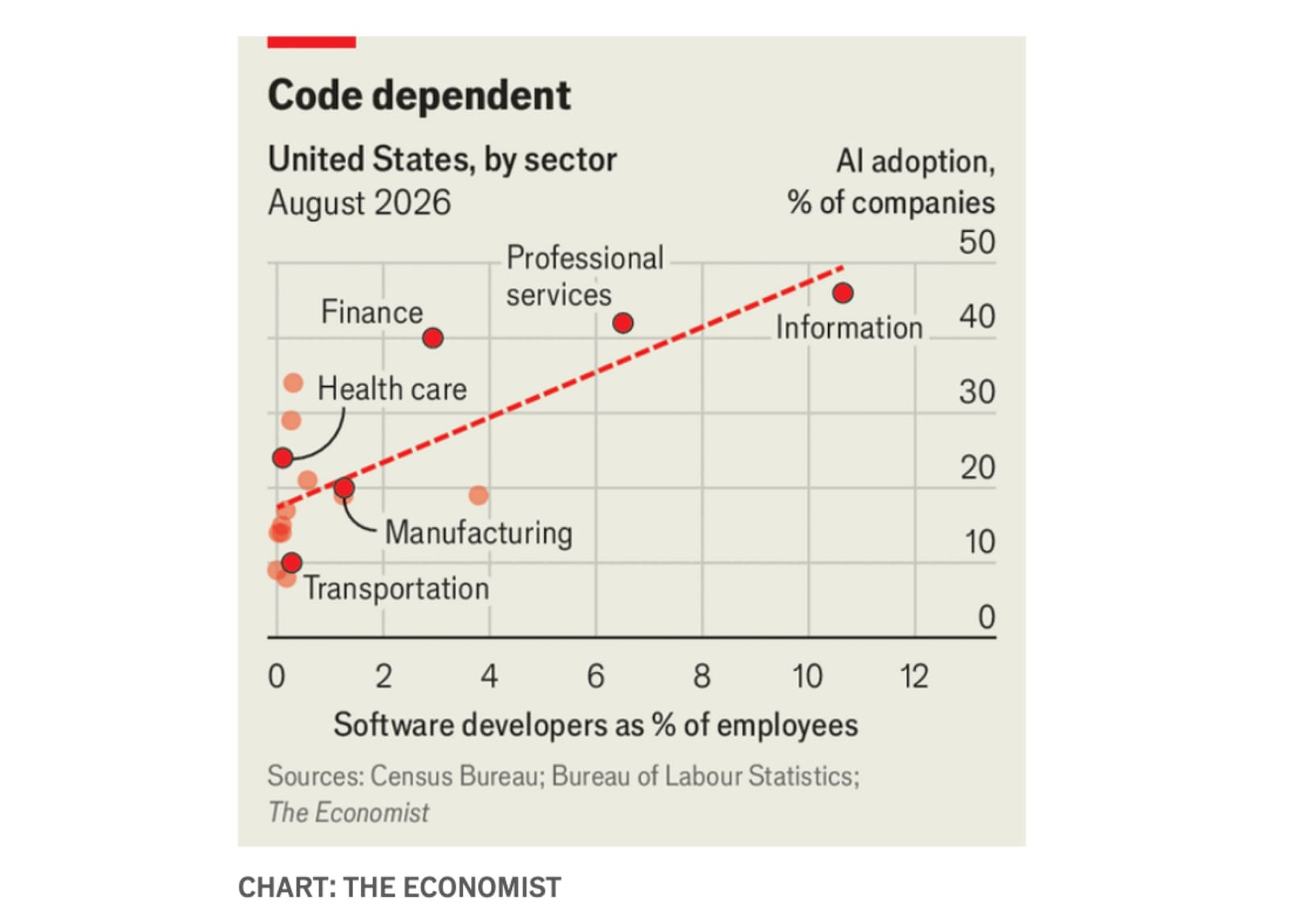
And he comments:
Paul Kedrosky: Why Software Developers Are Highly Unrepresentative of Broader AI Use <https://paulkedrosky.com/why-software-developers-are-hiunrepresentative-of-broader-ai-use/>: ‘Will anyone ultimately use AI as intensively as software developers do? That matters because coding is already a huge share of AI usage and revenue: roughly 80% of developers use AI coding tools, and coding may account for more than half of combined OpenAI and Anthropic ARR, by some estimates. See the… figure…. Note that it has finance in the wrong place, with the biggest banks, like Goldman and JPM, having more like 15% of employees in software development….
Coding is unusually expansive: A short prompt can trigger planning, code generation, testing, debugging, retries and repeated ingestion of a large codebase. Token use can explode relative to the size of the initial request. Much other white-collar work is more compressive: Summarization, document review, research synthesis, meeting notes and similar tasks take large inputs and produce relatively small outputs. Adoption and token intensity become different questions. AI could become ubiquitous across law, finance, consulting and management Those occupations might still consume far fewer tokens per worker than software development.
That matters directly for the capex thesis: The infrastructure buildout requires not just broad AI adoption, but enormous sustained token consumption. The Economist estimates annual AI revenue would need to rise from roughly $150bn today to about $2.5tn by decade-end.
The key forecasting error is treating coding as merely early rather than structurally different: If software development is both an early adopter and one of the most token-expansive occupations, extrapolating its usage curve across the rest of the economy will systematically overstate eventual compute demand…
In programming, you set the goal and the harness and the LLM begins doing its Clever Hans thing, stamping its foot and watching out for the desired reaction at which point it is done. Only this Clever Hans’s foot-stamping is at nanosecond speed, with a big model to capture far-away dependencies and the huge amount of relevant data that is the set of all running code that has ever been written, and repeating the actions over and over and over again until by lucky chance the desired result is achieved. That is, Paul Kedrosky, not going to be how knowledge workers in other professions are going to use “AI”.
Paul is riffing off of this from The Economist of London:
Anonymous: Will Anybody Use AI as Much as Coders Do? <https://www-economist-com.libproxy.berkeley.edu/business/2026/08/30/will-anybody-use-ai-as-much-as-coders-do>: ‘The answer will have big implications for the investment boom…. Uptake of the technology has been strongest by far among software developers. Four-fifths of them say they use an AI coding tool…. In June 2025 the combined annual recurring revenue of Cognition, Cursor, Lovable and Replit, four AI-coding startups, was roughly $800m. Today it stands at $6bn…. Lawyering, finance and customer service… bear some similarities to coding…. But four factors set coding apart: the availability of training data; how easy it is to test a model’s output; the amount of human interaction involved in the work; and software engineers themselves. AI companies are trying to make their other markets more coding-like, but doing so will not be straightforward…
Brad DeLong here: Briefly, coding is expansive while other white-collar work is compressive. A short program, or these days a short prompt, can and does trigger planning, code generation, testing, debugging, retries and repeated ingestion of a large codebase followed by a great deal of computation and reams and reams of output. In a world in which the computer will try twenty versions of a command before it hits upon the correct format, token creation and use explodes as the machine groups toward an anwer. By contrast, the business of a lawyer is to take the expansive set of legal codes and case situations that is the law and squeeze it down into a brief, an opinion, a recommendation. The business of a consultant is much the same. And the whole point of management is to throw away as much information as you can in order to make the problems of direction and coordination graspable and actionable. Summarization, document review, research synthesis, meeting notes and similar tasks. Large inputs, and relatively small outputs. No explosion of agentic activity once the universe of input documents has been defined and collected.
As Paul Kedrosky says, AI could become ubiquitous across law, finance, and consulting, yet those workers would still burn far fewer tokens each than software developers do.