CROSSPOST: DAVID ALBOUY, JONATHAN PARKER, STEPHEN DURLAUF, JON STEINSSON: On Acemoglu, Johnson, & Robinson’s “Colonial Origins...”
To call “perceived probability of expropriation in the 1980s” by the name of “institutions” is, at best, really weird. And David Albouy should not have to be chill with respect to Acemoglu, Johnson, & Robinson’s unwillingness to recognize that the IV analysis in their “Colonial Origins…” is an embarrassment that should never have been in the paper. Other than that, I greatly enjoyed the play. I think Albouy, Parker, and Durlauf are more than fair here:
We have:
Jonathan Parker: <https://x.com/ProfJAParker/status/2094567917048226040>: ‘Steve has the right way to interpret the important research & evidence in AJR & Daron’s related work. It fits a given narrative to historical details, tells a rich plausible story through that lens with lots of evidence. (And David’s work is important & deserves respect)…
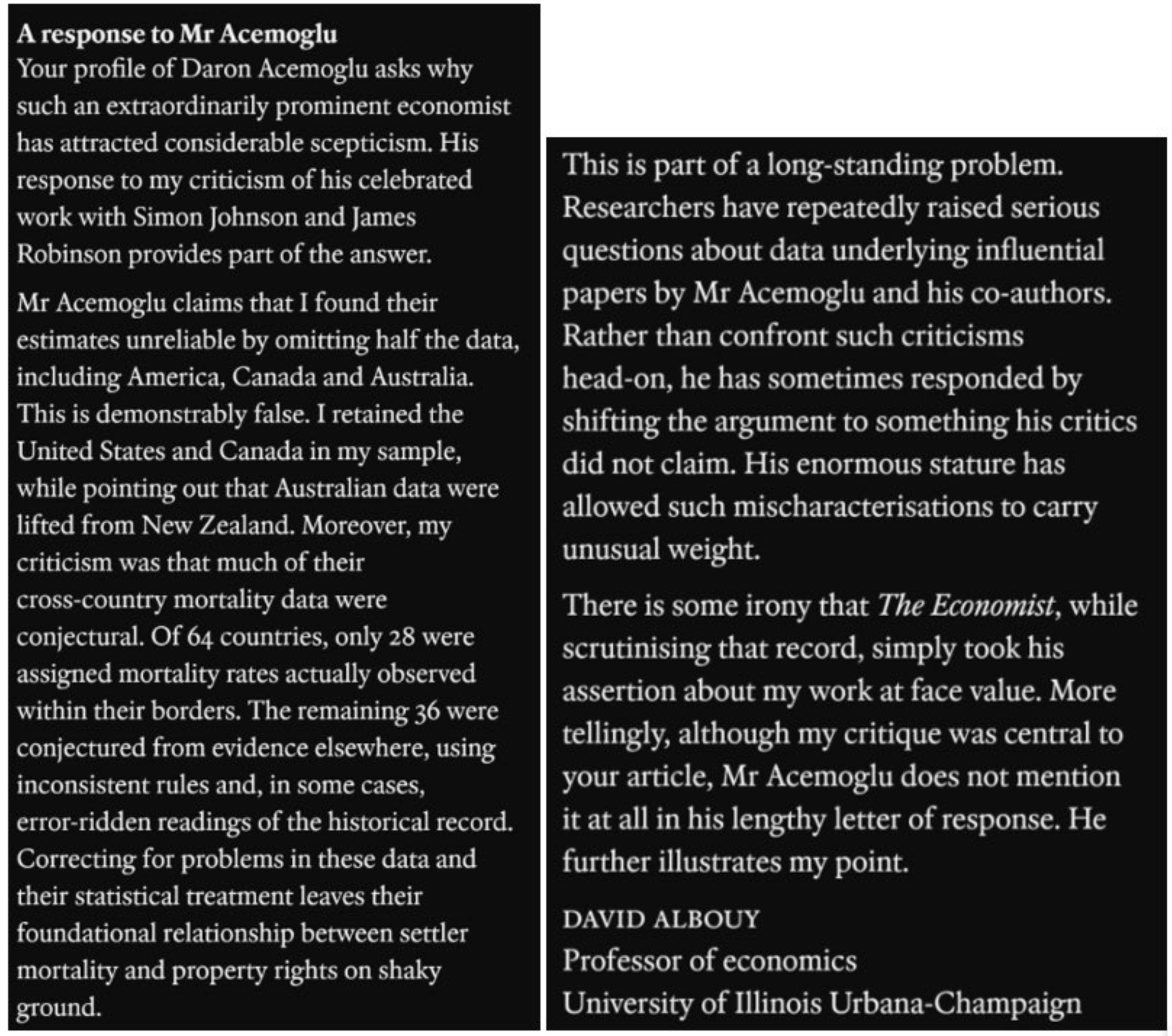
Steve Durlauf: <https://x.com/sndurlauf/status/2094545774080307362>: ‘David Albouy @albouy is entirely justified in being aggrieved. It was completely inappropriate for @TheEconomist to publish a response to their (ridiculous) article on Daron Acemoglu that contained a misstatement of the Albouy criticisms, just at it was inappropriate that the article’s author did not contact David to describe the nature and import of his criticisms for the ideas that AJR have developed, as opposed to the merits of a particular set of statistical exercises. There are huge questions surrounding the ways that credible empirical claims can be made about questions of the type AJR address.
Cross-country regressions have proven to a very fragile source of information on the mechanisms underlying growth and development. My view of the AJR research program is that the empirical dimension should be understood from the vantage point of inference to the best explanation, aka abduction, as a way to understand their research strategy, which implies historical/qualitative evidence is central. For details, see my paper
“Institutions, Development, and Growth: Where Does Evidence Stand?” Handbook of Economic Development and Institutions, Jean-Marie Baland, François Bourguignon, Jean-Philippe Platteau, and Thierry Verdier, eds., Princeton University Press, 2020…
David Albouy: <https://x.com/albouy/status/2094501978818621440>: ‘I tried to be chill, but Acemoglu’s false statement reminded me too much of the gaslighting I had to deal with to publish my comment. Acemoglu et al don’t respond directly to criticisms, and often make up demonstrably false claims to defend themselves, with no accountability:
Instead they issued a reply full of red herrings with the bullying title “Hither Thou Shall Come but no Further”. They could have acted as scientists but opted to confuse.
As a grad student, I emailed and visited Robinson’s office many times to talk about my preliminary investigations. He was never available. When I finally confronted him, he waved me away, saying, “I think you’re looking for a different Robinson”. Unbelievable, but true. I tracked down Johnson at an AEA meeting. In the spirit of scientific collaboration, I offered to sit down and go through the data points with him, he nodded in agreement saying that would be nice.
I never got a response to any emails after that. As for Acemoglu, I tried to make peace. But i still remember in 2007 after my R&R at the AER, I submitted a paper to REStat where Acemoglu was editor, trusting that he’d recuse himself and not handle it. A few months later, I got a rejection letter signed by Acemoglu…
Brad DeLong here: I wrote about how the IV is a dumpster fire only last April. My view has long been that (a) David Albouy is 100% correct here, and that (b) if Acemoglu, Johnson, and Robinson were wiser, they would recognize that David Albouy is their best friend in the world, for he provides an explanation for what are otherwise very uncomfortable—clock-striking-13-uncomfortable—IV results.
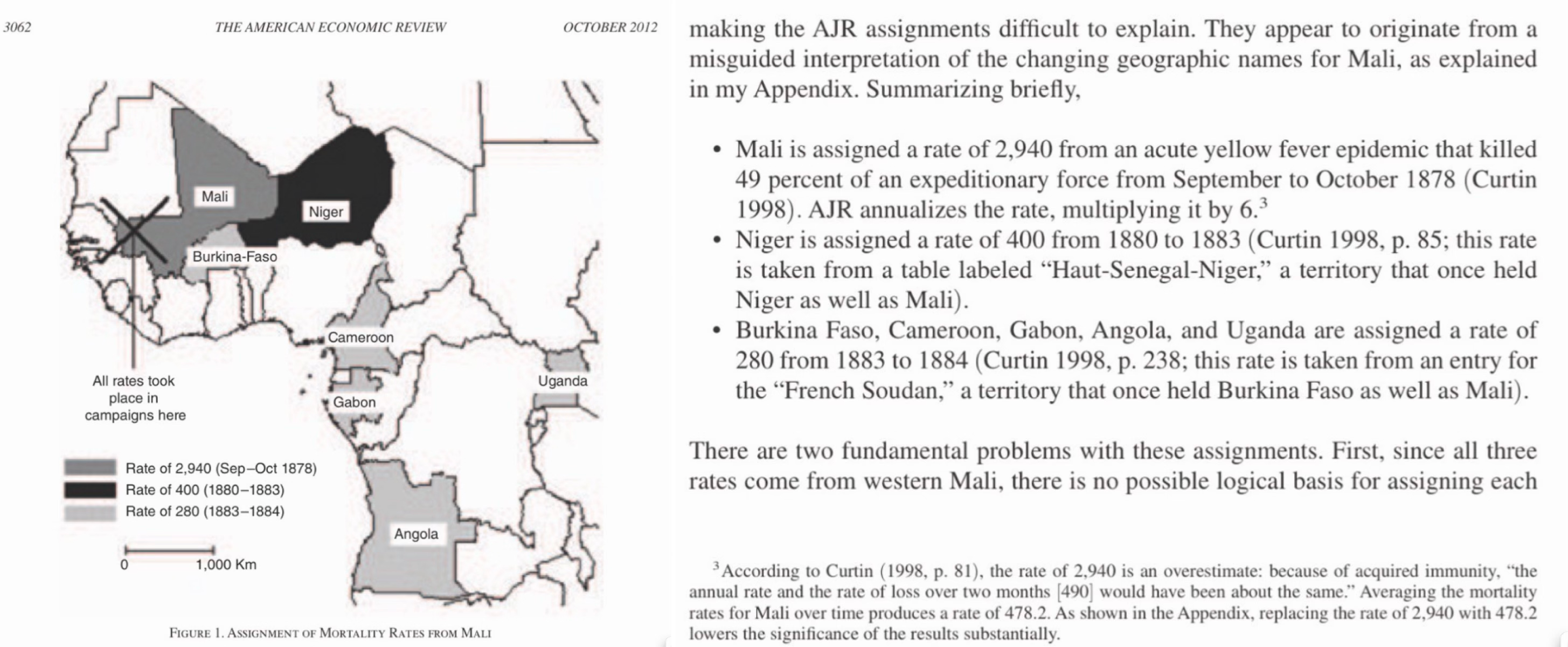
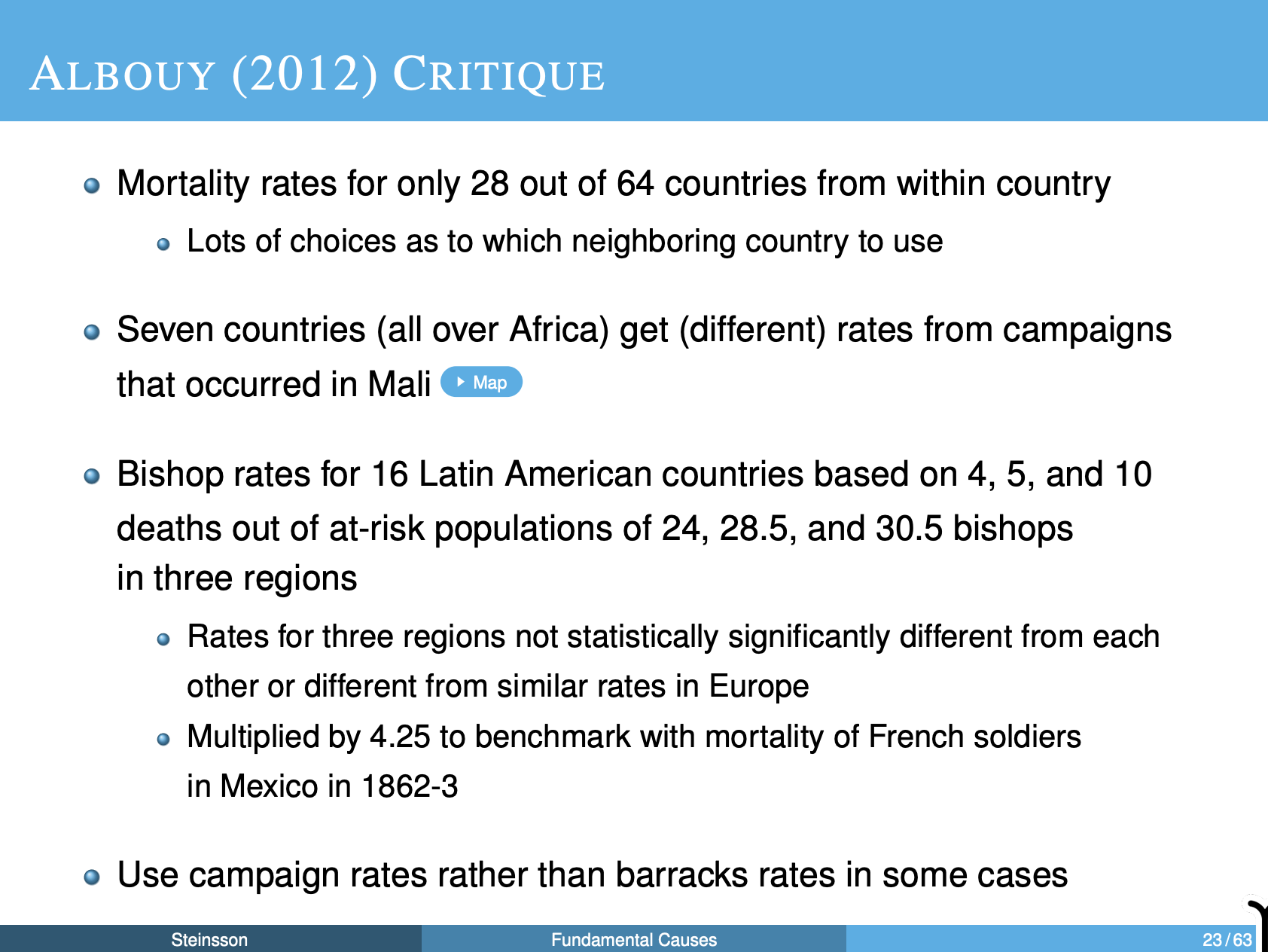
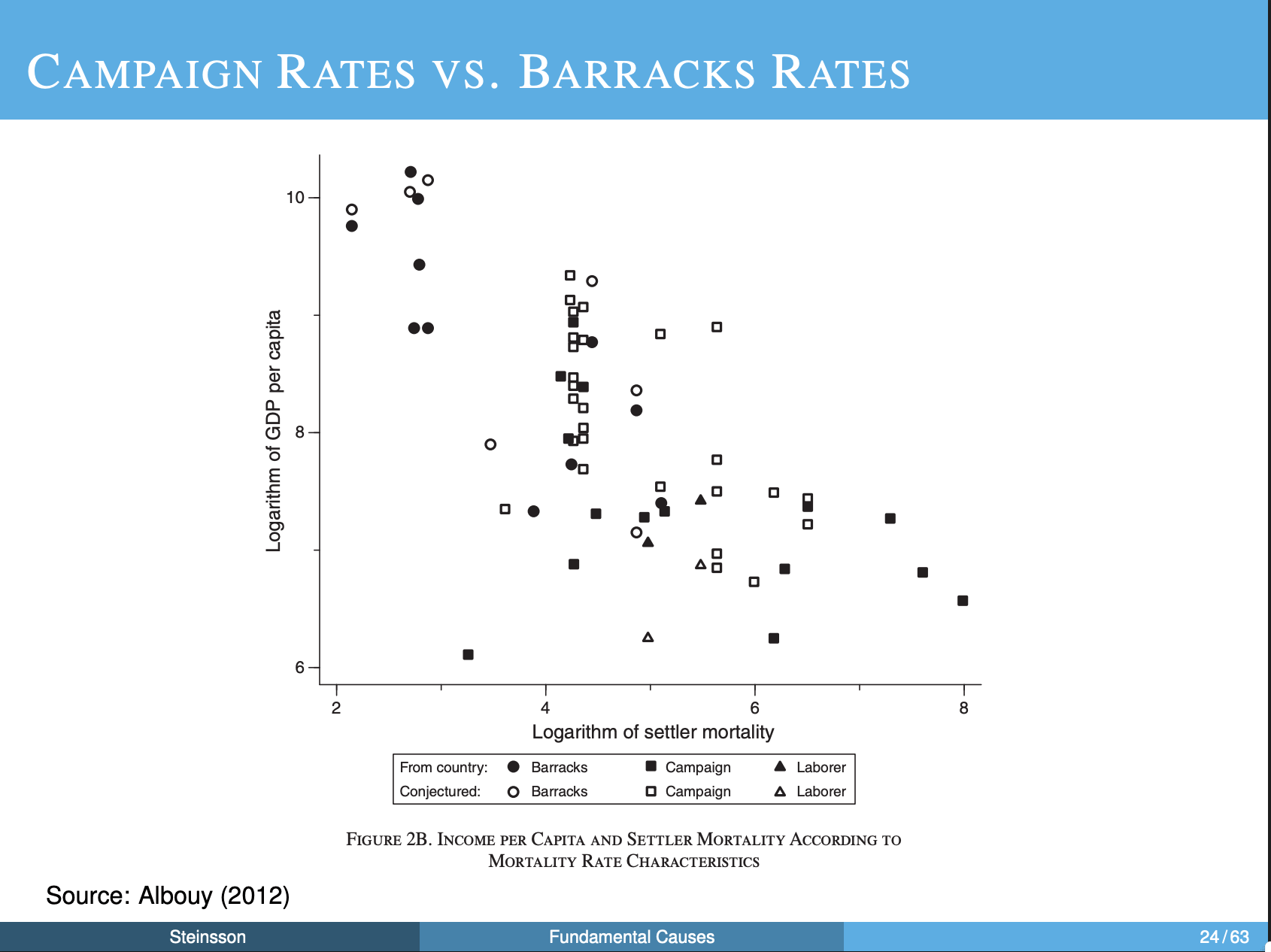
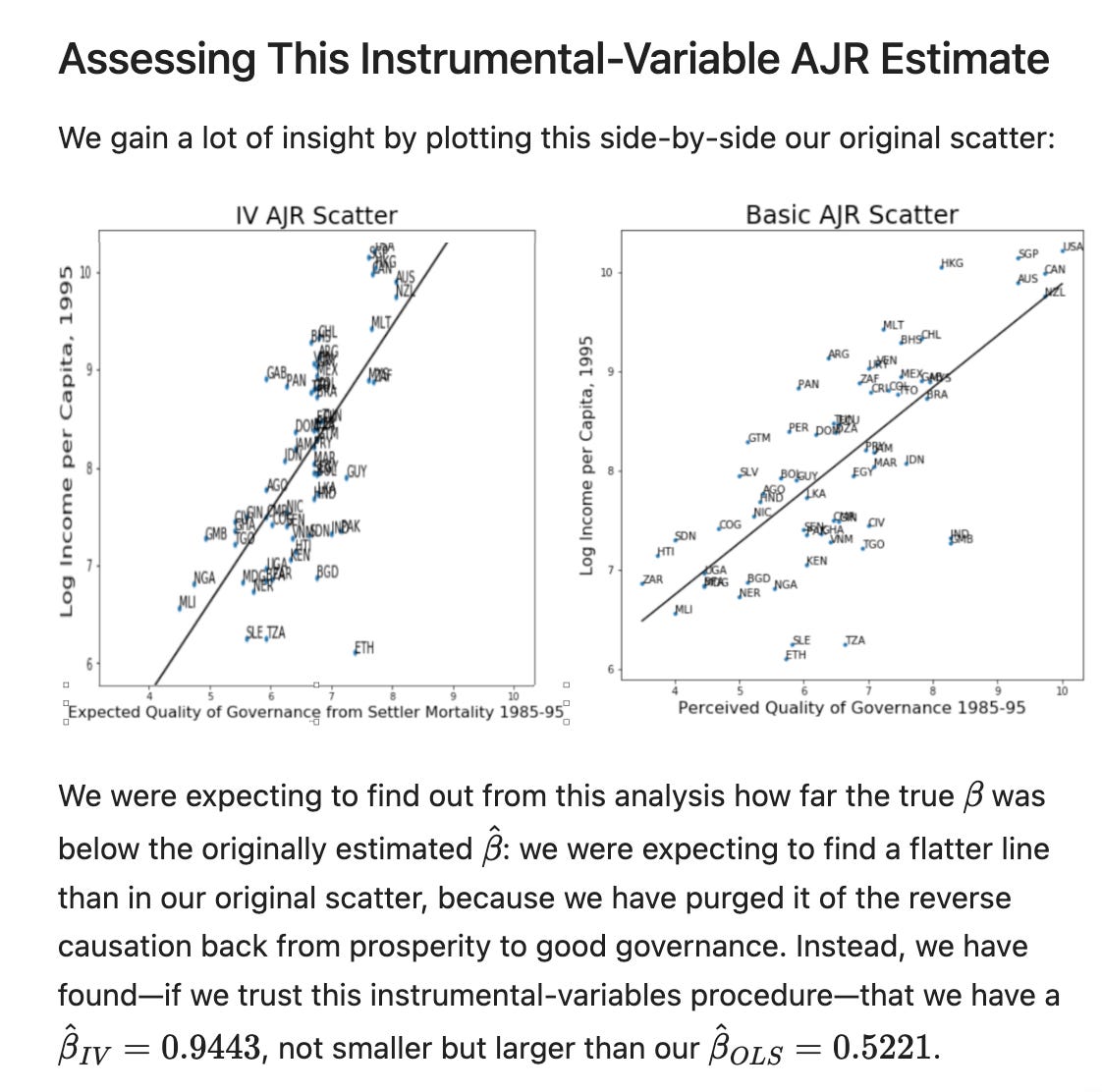
Briefly: AJR simply have no real first stage. The “1-in-1,000” significance on log-mortality-to-expropriation-risk melts to 1-in-25 once you notice the mortality assignments are smuggling in continent dummies, and to 1-in-3 once you separate barracks deaths from campaign deaths and laborer data. With a first stage that weak, the second-stage test statistic isn’t a t-distribution — it’s near-Cauchy: infinite variance, no standard deviation, and no mean at all. You are drawing noise from fat tails and calling it a coefficient. The Cauchy distribution is the devil — the lesson my sometime-roommate John Bound taught me back when we were both much younger. Weak first stage in, garbage out. Only the file drawer Darwinian-selection process launders that garbage into a “finding”. Weak instruments plus sampling on the instrument that produces a significant IV coefficient is the replication crisis in a clown suit, driving a clown car. And often you really do not want the refreshments in the trunk of that clown car, as AJR would recognize if they were wiser.
This is what I wrote back four months ago:
substackcdn.com/image/fet…}],"post_date":"2026-04-09T00:32:42.739Z","coverimage":"https://substackcdn.com/image/fetch/$s!oSWk!,f_auto,q_auto:good,fl_progressive:steep/https%3A%2F%2Fsubstack-post-media.s3.amazonaws.com%2Fpublic%2Fimages%2F8c9baf6f-213e-4c88-a086-9cb8fa2076be_1122x1112.png","cover_image_alt":null,"canonical_url":"https://braddelong.substack.com/p/contemporary-governance-and-contemporary","section_name":"Enlarging the Bounds of Human Empire","video_upload_id":null,"id":193571910,"type":"newsletter","reaction_count":26,"comment_count":79,"publication_id":47874,"publication_name":"DeLong’s Grasping Reality Weblog ","publication_logourl":"[substackcdn.com/image/fet…](https://substackcdn.com/image/fetch/$s!PgPl!,f_auto,q_auto:good,fl_progressive:steep/https%3A%2F%2Fsubstack-post-media.s3.amazonaws.com%2Fpublic%2Fimages%2Ffde2453e-9c18-4560-82ca-8b77ae62ef5b_1280x1280.png","belowTheFold":true,"youtube_url":null,"show_links":null,"feed_url":null)}“>
Colonial origins, causal claims, the baggage left behind in the overhead bin via the absence of a structural model, settler-colonist mortality, modern pro-prosperity “institutions”, and structural-empirical truth…
I was thinking I would do an economic history post yesterday and a political economy post today, but life is busy, busy, busy, what with chaos, staring at screens watching people get blown up and so forth. Then I sat across from Jón Steinsson at the faculty lunch, and in the course of the conversation he mentioned that he still taught the graduate students the quarter century-old Acemoglu, Johnson, and Robinson “Colonial Origins…” paper.
Why? Because it is both incredibly strong and incredibly weak, a true rabbit and a true duck, depending on how you look at. Teach it, and students get very valuable experience in having strong reactions and figuring out how to explain them—and also (we hope) practice in listening to people with whom you violently disagree but who think what they think for reasons.
AJR’s “Colonial Origins” is surely among the most influential empirical paper in historical development economics of the last quarter-century. Its argument is elegant:
European settler colonialists who found that they could survive and thrive in a colony built inclusive pro-growth developmental institutions.
European settlers who found that they couldn’t, and that they needed to grab what they could and return home before they succumbed to yellow fever or such, did not.
Places with high European settler mortality saw the development of “extractive institutions”, hostile to widely distributed prosperity both in the past and in the present.
Those early institutions persisted to this day.
Colonial-era European settler mortality gives us a lever—a valid instrument—to identify the causal effect of institutions on prosperity.
The result that Acemoglu, Johnson, & Robinson claim?: that differences in institutions explain about three-quarters of the income per capita differences across former colonies. Geography, latitude, disease burden—once you control for institutions, they do not matter.
But this is a paper that turned me into a Heckmanite—into a believer in the idea that only those who have fully specified structural models, at least in their mind’s eye if not out there on the table, have a valid warrant to do anything statistical that they claim is in any sense “causal”. Structural models keep you from abandoning burdensome baggage in the overhead compartment when you exit the plane—and AJR’s procedures and paper has a lot of such, which the non-structural IV-framing hides from view. Briefly: either prosperity has a strong negative structural effect on governance quality—which contradicts everything we know from political science and history—or settler mortality in the 17th century is a better measure of what matters in modern institutions than present-day institutional analysis by people who know about and can see them is.
If reading this gets you Value Above Replacement, then become a free subscriber to this newsletter. And forward it! And if your VAR from this newsletter is in the three digits or more each year, please become a paid subscriber! I am trying to make you readers—and myself—smarter. Please tell me if I succeed, or how I fail…