
The U.S. Federal Fiscal Flow Deficit Problem: CHART OF THE DAY
It is honest to say that America’s fiscal deficit problem has one cause: Republicans. But honesty, of course, is not something you get for free: it is a discipline you have to train for, which is why we get things like the passive voice in the title of this chart of the day:
A nice graph. I look at it, and say, why not just turn the tax-policy clock back to the Clinton-Gore 2000?
Adam Tooze <https://adamtooze.substack.com/p/top-links-1207-us-deficits-counting> picks this up from the Financial Times:
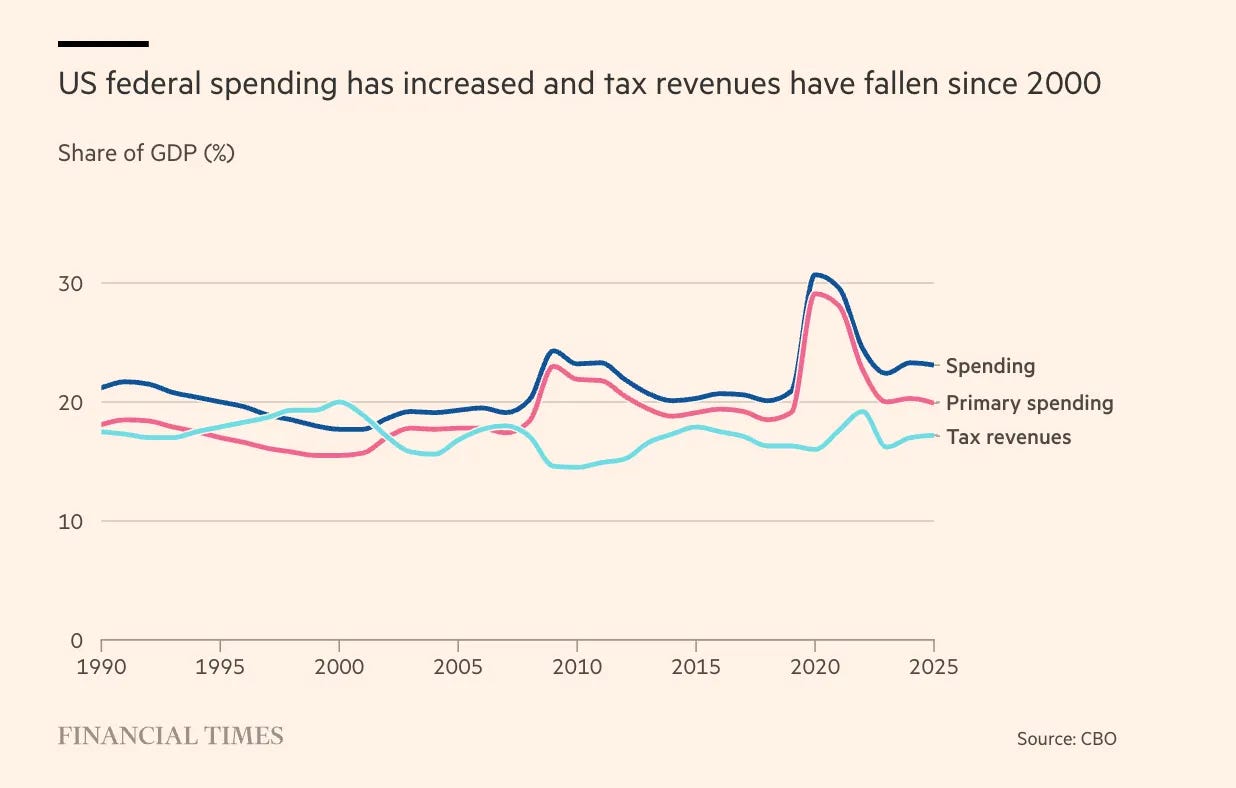
The revenue drop from 2000 to 2004 is 4/5 structural, not cyclical <https://en.wikipedia.org/wiki/Bush_tax_cuts>. CBO scored the 2001 (EGTRRA) and 2003 (JGTRRA) cuts as adding ~$1.5 trillion to the debt over 2002–2011 excluding interest, and ~$3 trillion over 2010–2019 including interest if fully extended. This is not contested by anyone doing arithmetic. Talk I hear of a “cyclical peak in revenues in 2000” explains a year or two of mean-reversion, not a quarter-century structural gap. Using it to explain the past generation is a category error.
The upper-income Bush cuts were sold as a recession-recover measure. But they had a constant interest-rate policy fiscal multiplier of only 0.26. They were among the least stimulative and most expensive things the government did <https://www.epi.org/publication/ib338-fiscal-cliff-obstacle-course/>. And no American tax cuts ever “paid for themselves” except for tariff reductions in the long run. Paul Krugman’s line still holds: supply-side claims that tax cuts would pay for themselves “never got any traction in professional economic[s]… even among conservatives”. Those who claimed they would were and are unprofessional economists and professional recoveries.
Thus my view: What was wrong with the tax rates and tax system as they stood in 2000?
Not very much.
Want to fix the deficit? Simply have the first item of business on January 21, 2029 be passing a Budget Resolution, to be followed on January 22, 2029 by a vote on the Reconciliation Bill restoring tax rates and taxable income coverage to what they were in 2000. Base-restoration matters as much as the headline rate. And also uncap FICA: impose the Social Security and Medicare taxes on all earned income. The 2026 wage cap is $184,500, so all earnings above it currently escape the 12.4% tax entirely. Removing the cap would raise on the order of $3 trillion over a decade <https://taxfoundation.org/blog/save-social-security-payroll-tax-cap-proposal/>.
If you won’t get on board for that as your initial bargaining position, I have one question: what is wrong with you?
After all, year 2000 was the last time I had confidence that the US had a competent government and that US society was by-and-large working and improving. Shouldn’t we do whatever we can to restore things to how they were then?
Anyone else willing to join me on this turn-back-the-clock exercise?
The graph appears and there is commentary on it in an article by Chris Giles.
I thought about about dropping a link, but decided not to. Giles is behaving badly here. He asks the question: “Why [has] the US fiscal position has deteriorated so much this century?” And then he works much too hard to avoid giving the correct answer: Republicans.
Instead, he talks about “the cyclical peak in revenues” in 2000, the Bush tax cuts “which were made permanent on a mostly bipartisan basis during the Obama administration”, “spending on services for an ageing population—social security, Medicare and veterans’ programs”, in addition to the Trump tax cuts.
Not, mind you, that Giles is a big fan of Trump and Bessent.
And I have to admit there is motion: the Giles of today admits that “the US has significantly cut tax rates for the richest this century, so some reversal of those would be likely and justified from a left-leaning president and Congress”. This is not something that we would have gotten from the Piketty-bashing Giles I remember from 2014 <https://www.forbes.com/sites/scottwinship/2014/05/27/laffaire-piketty/>.
But if you are not brave enough to tell the truth, to give the answer Republicans to the question why has the US fiscal position has deteriorated so much this century?, what use are you? Why would reading you be worth anyone’s time?
Herodotos 1:136 tells us that ἀληθίζεσθαι, truth-telling, was one of the only three things that young Persian aristocrats were taught. Herodotos matched ἀληθίζεσθαι with ἱππεύειν, to ride (to do the horse-thing), and τοξεύειν καὶ, to shoot (to do the bow-thing). Those are martial skills that need a huge amount of practice to attain and retain competence. Herodotos is right with the implication of coupling truth-telling with two martial skills. Honesty is more a discipline, something you train for, not a temperament. Analytic courage—a practiced refusal to hedge when the data points somewhere your political and ideological and careerist commitments point in a direction you would rather they not—requires practice as well.
It’s something to strive for.
There: that is off my chest.