
NVIDIA Earnings: CHART OF THE DAY
A productive bubble in the Perez–Janeway sense: the racks will survive even if the shareholders don’t. Whether they’ll be worth as much as the railroad track is what we cannot yet see.
Perhaps he real news isn’t the revenue guide — it’s the half-trillion dollars of third-party capital that NVIDIA is trying to start herding onto its customers’ liability sheets. In economiss’ economic-welfare terms, good natural-language interfaces are already a huge boon; in measured GDP terms, AI i not and may never be there. Don’t let NVIDIA’s income statement stand in for social value in either direction—and don’t let economists’ willingness-to-pay-based economic-welfare measures stand in for human well-being in an environment in which attention-hacking is rife.
We have:
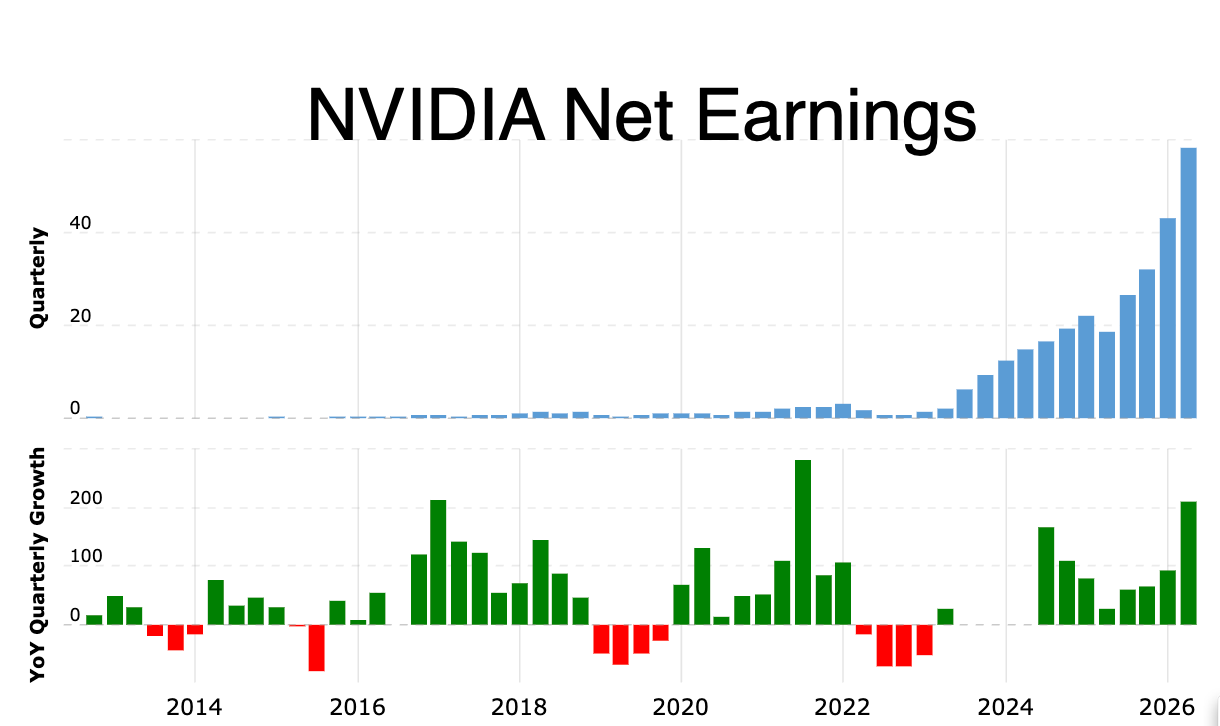
With commentary:
Lynn Thomason: Nvidia’s $100 Billion Shows Why AI Is Still the Trade <https://www.bloomberg.com/news/newsletters/2026-08-27/nvidia-s-100-billion-shows-why-ai-is-still-the-trade>: ‘Nvidia delivers. The AI lynchpin blew away expectations, predicting 70% sales growth for 2028, when analysts had anticipated 45%. The stock jumps 7%…. Nvidia’s stellar results are reinforcing investor confidence in the AI revolution, with CEO Jensen Huang saying the “golden age” of labs and startups is here…. Sales surged. It sees revenue in the current period at $108 billion. Compared with a year ago, that’s close to double…. There’s no let up in demand. Nvidia said it would be growing even faster if it had access to more supplies…. Hyperscalers spend big. The data center division beat estimates, with firms like Alphabet and Amazon accounting for much of those sales…. Margins will narrow. Nvidia warned that margins would shrink slightly in the coming months as it copes with a surge in memory costs. At the current price, Nvidia is poised to add about $370 billion of market value when trading begins. The shares are up 12% this year…
And just two days ago the word on Bloomberg was that “NVIDIA has lost some luster with investors this year”:
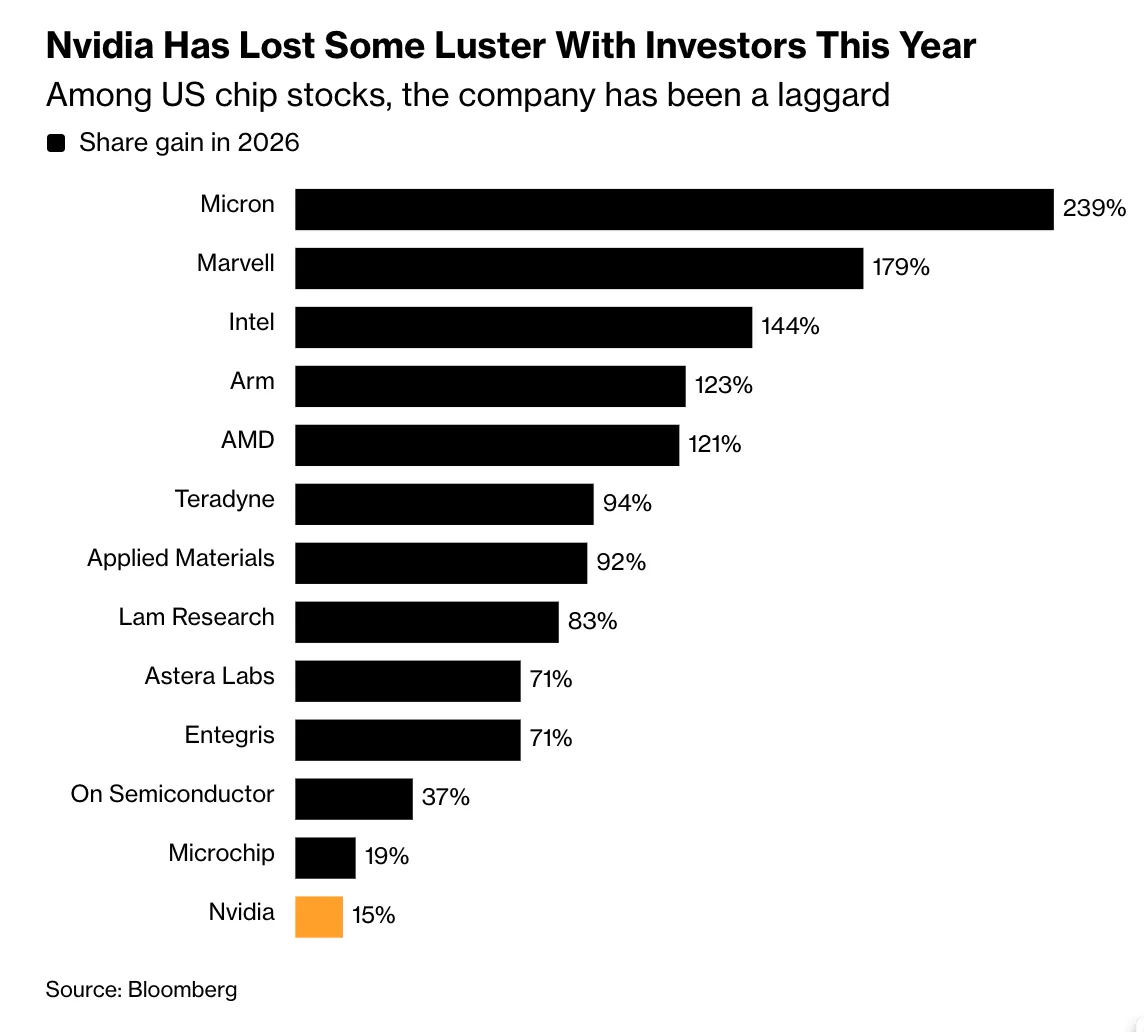
<https://braddelong.substack.com/p/nvidia-has-a-seven-day-stock-price>
This whipsawing of what Paul Krugman calls not Economics but Upanddownonomics is really not terribly helpful.
Nvidia’s profits are a combination of five things:
The strength of demand for its GPUs.
Its desire and ability to use its monopoly power to generate super-high margins.
The limitation of that by its not wishing to trigger its customers to make investments in ending their dependence on it and exiting from its ecosystem.
Upstream monopoly power by its own major suppliers.
Upstream supply chain difficulties.
What we want to know is: (a) How strong is demand for the GPUs? (b) Hopw much of that demand is really based on “fundamentals”? (c) What are those fundamentals based on—(i) utility to customers, (ii) moat-maintaining investments by platform-monopolists, (iii) belief that you have to learn-by-doing with these technologies on a large scale even though the utility to customers is not yet there because it will be there, (iv) “speculation”, and (v) that these days one grifts gullible investors not by starting a memecoin but by pointing to your racks of GPUs? That requires a careful parsing of (1). And changing your mind on those things as a result of the high-energy excitation mode that is the (1) through (5) factors producing NVIDIA quarterly earnings—that does not strike me as wise.
Bloomberg’s Ian King peers a little bit through the veil of time and ignorance here. Although I do not see NVIDIA’s willingness to go all-in on next year’s growth should ease anyone’s concerns:
Ian King: Nvidia Sees AI-Fueled Demand Boosting Sales 70% Next Year <https://www.bloomberg.com/news/articles/2026-08-26/nvidia-estimate-topping-forecast-fails-to-wow-investors>: ‘Nvidia… said revenue will grow about 70% next fiscal year, easing concerns that AI spending is poised to lose momentum…. Jensen Huang said demand is only accelerating…. “The AI infrastructure build-out is at full steam,” he said. “Vera Rubin, now in full production, was built to power exactly this moment.” Revenue in the current period will be $108 billion, plus or minus 2%…. Gross margin, the percentage of sales remaining after deducting the cost of production, will be roughly 74% in the quarter…. Nvidia [is] cop[ing]… with a surge in memory costs… expects the [gross margin] measure to bottom out in the fiscal fourth quarter… that runs through January — at 71% to 72%….
“We would love more supply,” Kress said in an interview. “It’s really about how much more could you do?” In the second quarter, which ended July 26, sales more than doubled from a year earlier to $96.2 billion…. Nvidia has now delivered sales above Wall Street estimates for 16 quarters in a row….
Nvidia has spent much of the past year lining up investment deals…including both developers of software and infrastructure… that… have, in theory, put Nvidia on the hook for tens of billions of dollars of liabilities…. Kress described the deals as a part of Nvidia’s efforts to increase supply. The biggest portion of its spending commitments took the form of long-term purchase agreements with vendors, she said. “The majority of what we have been helping folks with in terms of commitments is one very important thing called supply”…
“We would love more supply” is doing enormous rhetorical work here. Kress framing the deals as securing supply, not stimulating demand, is the crucial move — because it reclassifies factor (5), supply-chain difficulty, as bullish rather than as a ceiling. I’d want to see more about that, for whether and to what degree this is, you know, actually true is something I do not but would very much like to know.
I would like to see more about that especially because it really does not fit with the real news, which is the $500B “compute financing platforms” with Apollo, BlackRock, Blackstone, Brookfield, Goldman, and KKR. The chipmaker is organizing half a trillion dollars of third-party capital not to induce its suppliers to expand their on capacity, but to herd in people willing to bear downside risk so that its customers will be willing to buy its chips. That is demand being manufactured by financial engineering, rather than merely being met. Is this a bad thing for NVIDIA to do from the point of view of NVIDIA’s financials? Of course not! It is a very profitable thing for NVIDIA to do! What does it mean for the world economy as a whole? That also is something I do not know and would very much like to.
GM financing a car works because the car has known use-value to a buyer who will pay. The AI analog only holds if the downstream token-buyers eventually cover their compute bills. Right now the poster-child labs mostly don’t—so the vendor-finance defense is a bet on future monetization, not a description of present value. And circularity concentrates systemic risk precisely because the buyer set is thin, and the same dollars show up as payments to NVIDIA by a customer and equity investments by NVIDIA in downstream LLM-service provider. NVIDIA could, in the bad scenarios, lose twice here: once when a customer stops buying, and again when its equity stake in that customer craters. It is a correlated exposure that works equally well going up or down. Dressed as an increasing-speed flywheel.
And, of course, concentration has made this a macro question, not a tech-sector question. Nvidia is now ~8% of the S&P 500 and has supplied more than 10 of the ~84 percentage points of the index’s five-year return. The possibility of a genuine turn in AI capex cannot be contained inside semiconductors — it becomes everyone’s problem, including every teacher’s pension.
But step back: This is Carlota Perez and Bill Janeway territory: a “productive bubble.” Even if most investors lose their shirts, no one will tear up the GPUs, the fiber, or the substations — just as no one tore up the railroad track or the dark fiber. The infrastructure persists; the equity holders are the potential sacrificial capital. Will these datacenters be as useful in the end as the railroad tracks or the dark fiber? That depends on things we cannot now see.
And do beware the Solow-paradox trap in reverse. In economists’ economic-welfare terms — consumer surplus from people willing to pay for natural-language interfaces — AI is already a huge boon. In measured GDP-and-profit terms, it may show up modestly, or even as a productivity decline, because now Amazon needs the warehouse, the truck, and the GPU farm to sell you the same item. Don’t let NVIDIA’s income statement stand in for social value in either direction. And, in addition, do not let economists’ economic-welfare measures stand in for human well-being. Maximizing dopamine hits do not make for a fulfilling, or even a tolerably happy and engaged life, especially when they are the result of algorithmic attention-hacking programmed up by some of the most cynical people who have ever lived.
The honest posture is neither bull nor bear but high-dimensional agnosticism. I count at least a dozen distinct vectors here — grifters, defensive platform monopolists, socially-valuable-but-privately-unprofitable overbuilding, techno-millenarians, attention-extraction business models, and genuine general-purpose-technology diffusion — all superimposed. Anyone claiming this quarter resolves them into a single verdict is selling you a narrative, and the future here is one I frankly cannot see.
I see people confidently claiming that:
A megawatt of AI-capacity costs $15 million to run, and right now you can sell it for $50 million because it can produce $100 million in cost savings or revenue boosts for high-value customers who know how to harness it.
Anthropic and OpenAI are each scaling-up from 1.5 gigawatts of capacity at the end of 2025 to 5 gigawatts of capacity at the start of 2027: that is a potential revenue boost to their annualized revenue run rates from $20 billion (at $13M/mW) at the end of 2025 to $150 billion (at $30M/mW) should they find and maintain product-market fit.
And I see other claiming that datacenters will never be profitable once the huge demand from people who think they have to build the institutional muscle-memory capacity to utilize these technologies drops away.
We have to do our reasoning under conditions of genuine Knightian uncertainty. That means: decompose, refuse false precision, resist single-number verdicts. It is more important than ever for us to inoculate sreaders against “Upanddownonomics,” the sentiment-laundering that lets the same fact-situation mean opposite things 48 hours apart. And we need to flag where fragility actually sits: circular finance, thin buyer set, index concentration, off-balance-sheet commitments. Robustness and scenaior planning is only possible if we distinguish between watching the right and wrong dials.