
Bubble Watching: This Is What Happens in the Type of Period Called “Distress”: CHART OF THE DAY
The blow-up of Leopold Aschenbrenner’s Situational Awareness is a sign that we are near the peak of the bubble: this is what it looks like from the inside when demand stops riding on industry fundamentals and starts riding on leveraged-buyer reads of market sentiment. It is a sign that positive-feedback investment strategies are rampant and that demand curves are starting to slope the wrong way:
During an asset market boom, even a euphoric boom, prices rise as good news arrives and as more and more people take their money and decide that this is indeed the wave of the future. But then increases in demand switch from people becoming aware of the opportunity and bringing their money in, to people willing to bet on rising prices, willing to ignore Risk Management 101, and eagerly leveraging-up and pouring that leverage into the booming asset class. Rising prices taken as a reason to buy more induce a situation in which the smart money starts leaving quietly, and the game silently switches from owning value to finding a greater fool before everyone else does.
And then people are on the edge between hanging on hoping a greater fool comes along and selling out now. The shape of demand no longer rides predominantly on expected developments of industry, but on various reads of market sentiment.
That period in which a lot of people are following positive-feedback investment strategies is a period of “distress”.
We know it is distress because then we get things like this from the most overleveraged:
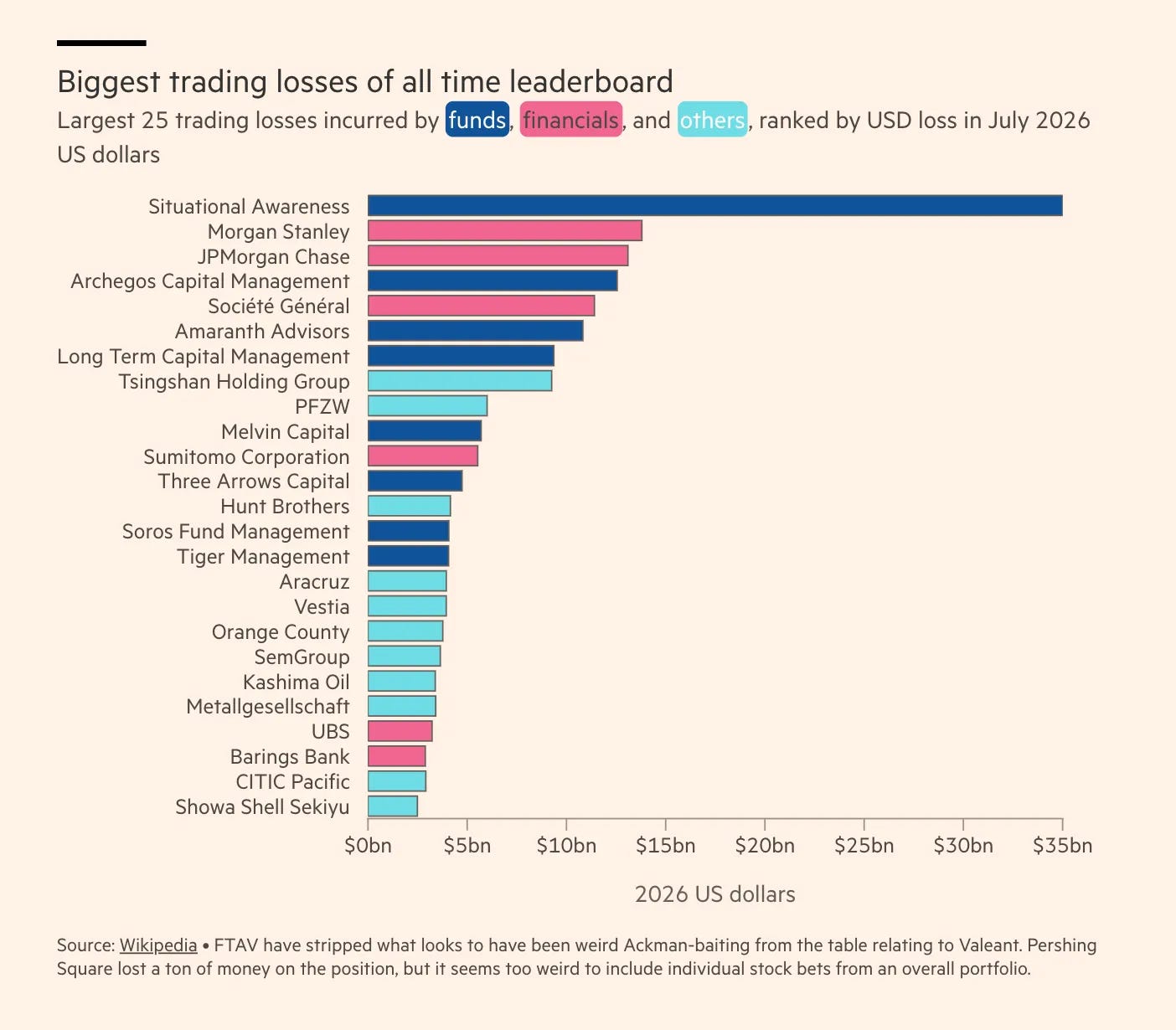
Via Adam Tooze <https://adamtooze.substack.com/p/top-links-1199-big-losses-meeting>, FT Alphaville <https://www.ft.com/content/340bf9e7-0e67-4d19-b671-3dc8186efb99> picking up “a cool table on Wikipedia” <https://en.wikipedia.org/wiki/List_of_trading_losses> based on Tom Coleman <https://rpc.cfainstitute.org/sites/default/files/-/media/documents/book/rf-publication/2011/rf-v2011-n3-1-pdf.pdf>.
The write-up is by Toby Nangle:
Toby Nangle: A Leaderboard of the Biggest Trading Losses of All Time <https://www.ft.com/content/340bf9e7-0e67-4d19-b671-3dc8186efb99>: ‘We found a cool table on Wikipedia.. to more easily contextualise the quantum of Aschenbrenner’s loss…. There are two steps to a fund losing a lot of money. The first step is to inspire faith in either a large number of fairly wealthy people or a small number of immensely wealthy people…. The second step is to do [is]… throw together a credible investment thesis, [and] have sufficiently high conviction… to cast aside risk management 101, maybe chucking a bunch of financial leverage into the mix…. The second step is easy. There are thousands of people yoloing in their mums’ basements around the world doing just this right now…. So if you’re interested in maximising your ranking on any quantitatively measured global leaderboard of trading losses, the first step is probably more important….
We’re fairly sure that this league table, like every other we’ve chanced upon, is only really capturing the kind of meltdowns that make good copy. There’s Tiger Global’s ca. $40bn bloodbath in 2022, for example, which arguably should put it at the top of the list. There’s a case that Jane Street…[belongs] given the reported $15bn hit that it took in July from its exposure to Aschenbrenner…
That last is a reference to:
Jill R Shah & Joshua Franklin: Jane Street Suffers $15Bn Hit After Meltdown at Situational Awareness: Jane Street posted a roughly $15bn loss in July after turmoil at AI-focused hedge fund Situational Awareness wrongfooted the US trading firm. The New York-based firm disclosed the figure to lenders as part of a deal to shift its roughly $11bn public debt pile to private investors including Pimco…. Jane Street has generated more than $40bn in net trading revenues in the year to Friday, even accounting for the July loss, which exceeds its entire haul for 2025…. Jane Street’s investment in Situational Awareness was unusual because the firm trades its own capital.… a former Jane Street employee worked at Situational Awareness and Jane Street co-founder and partner Robert Granieri attended [Leopold] Aschenbrenner’s wedding in California in recent weeks….
Jane Street was established in 2000 by a small group of founders including Granieri, who previously worked at Pennsylvania-based Susquehanna. It uses technology to make markets across assets such as equities, bonds, exchange traded funds and more. In recent years, it has expanded into longer-term strategies as well as investments in private companies, including AI lab Anthropic and data centre operator CoreWeave…
Time to pull out the Kindleberger! This time, from A Financial History of Western Europe:
At some stage in the process it becomes clear to a few, and then to more, that the fallacy of composition is at work, that the whole is rather less than the sum of the parts, that credit positions are extended beyond some limit sustainable in the long run, and that maintenance of capital gains depends on getting out of assets rising in price ahead of others.
There follows a period of what may be called ‘distress’: ‘We have no crash at present, only a slight premonitory movement of theground under our feet,’ wrote Lord Overstone to his friend, G. W. Norman, on 1 November 1845 (O’Brien, ed., 1845 [1971], Vol. 1, p. 368). From time to time the distress abates. On other occasions it intensifies. More and more speculators seek to get out of whatever was the object of speculation, to reduce their distended liabilities, and switch into money; and more and more it becomes clear that not everyone can do so at once.
There is a rush, a panic, and a crash—or perhaps a lender of last resort intervenes to make clear that it will furnish the market all the cash it insists it requires. In this circumstance, perhaps belatedly, panic and distress subside…
The phases of the process are: displacement—a technological or a super-political shock that calls forth a need for real economic adjustment and change—diffusion of euphoria as adjustment takes place, distress, crisis, panic, and then—perhaps—a lender of last resort.