Again, More of a Refining Crunch than a Crude Oil-Supply Crunch: CHART OF THE DAY
Russia’s refineries are substantially dark; Saudi’s Jazan has been hit, how badl I do not know; and the Strait of Hormuz has been near-shut since February. The crude market: it notices, but not that much. However, there is serious pain downstream, in the diesel crack spreads. Crude oil is not that unplentiful; the machines that turn it into diesel are not:
We have, today:
From:
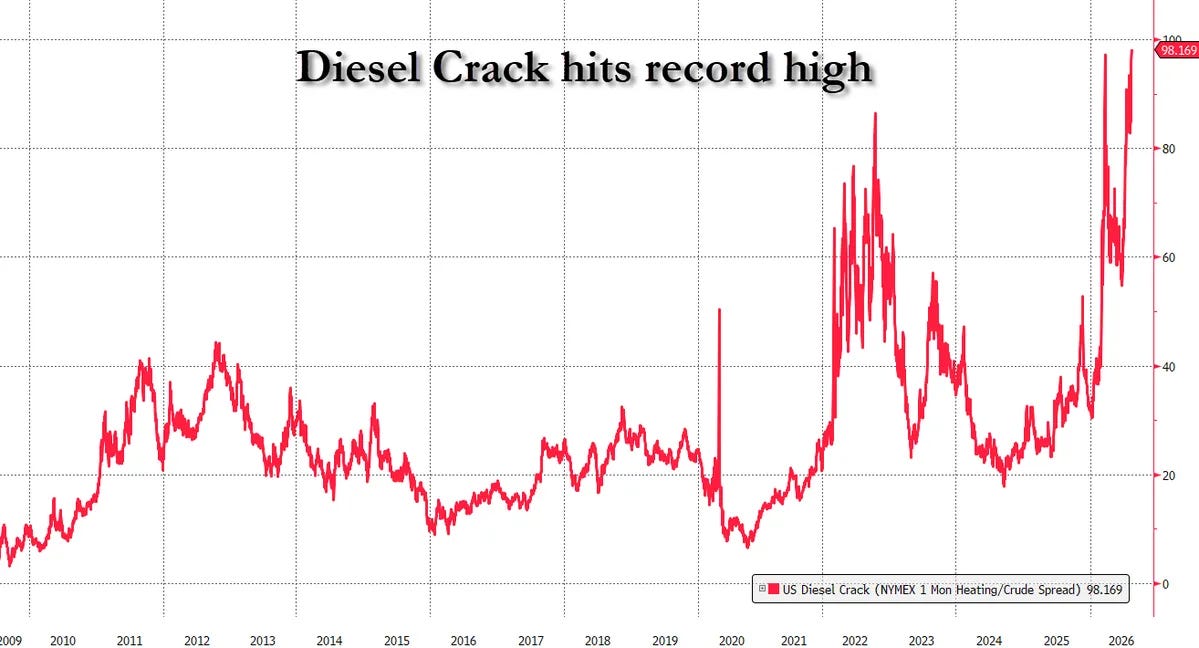
No. 1: Weekend Thoughts <https://no01.substack.com/p/weekend-thoughts-bd0?> ‘Diesel crack[ed product to crude-oil price spread] at a record [$]98.169[/barrel]…
Because bigger molecules pack more tightly and because cracking crude oil adds hydrogen from outside to the product, we get 1.05 barrels of product out of one barrel of crude oil input. Of that 1.05 barrels of product, in US refineries typically get: 0.30 barrels of diesel, 0.50 of gasoline, 0.10 of jet fuel/kerosene, and 0.15 of other products like propane, feedstock for plastics and such, asphalt, residual fuel oil, and so forth.
The diesel and the jet fuel/kerosene crack spreads move almost in lockstep.
This is a genuine crisis in the petroleum markets. But it is not so much a crude-supply crisis as a refining crisis. The world has lost roughly 7.5 million b/d of refining capacity with Russia effectively halting diesel exports as perhaps 2/5 of its capacity to refine crude oil is off line, with the Houthi strike hitting Saudi Aramco’s Jazan refinery, with the near-closure of the Strait of Hormuz since February.
Right now the diesel spread is roughly $100/barrel, gasoline is $35 (recreational and discretionary passenger-car driving is down because of its higher demand elasticity), jet fuel/kerosene is $50 (flight numbers are also down), and residual is $5.
Residual’s crack spread is usually negative: refineries wish that they could turn it into something else, but they cannot. Moreover, the 2020 ban on excess sulfur emissions is effective, and is effectively a ban on cheaply burning any residual from high-sulfur crude oil. So it is hard to generate an excess demand for the stuff.
Note that this crack-spread crisis is not in anticipation of the expiration of the “ceasefire” date coming to pass. It is on top of whatever a full closure of Hormuz would do to the crude-oil price.
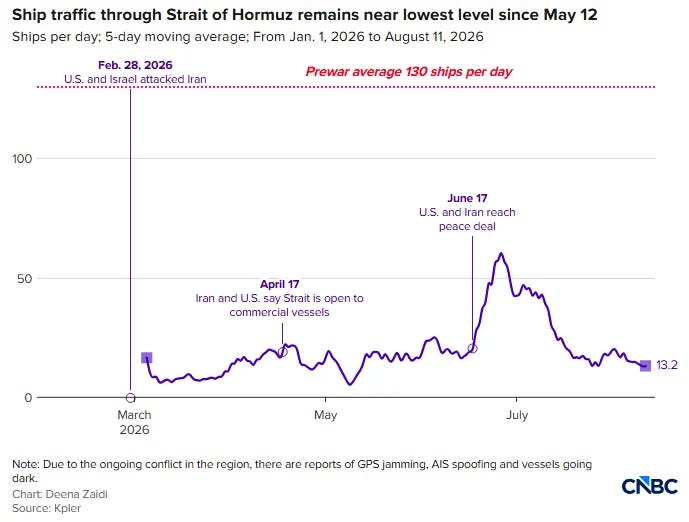
But, admittedly, that might not be much: there has been very little traffic through the Strait of Hormuz since February, or so we think, compared to the 130 ships per day that passed through the Strait of Hormuz in the Before Times: