2026-08-12 0.1% 1-Month 3.4% 12-Month Inflation CPI Release: CHART OF THE DAY
Relatively benign July headline CPI inflation masks gas-and-diesel momentum for next month—while the new Fed Chair mistakes silence for strategy:
The Bureau of Labor Statistics:
Bureau of Labor Statistics: CONSUMER PRICE INDEX – JULY 2026 <https://www.bls.gov/news.release/pdf/cpi.pdf>: ‘The Consumer Price Index for All Urban Consumers (CPI-U) increased 0.1 percent on a seasonally adjusted basis in July after falling 0.4 percent in June…. Over the last 12 months, the all items index increased 3.4 percent…. The index for shelter rose 0.1 percent in July, accounting for roughly two-thirds of the monthly all items increase. The index for food also increased 0.1 percent over the month, as the index for food away from home increased 0.3 percent. In contrast, the energy index declined 1.5 percent in July.
The index for all items less food and energy rose 0.2 percent after being unchanged in June…. The all items index rose 3.4 percent for the 12 months ending July after rising 3.5 percent for the 12 months ending June.
The all items less food and energy index rose 2.5 percent over the year, following a 2.6-percent increase over the 12 months ending June.
The energy index increased 14.7 percent for the 12 months ending July.
The food index increased 3.0 percent over the last year…
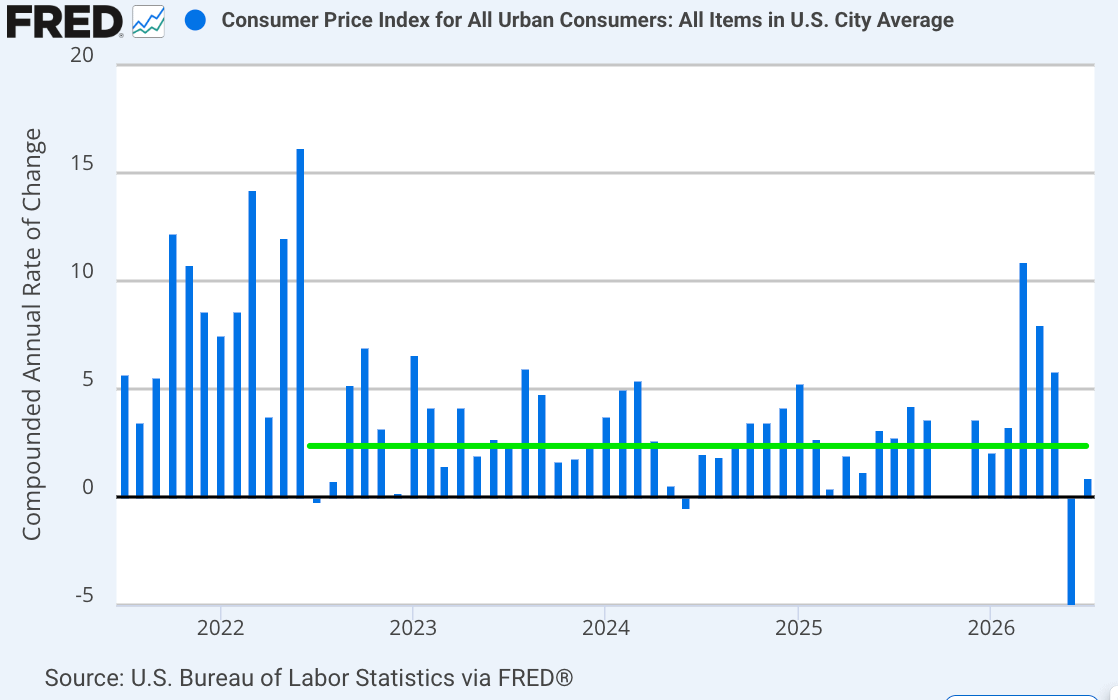
We have, for the CPI over the past five years:
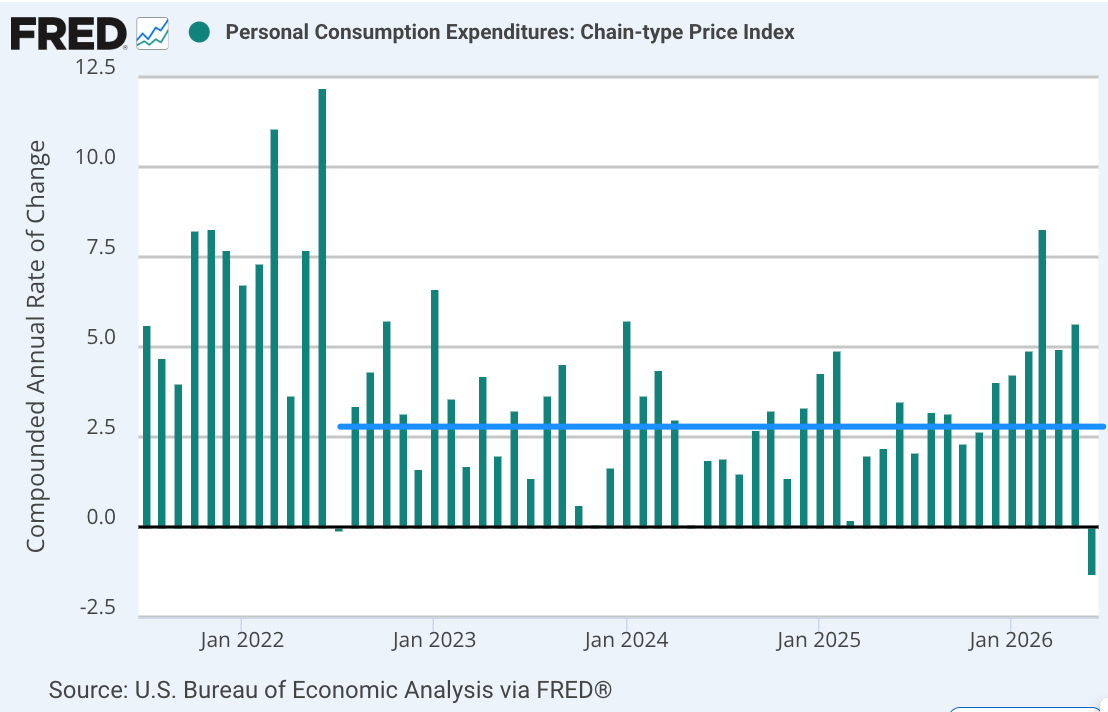
And for the PCE, which Alan Greenspan decided was his favorite indicator and which the Federal Reserve has settled on as its primary index:
One thing not in the data snapshot: gasoline-pump prices climbed through the second half of July but were offset within the survey window by late-June and July 4th declines. So there is gas-price momentum waiting for us next month. Plus diesel rose considerably faster than gasoline, and that will feed into freight, food and services .
There are also strong cross-currents producing perceived affordability shocks: meat up substantially, egg prices finally coming down, but a lettuce problem.
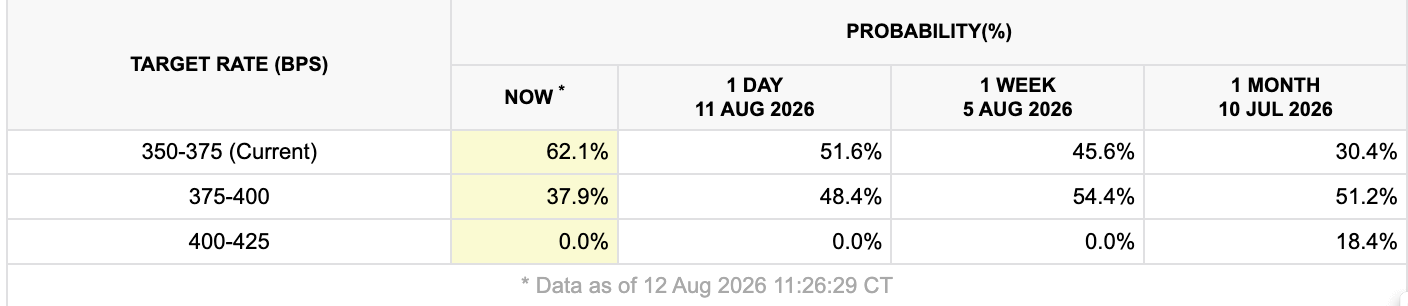
The CME Fed Watch for September <https://www.cmegroup.com/markets/interest-rates/cme-fedwatch-tool.html> has now gone from, a month ago, an 18% chance of two and a 51% chance of one quarter-percentage-point rate hikes to only a 37.5% chance of one rate hike.
I also see interesting thoughts from Rob Armstrong of the FT this morning about new Fed Chair Kevin Warsh’s demonstrations of incompetence in his playing hide-the-ball by refusing to give forward guidance with respect to how the Federal Reserve expects the economy to evolve and what its reaction function is. The good points made, however, are, I think, confused by Armstrong’s attempted steelmanning. My view: since Warsh can’t be bothered to explain himself to the degree of setting out a method to his madness, it is a waste of time for others to guess what he might be—but probably isn’t—thinking that makes sense.
What we actually have is an interesting argument by Morris and Shin <https://economics.mit.edu/sites/default/files/publications/morris-coordinatingexpectationsinmonetarypolicy.pdf> about financial market prices as knowledge transmission mechanisms about the state of the economy. But, as Armstrong says, it does not apply to interest rates. Interest rates have no knowledge about the state of the economy in them. There is only expected Federal Reserve interest-rate policy. You can say that Federal Reserve interest-rate policy reflects the state of the economy via the Fed’s reaction function, and so you can get the market’s view of the likely evolution of the economy by unwinding the yield curve through the lens of the Federal Reserve’s reaction function. But that does not call for omerta with respect to forward guidance. That calls for:
sharply distinguishing the two aspects of forward guidance:
(1) what the Federal Reserve' expects its reaction function to the state of the economy to be,
(2) how the Federal Reserve expects the economy to evolve;
plus emphasis that the Federal Reserve will indeed react—will be data-dependent—and respond according to its reaction function if the economy does not evolve as expected.
That is, I think, sensible. And I have long been annoyed at the failure of Fed Governors and Bank Presidents to do more to explicitly set out not just central cases for the evolution of the economy and of interest rates but of the distribution of possibilities and their respective desired reaction functions. distinguish. But that calls for more communication, not omerta.
Robert Armstrong: The maximally charitable reading of Kevin Warsh on forward guidance <https://www.ft.com/content/d3c55471-0e3d-4798-8355-2b661880d8b9?syn-25a6b1a6=1>: ‘New Federal Reserve chair Kevin Warsh’s omerta on forward guidance has come in for a lot of criticism… [with] the rise in long Treasury yields… confirming the poor reviews…. Warsh’s rhetoric is confused and unhelpful…. But I do see the argument for… what I think he is trying to do, in the absence of him explaining himself….
It is important that prices reflect… efforts… to form accurate beliefs about the world. Yes, some… are about what other people believe. Others… [are] about the state of the world…. To the extent that the central bank collects information about the economy from the private sector… more transparent communication… might reduce the informativeness of information…. If the central bank is too clear and specific about what it is going to do, individual views about the economy are crowded out. Prices cluster idiotically around the central bank’s projections….
But… [with] interest rates… “private” beliefs [are about]… the future action of the central bank… The valuable “private information” is just information about the way market… think[s about] the central bank…. Only if the Fed is credible and competent in the eyes of the market can the market give… signals it needs…. There is a nauseating hall-of-mirrors aspect to this, and a sense that a good central banker must perform a magic trick, inspiring confidence without providing reasons for confidence. Still, there is a logic here, and I see why it appeals to Warsh…
No. There is no logic here. Or, rather, Underpants Gnome logic only:
We will not tell the market what we will do.
The market will then assume we will do the right thing.
Market participants will then trade and push asset prices to those consistent with us doing the right thing.
We can then read the right thing off of the asset prices the market has set out.
We will then do the right thing.
And in doing the right thing, the interest rate path we follow will then validate market expectations.
There are many big problems with this way of “thinking”. The most central is that everyone knows that Kevin Warsh got the job by convincing Donald Trump that he would be a good lackey and, specifically, not do the right thing. Hence no (2). The next most central is that any adoption by Warsh of arguments along these lines is driven not by its intellectual merits but by the fact that Warsh knows that whenever he opens his mouth he angers either Trump or financial market participants, while if he stays silent they might temporarily overlook the fact that he is talking—or, rather, not talking—out of both sides of his mouth: saying—or, rather, not saying—radically different things to different sets of people.