
Late Summer for the Internal Combustion-Engine Vehicle Sector: CHART OF THE DAY
Internal-combustion car sales have fallen from 79 to 50 million a year in a decade, and Adam Tooze calls it “savagely squeezed.” Yet on current trends the gasoline engine will still power half of new cars, and two-thirds of the cars actually on the road, come 2036.
The nternal-combustion engine’s decline is not one story but four:
a shifting geography,
a value chain migrating toward China’s batteries,
ten million jobs clustered in places with names like Detroit and Wolfsburg, and
a coming peak in world oil demand for road transportation.
Sort out which of these bites first and you understand a lot about the economics, political economy, and politics of the next decade.
Adam Tooze sends us to the International Energy Agency <https://iea.blob.core.windows.net/assets/a096b500-9d47-411d-a5db-b297a5d95927/ElectricCarMarketsinaTimeofUncertainty.pdf>:
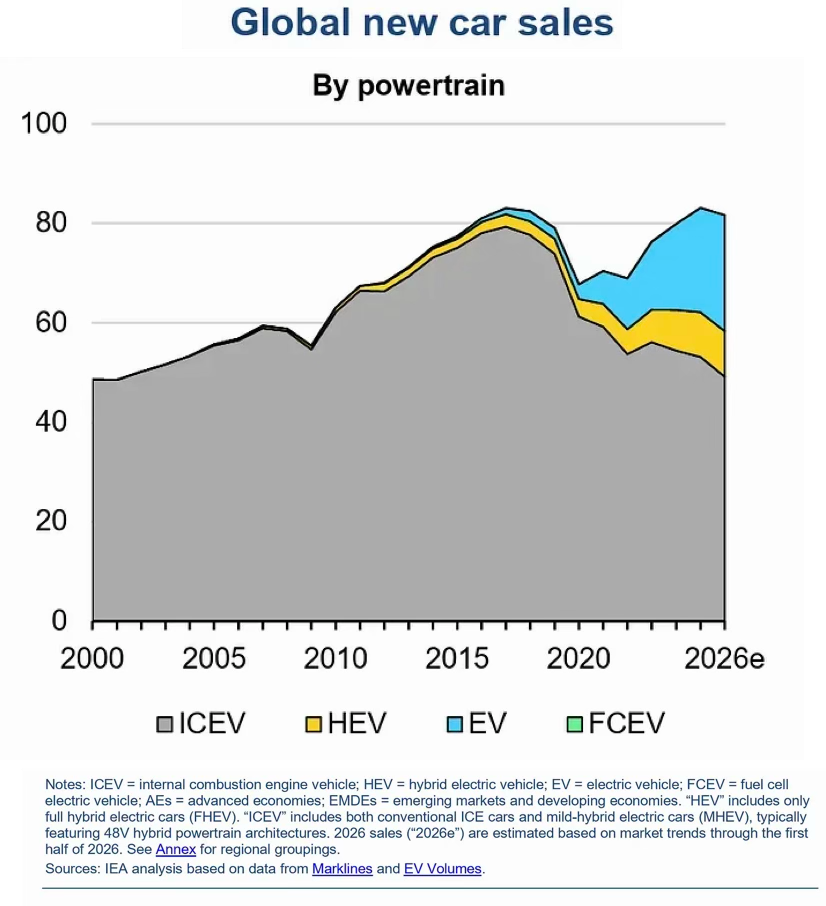
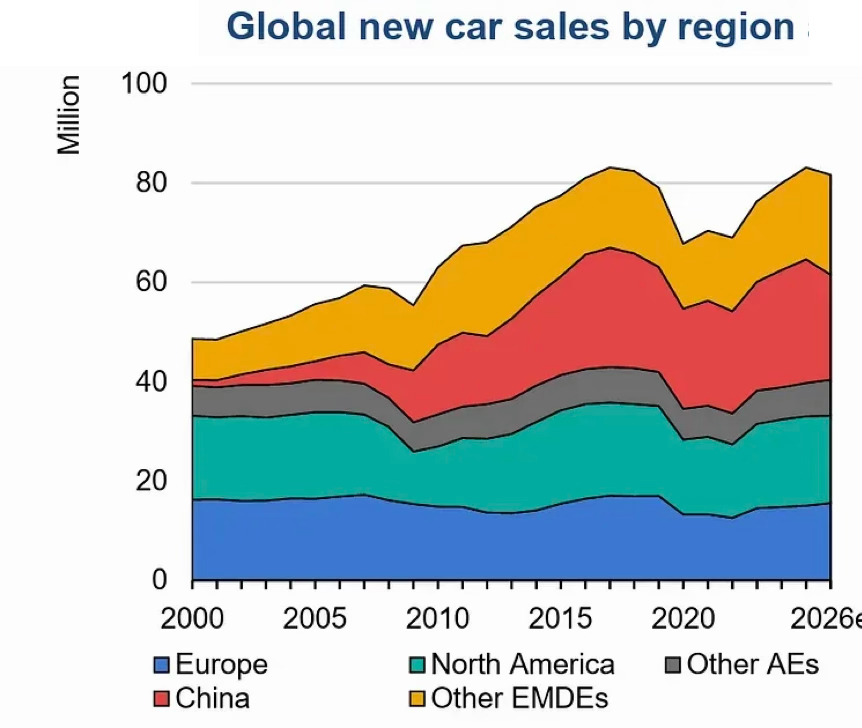
and he notes:
Adam Tooze: Top Links 1189 <https://adamtooze.substack.com/p/top-links-1189-did-bidenomics-work>: ‘The global car market as a whole is not buoyant, but internal combustion is getting savagely squeezed…
From 79 down to 50 million internal combustion-engine vehicles in a decade is, indeed, quite something. On the other hand, internal combustion-engine vehicles are, on this trend, likely to be still close to half of all new sales and some two-thirds at least of the total on-road vehicle fleet come 2036, in a world in which total vehicle production stays at something like 80 million—one new car for every hundred people—a year.
The lay of the land, as I see it right now:
First: Europe, China, and increasingly emerging markets are shedding gasoline vehicles fast. China is the swing factor: electric vehicles are closing in on 2/3 of China sales, and China is likely to stay 1/3 of the global car market for a while at least. The U.S. is, here and now in the age of Trump, the conspicuous laggard here.
Second, internal combustion-engine vehicle decline is driving a substantial transfer of value-added in the global transportation value chain. Looking at countries, roughly a quarter of every electric vehicle’s value is its battery, and China dominates that chain. Looking at firms, long-standing incumbents still own almost all of internal combustion-engine but only half of electric vehicle sales.
Third, employment in making internal combustion engines is the political-economic pressure point: we have ten million people employed in car manufacturing, globally clustered in places with names like Detroit, Nagoya, Shanghai, and Wolfsburg.
Fourth, oil demand—driven by the threefold combination of increased internal combustion-engine efficiency, the electric-vehicle shift of oil burning to the power plant, and the rise of renewable power plants—is something to watch. Come 2030 road-fuel demand worldwide is likely to have peaked.