
CROSSPOST: SEAN ILLING: You Can't Have Homer, Nietzsche & Jesus
On the one hand, Sean Illing is right that you can’t have all three of Homer, Nietzsche, and Jesus. On the other hand, perhaps you cannot even have Jesus entire. Is it the pre-crucifixion Petrine call to live in the Kingdom of Heaven or the post-crucifixion Pauline call to Believe and witness the destruction of all the Old God principalities and powers that is the core? “Feed my lambs” has always fit awkwardly with “destroy every reigning numinous authority and power”. Go for the second, and sitting cheek-by-jowl with Homer and Nietzsche becomes very possible.
The wise Sean Illing protests that you cannot, logically, simultaneously embrace Homer, Nietzsche, and Jesus. The right-wing response to that is: “Hold my beer and watch this!”
How do they manage to make that trick work?
My view: They just need to start by saying “Jesus Christ” with a particular, albeit to my way of thinking peculiar, emphasis. There have, ab initio, been two kinds of things that have called themselves “Christianity”. Call them, perhaps: Petrine, and Pauline.
Petrine Christianity: John 17:15ff.: So when they had dined, Jesus saith to Simon Peter, “Simon, son of Jonas, lovest thou me more than these?” He saith unto him, “Yea, Lord; thou knowest that I love thee”. He saith unto him, “Feed my lambs”…
Pauline Christianity: I Corinthians 15:19 ff.: If in this life only we have hope in Christ, we are of all men most miserable. But now is Christ risen from the dead, and become the firstfruits of them that slept…. Then cometh the end, when he shall have delivered up the kingdom to God, even the Father; when he shall have put down all rule and all authority and power. For he must reign, till he hath put all enemies under his feet. The last enemy that shall be destroyed is death…
For the first, the most important thing to know is that Jesus preaches the Golden Rule”: Do unto others as you would have them do unto you, for the Kingdom of Heaven is within your grasp, and the worthy grasp it and live in it by exercising compassion, giving freely without counting costs.
For the second, the most important thing to know is that Risen Christ is about to do So Much Winning, for he is on the point of launching the Theomakhy of the Eskhaton, the End-of-Times God-Battle. Paul thought the cosmos was occupied territory held by hostile superhuman powers, that God had already landed the decisive blow in the crucifixion, and that history was now the mopping-up interval before a final subjugation in which the last enemy destroyed would be Death itself.
These are two manifestly different religions. In one, you act as Jesus would. In the other, you believe in Christ and stand by and watch as your soul is redeemed. They can be made to run in harness, kinda-sorta, to some degree. But.
All this is a lead-in to Sean Illing here. For it is just the Petrine Christianity that Nietzsche opposes, and that is anti-Homeric.
With that correction, however, I think Sean is talking a lot of sense here:

CROSSPOST: SEAN ILLING: You can’t have Homer, Nietzsche and Jesus
<https://seanilling.substack.com/p/you-cant-have-homer-nietzsche-and> <https://seanilling.substack.com/>

Thoughts on The Odyssey and the incoherence of the cultural Right.
Sean Illing
Aug 04, 2026
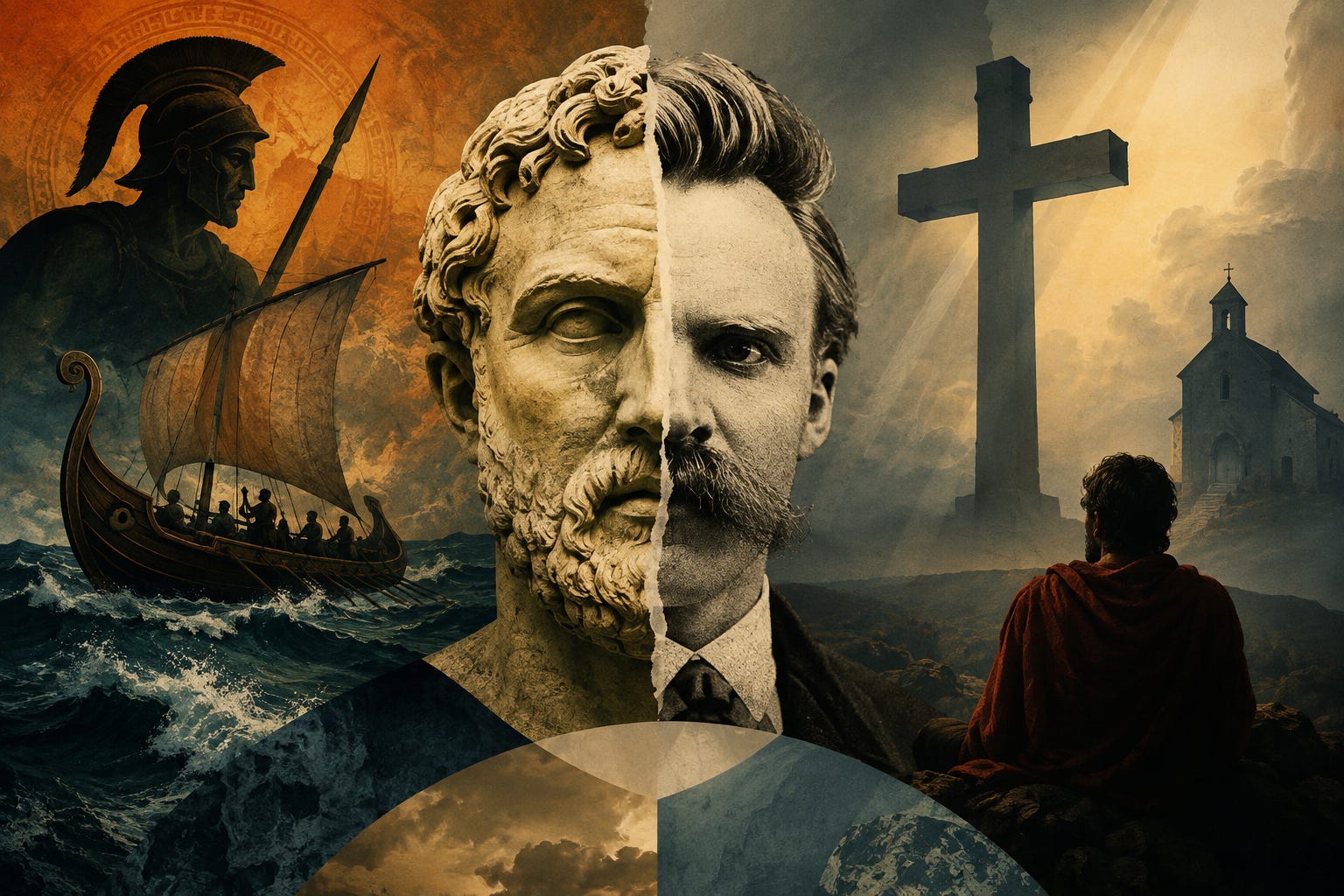
My friend (and former boss) Ezra Klein wrote a great piece this weekend about the right-wing uproar over Christopher Nolan’s The Odyssey. Well, “uproar” is maybe the wrong word here. “Confusion” is more on target.
I have to confess, I’ve kind of enjoyed the hysterical overreactions to the film. Anything that pisses off Elon Musk this much has to have some inherent value, right?
At this stage, there’s basically no amount of cultural stupidity that can surprise me. But the discourse around The Odyssey has been a real doozy. We’re talking about a mythic poem about gods and monsters composed centuries before anything resembling our modern conceptions of race or historical representation. Complaining that its cast does not look sufficiently “Greek” is like complaining that the actors in The Lord of the Rings do not look sufficiently Gondorian.
As best I can tell, the more interesting distortion has received much less attention. It’s true that Nolan’s film does take enormous liberties with Homer’s poem. It softens its pagan morality and filters Odysseus’s story through recognizably Christian ideas about guilt, mercy, repentance, forgiveness, and the moral equality of human beings. It’s fine, I suppose, to be annoyed by that. What’s revealing is that the self-appointed defenders of Judeo-Christian civilization seem far more exercised by the racial makeup of the cast than by Nolan’s replacement of Homeric morality with Christian morality.
Watching all this discourse reminds me of when I was covering Trump and the alt-right in my early days with Vox. Back then, the alt-right was deep in its obsession with Nietzsche. And in both cases, the attraction is understandable. Nietzsche and Homer offer visions of a pre-Christian moral universe organized around strength, hierarchy, honor, conquest, glory, and domination rather than humility, charity, pity, or universal human dignity.
The issue is that many of the people drawn to this vision also insist that they’re defending Christianity. They want the warrior ethic of Achilles and Odysseus, the aristocratic radicalism of Nietzsche, and the civilizational authority of Christianity. Because they don’t take any of these things seriously, they don’t confront the obvious contradictions among them.
If you recall, the once-famous white nationalist goober Richard Spencer told the Atlantic’s Graeme Wood back in 2017 that he was “red-pilled by Nietzsche.” “Red-pilled” is a common term for that “eureka moment” one experiences when first encountering some dark and previously buried truth. For Spencer and other alt-right enthusiasts of Nietzsche, that dark truth is that all the modern pieties about race, peace, equality, justice, civility, and universal suffrage are bullshit.
For people primed to believe this sort of thing, Nietzsche is a breath of fresh air. He’s the guy who tells you there are no capital-T truths, that the world is forever in flux. In his clearest and most straightforward piece of writing, The Genealogy of Morality, Nietzsche shreds the intellectual justifications for Christian morality, calling it a “slave morality” developed by peasants to subdue the strong.
There is, of course, much more to Nietzsche than this. But if you read him like a freshman cramming for a midterm, this is the exciting stuff you inhale and it’s just enough metaphysical dynamite to clear a path for your dormant prejudices.
Readers of this Substack will know that my dissertation was largely about Nietzsche, which means I have the privilege of constantly detecting recycled versions of his arguments from a century ago.
If you haven’t read The Genealogy, the story Nietzsche tells is that Christianity overturned classical Roman values like strength, will, nobility of spirit. These were replaced with egalitarianism, community, humility, charity, and pity. Nietzsche saw this shift as the beginning of a sweeping democratic movement in Western civilization, one that championed the weak over the strong, the masses over the individual, etc.
The “post-liberal” right, like the alt-right before them, seems infatuated with this strain of Nietzsche’s thought, probably because of the emphasis on “decline.” I think this is what gives the current fascination with Homer its political charge. The ancient epics offer up a world before liberalism, feminism, egalitarianism, and Christianity. Men fight wars, seize kingdoms, take slaves, chase glory, all that jazz.
But the intoxicating thing is the pre-Christian morality, where human beings aren’t equal and the strong unapologetically dominate the weak. There’s no trace of what people now call “suicidal empathy.”
Homer’s world, in other words, isn’t even remotely Christian. The moral universe of The Odyssey is hierarchical, aristocratic, violent, governed by reciprocal obligations rather than universal duties. Odysseus is admirable because he’s cunning, powerful, resilient. His greatness doesn’t consist in loving his enemies or caring for the meek. When he returns to Ithaca, he slaughters the suitors. He also orders the execution of the enslaved women who slept with them.
Nolan’s film can’t fully accept this morality, or at least Nolan clearly doesn’t think a modern audience will accept it. So the story is recast as a meditation on guilt and civilizational trauma. Odysseus is forced to confront what he has done and his heroism is purified through remorse. That, to me, is the real modernization of The Odyssey. The stupid casting controversy is a distraction from it.
Which brings us back to Richard Spencer. In his interview with the Atlantic, Spencer surprised Wood with a peculiar defense of Christianity: that the religion is false but it “bound together the civilizations of Europe.”
This view is more commonplace on the modern right than many people seem to think. While they don’t actually have any interest in Christ, they see the whole edifice of white European civilization as built on a framework of Christian beliefs. Christendom is the force that united the European continent and forged white identity.
Surely you can see the paradox: They believe the West has grown degenerate and weak because it internalized Christian values, but they find themselves defending Christendom because it’s the glue that binds European culture together.
But the moral legacy of Christianity is part of the plague they’re rejecting. Christ’s identification with the poor, the weak, the stranger, the prisoner, and the outcast is hard to reconcile with a politics organized around domination and exclusion. So are the injunctions to love one’s enemies, forgive wrongdoing, renounce vengeance, distrust wealth, and treat the least powerful members of society as bearers of divine worth. It goes without saying that these are not trivial contradictions. This is the moral center of Christianity.
Which is what makes the response to The Odyssey so amusing. The people complaining about its betrayal of Western civilization are mostly indifferent to the film’s actual betrayal of Homer. Nolan replaces the pagan warrior ethic with a moral vocabulary shaped by Christianity. This goes unnoticed by these critics because what they want from the ancient world isn’t historical or philosophical fidelity. They want an aesthetic of strength and they want Christianity to linger in the background as some vague container of order.
Nietzsche, to his credit, accepted that Christianity was central to the development of Western civilization, and his whole philosophy was focused on convincing people that the West had to move beyond Christianity. When Nietzsche declared that “God is dead,” he meant that science and reason had progressed to the point where we could no longer justify belief in God, and that meant that we could no longer justify the values rooted in that belief.
A big chunk of the contemporary right wants to live after Christianity while continuing to wield Christianity as an authority. It wants a politics of power, hierarchy, vengeance, and domination, but it also wants to call that politics “Christian.”
Nietzsche, at least, was honest about the conflict. He understood that Christianity had transformed the moral language of the West. He also understood that rejecting Christian theology while preserving Christian morality was unsustainable. You can’t just kill God and keep everything else.
The people raging about The Odyssey want to kill Christian morality and keep Christian identity. They want Christendom without Christ.
Nietzsche will always be our most punk rock philosopher, the guy who “philosophized with a hammer.” In the end, though, people find in his work what they went into it already believing. If you’re seeking a reason to reject a world you don’t like, you can find it anywhere, especially in Nietzsche.
You can read The Odyssey as a repudiation of the modern world, a story about masculine strength, natural hierarchy, heroic violence, the defense of home, and the restoration of order. All of that is definitely in the poem. What you can’t do is pretend that this ethic is indistinguishable from Christianity. Love it or hate it, Christianity introduced a moral revolution that privileged the weak over the strong, mercy over vengeance, and the equal value of souls over the natural hierarchy of the ancient world. Nietzsche hated Christianity precisely because he understood this.
The most interesting thing about the conservative response to The Odyssey is that it exposes a confusion about Christianity that the American right has never resolved because it’s not resolvable. Their heroes are pagan. Their morality is Nietzschean. Their identity is Christian.
Good luck with all that!
<https://seanilling.substack.com/p/you-cant-have-homer-nietzsche-and> <https://seanilling.substack.com/>
Brad DeLong here: Now St. Paul’s vision of the Theomakhy of the Eskhaton—of Jesus by passing through Death-and-Resurrection-and-Ascension waging war and destroying the Old Gods—does not get you all the way to Homer, let alone Nietzsche. But it does get you to a place where you can be very comfortable with them. For all the sweetness-and-light and the doing-unto-others was before the Hinge of History that was the Crucifixion. That was the Gospel preached to the other apostles, and it was preached by a man. Paul, by contrast, is the only apostle who has received the Gospel preached directly to him by a God.