Have I Picked the Wrong Week to Ponder Whether to "Relaunch" My SubStack?
My view: The most ambitious thing SubStack could do right now is stop pushing forward. But given who is running and funding the place, that is unlikely. Scott Carney says the platform is dying. I say it is more likely that it has reached the limit of its supply lines—and that the cure is to stop, dig in, and be satisfied. Bismarck stopped after Königgrätz; Napoleon pushed on past Smolensk; much depends on which choice is made now:
I think the better take is that SubStack may have reached its von Clausewitzian culmination point.
What do I mean by that? Von Clausewitz’s culmination point is the moment when a successful offensive has extracted everything it is going to extract, and one more step forward converts assets into a liability. The right move then is to stop, consolidate, and make the existing machine work better—which, in the case of SubStack, means bundling, subscription management, honest discovery. The big danger is that only a genius can recognize a culmination point. And SubStack’s deciders are not geniuses. They are founders who want to change the world. They are investors who want to be even richer Princelings of Silicon Valley. Are they capable of stopping to consolidate, and being happy turning to the task of solidifying and then running a normal, useful business?
No, I do not understand why Chat-GPT thinks that this is the most appropriate illustration it can produce for this weblog post…
Back up: Laura Tyson is the latest of the people of note and reputation and good judgment for whom I have enormous respect, who has advised me that, nw that I am at Teaching-Zero for the rest of this year, to spend the time from now up to next MLK Jr. Day seeing if I can do on a smaller scale what the highly estimable Scott Galloway <https://www.profgmedia.com/> and Paul Krugman <https://paulkrugman.substack.com/> and some others have managed to do with this particular SubStack harness. The hope is that it would be more fun than and not a lot less remunerative than giving talks to bankers and such—not that giving talks to bankers and such is not fun, but more fun.
And I have just about decided yes and that this weekend would be a good time to push my chips into the center of the table.
However, now comes Scott Carney to say: Not so fast!:
Scott Carney: The Real Reason that Substack is Collapsing <https://sgcarney.substack.com/p/the-real-reason-that-substack-is>: ‘The Subscription Model Has Maxxxed Out: A few years ago Substack transformed away from being a niche newsletter-delivery system and into the main refuge for tens of thousands of journalists who were fleeing (or been kicked out) of the mainstream media. The value proposition was simple: writers could come here to build an audience that would actually pay directly for their writing…. With a thousand paid subscribers you could live the middle class dream of earning close to $100,000 a year (well, more like $80,000 after all the fees). For a while it seemed like a reasonably good trade…. Early adopters on the platform did the best. Writers like Heather Cox Richardson and Matthew Yglesias arrived early….
So Substack tried to solve the problem by adopting a strategy that every other tech company had already worn thin. They pivoted to adding a twitter-like function called “Notes” (which created a distinction between ““subscribers” and “followers”). Soon they incorporated video and live-streaming and encouraged posters to clip shorts into their feeds with an AI-generated clipping program. In other words: Substack’s growth strategy was to offer almost the exact same things as every other social media network….
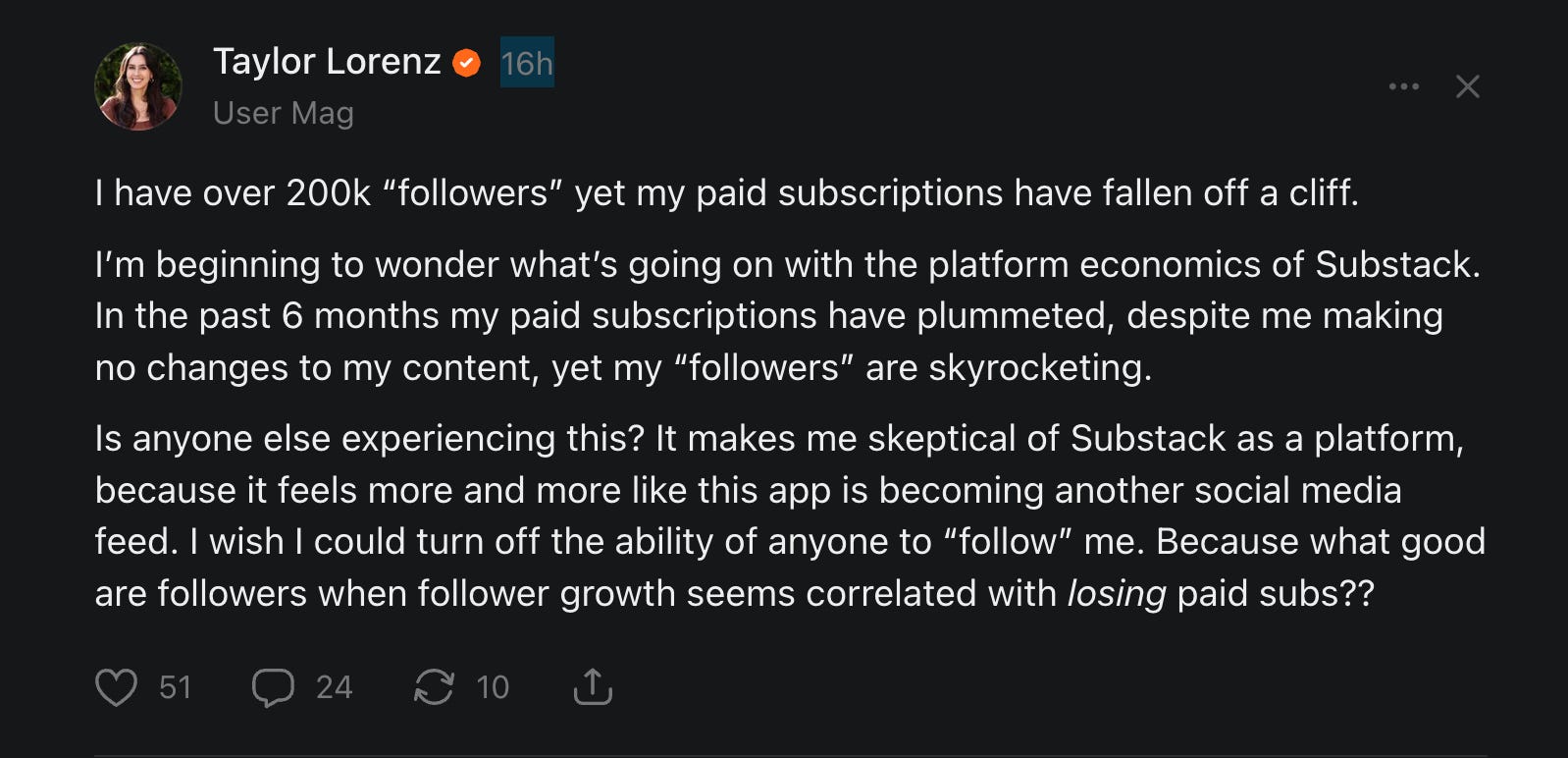
At first the strategy even sort of worked…. [But] take for instance this note from Taylor Lorenz from just yesterday:
I don’t have anywhere near Lorenz’s following, but my numbers look surprisingly similar…. Subscription fatigue.… I can’t make a rational argument for why my own work here on Substack or on YouTube is more valuable than, say, HBO which drops whole seasons of new TV shows every week….
The higher-ups at Substack… could have… allow[ed] creators to team up and pool their creative resources… could have instituted some sort of curated subscription bundle…. Watching the decay of my own business on this platform has made me reassess my overall economic strategy…. What I have found success in has been working directly with sponsors on YouTube videos…. [But then] there is always the temptation to lower editorial standards to court ever-more lucrative sponsors…. Substack offered the dream to creators that their readers really would be their customers instead of just eyeballs that they sell to third parties. It’s too bad that the architecture of the platform itself has ripped that dream away…
Brad DeLong here: Three things you need to remember to understand what SubStack thinks that it is doing:
First and most obvious: Substack is not preventing you and never has prevented you from running a group Substack. The decision to go individual is the individual’s decision. Admittedly, it is the path of least resistance when you start out, and SubStack could and I think should be doing more to “bundle”, but it is not blocking anybody’s way.
Second: Substack is eager for away to get its writers and videoers to find “sponsors” without succumbing to the slop of the eyeball attention-harvesting Facebook-like ecosystem. They are eagere to shake all the money trees in any ways they can that they can convince themselves are not triggering the malign transformation into another FaceBook-adjacent hellscape.
Third: As I understood the bet of Substack, it was that:
large numbers of writers and videoers would be able to find TrueFans—people whose minds resonated with theirs.
500 or 2,000 or 8,000 TrueFans.
The TrueFans would be willing to pay SubStack rates for essentially all that those they were fans of would write, podcast, and video.
Add to those the relatively rich people willing to pay to strengthen pubic reason and the public sphere—willing to contribute to making a better internet possible and real—the PatronFans.
Add to that a push by SubStack to encourage its writers to offer enough free content to to keep the free browsers coming back and searching for more things on SubStack.
Then some of those, somewhat to their surprise, would come across a SubStack and discover that with respect to that SubStack they were TrueFans.
And the alignment of SubStack and its writers and videors and readers and watchers would me maintained because the cash nexus would not be advertising but subscriptions.
The hope was that they would provide an alternative to the malign eyeball-attention clickbait outrage harvesting-for-advertising of the FaceBooks. This would provide an alternative to the SEO-feeding ad clickbait of the Googles and the Amazons.
Thus Scott Carney’s ire seems to me to be substantially replaced. SubStack seems to me to have architected its platform as best it can to give it the best chance it can of having a long-term public-sphere public-reason win. Thus when I came to the end of Carney’s piece, I was disappointed. He seems to think that people would subscribe to more newsletters if SubStack had not:
[when] more writers showed up [and] the [total pool of] subscription revenue pie didn’t grow commensurately… adopting a strategy that every other tech company had already worn thin… [of] adding… twitter-like… “Notes”… incorporat[ing] video and live-streaming… encourag[ing] posters to clip shorts into their feeds with an AI-generated clipping program… offer[ing] almost the exact same things as every other social media network…. [But] as the platform promotes more and more free content, users have less and less incentive (and time) to engage with the more thoughtful higher quality content that lives behind paywalls…
But he does not consider that Ghost and Beehiiv and Patreon and all the others that have not successfully attempted Discovery Engine supercharging appear to be doing worse than SubStack.
Plus I have a very different answer than Carney does to the question: How is this working for them—for us?
My view: It is working out much better than I thought it would.
My baseline these days is that trying to create a functioning public sphere of public reason in this attention-harvesting clickbait-outrage age of advertising supported microbytes is a work of Sisyphus. By that baseline, SubStack is doing great: substantially exceeds expectations.
It is also trying to place more bets on the table:
(i) Its “pivot to video”, the latest in the perennial story of pivots to video.
(ii) Its attempts to find a way to get its writers and videoers some money not through FaceBook-style eyeball harvesting but through PBS-style “sponsorships”.
(iii) Its pivot to SubStack notes, as a social-media platform about SubStack posts, in an attempt to further supercharge its Discovery Engine.
(iv) Its intellectual and ideological and it believes moral commitment that it doesn’t block content its readers want to pay for.
(v) And when they think of other places they can place some of their VC chips with a reasonable chance of success, they will place them.
Parenthetically, with respect to (iv): It fits very uneasily with its reliance on an algorithm to surface things that it thinks you might subscribe to without the guardrails it is morally obligated to provide that its algorithm needs to surface things that if you subscribe to them will make you closer to your Best Self. (In short: DO NOT BE THE NAZI BAR!!)
Thus my bottom line: SubStack is not collapsing. SubStack is exceeding rational and reasonable expectations.
But there is something in what Scott Carney sees. What is it? I think it is increasing signs that SubStack has reached what Carl Phillip Gottfried von Clausewitz called its culmination point.
What is a culmination point?
It is one of the central idea of von Clausewitz’s Vom Kriege. It is one of the few pieces of 1800s-era wisdom that has aged not at all. Any attacking army, von Clausewitz observed, is strongest at the moment it steps off. Everything that happens afterwards subtracts. Detachments must be peeled off to guard a lengthening supply line. Garrisons must be left in captured towns. The sick and the stragglers accumulate. The distance between the fighting edge and the magazines grows with every mile. Meanwhile the defender is doing the opposite: falling back onto his own depots, his own railheads, his own reserves, his own people, and—crucially, for von Clausewitz—onto the defense, which he insisted was the intrinsically stronger form of war.
Two curves, therefore. The attacker’s power declines. The defender’s rises. Somewhere they cross. That crossing is the culmination point: the moment at which the offensive has extracted the maximum it is ever going to extract, and after which one more step forward converts an asset into a liability.
The genuinely nasty part—the part that makes this a theory of psychology and not of logistics—is that the culmination point is invisible from the inside. An army that has just reached it does not feel exhausted. It feels victorious. It has been winning for months. The maps in the headquarters tent are covered in captured ground. Every instinct, every incentive, every officer hoping for promotion says: press on, the enemy is broken, one more push finishes it. And von Clausewitz’s warning is that past the culmination point you do not merely fail to gain more. The counterblow, when it comes, is out of all proportion. You lose what you had already banked.
Thus recognizing when you have reached it is the whole ballgame. The commander who recognizes his culmination point does four things, in order:
He stops. Not because stopping is glorious—it never is, and the army will hate him for it—but because the marginal expected value of the next advance has gone negative.
He consolidates. He fortifies what he holds. He makes the gains defensible rather than merely occupied.
He turns from conquest to administration. Supply lines get shortened and rationalized. The sick get well. Units get brought back up to strength. The machine that was built to seize things gets rebuilt into a machine that works well. This is the unglamorous part, and it is where nearly all of the durable value gets created.
And only then does he decide: is this win sufficient?
Do I bank it, make peace, and go home successful? Or do I want another campaign later—in which case my job right now is to accumulate the resources for it from a secure base, not to spend them today?
Otto von Bismarck in 1866 is the genius here. After the Battle of Königgrätz the Prussian generals wanted Vienna. King Wilhelm von Hohenzollern wanted a triumphal parade and Austrian territory. Bismarck wanted—and got, at the cost of a scene so operatic he reportedly threatened to go out the window—a lenient peace that took essentially nothing from Austria. He had gotten what he needed: Austria out of his “Little” Germany. Everything past that was a debt. The result was that Austria was not an implacable enemy in 1870, and Prussia had the resources for the campaign that actually mattered.
Napoleon in 1812 is the anti-genius here. (And he more than half knew it at the time.) His arrival at Smolensk was the culmination point. He looked at it, understood what it was, and pushed on to Moscow anyway. Stopping did not feel like winning. He got a burning city, a refused negotiation, and the road back without supplies through a Russian winter.
That brings us back to SubStack right now.
The thing to grasp is not “SubStack is collapsing.”
The thing to grasp is: do not push right now. Not this quarter.
The pivot to video, the AI clipping, the shorts, the notes-as-social-network, the sponsorship apparatus—all of those are ongoing.
But spending huge amounts of additional resources on each or any of these? Thinking up new things to try? They may well be the equivalent of fresh offensives launched from a supply line that is already at its stretching point. Each addition threatens to consume engineering attention, product coherence, and writer goodwill that could instead be spent making the thing that already works work better.
There is enormous unharvested value sitting inside the current SubStack: better bundling, better subscription-management tools so that “subscription fatigue” becomes a solvable UX problem rather than a hard ceiling, better discovery with actual morally consistent guardrails, lower frictions, lower fees. That is consolidation. That is the shortening of supply lines. It is worth more, right now, than any new frontal offensive over the tops, over the trenches, into the machine guns.
Thus my worry. It is really not a worry about product strategy. It is a worry about people. SubStack’s founders say that they want to make some money and change the world. I believe them. They are sincere. That mission is much of what makes the place good. But people who want to change the world are, constitutionally, not people who tell themselves that the world has been changed as much as it is going to be changed this decade, and that the correct move is to stop and tidy-up.
Plus: SubStack’s investors want something else again. They want a serious win—the kind that converts them into even bigger Princelings of Silicon Valley. The venture-capital arithmetic simply does not have a cell in the spreadsheet labeled “good business at current scale”. A firm whose entire model requires that one investment in twenty return a hundredfold cannot accept a culmination point. It must demand the march on Moscow, because a company that stops at Smolensk is, in portfolio terms, a write-off—even if it is profitable, even if it is beloved, even if it is doing exactly what it set out to do.
So the two groups who get to make the decisions now are both, structurally, predisposed to refuse to recognize the culmination point when they reach it.
And Cory Doctorow named that refusal the road to en****tification:
first the platform is good to its users;
then it abuses its users to make things better for its business customers;
then it abuses the business customers to claw back all the value for itself;
then it dies—or, worse, lives as a profitable, and in the worst case very profitable, blight on the landscape.
The alternative is that SubStack at roughly its current size can be a good business: one that pays its workers well, gives tens of thousands of writers a real living or a real supplement, and provides its readers and the wider society something scarce and valuable—a functioning corner of the public sphere that is not organized around harvesting outrage. Recognizing that would not be a failure of ambition. It would be the single most ambitious thing anyone in that industry has done in a decade.
Which brings me back to my chips: Should I push them in this first week of August? Or start lining up some more out-of-town talks this fall to keep me busy?
If reading this gets you Value Above Replacement, then become a free subscriber to this newsletter. And forward it! And if your VAR from this newsletter is in the three digits or more each year, please become a paid subscriber! I am trying to make you readers—and myself—smarter. Please tell me if I succeed, or how I fail…