Emily Wilson's Inordinate Rage Against Christopher Nolan's "Odyssey" Adaptation Seems Worth a Note: HUMANITIES
The Rotten Tomatoes Tomatometer says 94%. The audience says 97%. I liked it too. People I respect like Bret Devereaux, Theo Nash, and Patrick Wyman all read the film as a successful Bloomian “strong misreading”—and then Emily Wilson, who gave us the most celebrated recent Odyssey translation in English arrives to say she’d have been ashamed to write any part of the script. And to pile on: the reference to the nonexistent “sea peoples”—although the scribes of Usermaatre-Meryamun Rameses-Heqaiunu would like a word—the mishmash costumes, the flat script, the didactic Brexit and other modern allegories, the Western Sahara location, the race-neutral casting, the spectacle, Matt Damon’s lummoxy Odysseus. The objections contradict one another: too modern in its values, too celebratory of a territorial war. Reading Emily Wilson’s London Review of Books piece on Nolan’s Odyssey isn’t reading a review. It’s watching spaghetti hit walls over and over and over again. So what is going on here? Virgil, after all, wrote Odyssey fanfic too.
My view: Cory Doctorow’s theory of why writers rage against fanfic offers a potential explanation. His model of anti-fanfic fury is this. Writers—and a translator is definitely a writer—build persistent internal models of their characters in which they deeply believe. When someone else’s version feeds contradictory data into that model, the dissonance is unbearable. Odysseus has spent so much time in Emily Wilson’s head that she knows who he is. And the Nolan-Damon “lummox” is not him.
This morning I see another friend showing up, liking the Nolan Odyssey adaptation movie:
Tim Sullivan: <[twitter.com/Tim_Org/s...](https://twitter.com/Tim_Org/status/2084264542607917289)>: ‘I finally saw The Odyssey. It was terrific. My only complaint is that the "hospitality" theme was overblown -- but given that one common complaint about Nolan films is that they're hard to understand, I get why he want all in on the Zeus thing, even if it was heavy handed…
This is, as I have said before, the overwhelming general judgment:
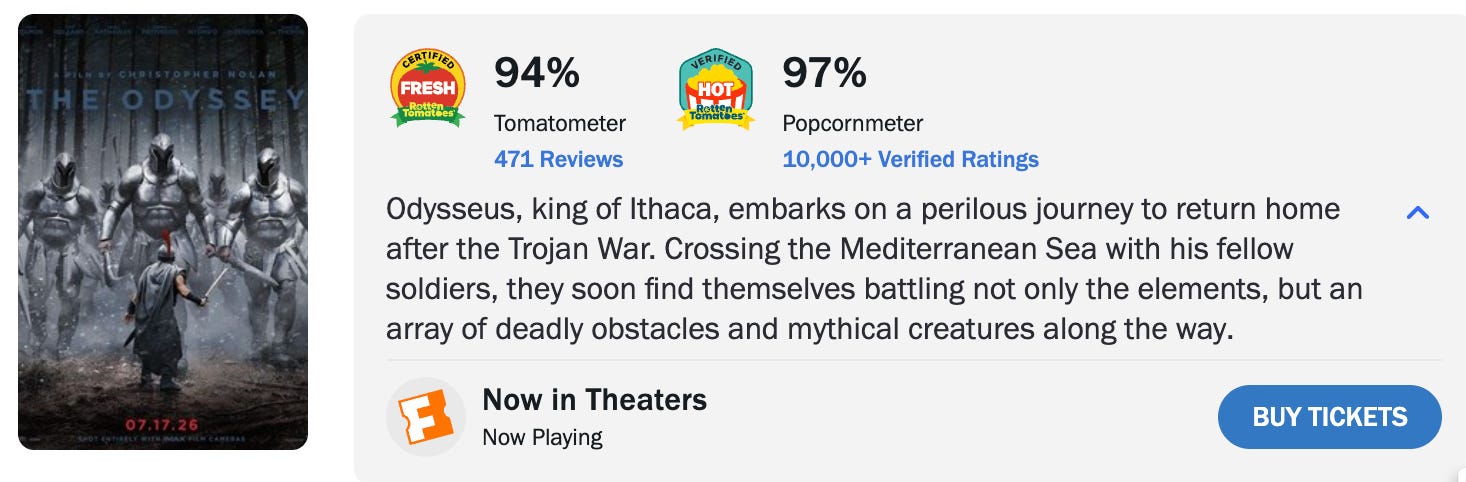
Rotten Tomatoes: The Odyssey <https://www.rottentomatoes.com/m/the_odyssey_2026>: ‘94%Tomatometer 471 Reviews; 97% Popcornmeter 10,000+ Verified Ratings: Odysseus, king of Ithaca, embarks on a perilous journey to return home after the Trojan War. Crossing the Mediterranean Sea with his fellow soldiers, they soon find themselves battling not only the elements, but an array of deadly obstacles and mythical creatures along the way…
And immediately behind Sullivan on my screen is Emily Wilson in the London Review of Books, with something remarkable, in this context.
It seems that she dislikes, well, pretty much every single thing, starting with Nolan’s view of Bronze Age history:
Emily Wilson: <https://www.lrb.co.uk/the-paper/v48/n14/emily-wilson/an-uncomplicated-man>: ‘The film’s… muddled premise: that this Hollywood version of Mycenaean Greece is the only ‘civilisation’ in the world…. Threats to ‘our civilisation’ from ‘the sea peoples’ [is] a now debunked 19th-century theory about maritime tribes who were thought to have attacked Egypt around 1200 BCE and to have also been responsible for the roughly coeval collapse of Mycenaean Greek culture…. The current consensus, as Nolan clearly knows, is that there was no such thing as ‘the sea peoples’…. The Greek-speaking world’s shift away from the more centralised, literate palace culture of the Mycenaeans in the 11th century BCE towards the fragmented social formations of the early Greek Iron Age was caused by a range of factors, including climate change, earthquakes and internal unrest…
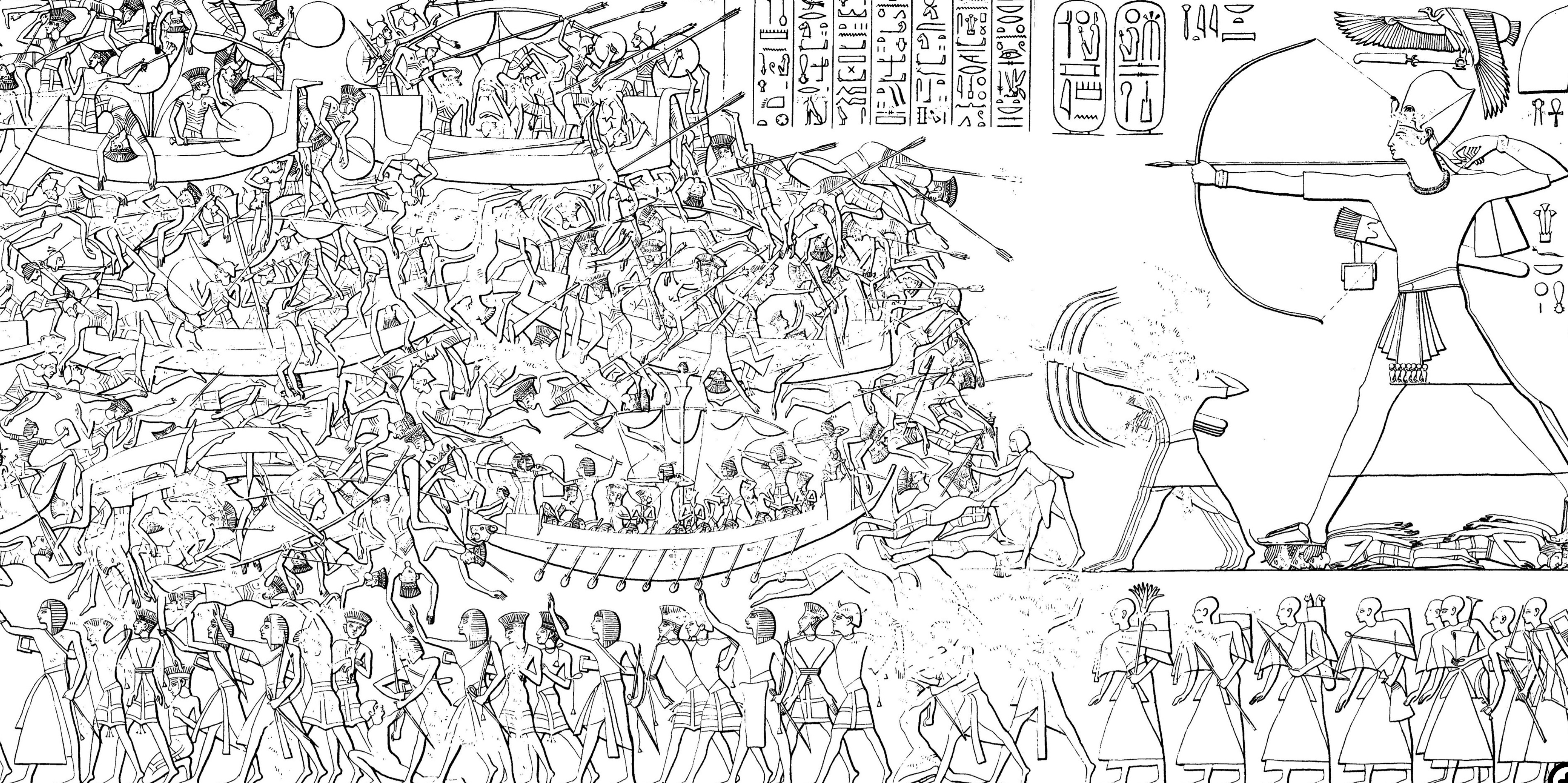
My first reaction is that the scribes of Usermaatre-Meryamun Rameses-Heqaiunu, who was XX Dynasty Pharaoh in Egypt from -1185 to -1154, profoundly disagree about the non-existence of the “sea peoples”:
The foreign countries made a conspiracy in their islands. All at once the lands were removed and scattered in the fray. No country could stand before their arms, from Khatte, Qode, Carchemish, Arzawa, and Alashiya on, being cut off at [one time]. A camp [was set up] in one place in Amor. They desolated its people, and its land was like that which has never come into being. They were coming forward toward Egypt, while the flame was prepared before them. Their confederation was the Peleset, Tjeker, Shekelesh, Denye(n) and Weshesh, lands united. They laid their hands upon the lands as far as the circuit of the earth, their hearts confident and trusting “Our plans will succeed!”…
But let that pass. There is much much MOAR. She is ashamed for the costume designers and scriptwriters:
The costumes, armour, boats and architecture are a mishmash…. The language is relentlessly expository, humourless and flat…. I would be ashamed to have written any part of this script…
She thinks the movie is too “woke”? She does not like that:
[Nolan’s] muddled [Trojan Horse] subplot is foisted on the film in order to make Nolan’s relentlessly didactic point about the contemporary Anglophone world: that the lies and xenophobia of the war on terror and Brexit began a cultural decline that is now destroying the values ‘we’ hold most dear…
Yes, those are her scare quotes there, carrying the message that maybe not all of us think it important to wring our hands over Farage and Johnson’s Brexit and George W. Bush’s War on Terra.