
Things Have Gone too Far!: LAUGH OF THE DAY
The Oatmilk Default: A “retired” economist’s field report from the coffeehouse inellectual frontier…
The QualComm Café in the basement of Sutarjda Dai Hall, just a stone’s throw from Evans Hall, has reopened.
This is of some importance to me. The Sutarjda Dai Hall QualComm Café is one of the five coffee shops ringing the Berkeley Economics Department’s Evans Hall—Sutarjda Dai Hall, Cory Hall, Stanley Hall, Hildebrand Hall Breezeway and South Halls. (Yes, Evans Hall is about the only campus building nearby that does not now have a coffee shop in it: O tempora! O mores!) Since I am now “retired”, and since a substantial plus from “retirement” is not to be spending time on the 5th floor of Evans Hall doing administrative things, I need a place to randomly run into economists. I do worry about the sea-squirt problem, after all <https://braddelong.substack.com/p/j-bradford-delong-professor-of-economics>.
It is pretty clear that Caffé Strada at College & Bancroft is not such a place, or not anymore, as the only colleague I have run into there this entire spring/summer has been David Card, once. So outside of the Qualcomm Café until the rains come—that seems to be the next potential watering hole to seek out, as I go to and fro on the campus (mostly to the library, to access things that cannot be accessed ex-library).
But this takes me aback:
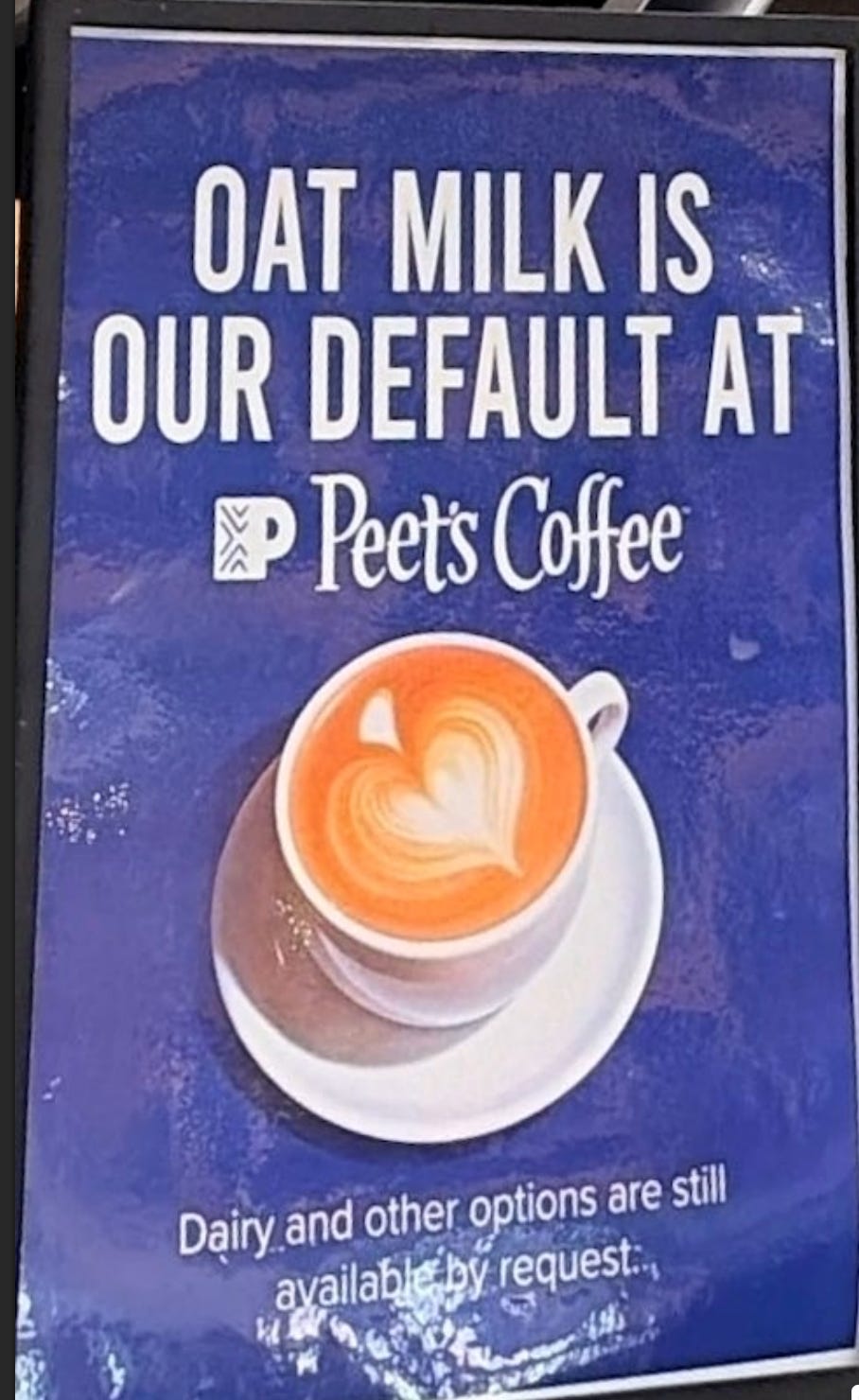
Is this a decision by Peets or by Berkeley Dining Services?
There seems to be some calculated ambiguity here, with respect to what kind of operation this newly reopened thing that is the QualComm Café is going to be: Peets Coffee beans, drink recipes, drink menu, and merch—that is clear. But stories say that the food is “made in-house” by UC Berkeley Catering, but with “some items sourced through partnerships”, and “carried over from the old Yali’s [North] menu”—id est, not Peets Coffee food items. But still, that does not elucidate where the oatmilk-default (per ounce, oat/2% cow: 15/15 cal, 0.4/1.0g protein, 2.0/1.5g carbs, 0.6/0.6g fat, 0.004/0.003g calcium, 0.000004/0.000004g vitamin D) decision comes from, and why.
What kind of balance-of-risks-and-benefits calculation underlies this decision?
Is it a result of the changing genomics of the American, or at least the California, university, in that its student population is no longer drawn overwhelmingly from those segments of the East African Plains Ape population over which genes for lactose tolerance made a sweep through over the past 7500 years?
Lactose-tolerance—lactase enzyme persistence—has, over the past 7500 years been, I am told, under stronger selection pressure for East African Plains Ape populations in Europe than almost any other human gene, driven by the European −13910 T allele spreading alongside our highly valued commensal the dairy cow. Today, lactase persistence runs ~89–96% in northwest Europe, but only ~15% in the Mediterranean terrains of Sardinia and Greece, and is less than 5% in East Asia and among the Amerindian population.
It is not, or it least it should not be, a demonstration of environmental concern: oatmilk generates at least as much in the way of global warming driver gases per gram of protein as does cow’s milk.
Plus there is my brother-in-law Paul Mahoney’s battle cry: “Dairy Fat for Brain Health!” is what he inscribes on his banners.
But for me, the key question is this: awill the oatmilk default make it more or less likely that the likes of David Card pass by?
References:
DeLong, J. Bradford. 2026. “Things Have Gone too Far!: LAUGH OF THE DAY”. DeLong’s Grasping Reality Weblog, July 27 (this post).
DeLong, J. Bradford. 2026. “J. Bradford DeLong: Professor of Economics, Emeritus: But Now I Need to Figure Out How Not to Eat My Brain in ‘Retirement’.” DeLong’s Grasping Reality Weblog, July 2.<https://braddelong.substack.com/p/j-bradford-delong-professor-of-economics>.
Card, David. 1990. “The Impact of the Mariel Boatlift on the Miami Labor Market.” Industrial and Labor Relations Review 43, no. 2 (Jan.): 245–257. <https://www.jstor.org/stable/2523702>.
Card, David, & Alan B. Krueger. 1994. “Minimum Wages & Employment: A Case Study of the Fast-Food Industry in New Jersey and Pennsylvania.” American Economic Review 84, no. 4 (Sept.): 772–793. <https://www.jstor.org/stable/2118030>.
Ritchie, Hannah. 2022. “Dairy vs. Plant-Based Milk: What Are the Environmental Impacts?” Our World in Data, January 19. <https://ourworldindata.org/environmental-impact-milks>.
Ségurel, Laure, & Céline Bon. 2017. “On the Evolution of Lactase Persistence in Humans.” Annual Review of Genomics and Human Genetics 18 (Aug.): 297–319. <https://www.annualreviews.org/doi/10.1146/annurev-genom-091416-035340>.