
Tesla Motors: CHART OF THE DAY
A car company by revenue, a rounding error by profit, and a meme by market cap—and with $300,000B of global liquid financial assets, there is an insufficient short-selling kitty to make things consistent…
Three stories can justify Tesla at 24x its fundamental worth: a SpaceX merger put, bottomless fanboy enthusiasm, and the ghost of 2021. None of them should survive contact with the hard cash-on-the-barrelhead logic of a well-functioning market. And yet.
The News
Tesla revenue for the quarter ending March 31, 2026 was $22.39B. Tesla net income for the quarter ending March 31, 2026 was $0.48B.
Tesla annual revenue for 2025 was $94.827B, a 2.93% decline from 2024.
Tesla annual revenue for 2024 was $97.69B, a 0.95% increase from 2023.
Tesla annual revenue for 2023 was $96.773B, a 18.8% increase from 2022.
Tesla net income for the quarter ending June 30, 2026 was $28.24B. Tesla net income for the quarter ending March 31, 2026 was $1.11B.
Tesla annual net income for 2025 was $3.794B, a 46.5% decline from 2024.
Tesla annual net income for 2024 was $7.091B, a 52.72% decline from 2023.
Tesla annual net income for 2023 was $14.997B, a 19.18% increase from 2022.
The Record (as of Yesterday Morning)
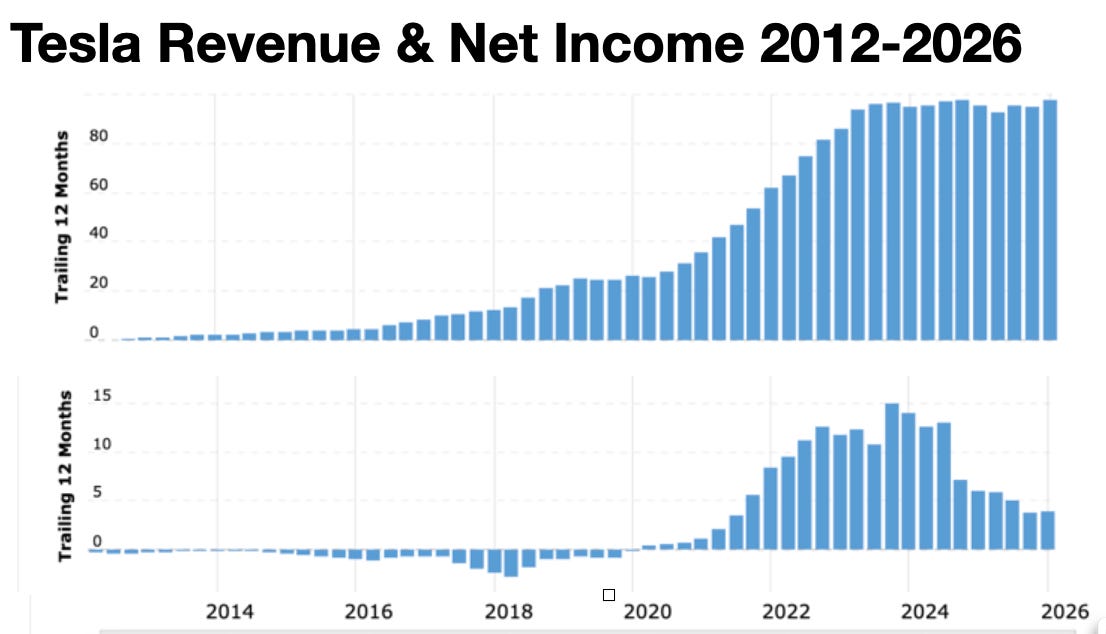
As a car-making and car-selling company, Tesla Motors is a $100B a year revenue company. As a GAAP profit-making auto company, Tesla Motors is a $5B a year at most or so company burning $6B a year on “AI”, which is generally regarded as either a zero-profit or a winner-take-all industry . As a meme-stock, the equity market capitalization of Tesla Motors is $1200B, down -$200B from where it was yesterday. Auto companies tend to have P/E ratios in the range of 3 (Stellantis, that is Chrysler-Fiat-Peugeot-Opel), to 10 (Toyota, with four times Tesla’s revenue and one-fifth of its equity market capitalization).
To the extent that there are cases for valuing Tesla at $1200B rather than $50B, they are three:
Elon Musk really does not want the bad headlines and the reputational hit that would come were Tesla’s equity valuation to collapse, therefore he will merge it into SpaceX, which has a profitable business in the form of StarLink, currently valued at $1500B, and that Tesla-SpaceX merger put has to be incorporated into Tesla’s valuation.
Infinite is the potential enthusiasm of MuskFanBoys:

If BitCoin, which is a financial ecosystem for which nobody pretends any more that there will be any real-world use case in which BitCoin holdings can be used to generate profits for a financial intermediary of any kind, is worth $1300B, then Tesla can stay $1300B above its “fundamental” value of $50B indefinitely. Moreover, there is no reason why MuskFanBoys cannot become even more enthusiastic about Musk than they are right now.
Elon just might do it again. In 2019 Tesla was a zero-profits company worth $40B on the equity market. By the end of 2021 it was a $1200B equity valuation company that was about to make more than $12B in the next year. Musk will not succeed in all of his ambitions for Full Self-Driving, CyberCabs, Optimus robots, and battery energy storage systems, but he may well succeed in at least one of them. Plus Tesla did deliver nearly 500,000 cars last quarter.
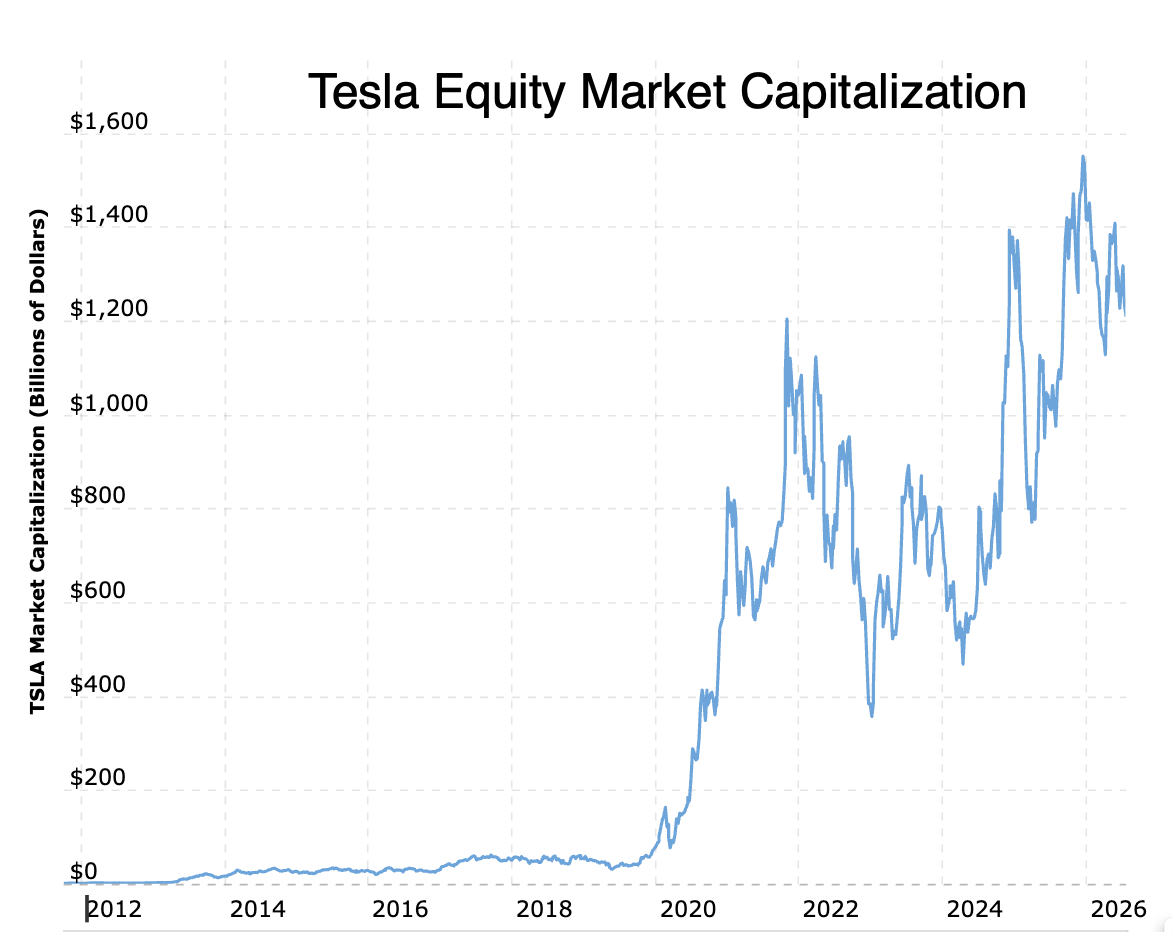
But I do confess to being somewhat flummoxed. There are roughly $300,000B in tradeable financial assets in the world. Tesla is 0.4% of them. It would not seem to be a big deal for the average investor holding those $300,000B to be willing to devote, say, 5% of their holdings to obvious shorts. That would give us a $15000B short-selling kitty in the world as a whole, for which Tesla would be a principal target.
But it seems not. Why not?
Do I have anything to add? Not really. The state of intellectual play here on why the limits to arbitrage are so strong does not seem to have advanced much since Shleifer-Vishny (1997) <https://shleifer.scholars.harvard.edu/publications/limits-arbitrage> <https://personal.lse.ac.uk/vayanos/Papers/LOAST_ARFE10.pdf>.
Well, there is one 90-year-old paper on this that I think is seriously evergreen. You can probably guess what it is :-) :