
The Strait of Hormuz Has Now Been Effectively Closed for 4 1/2 Months: CHART OF THE DAY
Hormuz closure removed Gulf crude and LNG → emergency stocks were released, pipelines bypassed, and non-OPEC output plugged some of the gap → prices spiked, then partially retreated → but the adjustment happened vai drawdown and rationing, not new durable supply or permanently altered demand → buffers depleted and deplete and demand was destroyed and is destroyed (not satisfied) in poor economies → so what happens when cushions empty, and when do cushions empty? When northern-hemisphere winter comes?
It seems to me that pangloss expectations are doing a lot of the work here: markets are pricing in a “Trump chickens out, chaos passes” scenario with probability near 1. Meanwhile, refiners run cuts have left us with downstream diesel and gasoline supplies tighter than crude, and the shortage has been rationed onto the poorer economies. Plus: What is really happening with liquid natural-gas?
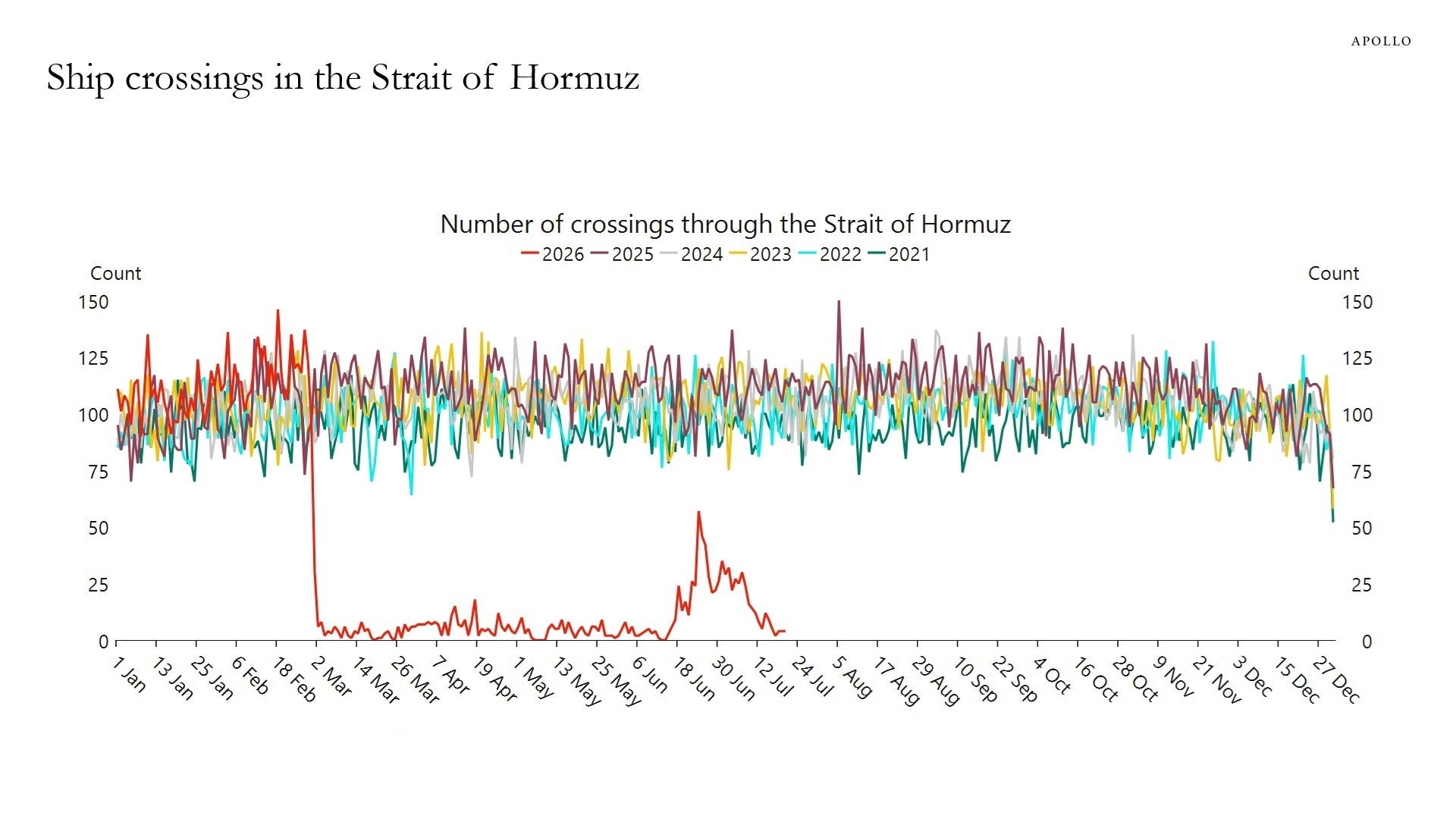
And Torsten Slok then writes:
Torsten Slok: The Chokepoint Risk <https://www.apollo.com/wealth/insights-news/insights/daily-spark/The-Chokepoint-Risk>: ‘Tanker crossings through the Strait of Hormuz have declined again, and refining crack spreads are widening sharply as constrained crude oil supplies prevent refineries from boosting throughput to meet steady demand for gasoline and diesel. The real tail risk emerges if inventories at critical nodes like airports or power plants suddenly run dry, triggering non-linear cascading damage…
I confess I am surprised—and a little unnerved by my own surprise. Given what I thought I knew about oil shocks, the effective closure of the Strait of Hormuz for 4½ months should have been an economic catastrophe on the order of 1973 or 1979. A quarter of seaborne oil and a fifth of the world’s LNG ran through that channel. And yet: Brent touched $126 in April, fell back to $71 by early July, and has only now clawed back above $95.
That is a serious disruption. It is not a global economic catastrophe like 1973 or 1979. Not yet at least. Why not?
I think the most important reasons are these:
We spent our buffers, & we had bigger buffers than in the 1970s: The IEA released some 400 million barrels of emergency stocks; Saudi Arabia and the UAE pushed crude out through their limited bypass pipelines; non-OPEC producers in the Americas and the North Sea lifted output. None of this is geography—there is still no second Strait of Hormuz—so none of it is permanent. Buffers drain.
The rise of both OPEC & the Islamic Republic of Iran looked permanent: Nobody thereafter expected the world to go back to anything like the old normal. Now, however, even though a lot of people are dead and a lot of wealth has been destroyed, everyone expects that Trump will again chicken out and that the wave of chaos will pass, with people afterwards hoping and pretending that it did not really happen.
The first is a reason to distrust the current semi-calm. The fact that the second is probably a vain hope is another reason to distrust the current semi-calm
But there is more:
The pain migrated downstream to product: This is Torsten Slok’s major point. Crude deliveries very partially recovered during the abortive ceasefire (we think: if we trust these numbers), but refineries had cut runs, so diesel and gasoline are now tighter than crude itself. A crude shortage is a price problem.
A diesel shortage would be a things-stop-moving problem: That may be much closer than the headline crude oil price suggests.
The demand that “cleared” the market mostly got destroyed, not satisfied. China cut purchases; Vietnam, Pakistan, Bangladesh, Nigeria, and others simply went short, with panic buying and states of emergency. The moderate Brent price reflects rationing in poorer economies, not abundance. The shortage was rationed to those least able to bear it, and we do not see the economic consequences there.
LNG as the quieter, more durable wound. QatarEnergy declared force majeure on all exports; restarting liquefaction takes weeks once ships can sail. US and Canadian gas replaced perhaps 70% of the lost Gulf volumes—but Europe went in with storage near 30% after a hard winter, and there is no strategic gas reserve to open the way there is for oil. Northern hemisphere winter is coming.
The first 4½ months were survivable because we drew down cushions. A further three months removes them. A guess: $120/bbl. crude by December, if the current stalemate continues, just as Europe is trying to refill for winter.
Tail risk is if the Houthis decide to see how much they can close Bab-el-Mandeb as well.
There was slack in the system that there was not in 1973 or 1979 (or, in reverse, in 1986). But it looks to me at least as if that slack is probably now gone.