
The Short Summer of Cross-Nation Convergence in Real GDP Per Capita Levels: CHART OF THE DAY
An expansion of the world-economic prosperous core countries from 900 million to 1.3 billion and of peripheral as share of core per capita income from 12% to 24% between 1990 and 2023 were absolutely wonderful things to see. But for the past decade, the relative income gap between core and periphery has not shrunk at all. It is not as bad as the 1820 to 1975 Great Divergence. But we ought to be doing much, much better…
Tibor Rutar reads Sandefur and Subramanian (2025) <https://www.chat-gdp.org/p/we-were-wrong-about-convergence>:
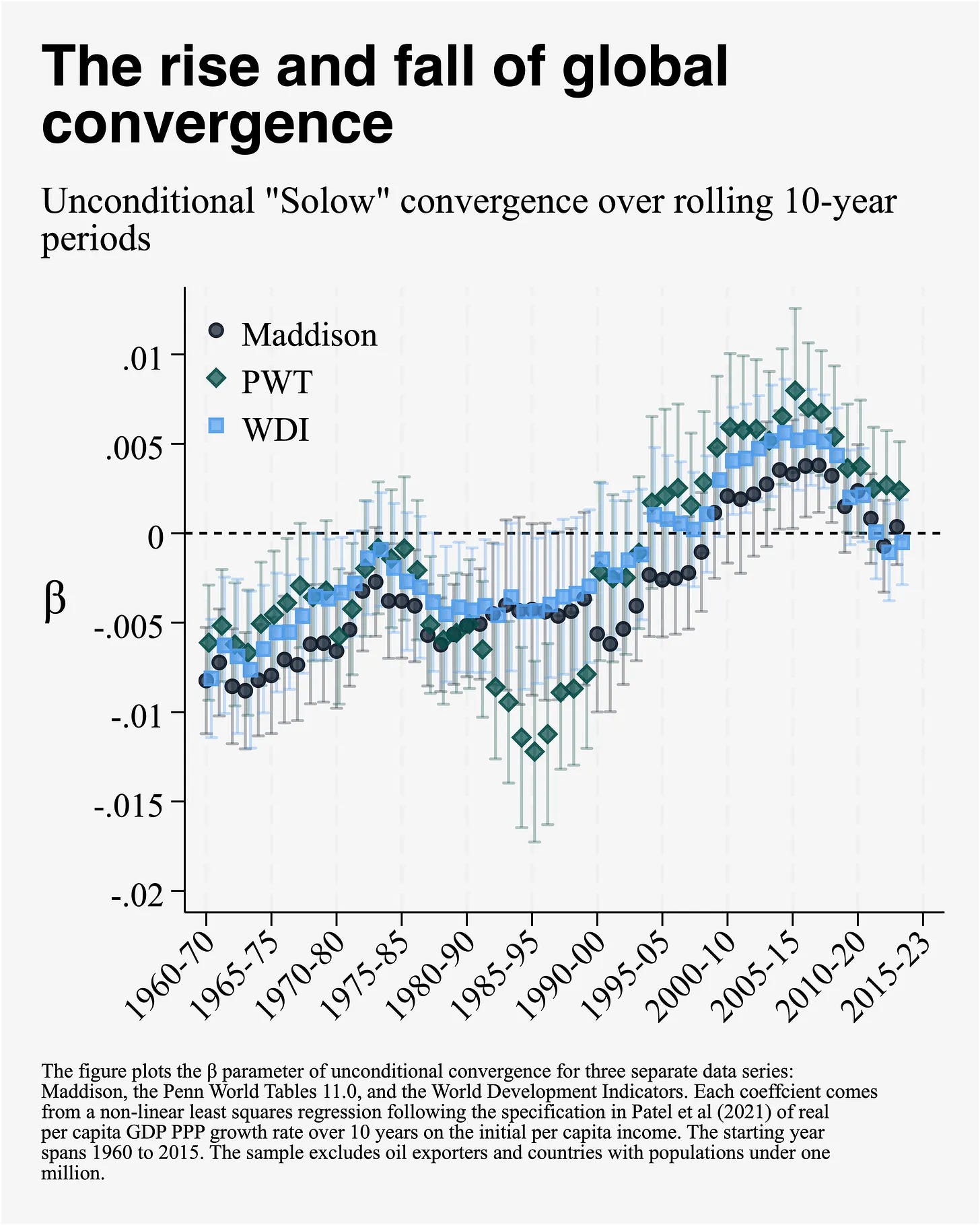
Tibor Rutar: Is the Capitalist Core Exploiting the Periphery, or Is It Just Deep Roots? <https://statsandsociety.substack.com/p/is-capitalist-core-exploiting-the>: ‘Between… 1995 and the late 2010s, a wonderful and never before seen thing was happening… substantial economic convergence between the developed and developing world. As is usually the case, most everyone was growing in absolute terms, but [then]… everyone outside the developed world was… closing the relative distance with the developed… because the poor ones’ [growth] rate was so incredibly fast….
[As] the Soviet experiment collapsed, as China and India liberalized, and as more economic openness and market integration swept the world, the poor finally started outpacing the rich, world-systems theory be damned…. WDI data… [show] that the periphery-core ratio rose from 11.5% in 1990 to 23.7% in 2023...
Moreover, there is the enlargement of what is by any real definition the “core” of the world economy: Portugal, Greece, Israel, South Korea, Taiwan, Singapore, Hong Kong, Cyprus, Slovenia, Malta, Czech Republic, Slovakia, Estonia, Latvia, Lithuania, Macao, Chile, Puerto Rico, and Croatia, plus—by any sensible way of dividing up the world—the country-sized Chinese provinces of Jiangsu, Fujian, and Zhejiang plus the megamuncipalities of Beijing, Shanghai, and Tianjin. That is 400 million people in addition to the 900 million in the countries already in the core as of 1960. (Cf.: a total world population of 8.4 billion today.)
Now there are relative losers since 1995: Venezuela, Zimbabwe, Libya; Yemen, Syria, Haiti, the Central African Republic, Eritrea; Equatorial Guinea, and Gabon. But they are few, and the causes are clear: it was kleptocratic communism for the first group, war and rumors of war and civil war for the second group, and the resource curse for the third.
Why the apparent end of the short summer of relative convergence? Sandefur and Subramanian speculate that it is the result of the end of international neoliberalism and domestic liberalism:
Justin Sandefur & Arvind Subramanian: We were wrong about convergence <https://www.chat-gdp.org/p/we-were-wrong-about-convergence>: ‘Several years ago, we celebrated a new era of unconditional convergence of global incomes. Since then, the trend has reversed…. In a Foreign Affairs piece last year, we argued that “hyperglobalization” was a key driver of convergence…. Trade as a share of GDP has either levelled off or declined in both low- and middle- income countries…. But is there something much bigger going on?… Key driver[s] of convergence… a turn toward markets but more fundamentally that a majority of developing countries began to follow a variant of U.S. President Barack Obama’s famous foreign policy dictum: “Don’t do stupid s***.”… The world has become more illiberal, majoritarian and nationalistic, reflected in perceptible democratic backsliding…. The links between weak political institutions/illiberalism and economic outcomes are tenuous at least over short horizons, but there are connections…. Crackdown[s] on private sector entrepreneurship that produced frontier technologies and services… the weaponization of the state against political opposition has also been directed at domestic and foreign investors… defiance of macro-economic orthodoxy… [as] a handmaiden of political authoritarianism…. Across the Sahel’s “coup belt”, military takeovers in Mali, Niger, and Burkina Faso have come with economic volatility, withdrawal from regional trading blocs, and fiscal contraction in the face of lost aid revenue…. Seclining trading opportunities externally and deteriorating institutions domestically is a cocktail that is not conducive for long-run economic growth…