Christopher Nolan's Remix of the Story of Odysseus: Humanities Tuesday
Here we are: ἄνδρα μοι ἔννεπε, μοῦσα, πολύτροπον, ὃς μάλα πολλὰπλάγχθη, ἐπεὶ Τροίης ἱερὸν πτολίεθρον ἔπερσεν—ándra moi énnepe, moûsa, polýtropon, hòs mála pollàplánchthē, epeì Troíēs hieròn ptolíethron épersen—about the man whose mind and body goes to many places, sing to me, muse, who was so very greatly forced to wander, after he had sacked the sacred citadel of Troy.
Odysseus’s name does not appear until line 11. Contrast with the Iliad, in which the name Akhileus appears as word five.
I saw it yesterday. I was very impressed. It is very good—my favorite Christopher Nolan movie, definitely. Highly recommended.
For commentary? Let me pick two:
We have the extremely wise and learned:
Theo Nash: Apocalypse Troy: Nolan’s Odyssey & the End of Civilization <https://antigonejournal.com/2026/07/nolan-odyssey-end-civilization/>: ‘In the film’s greatest twist, perhaps unsurprising from the director of Oppenheimer, it is revealed that the Sack of Troy was such a violent breach of Zeus’ Law of xenia (hospitality) that it has dissolved the entire logic of civilisation. The Age of Bronze is doomed to end, and in future generations “songs will be all they have to remember those of us who wrote”…. Although the Greeks knew that the Age of Heroes had come to an end, the early poetic traditions did not connect this explicitly with divine rage or retribution. The Greek poets, in general, were not generally aware of the Bronze Age collapse, even if they knew that an end came to the songs….
The idea of the Sack [of Troy] as an unholy excess is not unknown in Greek art or literature, however. This tradition is predominantly Athenian, sparked by the sack of Miletus — an old ally — in 494, and of Athens herself in 479 at the end of Xerxes’ punitive expedition. In vase paintings of this and the following period, the Sack is depicted not as triumph but excess, a series of hubristic actions undertaken by the over-zealous conquerors. Focus is placed on the killing of Astyanax, Hector’s infant son, and Priam himself, often through the shorthand of Neoptolemus, Achilles’ avenging spirit of a son, bludgeoning the grandfather to death with his grandson’s corpse. The rape of Cassandra by the lesser Ajax is frequently also depicted, beneath the dispassionate gaze of Athena’s cult statue.
These scenes are given voice by Euripides in his Trojan Women (415 BC), where Athena articulates a view nearly consistent with Nolan’s interpretation. Outraged by Ajax’s rape of Cassandra, and the Greeks’ refusal to punish him, Athena turns on her former favourites and decrees a δύσνοστος (dusnostos), cursed homecoming. With the help of Zeus and Poseidon, she will see to it that the sea and sky rebel against the Greek ships, so that “the Greeks know to honour my temples, and revere the other gods” (85–6). Poseidon agrees: “a fool sacks the towns of men, their temples and tombs, the monuments of the dead; and in that ruin he himself is destroyed.”
Still the punishment here is essentially personal: Athena is punishing the Greek men on their return. Many of course do not make it home; others do not like what they find. But the punishment is not societal; she is not dooming an entire civilisation. That is all Nolan, and the most creative and invigorating idea that he introduces in his Odyssey. By marrying literary traditions of the Sack to the historical reality of the Bronze Age collapse, he creates something new which belongs a little bit to Classics, but more to his own fascination with the cost of our greatness: from the exiled hero of Inception, a Batman who cannot escape the mask, an Oppenheimer worried he has destroyed the world, to an Odysseus who already has…
Very nicely put.
And the equally wise and learned:
Bret Devereaux: <[twitter.com/BretDever...](https://twitter.com/BretDevereaux/status/2078972264205205772)>: ‘Got out to see Christopher Nolan’s take on the Odyssey. Fascinating movie, but to use a metaphor - it is a remix, not a cover; it has its own themes and ideas. Which is fine - folks have been remixing Homer for basically the whole of the western literary tradition. The themes Nolan has built the story around are interesting (if sometimes a bit on the nose in some of the dialogue) and the Odyssey is an effective frame to deliver them with. It’s a good movie. Just not a straight retelling (nor does it pretend to be).
The funny thing, the chuds hate this film because Nolan cast trans and non-white actors but if they actually were media literate, they’d hate this version of the Odyssey because it adopts their civilizational frame and then violently rejects their ideology as destructive to it. Thematically, Nolan is using the Odyssey to almost speak *as* ‘western civilization’ and then what he says is, “you men (very much *men*), with your violent inhospitality, your greed and appetites are what has destroyed civilization by breaking the bonds between people.”
I’d almost describe the Odyssey, thematically, as a *conservative* critique of the kind of overpowering, violent, grasping masculinity of the chuds and the far right - that revels in cruelty to strangers, in aggression and war crimes and dominance. Absolutely fascinating. Not ‘western civ. doesn’t exist’ nor ‘western civ. is bad’. Rather, “western civilization is real & good, captured in writing & song and we are *killing* it with our violence, cruelty and greed, we have *become* the barbarians at our own gates.”
Conservative in that sense…
Plus we have Rotten Tomatoes:
Melissah Yang: The Odyssey Audience Reviews: Epic Filmmaking That You Need to See on the Biggest Screen Possible <https://editorial.rottentomatoes.com/article/the-odyssey-audience-reviews/>: ‘Those who have been verified as having seen the film overwhelmingly agree with the critics, as The Odyssey is not only Certified Fresh on the Tomatometer, but also Verified Hot on the Popcornmeter, with fans lavishing all kinds of praises upon the the acting, the storytelling, the atmosphere, the music, and of course, that IMAX cinematography….
“What a masterpiece. Not only a technical achievement, but also a cultural one. In a hyperbolic and unsatisfied world, it shows how good we have it and how history is doomed to repeat itself. One of Nolan’s best (if not his most glorious moment to date), it’s a blockbuster with a deep rooted message that will stand the test of time, for how much time our civilization has.” — Kenny
“Read and studied The Illiad and The Odyssey as an English major 30+ years ago. The images, the adventures, the twists and reveals are all there in this retelling. Some of the big events I was waiting for did not happen or happened in a different way, but for me, it did not detract from my enjoyment of the story. Superb acting, cinematography, etc. Overall 10 out of 10. I did see it in IMAX which just added to everything epic about this movie.” — Heather
“Christopher Nolan’s The Odyssey is a triumphant reminder that the oldest stories are often the most enduring… Matt Damon delivers one of the finest performances of his career as Odysseus. He captures the king’s intelligence, weariness, and quiet determination without ever slipping into caricature… Visually, the film is breathtaking… Perhaps the film’s greatest strength is Nolan’s screenplay. Rather than overexplaining Homer’s poetry or cluttering it with unnecessary exposition, he trusts the audience. The dialogue is lean, purposeful, and often profound… Great adaptations don’t replace their source material—they remind us why it became immortal in the first place. Nolan’s The Odyssey does exactly that.“ — Pam K
…
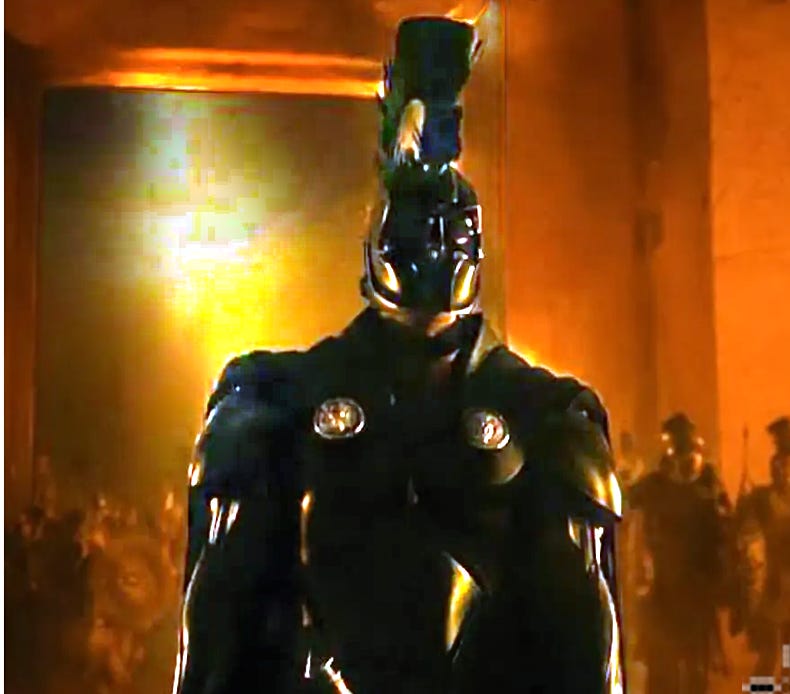
High King Agamemnon of Mykenai enters Troy through the Skaean Gate.
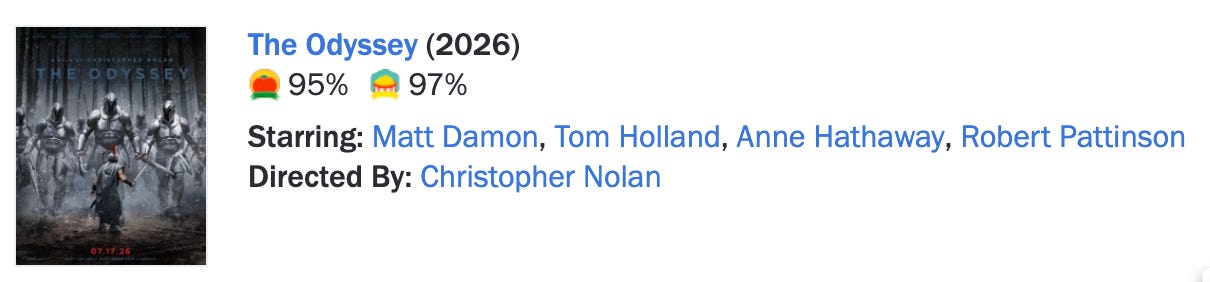
Impressive movie. Kirk Douglas, Armand Assante, Ralph Fiennes—Matt Damon does, I think, a much better job with what is potentially the truly great role of Odysseus. 95% on the critics’ tomatometer, 97% on the audience popcornmeter. Thus clear signs that if this kind of thing is a thing you like, you will really really very much like this thing.
But there are professionals who are nay-sayers—a combination of academics who are upset because it is not true to Homer’s Odyssey, and critics who are on the fringe.
The academics seem to me to be petty and stupid. You cannot show the real Odyssey on a screen to an audience in the 2000s. You simply cannot. For how are you going to show something like this?:
“These dead must be disposed of first of all. Direct the women. Tables and chairs will be scrubbed with sponges, rinsed and rinsed again. When our great room is fresh and put in order, take them outside, these women, between the roundhouse and the palisade, and hack them with your swordblades till you cut the life out of them, and every thought of sweet Aphroditê under the rutting suitors, when they lay down in secret.”
As he spoke here came the women in a bunch, all wailing, soft tears on their cheeks. They fell to work to lug the corpses out into the courtyard under the gateway, propping one against another as Odysseus ordered, for he himself stood over them. In fear these women bore the cold weight of the dead. The next thing was to scrub off chairs and tables and rinse them down. Telémakhos and the herdsman scraped the packed earth floor with hoes, but made the women carry out all blood and mire.
When the great room was cleaned up once again, at swordpoint they forced them out, between the roundhouse and the palisade, pell-mell to huddle in that dead end without exit. Telémakhos, who knew his mind, said curtly: “I would not give the clean death of a beast to trulls who made a mockery of my mother and of me too—you sluts, who lay with suitors.”
He tied one end of a hawser to a pillar and passed the other about the roundhouse top, taking the slack up, so that no one’s toes could touch the ground. They would be hung like doves or larks in springes8triggered in a thicket, where the birds think to rest—a cruel nesting. So now in turn each woman thrust her head into a noose and swung, yanked high in air, to perish there most piteously. Their feet danced for a little, but not long.
To the court they brought Melánthios, chopped with swords to cut his nose and ears off, pulled off his genitals to feed the dogs and raging hacked his hands and feet away. As their own hands and feet called for a washing, they went indoors to Odysseus again. Their work was done…
If you do not graphically show dogs eating the testicles of a maimed torture victim in great pain, you have not been true to the Odyssey. The question of what you do in order to translate the story to a modern audience depends very much on what the “story” is and what kind of thing “translation” is. But to complain that Nolan is not faithful to Homer is to be a moron.
Four critics have crossed my screen who strongly dissent from the strongly favorable consensus: