
Automation & Labor & Inclusive AI: HOISTED FROM THE ARCHIVES
“AI” truly is potentially poised to liberate us from dehumanizing work—unless the market makes that potential liberation into a dystopian catastrophe for human equity. What I thought back in 2018 the big issues were going to be, with the real danger being not that AI takes all the jobs, but that it takes the wrong ones for the wrong reasons…
Consider the implications of the observations that, (i) for many of the jobs we ask it, to do the human brain is a vastly underutilized and thus bored supercomputer; and (2) that technology successively devalued backs, then fingers, and now the cognitive “‘bot work” that fills in around machines. “AI” thus ought to finally end many jobs that never should have been “human” in the first place. But will it?
Because large, capital-intensive firms can internalize the gains from labor-replacing AI, the market will relentlessly fund that path—while neglecting AI that empowers workers in care, services, and other labor-intensive sectors. The result will be pressure that widens the equity gap—unless public institutions deliberately define, build, and most important deploy “inclusive ‘AI’”.
The impact of “AI” on work really does depend on whether we build equity-enhancing, labor-augmenting systems instead of only capital-serving, labor-replacing ones. Our social media experience really is a cautionary tale about how things can go very wrong when market signals empower the Zuckerbergs who ought to know better to pursue attention-harvesting rather than user-serving business models, as highly profitable as they have turned out to be.
What I said eight years ago:
Thank you very much.
Let me follow the example of our Lord and Master Alpha-Go as it takes the high ground first.
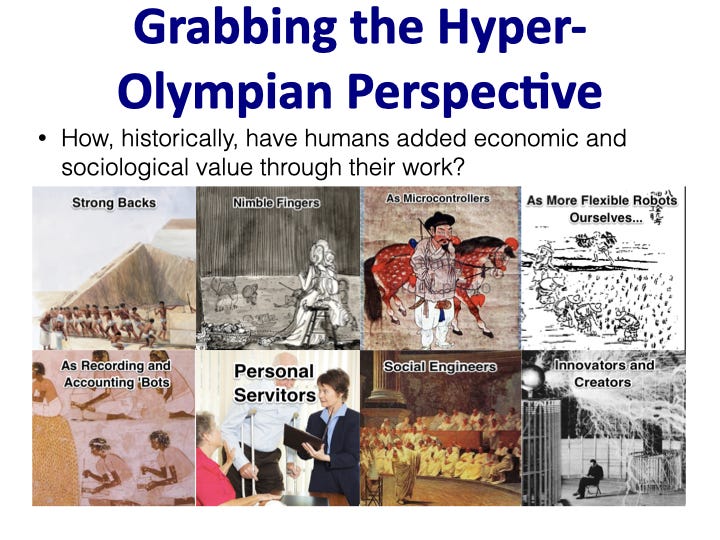
Let me, therefore, take the hyper-Olympian and very long run historical point of view.
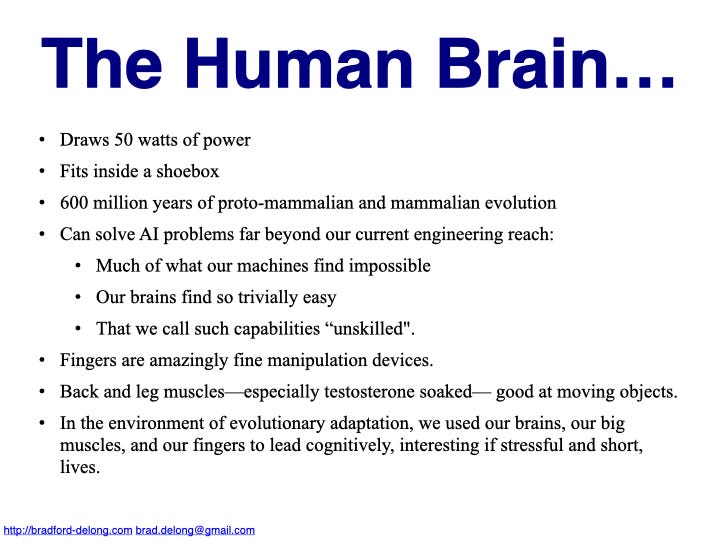
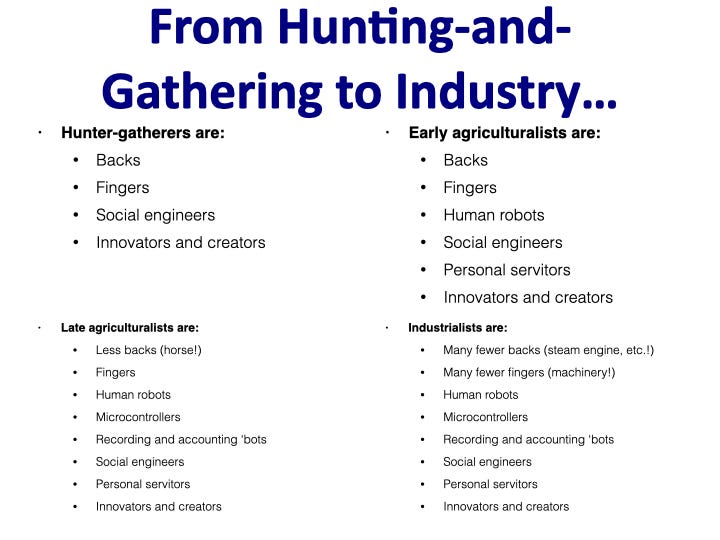
The human brain is a massively parallel supercomputer that fits inside half a shoebox. It draws 50 watts of power. It is an amazing innovation, analysis, assessment and creation machine. 600 million years of proto-mammalian and mammalian evolution coupled with the genetic algorithm means that almost every single human can solve AI problems far beyond our current engineering reach—so much so that much of what our machines find impossible our brains find so trivially easy that we call such capabilities “unskilled”.
When combined with our brains, human fingers are amazingly fine manipulation devices.
Human back and leg muscles—especially when testosterone soaked—are quite good at moving heavy objects.
Thus back in the environment of evolutionary adaptation, we used our brains, our big muscles, and our fingers to lead cognitively interesting if stressful and short lives.
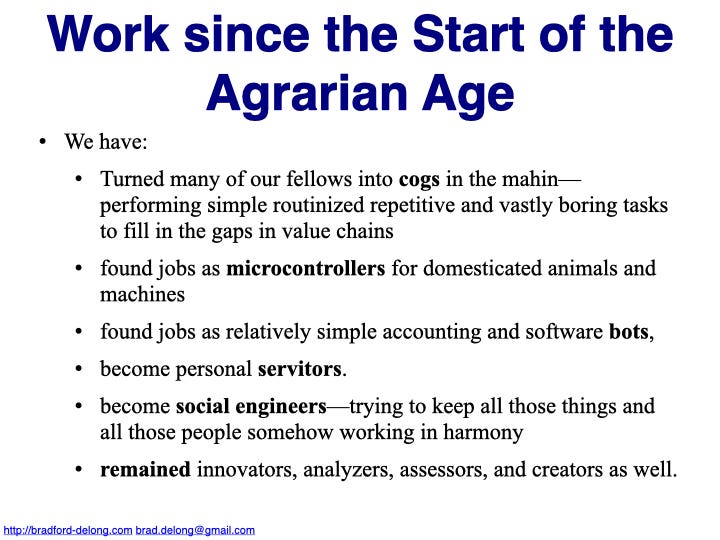
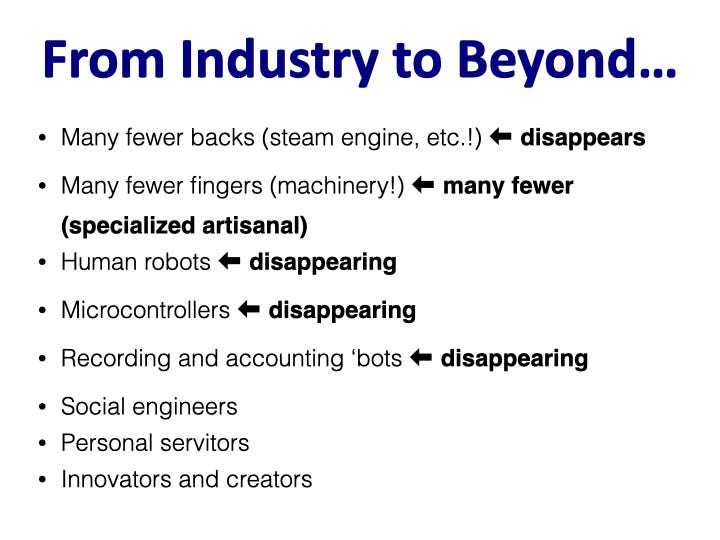
But history has rolled forward since the hunter-gatherer age. And as history has rolled forward, we have figured out other things to do to add economic and sociological value than their uses in the hunger-gathers paradigm. Over the long historical sweep, the ability to add value using our backs to move heavy objects and our fingers to perform fine manipulations in cognitively-interesting ways has, relatively, declined. We have, so far:
turned many of us into robots ourselves, performing simple routinized repetitive and vastly boring tasks to fill in the gaps in value chains between the robots that we know how to build.
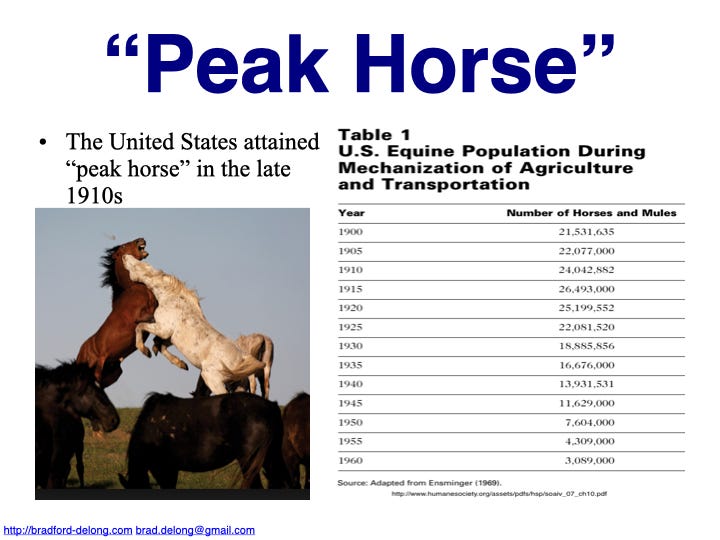
found jobs as microcontrollers for domesticated animals and machines—the horse does not know what plowing the furrow is.
found jobs as relatively simple accounting and software bots, keeping track of stuff, what it is useful for, and how its use is to be decided.
become personal servitors.
become social engineers—trying to keep all those things and all those people—especially, perhaps, trying to keep those brains soaked in testosterone—somehow working in harmony, somehow pulling together, although admittedly with limited success.
remained innovators, analyzers, assessors, and creators as well.
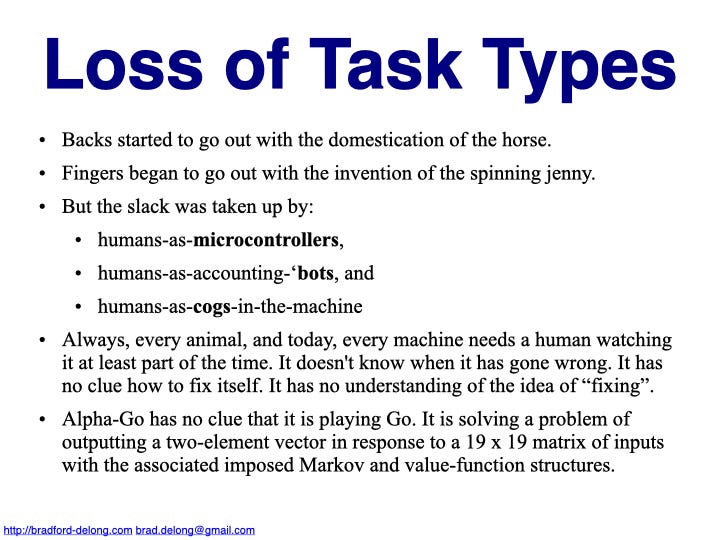
Backs started to go out with the domestication of the horse. Fingers began to go out with the invention of the spinning jenny. But humans-as-microcontrollers, humans-as-accounting-‘bots—paper shufflers—and humans-as-the-robots we cannot yet build—took up all the job slack. Every horse needs a microcontroller. And a human
brain was the only possible option. Even today, to a large amount every textile machine needs a human watching it at least part of the time. It doesn’t know when it’s gone wrong. It has no clue how to fix itself. It no more understands the idea of “fixing” any more than Alpha-Go understands that it is playing Go, and not just solving a problem of outputting a two-element vector in response to a 19 x 19 matrix of inputs with the additional structure that the output changes the matrix and that the possible matrices have a value-function structure.
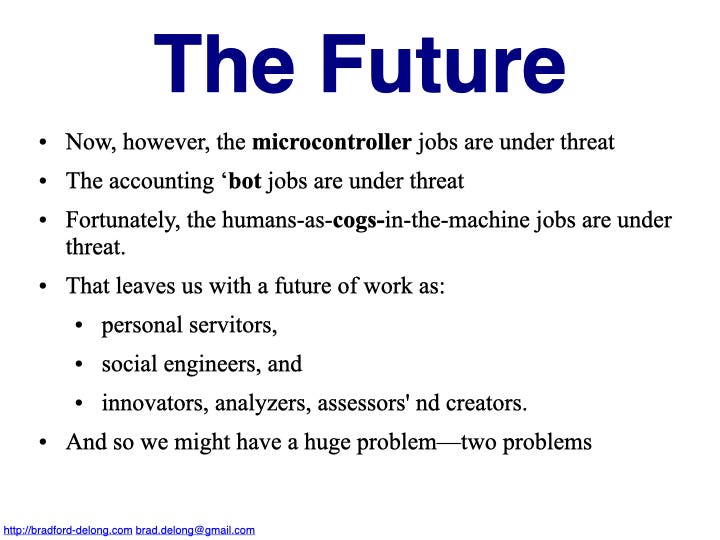
Now, however, we can finally peer into a future in which the microcontrollers and the accounting bots are on their way out in a manner analogous to the backs and the fingers. Fortunately, this brings with it the forthcoming extinction of the the jobs that treat humans as simple robots: simple cogs in the machine that is Henry Ford’s River Rouge assembly line. Many occupations that vastly underutilize the massively parallel supercomputer that fits in half a shoebox are on the way out—and good: for those are not properly “human” jobs at all.
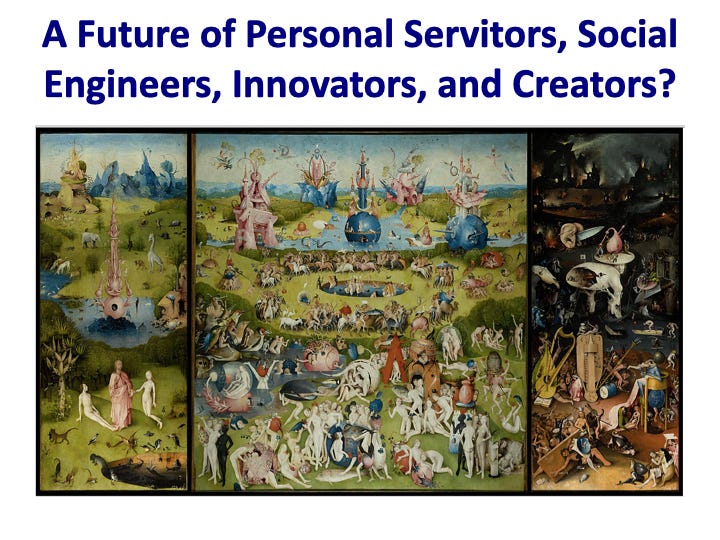
That leaves us with a future of work—not next year, and not next decade, but further out by some unknown time—in which humans’ jobs will be as:
personal servitors,
social engineers, and
innovators, analyzers, assessors’ nd creators.
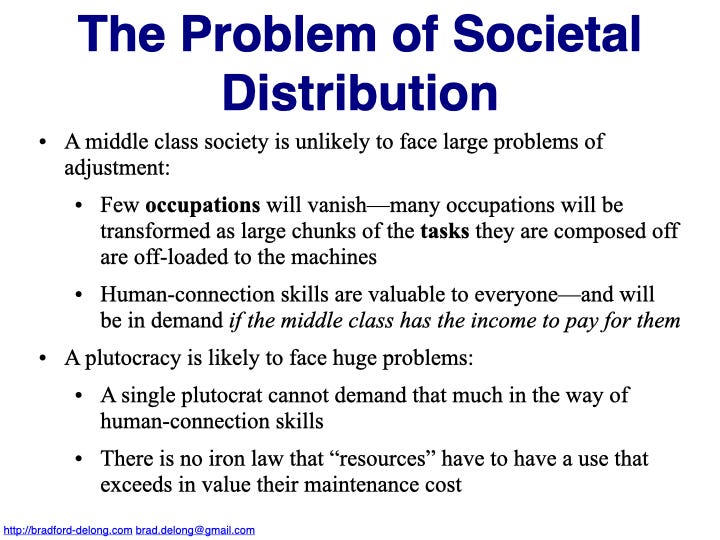
And here we might well, someday, have a huge problem.
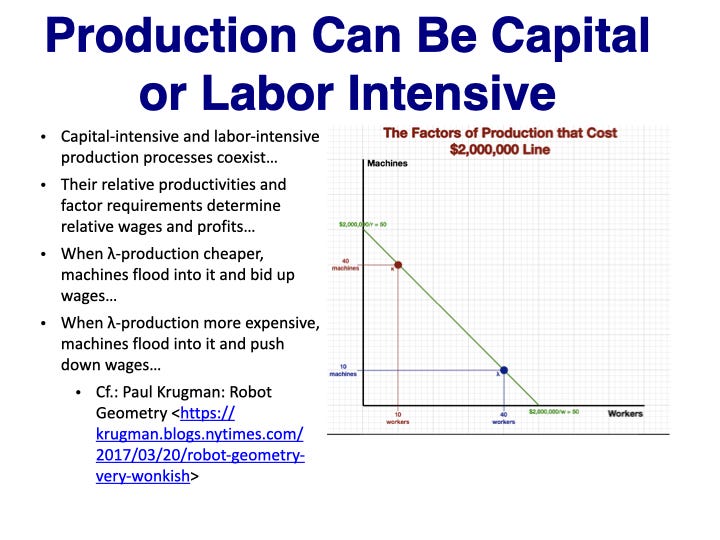
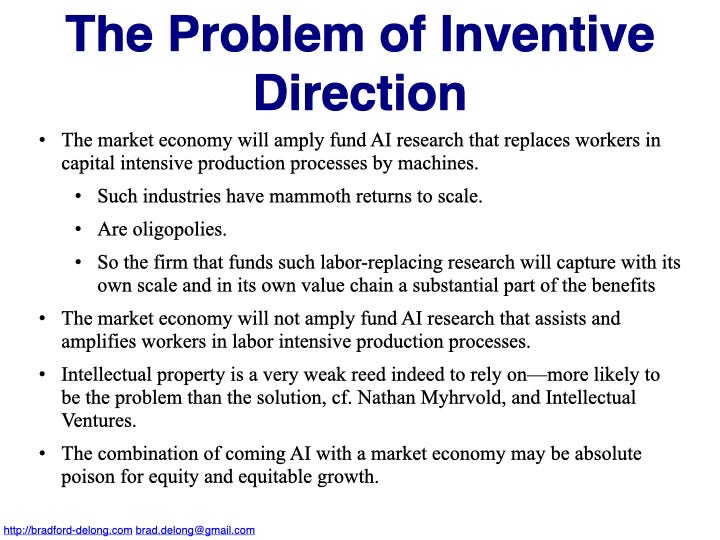
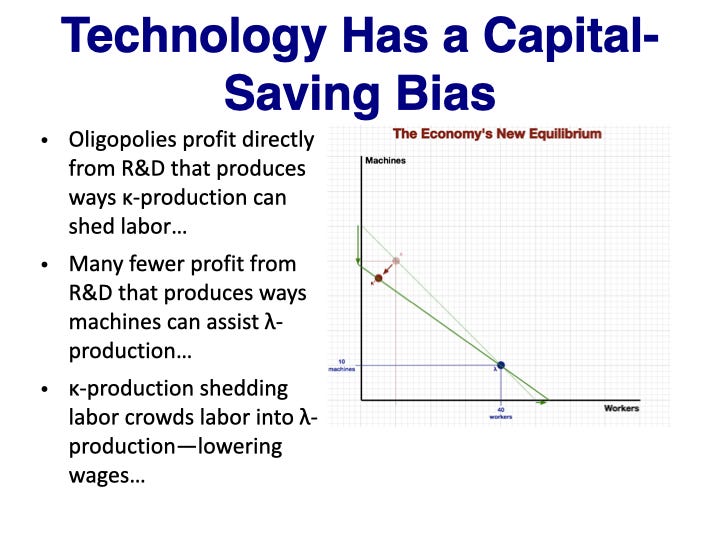
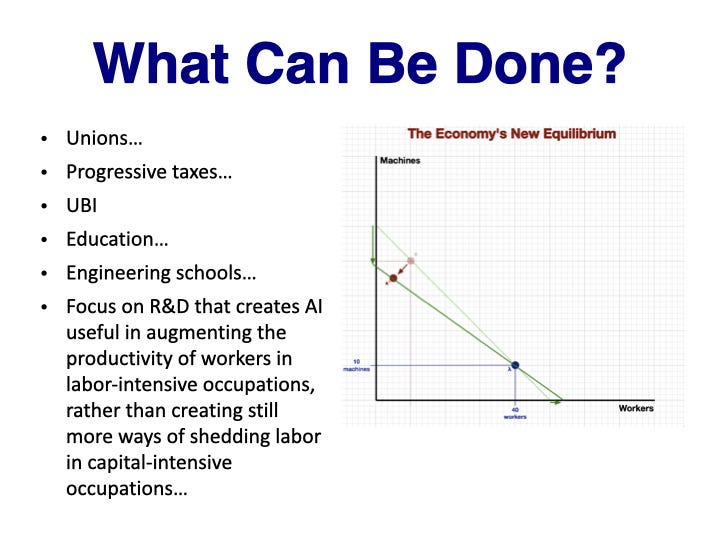
The market economy will amply fund AI research that replaces workers in capital intensive production processes by machines. Such industries have mammoth returns to scale. They thus tend to be characterized by large oligopolies. And so the firm that funds such labor-replacing research will capture with its own scale and in its own value chain a substantial part of the benefits of such R&D. But the market economy will to amply fund AI research that assists and amplifies workers in labor intensive production processes. Such tend to be small scale. The inventors and the innovators cannot capture even a small part of the benefit in their own production processes and value chains. And intellectual property is a very weak reed indeed to rely on to fix the problem—in fact, intellectual property is more likely to be the problem than the solution, cf. Nathan Myhrvold, and Intellectual Ventures.
That means that the combination of coming AI with a market economy will be absolute poison for equity and equitable growth. It will race ahead with the first: shedding workers in capital intensive production processes. Yet AI could be gold for equity: amplifying the capabilities of workers in labor intensive production processes would, as John Maynard Keynes once said, bring us vastly closer to economic El Dorado.
Utopia or dystopia? Heaven or hell? I turn that over to you. And by “you”, I definitely include our [note from 2026 then-]engineering dean Shankar Sastry. Because firms will not invest on a large scale in AI that amplifies the capabilities of labor in labor intensive industries, it will not happen unless some NGO does it.
How about an engineering school?
How about an engineering school at a public university?
And let me stop there.
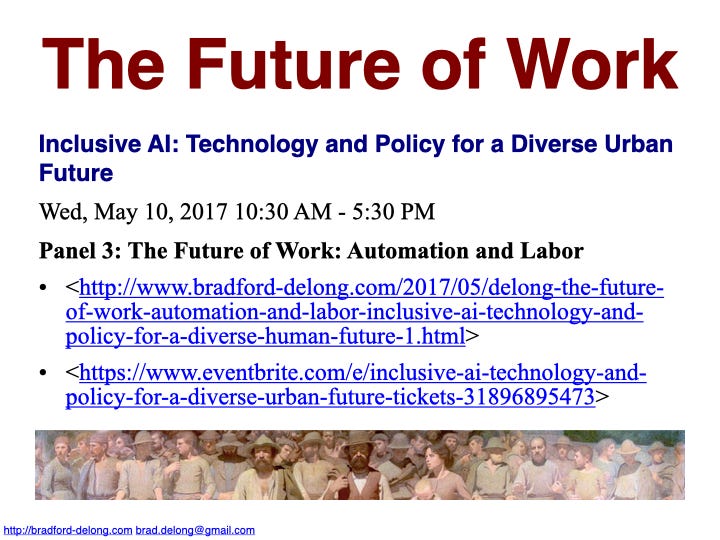
UPDATE 2026: Does this still hold up? My core claim that “the combination of coming AI with a market economy will be absolute poison for equity and equitable growth” if investment flows only into labor‑replacing AI for capital‑intensive industries, even though AI “could be gold for equity” if used to amplify workers in labor‑intensive sectors?
Some readings that I think that are worth reading and thoughtfully considering:
Pascual Restrepo: Emphasizes task‑level automation, rent destruction, and the possibility that ownership of compute becomes the new bottleneck—reinforcing your concern that capital‑intensive owners capture the gains.
Pascual Restrepo on AI, automation, and the future of workErik Brynjolfsson & Anton Korinek: Paints a very optimistic productivity picture but explicitly notes that distributional outcomes depend on institutions and policy; without them, large gains can be captured by capital and superstar firms.
The Macroeconomics of Artificial IntelligenceMartin Neil Baily, Erik Brynjolfsson & Anton Korinek: Argues generative AI could drive a major productivity boom but warns that labor‑market disruption and a shift of income toward capital are real risks if policy doesn’t push toward broad sharing of gains.
Machines of mind: How generative AI will power the coming productivity boomInternational Labour Organization: Finds exposure highly concentrated in clerical and some professional roles, with gendered and income‑level asymmetries—empirical backing for the claim that AI pressures can widen equity gaps without countervailing policy.
Generative AI and Jobs: A Refined Global Index of Occupational ExposureInternational Labour Organization: Stresses that transformation rather than mass unemployment is the central scenario, but highlights quality, bargaining power, and job‑polarization concerns—precisely your equity margin.
Generative AI and jobs: a global analysis of potential effects on job quantity and qualityOECD AI Policy Observatory: Synthesizes cross‑country evidence: AI’s impacts are uneven, tend to reinforce existing power asymmetries, and require active policy to avoid rising inequality and concentrated control over digital infrastructure.
Future of Work: Working Group ReportAlexander Pan: While framed as technical misalignment, it points to the risk of agentic systems being optimized for firm‑level profit proxies that ignore or actively undermine worker welfare and broader equity goals.
Understanding Misalignment in AI AgentsAnton Korinek & Joseph E. Stiglitz: General‑equilibrium treatment of how AI can depress labor’s share and magnify inequality unless institutions and policy reorient it toward complementing, not replacing, workers.
Artificial Intelligence & Its Implications for Income Distribution & UnemploymentMauro Cazzaniga & al.: Cross‑country overview of how GenAI may reshape task content, wages, and inequality, with heavy emphasis on asymmetric exposure across skills, sectors, and income groups.
Gen-AI: Artificial Intelligence & the Future of WorkKristalina Georgieva: Short, punchy articulation of the Fund’s current view: big productivity upside, but large risks of inequality and dislocation absent active policy.
AI Will Transform the Global Economy. Let’s Make Sure It Benefits Humanity.Anton Korinek, Martin Schindler, & Joseph E. Stiglitz: Lays out the macro and distributional challenges as AI moves toward more general capabilities, including the prospect of sharply reduced labor income share.
Technological Progress & Artificial IntelligenceDavid Autor: Uses US data to document urban job polarization and the erosion of middle‑skill, middle‑wage work, framing how pre‑AI automation has already pushed the system in your “poison for equity” direction.
Work of the Past, Work of the FutureJames Manyika & al.: MGI full technical report with cross‑country breakdowns and transition maps by occupation and skill.
Jobs Lost, Jobs Gained: Workforce Transitions