CROSSPOST: CLAUDIA SAHM: What Will It Take for the Fed to Hike?
Three months ago, the FOMC—the Federal Reserve’s Federal Open Market Committee with its 19 participants—was split, with a 50% chance of a half-a-percentage-point cut and a 50% chance of standing pat over the rest of this year. Now it is split between a 50% chance of a half-a-percentage-point raise and a 50% chance of standing pat over the rest of this year. That is a substantial shift to see in three short months between March and June, when very little happened in terms of changes in the global economic and geopolitical situation…
It’s CROSSPOST/MONDAY MACRO time: Newly-confirmed Fed Chair Kevin Warsh does not like and says that Fed should not do “forward guidance”. His entire FOMC—Federal Open Market Committee—disagrees:
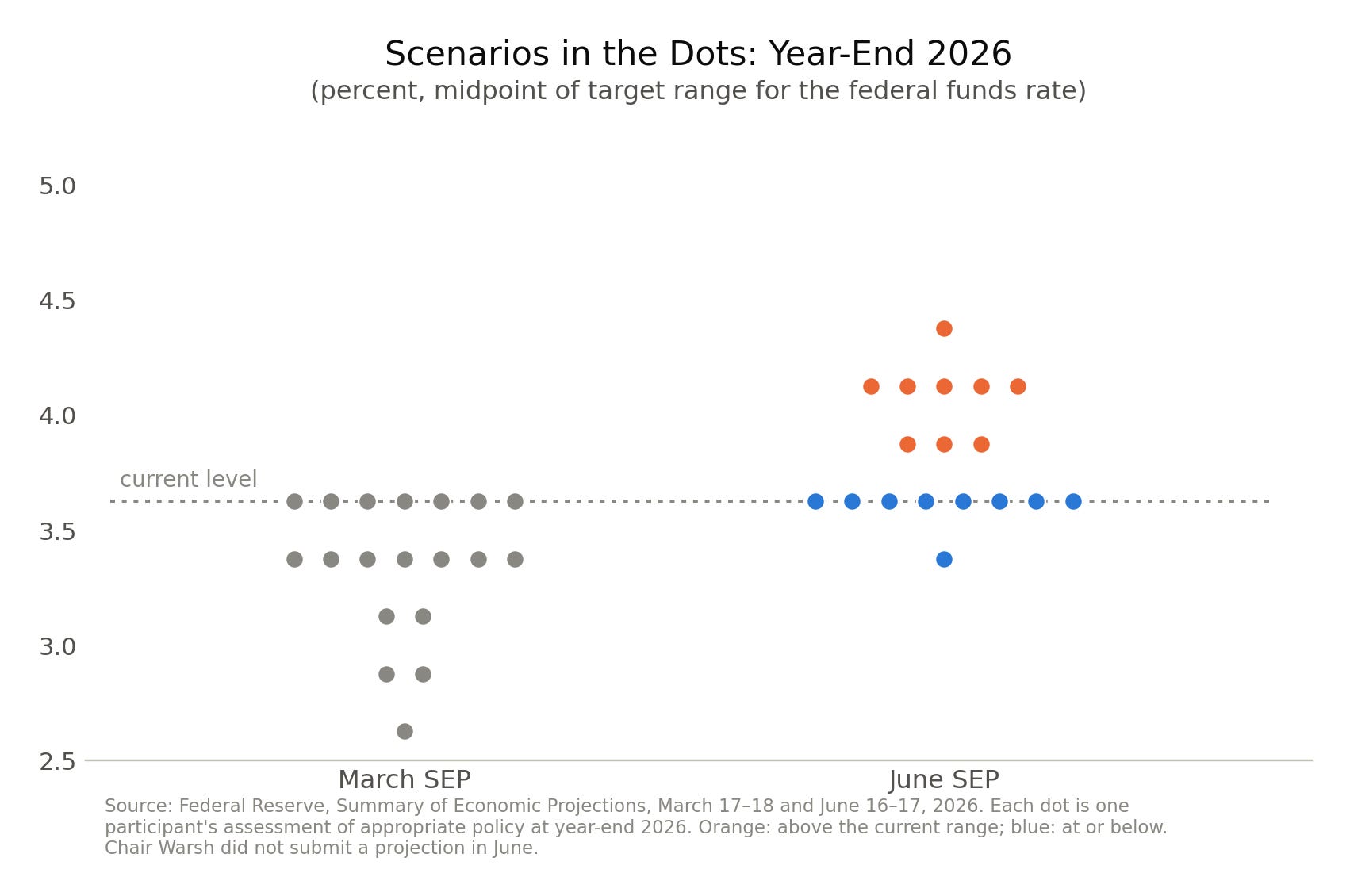
In three months, the committee shifts from “we may well stand pat, but we may well cut short-term Treasury nominal interest rates by half a percentage point before next January” to “we may well stand pat, but we may well raise short-term Treasury nominal interest rates by half a percentage point before next January”.
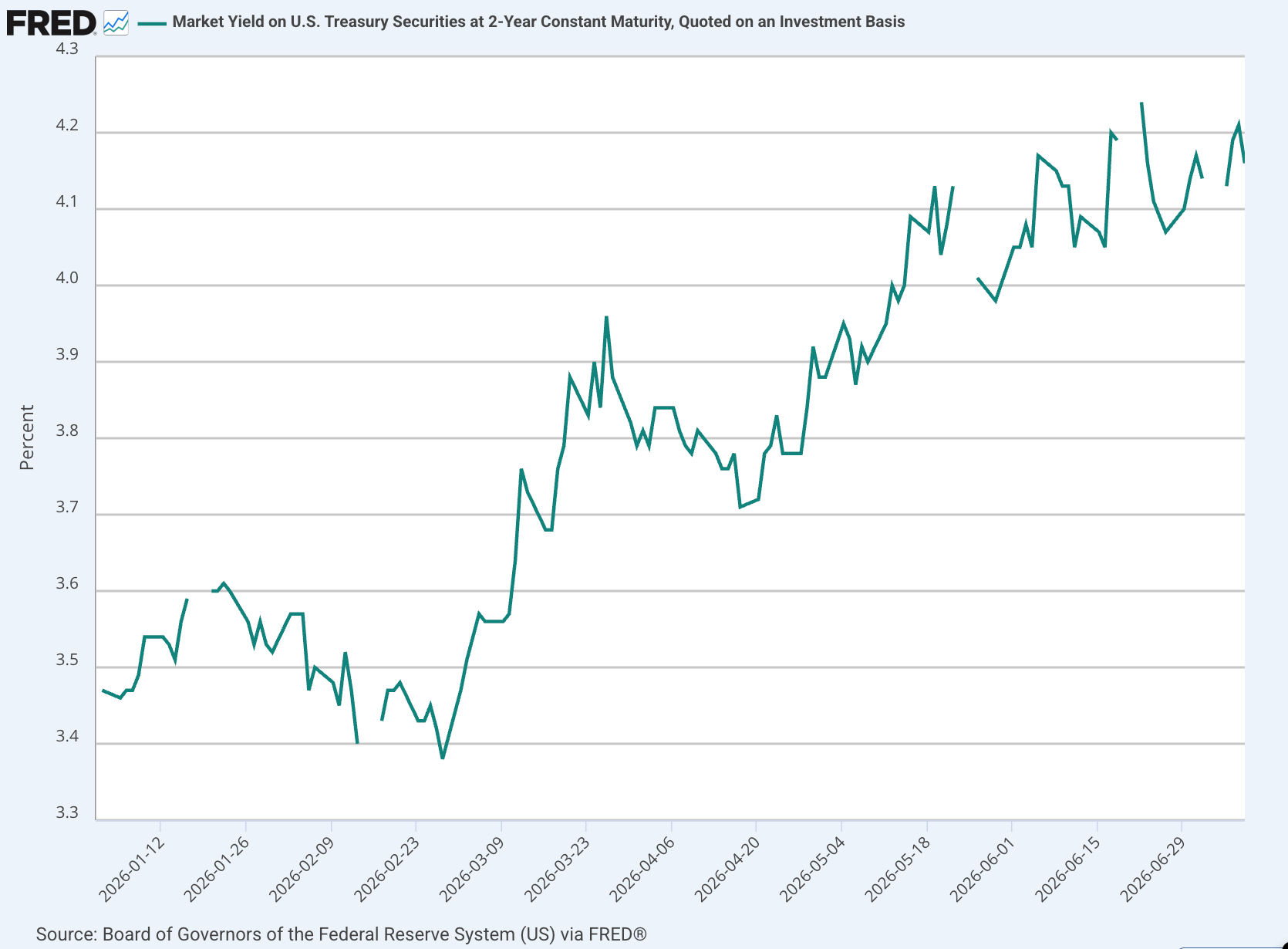
And Ms. Financial Market has listened, and believed:
Claudia Sahm hath the lesson today: The committee’s view is:
dense yet straightforward…. Scenario A: Inflation improves soon, then hold rates and maybe eventually cut. Scenario B: Sticky inflation and a stable labor market, then some hikes. Almost everyone agreed on what to do with the federal funds rate in each scenario; they disagreed on which scenario was more likely…

CROSSPOST: CLAUDIA SAHM: What Will It Take for the Fed to Hike?
<https://stayathomemacro.substack.com> <https://stayathomemacro.substack.com/p/what-will-it-take-for-the-fed-to>

The June FOMC minutes laid out two scenarios, and the committee is split right down the middle on the outlook for inflation.
Claudia Sahm
Jul 12, 2026
The highlight of last week: I was wrong!
On CNBC Wednesday morning, I predicted that the FOMC minutes would be “much shorter and with fewer details.” Steve Liesman pushed back, arguing that the minutes are a committee document. (So is the FOMC statement, and it still got hacked in half, even deleting “maximum employment.”) In the end, the minutes came in about a fifth shorter, so I was right on length, but the substance was preserved. Steve got that right, thankfully. There was as much information as usual on the debate among Fed officials at the meeting.
What’s the plan?
Most importantly, we learned why the Fed held rates steady in June, despite headline inflation twice its target, and what it would take for them to hike this year. Here is the key passage from the FOMC minutes; unpacking it will be today’s focus:
Most participants remarked on scenarios in which inflationary pressures would dissipate and inflation would soon begin to return to 2 percent. In such scenarios, almost all of these participants noted that it would likely be appropriate to maintain or eventually lower the target range for the federal funds rate. Most participants, however, also pointed to scenarios in which, in the context of stable labor market conditions, inflation would remain elevated due to strong AI-related demand, the conflict in the Middle East, or the effects of tariffs. In such scenarios, almost all of these participants indicated that some policy firming would likely be warranted to return inflation to 2 percent.
It’s a dense yet straightforward paragraph:
Scenario A: Inflation improves soon, then hold rates and maybe eventually cut.
Scenario B: Sticky inflation and a stable labor market, then some hikes.
Almost everyone agreed on what to do with the federal funds rate in each scenario; they disagreed on which scenario was more likely.
Pictures can help bring these scenarios to life. Here are my illustrations. The minutes speak in words, not numbers, so the specifics—the inflation measure, the size and timing of “some firming”—are my translation of the Fedspeak. First, the inflation conditions in the two scenarios:
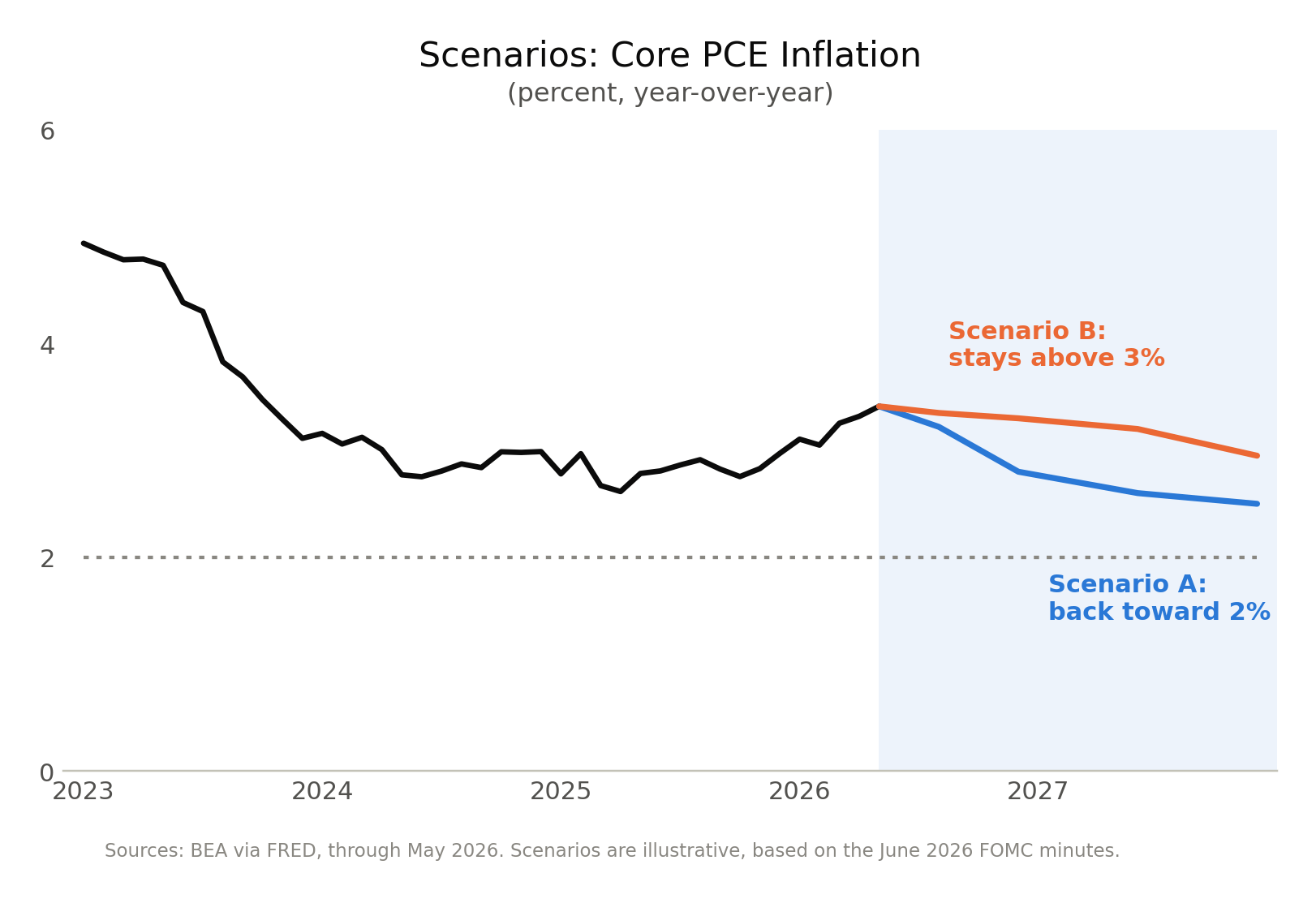
My scenarios use core PCE, even though the Fed’s target is total PCE inflation, and the text does not specify the measure. Fed officials will want to avoid being swayed by sharp moves in energy prices stemming from the conflict in the Middle East. The energy wedge is already visible: 4.1% headline versus 3.4% core in May. Core would still capture any broadening of the energy shock. Measures that exclude outliers, such as the trimmed mean, will receive attention, but they performed poorly during the pandemic, and this debate will be settled old-school.
The hike scenario comes with a laundry list of inflationary factors: energy supply disruptions, tariffs, and AI demand. Sticky inflation, regardless of the reason, will lead to firming. The patience the committee showed while tariffs passed through to consumers and earlier, while pandemic-strained supply chains healed, has worn thin. Core inflation improves soon, or there will be hikes. Expect less storytelling on the components as a reason to wait.
Soon is the most important detail in the hold scenario; without it, the scenario would sound very much like Team Transitory 2.0. Soon is not well-defined, but it does suggest that the core inflation data in the coming months need to improve. In June, Fed officials voted unanimously to hold, though a few argued for a hike in the meeting. Those few could act as soon as the July meeting, but the September or October meeting is a more likely deadline for the majority. That is not far away.
The hike scenario is about more than inflation. The qualifier “in the context of stable labor market conditions” is important. At its June meeting, the Fed sent a clear signal that it will deliver price stability. That was not a denial of its maximum employment mandate. It was a recognition that, with the unemployment rate stable in the low 4s and job growth up from last year, the problem now is inflation. If the labor market becomes a problem, the hike scenario is not so simple.
The scenarios suggest two different paths for rates this year.
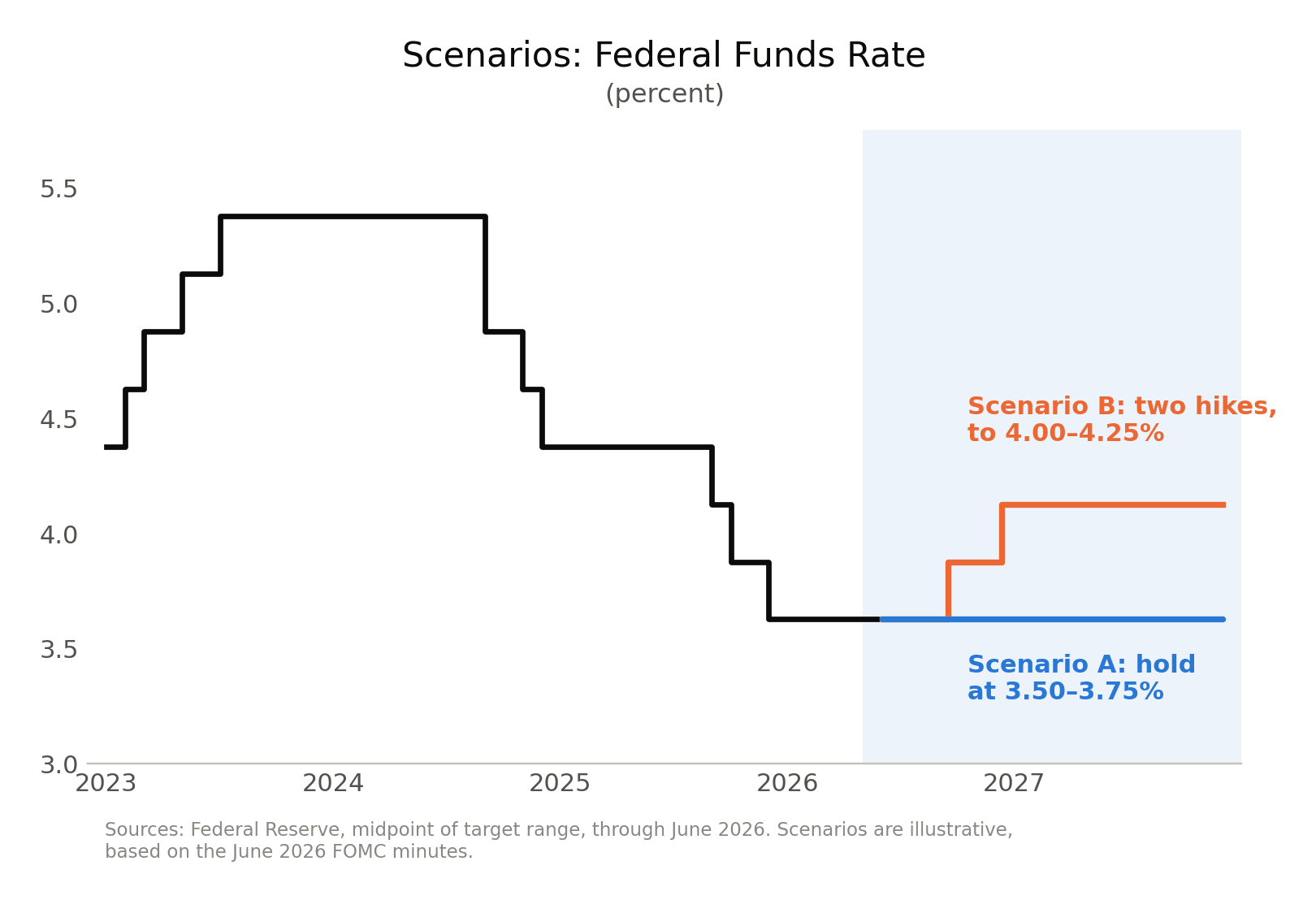
The hike scenario calls for “some firming,” which I interpret loosely as 25-basis-point increases in September and December. The “some” is an important qualifier, indicating a modest increase in total rather than a full-blown tightening cycle. The current level of the funds rate is close to neutral, so even a half-percentage-point increase could add some restriction. Coming out of the pandemic, with rates near zero, the Fed had to cover a lot of ground with hikes to create any restriction. Some firming would be the Fed ensuring that current inflation excesses are temporary.
What’s more likely?
That’s largely a question about what’s more likely to happen with inflation and employment in the coming months, and then a bit about building a majority around one interpretation on the FOMC. For this year, I would put a 60% chance on the hold scenario and a 40% chance on the hike scenario. In favor of the no-hike case: Recent months have seen less tariff pass-through into inflation, housing disinflation is ongoing, the effects of energy shocks on core tend to be modest, and the labor market shows no signs of overheating. In favor of a hike: supply shocks and shortages often take longer than you expect to work out. Plus, the arithmetic for getting core under 3% soon is demanding: to get there by December, monthly prints need to average 0.18%, versus about 0.29% over the past three months.
Fed officials are even closer to a coin flip than I am. The dot plot showed that nine officials judged that one or more rate hikes would be appropriate this year, eight favored holding rates, and one favored a cut. The Chair did not submit a dot. Note the timing: the dots came out right as the US and Iran signed their memorandum in June, so any relief on energy prices isn’t in them yet. The two scenarios also help us interpret the dot plot. Fed officials were divided in their outlook for inflation, not in how to react to inflation.
What I like about the scenarios is that the Fed is not keeping the financial markets guessing. They are fairly straightforward, and they explain what the Fed is looking for. We can all watch the economic data—CPI, PPI, and import prices for June—this week and continue to update the likely path for the federal funds rate.
In closing.
We had to wait three weeks, but the FOMC minutes really delivered. The two scenarios do not cover all possible outcomes, but they indicate what Fed officials are most concerned about and how they would respond. The rest is up to the data, and the data-driven Fed is alive and well. Knowing something about the Fed’s reaction function is more useful than knowing where they guess the funds rate will end up. Guesses go stale a lot faster than contingency plans.
<https://stayathomemacro.substack.com> <https://stayathomemacro.substack.com/p/what-will-it-take-for-the-fed-to>
Brad DeLong here: There is a third dimension to this story that the extremely sharp Claudia Sahm does not mention: Kevin Warsh has now been confirmed as Federal Reserve Chair. His stated opposition to forward guidance, his willingness to without evidence dismiss Phillips curve worries of cost shocks from a tight labor market as a potential inflation driver, and his long-standing attachment to the false and magical belief that unfinanced tax cuts for the rich somehow expand aggregate supply while shrinking all investment—all, to put it politely, point to a fundamentally different approach to monetary policy than what we have seen since at least the days of Arthur Burns back in the 1970s. If he leads his committee, rather than follows it.
Remember: In 2010, when the Fed was still grappling with the aftermath of the Great Recession, Warsh famously stated that he didn’t think we should be complacent about inflation risk—even as unemployment hovered near 10% and core inflation ran well below target. This misreading of macroeconomic conditions was symptomatic of a deeper problem: Warsh has consistently prioritized inflation fighting over employment stabilization, even when the data suggested otherwise, whenever a Democrat has been in the White House.