
(SEMI-)CROSSPOST: JOEY BROOKHART, CRYSTAL HUANG, & DYLAN PATEL: Anthropic 3Q26 Profit Over $1B: The Anthropic IPO Financials Sneak Peak
A lab that was burning cash on GPUs 18 months ago is now plausibly minting a billion dollars of quarterly profit by arbitraging three things: the collapse in the cost of “intelligence,” the stickiness of enterprise demand for agents that actually do work, and a balance‑sheet semi-shell game in which everyone else owns the iron and Anthropic takes the margin. Nevertheless, it is not primarily a playing fast-and-loose with non-GAAP numbers story here…
That Anthropic may well be seriously profitable in this current quarter is with respect to my visualization of the Cosmic All a real shock. By now not only xAI but FaceBook and Google are renting out GPUs that they had previously reserved for themselves for model training to Anthropic for inference. Plus I hear of Anthropic vacuuming up whatever datacenter capacity it can shake loose—Akamai, AWS, CoreWeave, and Fluidstack, among others—not on the grounds that this will attract sticky customers for the long run but rather that it will make financials look better in the run-up to the Anthropic IPO.
There is definitely thought to be some secret sauce in Anthropic’s model harnesses, and there may well be real secret sauce in Anthropic’s model harnesses, and I do not understand how this can be—but then, if I understood it, others smarter than me would have copied it by now, and it would not now exist.

(SEMI-)CROSSPOST: JOEY BROOKHART, CRYSTAL HUANG, & DYLAN PATEL: Anthropic 3Q26 Profit Over $1B: The Anthropic IPO Financials Sneak Peak

Anthropic’s Opportunity is Theirs to Lose
Joey Brookhart, Crystal Huang, and Dylan Patel
Jul 07, 2026
∙ Paid
When Dario Amodei left OpenAI to start Anthropic in early 2021, the viral release of ChatGPT was over 18 months away and the commercialization of LLMs was practically zero. Just a few short years later, Anthropic and OpenAI combine for ~$100B of ARR and a clear winner emerged in the profitable monetization of AI models in 2026 as Claude Code took the software development world by storm.
Anthropic confidentially filed for IPO on June 1st. Over 1 month later, equity raises from hyperscalers loom, and a reported OpenAI push out of their own IPO until 2027 has led some to question the ability of the labs to raise. However, Anthropic is the clear clubhouse leader in capturing the B2B market today and is doing so in a profitable manner against an unfocused and money-burning competitor.
With this lead, we expect Anthropic to take advantage of their superior business model and margins to invest in further in new models that help extend their lead and monetization over closed and open source competitors. Anthropic has the ability to truly make OpenAI dance and we see Anthropic as the first $6T company as a base-case possibility if they continue to execute. Pricing power, gross margins, business model, and profitability are all reasons for Anthropic to IPO first and put the impetus on OpenAI to open their financials and raise the necessary capital to compete and fund the massive AI buildout still to come.
We’ve already seen 2 AI Labs IPO this year (Zhipu and Minimax from China), but Anthropic would be the first AI lab of this scale to do so. A confidential filing means there are no public numbers disclosed. Fortunately, the Tokenomics team at SemiAnalysis works to build the financials from the bottom-up by SKU, tier, and customer type. Recently, a WSJ article on Anthropic’s financials confirmed the accuracy of the work our Tokenomics team does across labs and hyperscalers to help investors, corporates, and other stakeholders understand the economics and financials of the AI Ecosystem.
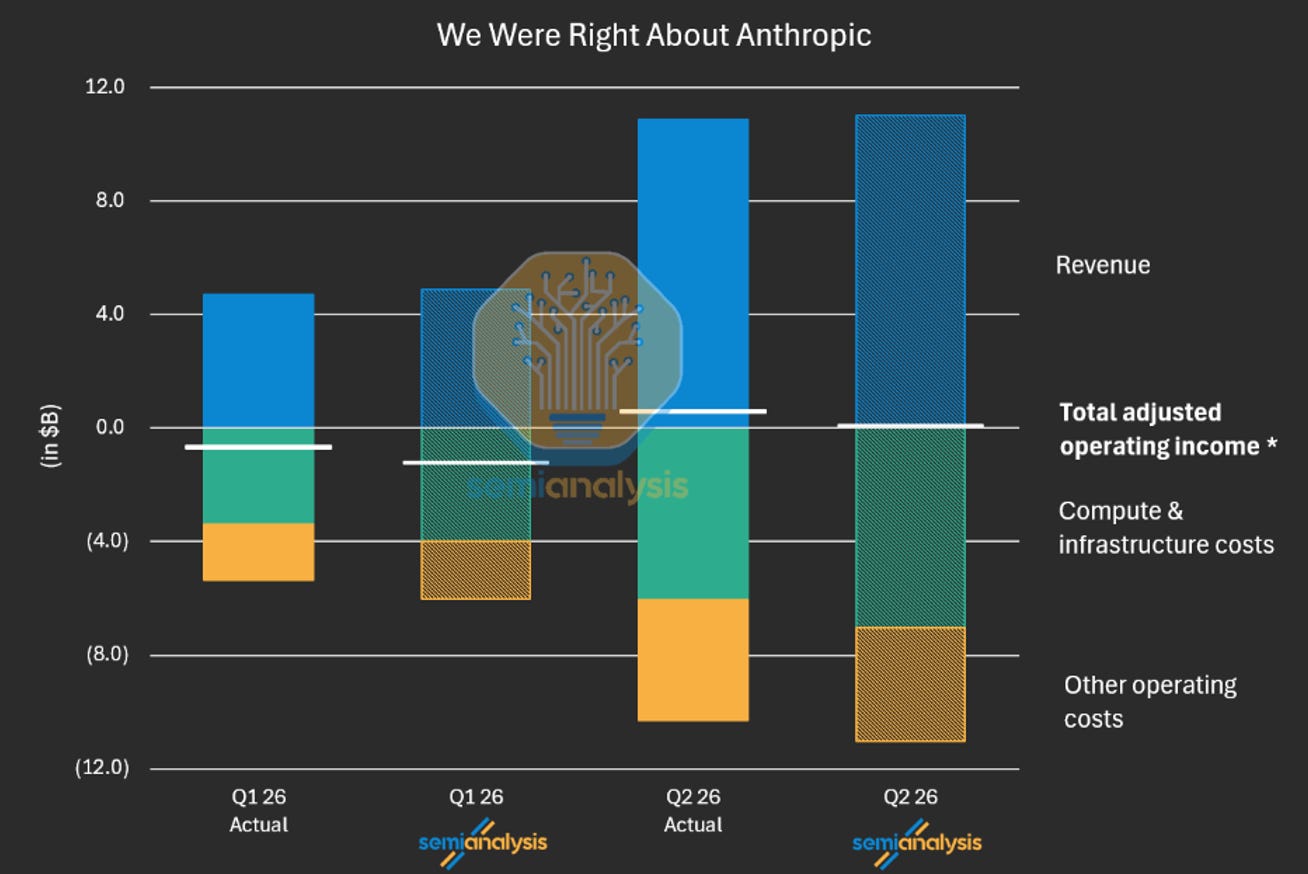
In this article, we’ll dive deep into the work our team has done in the Tokenomics Model and walk you through the financial details of Anthropic, how that compares to OpenAI, where we see the market moving, and implications for the value chain and broader AI market. While other SemiAnalysis work focuses on the technical aspects of AI Labs, this piece will focus solely on the current and future financials, margin economics, and long-term outlook for Anthropic…
Brad DeLong back again: As I see it, Semianalysis gets to “>$1B profit in 3Q26” by stitching together three pillars:
very fast revenue growth,
sharply higher gross margins,
a cost structure that scales much more slowly than revenue.
The underlying mechanics can be gleaned in their recent public pieces on Anthropic, Claude Code, and “AI value capture,” plus in the TokenBudgeting note that AI Weekly summarized. I’ll reconstruct their logic, as best I can.
(1) Anthropic’s annual run rate has gone from about $9B to over $44B in roughly a year, driven by “agentic” workloads: Claude Code, Cowork, etc.)<https://newsletter.semianalysis.com/p/ai-value-capture-the-shift-to-model>. Claude Code as killer app. High B2B mix and high per‑seat spend. Token consumption still in early S‑curve. The story is of Anthropic running a very large, mostly B2B ARR base anchored in coding and, increasingly, general “agentic” workflows, with top‑decile customers spending like this is core infrastructure, not a toy. A 10% operating margin on, say, $11–12B of quarterly revenue gets you to ~$1.1–1.2B of quarterly operating profit.
(2) Margin expansion. They think Anthropic’s inference gross margins rose from about 38% to over 70% within a year as both hardware and software got dramatically more efficient, even as they cut list prices on some SKUs. Blackwell GPUs and custom ASICs (TPUv7, Trainium 3) producing 17–30x more tokens per second per accelerator than prior‑generation H100s, with only ~70% higher TCO per GPU. On the software side, wider execution pipelines, disaggregation, multi‑token prediction, etc.) give >10x inference throughput gains on the same hardware.
(3) Agentic workloads are even more margin‑friendly. They tend to have very high input:output token ratios and huge cache hit rates. Plus the mix is shifting toward higher-price models, from mid‑tier Sonnet to more expensive Opus and now to Opus Fast, Fable. The most AI‑entusiastic customers are price‑insensitive because they see productivity gains dominating, if not now, in the near future as their engineers gain metis at manipulating these new information technologies.
(4) Consider the structure of Anthropic’s deals with hyperscalers. When Anthropic’s models are sold through AWS and Bedrock on a “token‑as‑a‑service” basis, Anthropic is the seller of record and books the full token revenue, while AWS earns a combination of infrastructure fees and a distribution/revenue‑share fee. <https://newsletter.semianalysis.com/p/anthropic-growth-and-bedrock-mix>. They get access to AWS’s customer base and massive GPU/Trainium capacity without having to sign huge, fixed “take‑or‑pay” contracts. Their own capital intensity and depreciation line is lower than if they were buying/renting all compute “wholesale.” A big chunk of capex and power/ops spend sits on AWS’s books, but Anthropic still books most of the token revenue. That makes the Anthropic P&L very levered to revenue growth.
Thus $1B+ of quarterly profit seems attainable.
A natural objection is: “Won’t competition compress margins before you ever see that billion‑profit?” SemiAnalysis sees open‑source models as still noticeably worse for serious knowledge work, so not putting much pressure on premium-model pricing (yet). Their datacenter modeling insists that GPU/TPU/Trainium capacity and power are structurally scarce through at least 2027. If demand for tokens is racing ahead of supply, and if multiple labs are compute‑constrained, then anyone who can deliver frontier‑quality tokens can price off the perceived value of the work, not off marginal cost. That’s how they justify keeping that 70%+ gross margin assumption and then letting operating margins climb into the double digits by late 2026.
The early external reaction I have seen is a mix of intrigue and skepticism. AI‑industry newsletters like AI Weekly are treating SemiAnalysis’s TokenBudgeting work as basically credible, while acknowledging it rests on vendor conversations and card‑spend data rather than audited statements
The intellectually serious questions, to me, are:
Whether Anthropic can actually sustain that pace of ARR growth given emerging competition and enterprise procurement friction.
Whether hyperscalers and Nvidia/TSMC reprice their contributions enough to claw back more of the value, compressing model‑lab margins.
Whether enterprises, once past the “Claude Code honeymoon,” normalize around lower per‑employee AI budgets than SemiAnalysis’s 99th‑percentile anecdotes imply.