Is Kevin Warsh as Bad a Central Banker as He Seems? Perhaps...: TUESDAY MACRO
Standing on one’s Fifth Amendment right against self-incrimination is no way to create a stable standard of value. Removing any semblance of a signal about what the Fed might do next with interest rates leaves markets with no choice but to guess in the dark.
A Fed chair who refuses to show his work is taxing the economy with avoidable risk. By shredding forward guidance, Warsh isn’t restoring discipline – he’s deepening uncertainty.A communications strategy of not communicating definitely helps him balance Trump’s demands with Wall Street’s hopes, but it is not good monetary policy. Markets can try to deal with hawks and they can try to deal with doves. But how can they deal with and price in a Chair who will not say what game he is playing?
A well-functioning market economy requires a monetary standard: some set of rules and expectations for what the magical things that comprise liquid trust in the good faith and ability to pay of counterparties are, and how and how much of that liquid trust there is. As John Maynard Keynes wrote back in 1924, the market economy:
John Maynard Keynes: A Tract on Monetary Reform <https://www.gutenberg.org/files/65278/65278-h/65278-h.htm>: ‘cannot work properly if the money… is undependable. Unemployment, the precarious life of the worker, the disappointment of expectation, the sudden loss of savings, the excessive windfalls to individuals, the speculator, the profiteer—all proceed, in large measure, from the instability of the standard of value…. The costs of production… the rewards of labour, enterprise, and accumulation… [and] a fourth cost, namely risk; and the reward of risk-bearing is one of the heaviest, and perhaps the most avoidable, burden on production. This element of risk is greatly aggravated by the instability of the standard of value….
I dedicate this book, humbly and without permission, to the Governors and Court of the Bank of England, who now and for the future have a much more difficult and anxious task entrusted to them than in former days…
In something like our current Age of the Central Banker, clarity as to the policy of the Federal Reserve is perhaps the most essential part of the creation of a stable standard of value: how will the Federal Reserve backstop liquid asset values in order to try to make Say’s Law work in practice, so that potential supply is matched by demand? People need to know the answer to this question if risk is to be diminished, and if the risk-bearing tax on enterprise and employment is to be lightened.
We are thus all eager to hear what brand-new Fed Chair Kevin Warsh has to say about what the policy of the Federal Reserve will be: his answers to questions of the form, if the economy does X, the Fed will do Y, and in economic situation Z, our reaction is likely to be W. To first order that Fed reaction function is likely to be something like a Taylor rule: an unemployment rate of u and an inflation rate of π induce the Fed to set a short-term Fed Funds interest rate of r, with the value of r calculated by some three-parameter linear function:
And then other circumstances lead the Fed to set its actual r above or below the Taylor-rule level. Hence one of the key jobs of the Federal Reserve is to communicate, clearly and unambiguously, its view as to the current values of α₀, α_u, and α_r; plus its current laundry list of other circumstances it is likely to respond to if they occur, and how much.
This is called the Federal Reserve’s “communications strategy” or its “forward guidance”.
What does Kevin Warsh has to say? What he has to say is: I am not going to say anything.
Daire MacFadden, Unhedged reporter, is rather unhinged as a result:
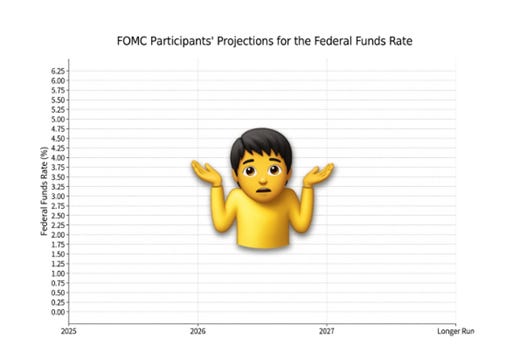
Daire MacFadden: No Dots, No Plots <https://ep.ft.com/permalink/emails/>: ‘New chair Kevin Warsh has, as expected, given up on forward guidance. Actually — as many are pointing out — he’s given up not just on guidance about the future but also guidance about the present and the past. Dario Perkins of TS Lombard summed it up nicely in the chart below. The emoji in the middle shows us where a legible (if imperfect) Fed dot plot used to be:
In short, Warsh’s turn towards the taciturn potentially increases uncertainty and the risk of policy surprises — a recipe for higher borrowing costs, if ever there was one. Warsh’s press conference… offered a preview of this new regime. In the 24 hours before and after the meeting, markets significantly repriced the likely path of Fed policy over the coming year. They went from expecting one rate rise to expecting two by June next year, with the first due in the fourth quarter…. Bank of America — not to be outdone by market consensus — thinks the number of rate increases could be higher and come sooner… [as] the labour market is showing no signs of slowing and inflation is above target and sticky….
Warsh barely mentioned the full employment side of the Fed’s mandate during the presser, which could be taken as a sign that he considers it met or less important now than price stability…. As if to underline the point about less communication sparking more confusion, investment house Amundi put out its own forecasts on Monday. It has concluded that the number of Fed rate rises this calendar year will be… zero…. Warsh has said a lot about speaking less. So far the proof of the new regime is June’s FOMC statement (cut to under half the typical length) and his refusal to plot a dot…
What Warsh has said is, roughly:
The Federal Reserve will deliver price stability—i.e., not worry about other things like full employment and enabling productivity growth via reallocation to high-value sectors until that first is taken care of.
He only cares about the left side of the decimal point when it comes to inflation—i.e., rather than attempt to make the PCE inflation rate average 2%/year over time, he will be satisfied as long as recent data records inflation as being 2.X%/year—which is an 0.50%-point increase in the Federal Reserve’s inflation target.
He does not think that the Philips Curve is real—i.e., that interest-rate increases are not a reliable way of cooling off the economy and diminishing inflation when inflation is above target, and hence price stability is not being delivered.
No. Nobody can make sense of this. It doesn’t.
Janet Yellen once remarked to me that her experience at the Fed of the 1990s was the introduction of the Taylor rule framework—where the interest rate would normally be given current inflation and unemployment, what adjustments above or below that normal level we are making because of current circumstances, and how the interest rate will change as the economy evolves— was a very major policy win in terms of establishing a stable monetary standard in these modern days, and also a substantial win in terms of clarifying the Federal Reserve’s own thought in its internal discussions. That seems to be, as far as the Fed chairman is concerned, now gone.
My interpretation of what is going on is rather cynical: it is that Kevin Warsh has told an awful lot of lies to get to his position. Donald Trump and the Trumpists think that he is a convinced interest rate dove, and that the only reason right now he is not pushing for rapid interest rate decreases is that he wants to nudge the committee rather than begin his term with a confrontation. The financial market community thinks that he pulled the wool over Donald Trump’s eyes by pretending to be an interest rate dove. Well, actually, he is a normal central banker. Those two sets of beliefs are inconsistent. Anything Kevin Warsh says is likely to disrupt at least one of them, and that could cause him trouble.
Hence he is going to make it a matter of principle to shut up. The longer he can preserve ambiguity, the better for him personally in his place at the top of this particular greasy pole.
That this is lousy economic policy and lousy communications strategy does not seem to be a consideration.
Very cynical, yes. But is it wrong?
Claudia Sahm is much more polite than I am, but in her polite way she appears equally alarmed at the prospect of a Fifth-Amendment Fed:
Claudia Sahm: Where Is the Fed Headed? <https://stayathomemacro.substack.com/p/where-is-the-fed-headed>: ‘The Fed’s guiding principle in communication should be transparency in service of accountability. The Fed cannot guarantee that unemployment and inflation will be low, but it can guarantee it will pursue those goals diligently and show its work…. Last week on Bloomberg, I was asked…. “If you had free rein of the institution and could readjust — adjust the communication apparatus at the Federal Reserve — what would you change? What would you get rid of?” I fumbled a bit — 6:45 am, no coffee — but the themes came through…. “I watched a Fed become more transparent, more speaking to the public. I think it is very important for accountability’s sake that the public, the Congress understands what the Fed is doing, why they are doing it…. Show your work…. Accountability… is important…. Fine-tuning… how the Fed gives information so markets can understand it and help…. There is a lot of fine-tuning. The dot plot is not a perfect tool in any form, but the spirit has real merit…. It is very easy to delete things…. But that doesn’t necessarily move the ball forward in terms of improving the goal-setting, improving the transparency.”… I can list my preferred tweaks, but honestly, that’s a sideshow to getting the Fed to elevate transparency and accountability…
If reading this gets you Value Above Replacement, then become a free subscriber to this newsletter. And forward it! And if your VAR from this newsletter is in the three digits or more each year, please become a paid subscriber! I am trying to make you readers—and myself—smarter. Please tell me if I succeed, or how I fail…