
CROSSPOST: BRIAN KLAAS: The Great Cognitive Divide
You need to learn how to use a gym before you can benefit from it.
Brian Klaas’s central thesis here is that AI works like a cognitive gym. It amplifies the capable, motivated, and well-prepared in critical thinking, motivation, and ability to learn, while letting everyone else stagnate or regress. Mediocre work is trivial to produce, hence those who are satisfied producing it never exercise their cognition muscles. But AI has raised the ceiling for those who can genuinely leverage it. Those with critical thinking, curiosity, willingness to struggle with hard problems skills can use AI to displace “the boring, tedious tasks that add nothing to your intellectual experience of being alive”.
The “but” unmentioned here is that for many people producing mediocre work is boring and tedious—and that includes the work of trying to derive entertainment from reading books! Doing mediocre work with trivial effort leaves more time and energy to do the other things that are the core of your life. I am attracted to the argument that you are a more capable mind and a better person if you are trained to approach the world through the print-channel and the calculation-programming-channel rather than simply watching short-form videos. I strongly think that everyone needs to have an AI info-butler asking them every five minutes: is this really the best use of your time?
Even given all that, I still am on Brian Klaas’s side here: we need to construct systems to force people to become more book-learning focused and thus more literary then our technologies and their advertising-focused market harnesses are pushing them to be.
But there is a big problem: How?

CROSSPOST: BRIAN KLAAS: The Great Cognitive Divide
<https://www.forkingpaths.co/p/the-great-cognitive-divide>

How AI could ensure the smart get smarter while everyone else gets left behind
Jun 30, 2026
Much has been written about the potential and perils of artificial intelligence. Tech bros fawn over it as a get-rich-quick panacea of emancipatory potential, making grandiose plans to use their well-padded crypto accounts to upload their brains into the eternal ether. Billionaire CEOs salivate at productivity gains and soaring profit margins without those pesky corresponding payrolls.
By contrast, social scientists—and many concerned citizens—worry about its disruptive impact on mass employment and the existential risk it could introduce into an already fragile global system.
For many, the reaction to artificial intelligence is all-or-nothing; a disaster for humanity that hollows out the essence of our species, or an information revolution that will usher in the previously unimaginable with an exhilarating digital whoosh.
These contrasting reactions are missing a crucial, hidden dynamic that is already underway. If we are not careful, one of the most consequential impacts of artificial intelligence will be a great cognitive divide, a bifurcation of humanity’s intelligence, a new era of mental inequality with long-lasting consequences for our species.
I: The Cautionary Parable of Air France Flight 447
On June 1, 2009, the autopilot on Air France Flight 447 unexpectedly disengaged, roughly 300 miles northeast of Brazil’s coastline, en route to Paris. This was highly unusual; most commercial airliners fly almost exclusively on autopilot when at cruising altitude.
Suddenly, and without warning, the pilots were forced to perform manual skills that they had offloaded to a machine for most of their flying career. Sensors were giving incorrect, implausible readings. With warning lights blinking and alerts sounding in the cockpit, they struggled to make sense of what was happening. In a state of confusion, the pilot tried to sharply climb—at an angle that was far too steep.
Unable to understand what the sensors were telling him, one of the pilots shouted out in frustration: “I don’t have control of the aircraft at all!”
Four minutes after the autopilot disengaged, the now-stalled aircraft was descending at nearly 11,000 feet per second. The pilots, who were used to offloading much of the cognitive load of flying to their trusty autopilot, were unprepared when the machine failed.
Air France flight 447 hit the ocean at tremendous speed, disintegrating completely, and instantly killing 228 passengers and crew members onboard.
This is a particularly tragic example of cognitive offloading, in which skills withered over time because the pilots lost some of their self-sufficient abilities by relying on fallible digital devices. Similarly, research shows that London cab drivers tend to have an enlarged hippocampus from memorizing the full road map of London, whereas those who navigate based on Google Maps become worse than previous generations at spatial memory. Use it, or lose it.
I previously wrote about the perils of cognitive offloading I’ve experienced:
When I was a kid, I could rattle off telephone numbers. Landlines. Clunky, oversized cell phones, bricks in purses. I knew the digits by heart. I still do. My best friend down the street. My parents. I used to know street names, too. Grids and lines, meandering through my head, a 12 year-old human MapQuest. You could learn a place in those days with 1990s GPS technology: Go Play Somewhere.
Then, I got a cell phone. For digits and coordinates, that part of my brain was siphoned off into the little flip phone. It never recovered. I don’t know any new phone numbers. Street names are passé. What3Words is the future. It’s now easy to ignore the surrounding environment. After all, you can always just look it up. You got lost? How? Did you forget to charge it?…
Several research studies have already highlighted the risks of cognitive offloading with LLMs such as ChatGPT. A 2025 MIT study (with a small sample size) showed reduced brain connectivity in those who wrote an essay with some assistance from ChatGPT and an inability to remember what they had just written. And a worrying, albeit preliminary 2026 study shows evidence that when people use AI to help them with a tasks, they become less persistent, give up more quickly when learning something, and have reduced overall performance.
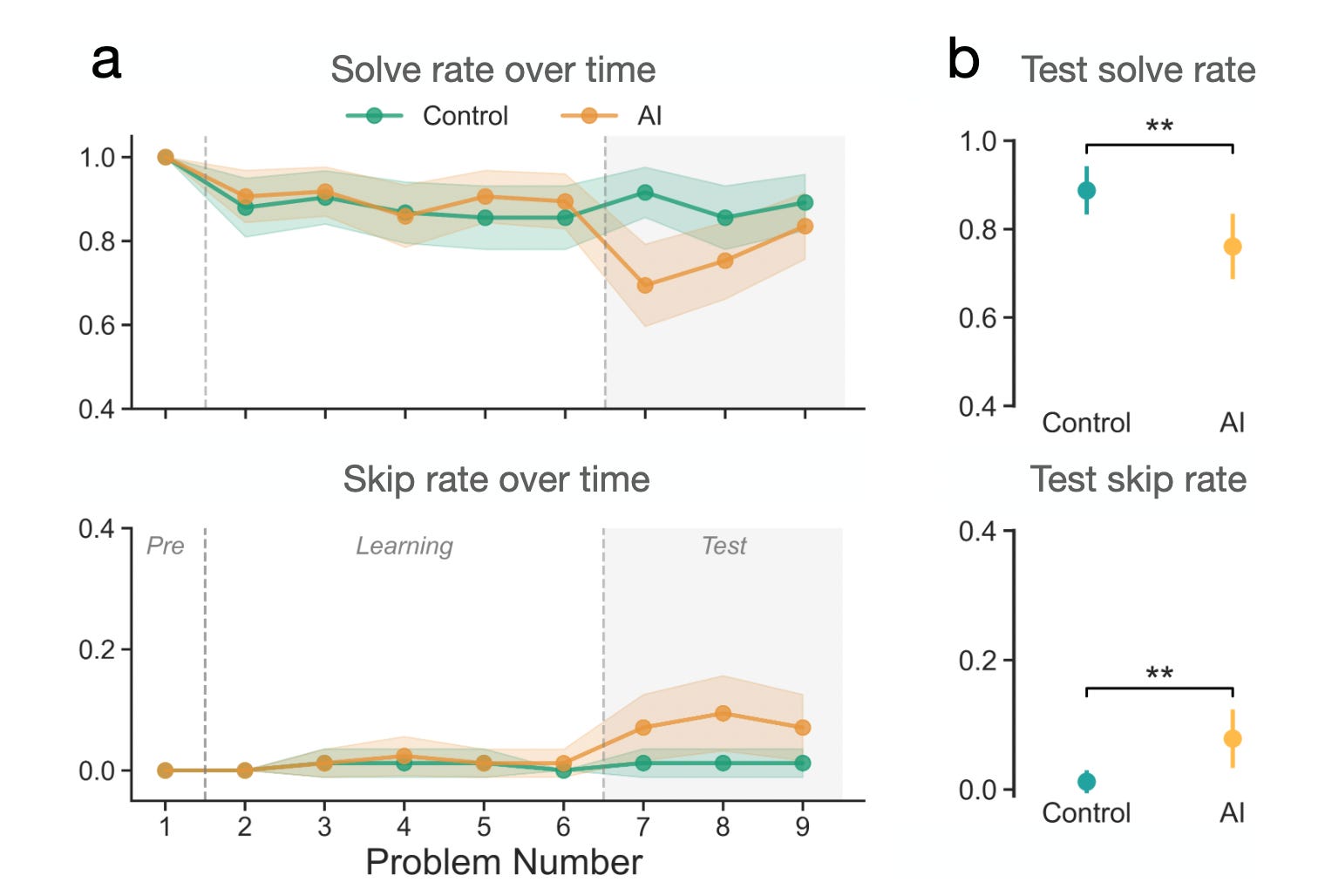
Our world is about to undergo the largest natural experiment in the history of cognition: what if most tasks that previously demanded some level of intellectual processing can simply be handed off to a machine? And crucially, as that happens, who will be the winners and losers of that new reality when it threatens our collective ability to think effectively?
II: Cognitive Gyms & AI as an Amplifier
Imagine that a person comes up to you at the gym with some helpful advice while you’re lifting weights or running on the treadmill.
“A forklift could lift the same amount with way less effort,” they tell you. “And you’re not optimizing when you’re on that treadmill; you could cover five kilometers a lot faster on a bike, or better yet, in a car.”
You might, quite understandably, contemplate whether they are mentally ill.
That’s because even though their suggestions are obviously correct, they have made an egregious category error: the point of going to the gym isn’t to liberate the maximum possible amount of weight from the stubborn grip of gravity or to move the treadmill belt the maximum possible distance in the shortest period of time. If it were, we wouldn’t have gyms in the first place; machines can already do those tasks better than us.
However, gyms are not equally useful to all humans. If someone is bedridden or has no clue how to lift weights, the mere existence of a gym doesn’t help them get stronger or faster. Instead, it might actually increase the statistical gap between local people in terms of their physical health. That’s because for someone who’s already a physically fit specimen with exercise know-how, a gym being built nearby can unlock accelerated physical improvements. The least fit will stay unfit; those most fit will get fitter.
Now, let’s add a third kind of person into the mix: someone who never goes to the gym but uses anabolic steroids to appear stronger. They will likely put on some visible muscle. Glance at them walking down the street and you might wrongly assume they’re regularly going to the gym. But it’s all an illusion: if you tested them medically, they’re likely to be less healthy than before they took the steroids.1 Appearance, without the substance.
Artificial intelligence can provide a function that’s a bit like humanity’s cognitive gym. Rather than having equal, across-the-board effects, AI can act like an amplifier, further driving a decisive wedge between two groups of people: those who have an abundant supply of critical thinking skills and a willingness to learn—and those who do not.
Admittedly, it doesn’t appear that way at first glance. To the untrained eye, it looks like AI can be a great equalizer, allowing functionally illiterate people to magically cook up glittering sludge that passes as polished prose (but is bereft of original intellectual nutrients).
That’s because there has been a huge influx of people who are a bit like the lazy steroid user who may be tempted to use a forklift to lift weights. They seem more intelligent based on their outputs, even as they are getting less smart over time. As they offload more and more critical thinking to artificial intelligence tools, they are allowing their brains to atrophy from excessive cognitive offloading to a machine.
Artificial intelligence has already created a lower floor to what humans produce: mediocre outputs are now absurdly easy to create. Anyone can, with a few keystrokes, “write” a moderately compelling, cringe-laced LinkedIn post or a decent technical report. PowerPoints and spreadsheets are child’s play.
But artificial intelligence has also raised the ceiling of possibility for those who already have critical thinking skills, a willingness to learn, and are knowledge workers who can amplify their existing skills with powerful digital companion tools.
A mathematician might explore stubborn problems faster, sometimes with creative, unexpected results, allowing her to focus more time on the truly difficult mathematical frontiers of knowledge. A skilled researcher might be able to engage in AI-assisted intellectual brainstorming of possible avenues to explore before embarking on a major new scientific inquiry.
In the developing world, smart, intellectually curious people without access to formal education can unlock a cognitive future that would have previously been impossible through freely available AI-based teaching tools, (which is one reason why AI optimism is so prevalent in the world’s poorer nations).2
As the evolutionary biologist Stephen Jay Gould wrote in A Panda’s Thumb:
I am, somehow, less interested in the weight and convolutions of Einstein’s brain than in the near certainty that people of equal talent have lived and died in cotton fields and sweatshops…
The net social effect of AI may well be a world of more severe economic inequality, ushering in the Silicon Valley tech bro’s ultimate fantasy of a permanent underclass. In rich countries, millions may lose their jobs and billionaires may become trillionaires. And in poor countries, despite the optimism, there is no Silicon Valley in Madagascar or Myanmar, so many of the rich fruits of technological innovation will, yet again, be plucked in the global north.
Nonetheless, an ambitious, clever individual in a poor country can now come home from a menial job and, for free, use AI tools as a better tutor than they could ever hope to pay for previously. But that can only act as an amplifier for a certain kind of person: for someone illiterate, exhausted by sweat shop toil, or unable to break out of menial labor markets, they may spend endless hours on ChatGPT or Claude learning about mathematics and engineering, or conquering fresh fields of humanities knowledge through progressive tutoring, but it may not matter for anything beyond their own cognitive development.3
The most likely outcome is therefore a stark one: hardworking, intellectually curious critical thinkers who know how to use AI to enhance their intelligence will get smarter; meanwhile, everyone else falls cognitively behind, as they eagerly siphon off any mental toil to machines.
To understand why, we need to explore a useful economic framework that perfectly captures why AI will create a bifurcation in cognitive abilities, depending on who uses it and how they incorporate it into their lives.
III: Substitutes vs. Complements
Economists have highlighted a theoretical divide between substitutes and complements. Does a good replace another, or does it support it and make it better? A related term is displacement, in which a technological innovation makes a previous technology obsolete.
When ATMs were invented, many feared that bank tellers would be obliterated, hundreds of thousands out of work in an automated blink. Instead, even as ATMs spread from fringe futuristic technology to being ubiquitous features of daily life, the number of tellers actually rose modestly over that period.
David Autor (2015) wrote about the phenomenon, explaining how this freed up bank employees to engage in so-called relationship banking, selling products to clients rather than just fulfilling the menial job of distributing cash. It’s a clear example where something looked like it would displace employment, but ended up complementing it.
Now, if we apply those economic concepts to the surge in AI usage and offloading cognitive demands, we have a stark framework for understanding what I call the great cognitive divide that’s looming on the horizon.
For the mathematician who is using AI to push theoretical frontiers or the heart surgeon who is using AI to help invent new medical interventions with greater precision, artificial intelligence doesn’t offload their critical thinking; it amplifies their intellectual effectiveness while boosting the bandwidth of that person’s brain to focus on ever-greater innovations and creative solutions to longstanding problems that aren’t easily solvable with existing training data.
By contrast, if a person who previously had to engage their brain to fill out spreadsheets or write technical reports is now exclusively using AI tools to displace their critical thinking—while completing the same tasks—then those individual brains will atrophy over time without sufficient alternative effort to keep them cognitively engaged. (Similarly, passive social media scrolling often displaces, rather than complements, more enriching cognitive activities like reading books.)
However, many tasks currently done by humans are tedious busywork, yielding entire careers that David Graeber kindly called bullshit jobs. This is where the ATM example may offer cause for optimism. The ATM innovation was better for everyone—not least for the bank teller—who could now focus on activities that don’t just involve counting cash and handing it to someone but are instead more intellectually interesting.
Similarly, if AI can help streamline what Jamie Bartlett calls techno admin—the soul crushing digital tasks we all must do in modern life—then that displacement should be welcomed. (No brain cells are wasted on ticking digital boxes.)
That’s why these categories offer a powerful theoretical scaffolding to understand a new frontier of cognitive load: the goal of AI for humans should be to displace the boring, tedious tasks that add nothing to your intellectual experience of being alive and to complement the cognitive passions by amplifying one’s natural talents and existing abilities.
IV: Resist the Sirens of Cognitive Offloading
However, as my previous essay about “The Death of the Student Essay” argued, intelligence amplification can only happen after people already possess critical thinking skills and are willing to pursue critical thinking as an end in itself. If you never learn how to use the cognitive gym and aren’t willing to put in some demanding ideational work, your brain will never grow.
For young people who substitute or displace their education by using AI shortcuts that outsource the process of learning how to think, artificial intelligence will never complement their cognition. Instead, it will just turn education into a mental dead end, a hard limit on what could otherwise be a rich internal life of curiosity and knowledge.
Similarly, for people who mistakenly see “outputs” as the goal rather than merely the economically useful byproduct of switching on their brains, they will be increasingly tempted to offload everything to AI tools, putting them in the same boat as those who never develop critical thinking in the first place. Legions risk becoming akin to the parable of a lazy steroid user who never works out: churning out cringe-worthy AI-generated LinkedIn posts en masse, while their brain slowly becomes a useless squatter in their skull.
The problem for both groups is this: some people will get really good at using ChatGPT or Claude, producing some seemingly excellent outputs along the way, thereby lulling themselves into a false sense of comparative advantage.
But if they don’t learn how to think, then any AI-based skills they develop will have two pitfalls:
First, their skills will be tied only to a specific technology, not a flexible cognitive aptitude that can survive further technological advancement.
Second, those skills won’t be remotely unique. Right now, someone can get an edge professionally by being good at using AI tools, since some people are better than others at adopting the technology. But just as people used to proudly type “proficient in Word and Excel” on their CVs, over time, such skills became taken for granted. And in a world that will inevitably involve AI interlaced with the human experience, nobody will stand out for being good at writing AI prompts.
Therefore, as cognitive offloading seductively tempts a population obsessed with optimized efficiency, the edge will ultimately go to the diligent smart thinkers who complement their intelligence rather than swapping their mind with an LLM.
This, then, is my plea: resist the siren song of overzealous cognitive offloading. Next time you use ChatGPT, ask yourself: is this a substitute for my mind, or complementing my ability to use my brain more effectively? Am I streamlining a pointless task so I can focus on more interesting ideas, or depriving myself of interesting ideas because a shortcut beckons?
Human brains are the most complex and wonderful creations in the known universe, but they wither when left unused. I worry that we could already be sleepwalking toward that mental chasm, one mindless AI prompt at a time.
1 Steroid misuse can impact cholesterol, raise blood pressure, suppress testosterone, produce psychological effects, dampen fertility, and damage the heart.
2 Interestingly, AI optimism is strongest in developing nations and weakest in developed nations, which makes sense—job loss is likely to occur in rich economies whereas AI may present fresh economic opportunities to people who live in poor countries. Moreover, people are particularly worried about AI in the US, where the social safety net is so weak; after all, losing one’s job doesn’t mean just loss of income, but also uncertain unemployment benefits, potential loss of health insurance, child care, etc.
3 It’s worth noting that I believe cognitive development and exploring knowledge for its own sake is a worthy goal for literally every human being on the planet.